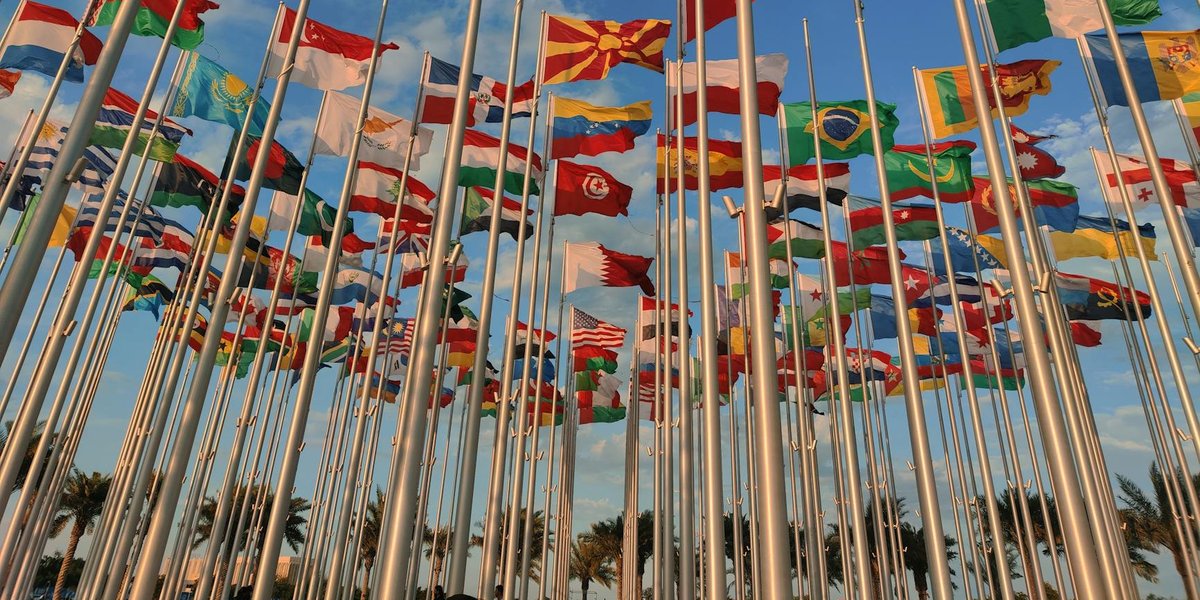
Red is the most common color on Earth’s flags. Roughly three out of four national flags use it — somewhere between 74% and 78% depending on who’s counting, which works out to around 150 of the world’s ~195 flags. White comes second at about 71%, blue third near 50%. So if you’re trying to identify a flag and “it had red in it” is all you’ve got, you’ve narrowed it down to… most of the planet.
This page fixes that. Below is the full set of countries whose flags contain red, broken down by the other colors in the flag — because that’s how you actually find one. Red and white only? Short list. Red, green, and white? Different short list. Scroll to the combo you saw and you’ll find your flag fast.
Table of Contents
- Why so many flags are red
- Red and white flags
- Red, white, and blue flags
- Red, green, and white flags
- Red, yellow, and green (the pan-African red)
- Red with black
- Red, yellow, and other combos
- How to identify a red flag you spotted
- What red means on a flag
Why so many flags are red
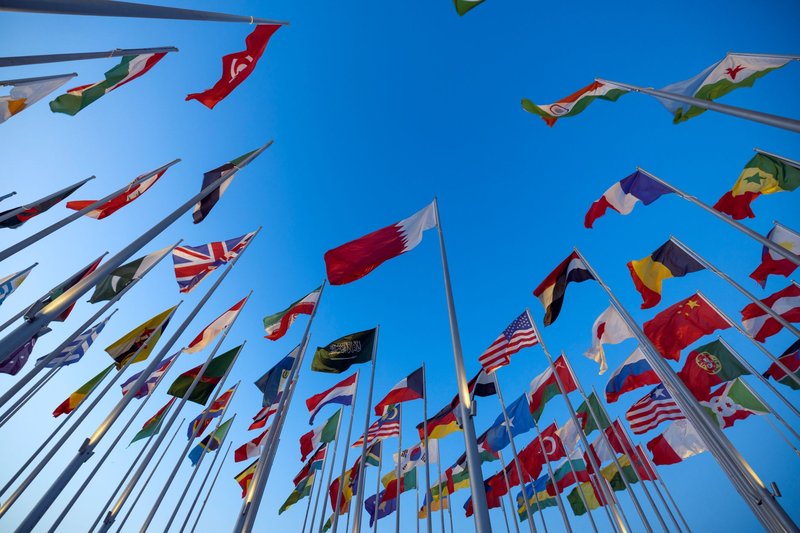
Red didn’t win by accident. It’s the loudest color in the visible spectrum — it carries at a distance, holds up on a battlefield banner, and reads clearly against sky or sea. That practicality met three separate symbolic traditions that all happened to land on the same color.
In European heraldry, red (gules) meant courage, valor, and blood spilled in war. When socialist and communist movements designed their flags in the 19th and 20th centuries, they used red for revolution and the blood of the working class — that’s why the USSR, China, and Vietnam all run red-heavy. And across East Asia, red has meant luck, joy, and prosperity for millennia, which is part of why China’s flag is a sea of it.
Then there’s the pan-African tradition, where red stands for the blood shed in the fight for independence. Three different reasons, one color, and the result is a planet covered in red flags. Guinness World Records lists red as the single most-used color in national flags.
Red and white flags
The cleanest category. Just two colors, and a surprising number of countries pull it off without anything else.
| Country | Design note |
|---|---|
| Japan | Single red disc (the sun) centered on white |
| Canada | Red maple leaf between two red bands |
| Switzerland | White cross on red, square flag |
| Denmark | White Nordic cross on red — the oldest continuously used national flag |
| Austria | Red-white-red horizontal bands |
| Poland | White over red |
| Indonesia | Red over white |
| Monaco | Red over white (near-identical to Indonesia) |
| Singapore | Red over white with crescent and stars |
| Bahrain | White and red split by a zigzag (five points) |
| Qatar | Maroon and white, serrated edge |
| Tunisia | Red with white disc, crescent and star |
| Turkey | Red with white crescent and star |
| Tonga | Red with a white canton holding a red cross |
| Georgia | White with five red crosses |
| Latvia | Dark carmine red with a narrow white band |
| Malta | White and red with the George Cross |
| Peru | Red-white-red vertical bands |
| Greenland | White and red with an offset disc |
Two of these will trip you up. Poland and Indonesia are the same two stripes flipped — Poland is white on top, Indonesia red on top — and HowStuffWorks notes Monaco and Indonesia are so close that the only reliable difference is the proportions. Indonesia’s is slightly wider.
Red, white, and blue flags
The biggest combo, and the one that produces the most “wait, which country is that” confusion. The tricolor template (three vertical or horizontal bands) spread from France and the Netherlands across the world.
| Country | Design note |
|---|---|
| United States | Red and white stripes, blue canton with 50 stars |
| United Kingdom | Overlaid crosses (the Union Jack) |
| France | Blue-white-red vertical |
| Netherlands | Red-white-blue horizontal |
| Russia | White-blue-red horizontal |
| Czechia | White and red with a blue triangle |
| Slovakia | White-blue-red with a coat of arms |
| Slovenia | Same bands as Slovakia, different crest |
| Croatia | White-blue-red with a checkerboard shield |
| Serbia | Red-blue-white with crest |
| Chile | White and red with a blue canton and one star |
| Cuba | Stripes with a red triangle and white star |
| Norway | Blue cross outlined in white on red |
| Iceland | Red cross outlined in white on blue |
| North Korea | Blue-red-blue with a red star in white disc |
| Thailand | Red-white-blue-white-red horizontal |
| Cambodia | Blue-red-blue with a white temple |
| Laos | Red-blue-red with a white disc |
| Australia | Blue with Union Jack and stars (red appears via the Jack) |
| New Zealand | Same family as Australia |
| Costa Rica | Blue-white-red-white-blue |
| Panama | Quartered red, white, and blue with stars |
The Netherlands and Russia are a classic mix-up — same three colors, but the Netherlands leads with red on top and Russia leads with white. Norway and Iceland are mirror twins: swap which color is the cross and which is the field. The clustering isn’t random either — Slovenia and Croatia, two of the trickiest tricolors here, sit side by side on the map, and they turn up together again among the countries that border the Adriatic Sea, which is part of why their flags share so much DNA.
Red, green, and white flags
This is the combo people search for by itself (“flags with red green and white”), and it’s mostly Italy’s tricolor descendants plus a cluster of Middle Eastern and North African flags.
| Country | Design note |
|---|---|
| Italy | Green-white-red vertical |
| Mexico | Same bands as Italy plus the eagle-and-snake crest |
| Hungary | Red-white-green horizontal |
| Bulgaria | White-green-red horizontal |
| Iran | Green-white-red with central emblem and script |
| Oman | White-red-green with the national emblem |
| Maldives | Red field, green rectangle, white crescent |
| Belarus | Red and green with a white ornamental stripe |
| Lebanon | Red-white-red with a green cedar |
| Algeria | Green and white with red crescent and star |
| Madagascar | White vertical band, red and green horizontal |
| Suriname | Green-white-red-white-green with a yellow star |
Italy and Mexico are the obvious pair — if you see the green-white-red vertical and there’s an eagle in the middle, it’s Mexico. Bare bands, it’s Italy. Hungary and Bulgaria both use horizontal versions but stack the colors differently.
Red, yellow, and green: the pan-African red
A huge group of African nations use red, yellow (or gold), and green — the pan-African colors first flown by Ethiopia. Here red almost always carries the same meaning: the blood shed for independence.
| Country | Design note |
|---|---|
| Ethiopia | Green-yellow-red with a blue disc emblem |
| Ghana | Red-yellow-green with a black star |
| Senegal | Green-yellow-red vertical with a green star |
| Mali | Green-yellow-red vertical |
| Guinea | Red-yellow-green vertical |
| Cameroon | Green-red-yellow vertical with a star |
| Congo (Republic) | Diagonal green, yellow, red |
| Togo | Green and yellow stripes, red canton with a star |
| Benin | Green band, yellow and red horizontal |
| Burkina Faso | Red over green with a yellow star |
| São Tomé and Príncipe | Green-yellow-green with a red triangle and stars |
| Zimbabwe | Multiple bands including red, with a red star |
| South Africa | Six colors including red — a category of its own |
| Mozambique | Green, black, yellow, red triangle |
The pan-African flag tradition traces back to Ethiopia, the one African nation never colonized, which is why so many newly independent states adopted its palette as a statement. The palette turns up on banners of every size, too — even several of the continent’s tiniest nations fly it, as you’ll see among the smallest countries in Africa by area, where São Tomé and Príncipe sits near the bottom of the list.
Red with black
A smaller, striking group. Red over black, or red with black detailing, shows up across the Middle East, the Caucasus, and a few island nations.
| Country | Design note |
|---|---|
| Egypt | Red-white-black with the Eagle of Saladin |
| Syria | Red-white-black with stars (varies by recognition) |
| Iraq | Red-white-black with green script |
| Yemen | Red-white-black horizontal |
| Sudan | Red-white-black with a green triangle |
| Albania | Red field with a black double-headed eagle |
| Trinidad and Tobago | Red with a black diagonal edged in white |
| Angola | Red over black with a yellow emblem |
| Kenya | Black-red-green with a Maasai shield |
| Malawi | Black-red-green with a rising sun |
| Papua New Guinea | Red and black diagonal with a bird and stars |
The red-white-black horizontal pattern (Egypt, Yemen, Iraq, Syria) is the Arab Liberation flag family — they look nearly identical and differ mainly by the emblem in the center band.
Red, yellow, and other combos
The leftovers that don’t fit cleanly above but still wave red.
| Country | Colors |
|---|---|
| China | Red with five yellow stars |
| Vietnam | Red with a single yellow star |
| Spain | Red-yellow-red with the coat of arms |
| Germany | Black-red-gold horizontal |
| Belgium | Black-yellow-red vertical |
| Portugal | Green and red with the national arms |
| Morocco | Red with a green pentagram |
| Turkey | Red with white crescent and star (also listed under red/white) |
| Vietnam | Red with gold star |
| Kyrgyzstan | Red with a yellow sun emblem |
| Bhutan | Diagonal yellow and orange-red with a dragon |
| Myanmar | Yellow-green-red with a white star |
| Bolivia | Red-yellow-green horizontal |
| Ecuador | Yellow-blue-red with the coat of arms |
| Venezuela | Yellow-blue-red with stars |
| Colombia | Yellow-blue-red horizontal |
China and Vietnam are the easy ones: a field of red with yellow stars means one of the two — five stars is China, one big star is Vietnam. Bhutan is the odd one out here, with that orange-red half that sits right on the line between two colors — if that’s the edge case you’re chasing, the handful of countries with red, yellow, and orange flags is a tiny club worth a closer look.
How to identify a red flag you spotted
Work it like a decision tree. Ask the questions in this order and you’ll land on a short list every time.
- Is it red and only one other color? Red + white sends you to Japan, Canada, Switzerland, Denmark, Poland, Indonesia, and the rest of that table. Red + a single yellow star is Vietnam; red + five yellow stars is China.
- Does it have three equal bands? Then it’s a tricolor. Note the order top-to-bottom or left-to-right — order is everything. Green-white-red is Italy or Mexico; the eagle breaks the tie. White-blue-red horizontal is Russia; red-white-blue horizontal is the Netherlands.
- Is there a cross? Nordic cross (offset toward the hoist) means Scandinavia: red field with white cross is Denmark, red cross on white is Switzerland (and Switzerland is square — a dead giveaway).
- Is there a crescent and star? Turkey (red field), Tunisia (white disc), Algeria, or Malaysia’s family. The background color and disc placement separate them.
- Red, yellow, and green together? Almost certainly African — pan-African colors. Look for the distinguishing emblem (Ghana’s black star, Ethiopia’s blue disc).
If you can name the two or three colors and whether there’s an emblem, crescent, cross, or stars, you can pin down nearly any flag from the tables above.
What red means on a flag
There’s no single answer, which is exactly why the color is everywhere. Red carries at least four distinct meanings depending on the flag:
- Courage and valor — the heraldic European reading. Common in older Western flags.
- Revolution and the blood of workers — the socialist and communist reading. China, Vietnam, the former USSR, and others.
- Blood shed for independence — the pan-African reading, traced to Ethiopia and adopted across the continent.
- Luck and prosperity — the East Asian reading, central to China’s choice of a fully red field.
Same pigment, opposite stories. A red flag in Beijing and a red flag in Accra are saying different things, and that’s the genuinely interesting part of vexillology — the color is a container, and each nation pours its own history into it.
So the next time someone asks how many countries have red on their flag, the honest answer is “ask which ones don’t” — the no-red club includes Greece, Jamaica, Ukraine, India, Saudi Arabia, Pakistan, and a handful of others. It’s a much shorter list.