
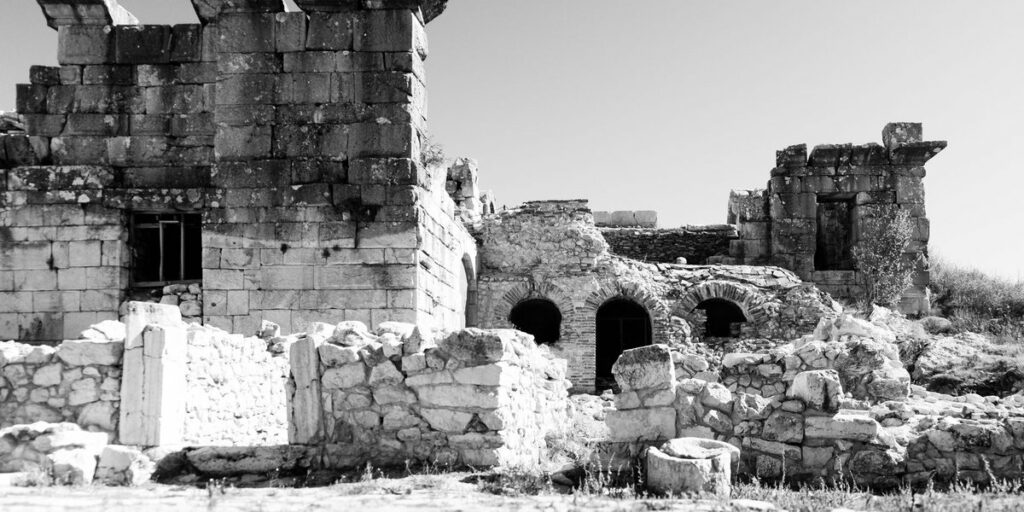
Ask whether Australia has “ancient ruins” and you’ll get a shrug. No Colosseum, no Machu Picchu, no crumbling temples poking out of the jungle. But that question quietly assumes ruins have to be built from quarried stone by people who left columns behind.
Australia’s oldest “ruins” predate the pyramids by tens of thousands of years — they’re rock galleries and grinding grooves left by the world’s longest continuous living culture. Layered on top of that: convict settlements the British tried to forget, and gold-rush towns that swelled to thousands of people, then emptied in a decade. Stone walls, brick chimneys, and rusted poppet heads, scattered across a continent.
This is a regional rundown of 15 of them. Each entry tells you what you’re actually looking at, how hard it is to reach, and whether you need a permit or a guide. A few of these you can drive to in flip-flops. A couple require a four-wheel drive and a satellite phone.
Table of Contents
- A quick note on “ruins” in Australia
- Tasmania: Convict Country
- New South Wales & Norfolk Island
- Western Australia: Rock Art & Gold
- The Northern Territory & Top End
- Queensland & the Outback
- Victoria & South Australia
- Comparison Table
- Visiting Indigenous Sites Respectfully
A quick note on “ruins” in Australia
Three very different things get lumped under this heading, and it helps to keep them straight before you start planning.
Indigenous sites are the oldest by a wide margin — petroglyphs, painted shelters, stone arrangements, and middens, some dated past 40,000 years. These aren’t “abandoned.” Many remain culturally active and legally protected, and a few are sacred enough that photography or access is restricted. Treat them accordingly.
Convict and colonial ruins date from roughly 1788 to the 1860s: penal stations, military barracks, and probation stations, mostly sandstone and brick. Several are now UNESCO World Heritage-listed under the Australian Convict Sites inscription.
Mining and pastoral ruins are the youngest — gold-rush ghost towns and outback station remnants from the 1850s through the early 1900s. These are the easiest to wander freely, and often the eeriest.
Tasmania: Convict Country
Tasmania holds the densest concentration of convict ruins in the country, and the best-preserved.
1. Port Arthur Historic Site
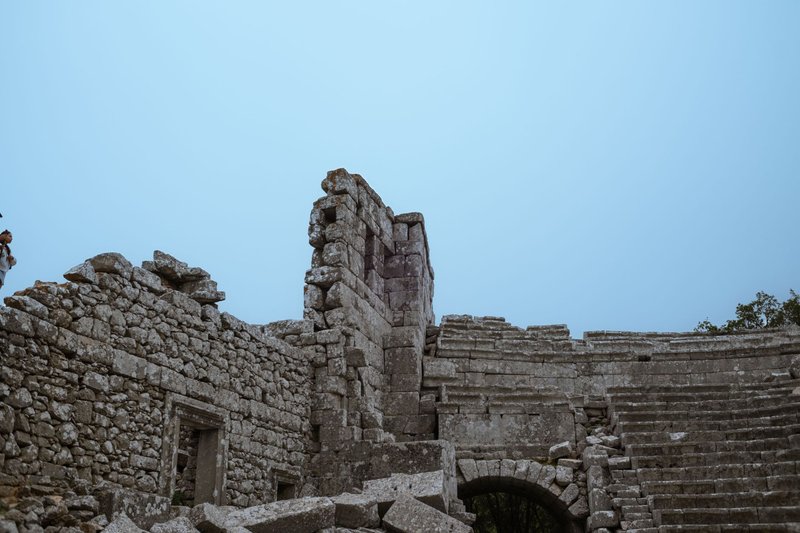
The big one. Port Arthur ran as a penal settlement from 1830 to 1877, on a peninsula connected to the mainland by a strip of land so narrow they chained guard dogs across it to stop escapes. What survives is genuinely substantial: the roofless shell of the Penitentiary (once a flour mill, then a barracks for nearly 500 convicts), the Separate Prison built on the then-radical theory that isolation and silence would reform men, and the Church.
Access is easy — it’s a 90-minute drive from Hobart on sealed roads, with a visitor center, cafe, and ghost tours after dark. Budget at least half a day. Entry tickets are valid for two consecutive days, which tells you something about the scale.
2. Maria Island
An entire island that’s now a national park with no permanent residents, no cars, and a set of convict ruins at Darlington. The probation station here operated in the 1840s, and the brick Commissariat Store and Penitentiary still stand among grazing wombats and Cape Barren geese. You reach it by ferry from Triabunna; bring everything you need, because there are no shops. The combination of crumbling colonial brick and tame wildlife wandering the lawns is unlike anywhere else on this list.
3. Coal Mines Historic Site
Port Arthur’s grimmer satellite, about 30 minutes away on the Tasman Peninsula. Convicts considered the worst offenders were sent here to dig coal — Tasmania’s first operational mine. The ruins are sprawling and largely unrestored: solitary punishment cells underground, the remains of barracks, and shafts you can peer into. It’s free, far quieter than Port Arthur, and you’ll often have the place to yourself. Wear proper shoes; the ground is uneven and some of it is overgrown.
New South Wales & Norfolk Island
4. Kingston, Norfolk Island
Norfolk Island sits in the Pacific, a two-hour flight from Sydney, and its Georgian settlement at Kingston is the second-listed World Heritage convict site after Port Arthur. The penal colony here had a brutal reputation even by the standards of the time. Today the foreshore is lined with elegant stone Georgian buildings and the ruins of the old gaol, set against turquoise water that looks almost offensively pretty for a place with this history. It’s the most photogenic convict ruin in the country and the least visited, simply because of the flight.
5. The Old Great North Road
Not a building but a road — a convict-built highway through the bush north of Sydney, and the most intact early-colonial engineered road surviving anywhere built by convicts. The Devines Hill section near Wisemans Ferry shows hand-cut stone buttresses, drains, and retaining walls assembled by chain gangs in the 1830s. It’s a walking track now, free and open, about an hour and a half from Sydney. You’re hiking on a 190-year-old road graded by men in irons.
Western Australia: Rock Art & Gold
6. Murujuga (Burrup Peninsula)
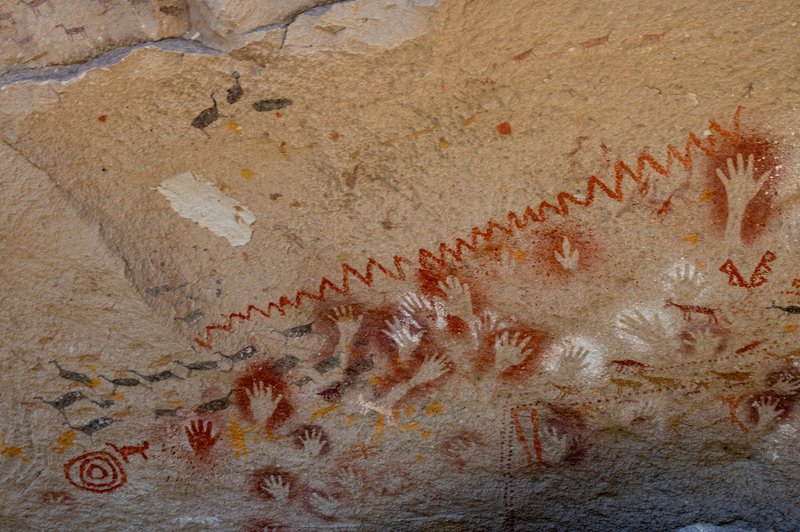
Murujuga, on the Burrup Peninsula in the Pilbara, holds the largest concentration of petroglyphs on Earth — estimates run past a million rock engravings, some thought to be over 40,000 years old, including depictions of animals now extinct. It became a National Park co-managed with traditional custodians and was added to the World Heritage List in 2025. You can visit via guided tours or marked trails at Deep Gorge. This is the closest thing Australia has to an open-air gallery spanning the entire history of human art. Go with a Aboriginal guide if you can — the context transforms the experience.
7. Gwalia Ghost Town
Beside the still-operating Sons of Gwalia mine near Leonora, Gwalia is the rare ghost town preserved almost as residents left it in 1963, when the mine closed and the population evacuated nearly overnight. Corrugated-iron miners’ cottages still hold furniture, kettles, and newspapers. There’s a museum in the old mine office, and the State Hotel ruins nearby. Herbert Hoover — yes, the future U.S. president — managed this mine as a young engineer in the 1890s. It’s a 2.5-hour drive north of Kalgoorlie on sealed road.
8. Cossack
A boom-and-bust pearling and gold port near Roebourne, abandoned by the 1950s after the harbor silted up. A cluster of solid bluestone colonial buildings survives — the courthouse, post office, and bond store — restored and standing alone on the coast with almost no one around. The contrast of formal colonial architecture against empty mangrove flats is the appeal, and the mangrove flats and tidal inlets here are a reminder of how many quiet bays along the Australian coast once hosted thriving ports that have since faded. Free to visit, accessible by sealed road off the North West Coastal Highway.
The Northern Territory & Top End
9. Ubirr, Kakadu
Ubirr’s rock-art galleries in Kakadu National Park hold some of the most accessible and spectacular Aboriginal painting in Australia, including X-ray-style barramundi, the Rainbow Serpent, and — rarely — a painting of a thylacine, the now-extinct Tasmanian tiger that vanished from the mainland thousands of years ago. A short walk leads through the galleries to a lookout over the Nadab floodplain, best at sunset. Kakadu requires a park pass, and you’ll want to check seasonal access, since wet-season flooding closes roads.
10. Nourlangie (Burrunggui)
Also in Kakadu, Nourlangie’s Anbangbang shelter was used for tens of thousands of years, and its main gallery was repainted in the 1960s by Najombolmi, a renowned artist, depicting Namarrgon the Lightning Man. The looped walk is short and sealed. Between Ubirr and Nourlangie you get a sense of how these shelters functioned — not as monuments, but as homes, classrooms, and galleries used continuously across an almost incomprehensible span of time.
Queensland & the Outback
11. Kuridala
A copper-mining ghost town near Cloncurry in outback Queensland that once had thousands of residents, a smelter, hospitals, and pubs. Now it’s brick chimney stacks, concrete foundations, and a cemetery, sitting in red dirt with nothing around for miles. The smelter ruins are the standout. This one requires a high-clearance vehicle and self-sufficiency — there are no services, and you should carry water and tell someone your plans before heading out. If you’re combining the trip with greener detours, it’s worth checking which of the state’s national parks in Queensland lie along your route, since several sit within range of the outback mining belt.
12. Mary Kathleen
A uranium town built in the 1950s, fully operational into the 1980s, then completely dismantled — buildings sold and removed, leaving only the street grid, kerbs, and concrete slabs laid out across the landscape like an architectural blueprint. The eerie part is how orderly it is: you can walk the named streets of a town that no longer has a single building. It’s off the Barkly Highway between Mount Isa and Cloncurry, accessible by gravel road.
Victoria & South Australia
13. Walhalla
A gold-mining town deep in a Victorian valley that once held thousands but dwindled to a handful of residents after the gold ran out. Unlike a true ghost town, parts of Walhalla were restored and it’s now a working historic village, but the Long Tunnel Extended Mine and the buildings clinging to the steep gorge give it a haunted, half-empty feel. It was one of the last towns in the country to get mains electricity — in 1998. A scenic two-hour drive east of Melbourne.
14. Steiglitz
A near-empty gold town an hour from Melbourne near the You Yangs, where the courthouse still stands among scattered ruins and bush. It boomed in the 1850s and 60s, then faded. Today it’s a historic park you can wander freely — quiet, free, and far less touristed than Walhalla, which is rather the point.
15. Old Government House Ruins, Belair
Tucked into Belair National Park near Adelaide, the Old Government House precinct includes colonial-era ruins and the restored summer residence of South Australia’s governors. It’s the most accessible entry on this list — a short drive from the Adelaide CBD with picnic grounds nearby — and a gentle introduction to colonial ruins if the outback ghost towns sound like a stretch.
Comparison Table
| Site | State | Type | Era | World Heritage |
|---|---|---|---|---|
| Port Arthur | TAS | Convict | 1830–1877 | Yes |
| Maria Island | TAS | Convict | 1840s | No |
| Coal Mines | TAS | Convict | 1833–1848 | Yes |
| Kingston | Norfolk Is. | Convict | 1788–1855 | Yes |
| Old Great North Road | NSW | Convict | 1830s | Yes |
| Murujuga | WA | Indigenous | 40,000+ yrs | Yes |
| Gwalia | WA | Gold rush | 1890s–1963 | No |
| Cossack | WA | Colonial port | 1860s–1950s | No |
| Ubirr | NT | Indigenous | 20,000+ yrs | Yes (Kakadu) |
| Nourlangie | NT | Indigenous | 20,000+ yrs | Yes (Kakadu) |
| Kuridala | QLD | Mining | 1900s–1920s | No |
| Mary Kathleen | QLD | Mining | 1950s–1980s | No |
| Walhalla | VIC | Gold rush | 1860s–1900s | No |
| Steiglitz | VIC | Gold rush | 1850s–1860s | No |
| Belair | SA | Colonial | 1850s–1880s | No |
Visiting Indigenous Sites Respectfully
The rock-art galleries and engraving sites on this list aren’t ruins in the way a ghost town is. They’re part of a living culture, and several carry restrictions that aren’t bureaucratic box-ticking.
A few ground rules. Stay on marked paths and behind barriers at art sites — oils from skin and the brush of a hand degrade pigment that has survived for millennia. Never touch or trace paintings. Check for photography restrictions; some sacred sites prohibit it entirely, and signage at places like Kakadu and Murujuga will tell you. Where guided tours run with traditional custodians, take them — the Australian Government’s Kakadu guidance and similar park resources point you to operators who share the right context.
And carry the obvious outback supplies for the remote entries: more water than you think, a full tank, and a plan you’ve told someone about. The mining ghost towns sit in country where help is hours away, and the romance of an empty town fades fast if your vehicle won’t start. Plan well, tread lightly, and these ruins reward the effort far more than the listicles that only show you the photogenic angle.