
If you search for a list of airports in Lesotho, you’ll get a different number every time. Wikipedia says one thing, OurAirports says another, and a couple of directory sites land somewhere in between — 17, 34, 35. They’re all sort of right, which is exactly why none of them are useful.
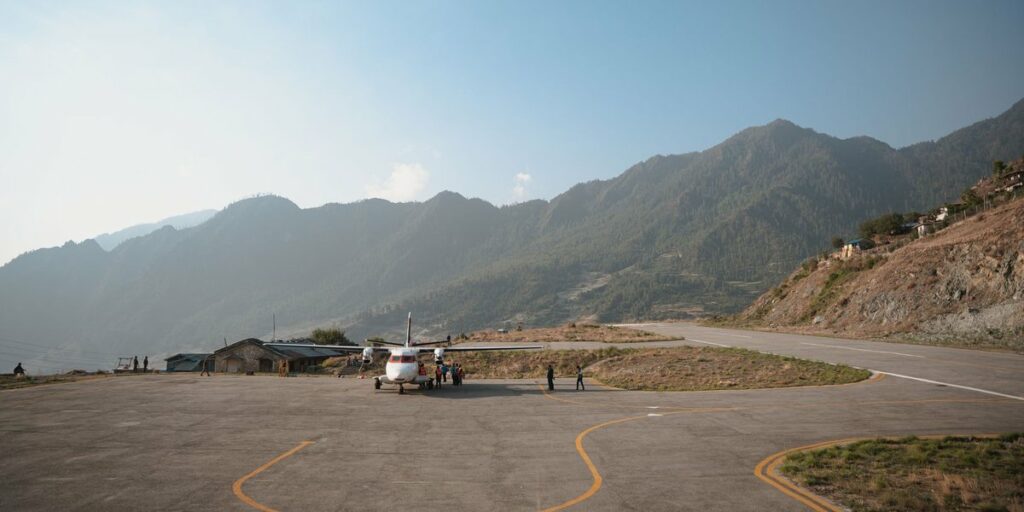
Here’s the short version: Lesotho has one airport with scheduled passenger flights. Everything else is a dirt or gravel strip serving mountain villages, clinics, diamond mines, and the occasional charter. The reason the counts disagree is that database sites can’t decide whether a 700-meter grass strip next to a rural hospital counts as an “airport.” Once you separate the categories, the numbers make sense.
This guide gives you the full table with codes and districts, profiles the strips worth knowing about, and — the part the directory sites skip entirely — explains how you actually get into the country by air.
Table of Contents
- The one airport that matters: Moshoeshoe I International
- Why the airport count keeps changing
- Full list of airports and airstrips in Lesotho
- Notable mountain airstrips
- How to actually fly into Lesotho
- Quick answers
The one airport that matters: Moshoeshoe I International {#moshoeshoe}
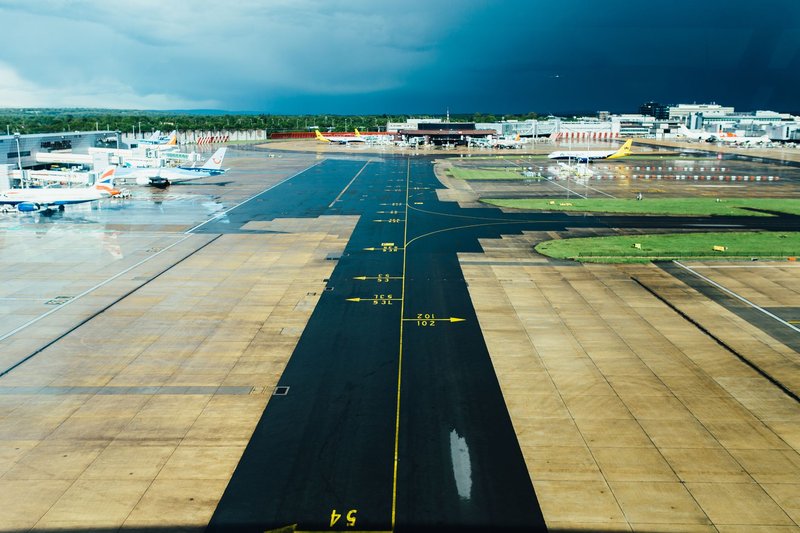
Moshoeshoe I International Airport (IATA: MSU, ICAO: FXMM) is the only airport in Lesotho with scheduled commercial service, and for most travelers it’s the only one you’ll ever set foot in. It sits about 18 km southeast of Maseru, the capital, near the town of Mazenod. The airport is named after Moshoeshoe I, the founding king of the Basotho nation.
Don’t expect a hub. The terminal is small, the schedule is thin, and the single scheduled route runs to OR Tambo International in Johannesburg, flown by Airlink, the South African regional carrier. Flight time is roughly 50 minutes to an hour. That one route is, functionally, Lesotho’s air link to the rest of the world — to go anywhere else, you connect through Johannesburg.
The runway is paved and long enough to handle regional jets like the Embraer aircraft Airlink uses, which is more than you can say for any other strip in the country. There’s a customs and immigration desk, since this is an international point of entry, so you can clear in here rather than at a land border.
A practical note: schedules into MSU have historically been light, sometimes a single daily rotation, and they’ve changed with demand. Check current timetables directly with the airline before you build a tight itinerary around a connection.
Why the airport count keeps changing {#why-the-count-changes}
The conflicting numbers across reference sites aren’t errors so much as different definitions. Here’s how the airports in Lesotho actually break down:
- International airports (1): Moshoeshoe I International. Paved runway, customs, scheduled service.
- Domestic/public airstrips (a handful): Strips at district towns like Mokhotlong, Qacha’s Nek, and others that have historically seen domestic flights or charters. Mostly gravel or grass, no scheduled service today.
- Private and remote airstrips (the rest): Dozens of short strips serving mountain villages, mission hospitals, mines, and lodges. Many are little more than a flattened field with a windsock.
When a directory counts “17,” it’s usually listing the named, somewhat-established strips. When it says “34” or “35,” it’s sweeping in every cataloged airstrip — including private and disused ones. Neither is wrong. They’re answering different questions.
The one number that’s stable and worth remembering: one airport with scheduled passenger flights. The Civil Aviation arm of Lesotho’s Ministry of Public Works and Transport oversees the licensed aerodromes, but the long tail of mountain strips operates on a far more informal basis.
Full list of airports and airstrips in Lesotho {#full-list}
The table below covers the named airports and notable airstrips with assigned ICAO codes. Only Moshoeshoe I International carries an IATA code and scheduled service — that’s the norm for a country where nearly all flying is charter or medical.
| Airport / Airstrip | District | ICAO | IATA | Scheduled service |
|---|---|---|---|---|
| Moshoeshoe I International | Maseru | FXMM | MSU | Yes (to Johannesburg) |
| Mejametalana (Maseru) | Maseru | FXMA | — | No |
| Mokhotlong | Mokhotlong | FXMK | — | No |
| Qacha’s Nek | Qacha’s Nek | FXQN | — | No |
| Semonkong | Maseru | FXSM | — | No |
| Matsaile | Mohale’s Hoek | FXMS | — | No |
| Lebakeng | Qacha’s Nek | FXLK | — | No |
| Leribe | Leribe | FXLR | — | No |
| Mafeteng | Mafeteng | FXMF | — | No |
| Mohale’s Hoek | Mohale’s Hoek | FXMH | — | No |
| Nkaus | Mohale’s Hoek | FXNK | — | No |
| Pelaneng | Leribe | FXPG | — | No |
| Quthing | Quthing | FXQG | — | No |
| Sehonghong | Thaba-Tseka | FXSH | — | No |
| Sekake | Qacha’s Nek | FXSK | — | No |
| Seshote | Leribe | FXSS | — | No |
| Thaba-Tseka | Thaba-Tseka | FXTA | — | No |
| Tlokoeng | Mokhotlong | FXTK | — | No |
| Letseng (diamond mine) | Mokhotlong | — | — | No (private) |
ICAO codes for Lesotho all start with FX — that’s the country’s prefix. Beyond the strips above, OurAirports and similar databases catalog additional small or closed fields, which is where the higher counts come from.
Notable mountain airstrips {#mountain-airstrips}
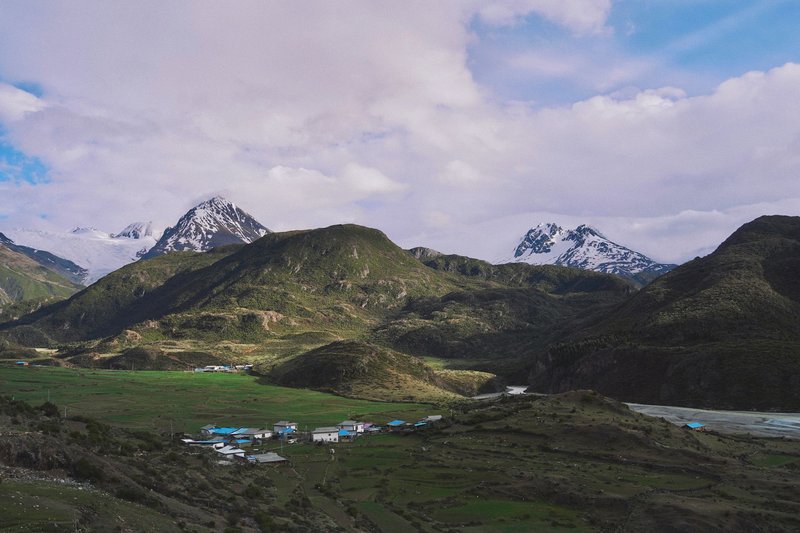
The interesting flying in Lesotho happens away from Maseru. The country isn’t called “the Kingdom in the Sky” for nothing — it’s the only nation entirely above 1,000 meters in elevation, and its mountain interior is genuinely hard to reach by road. Airstrips have long filled the gap, especially for medical evacuation and supply runs.
Mokhotlong (FXMK) sits in the remote northeast, near some of the country’s highest terrain and not far from the Sani Pass route into South Africa. For decades it was a lifeline strip for a district that road infrastructure reached late.
Qacha’s Nek (FXQN) serves the southeastern corner, tucked against the South African border. Like Mokhotlong, it’s a district capital that historically depended on air access more than the lowland towns did.
Semonkong (FXSM) is best known to travelers for the nearby Maletsunyane Falls, one of the tallest single-drop waterfalls in southern Africa at around 192 meters. The strip here mostly sees charter and lodge traffic rather than scheduled flights.
Matsaile (FXMS) and Sehonghong (FXSH) are deep-interior strips that have supported mission hospitals and remote communities — the kind of place where a small plane is faster than half a day of mountain road.
Then there’s the Letseng diamond mine strip in Mokhotlong district. Letseng is one of the highest diamond mines in the world, operating above 3,000 meters, and it maintains its own private airstrip for moving staff and high-value cargo. It’s a good example of why the “airport” count is slippery: it’s a real, used airstrip, but it’ll never appear in a passenger timetable.
How to actually fly into Lesotho {#how-to-fly-in}
Here’s the part the database sites leave out. For a traveler, “airports in Lesotho” really comes down to one question: how do I get there?
Option 1 — Fly into Maseru (MSU). Book a flight to Johannesburg (JNB), then connect to Moshoeshoe I International on Airlink. This is the only way to arrive by scheduled flight. It’s convenient if you want to land in the capital, but the limited schedule and single connection point mean you’re at the mercy of one daily-ish rotation.
Option 2 — Fly into South Africa and drive. Many visitors skip MSU entirely. They fly into Johannesburg (JNB) or Bloemfontein (BFN) — Bloemfontein is the closest major South African airport, roughly 140 km from the Maseru Bridge border post — and cross by land. Maseru is an easy drive from Bloemfontein, and renting a car in South Africa is generally cheaper and more flexible than relying on Lesotho’s thin air links. South Africa completely surrounds Lesotho, so a land crossing is always part of the picture unless you fly straight into MSU.
Option 3 — Charter for the mountains. If your destination is a remote lodge, a mine, or an aid project in the highlands, scheduled flights won’t get you there. You’ll arrange a charter, and the operator will know which strips are currently usable — conditions change, and some fields go in and out of service. The U.S. State Department’s Lesotho page is a reasonable place to check current entry requirements before you plan any of this.
For the vast majority of trips, Option 2 wins. The flying into Maseru is a nice-to-have, not a necessity.
Quick answers {#quick-answers}
How many airports does Lesotho have? One with scheduled passenger service (Moshoeshoe I International), plus roughly 15–20 named airstrips and a longer tail of private and minor fields. Counts of 34–35 include every cataloged strip; counts near 17 list the established ones.
What is the main airport in Lesotho? Moshoeshoe I International Airport (MSU / FXMM), about 18 km from Maseru. It’s the country’s only international airport and its only one with scheduled flights.
Can you fly directly to Lesotho from outside Africa? No. The only scheduled route into MSU is from Johannesburg, so you’ll always connect through South Africa. Many travelers fly to Johannesburg or Bloemfontein and drive in instead.
What’s the airport code for Maseru? IATA: MSU, ICAO: FXMM. All Lesotho airfields use the ICAO prefix FX.
Schedules and strip conditions in Lesotho change. Confirm current flights with the airline and entry rules with official sources before traveling.