TLDR
Ukraine’s last full census, taken in 2001, counted the population as roughly 77.8% Ukrainian and 17.3% Russian, with the remaining 5% split among Belarusians, Romanians, Moldovans, Crimean Tatars, Hungarians, Poles, Jews, Bulgarians, Armenians, and smaller groups. That data is now 20+ years stale, and two wars — 2014 and 2022 — have scrambled it further: mass displacement, a hollowed-out Russian minority in government-controlled territory, and an occupied Crimea where the indigenous Crimean Tatar population lives under active persecution. Nobody has a current, reliable count. What follows is the best picture available, plus what the old numbers miss.
Table of Contents
- The last real headcount
- Ukrainians: the majority, but not a monolith
- Russians: a shrinking, geographically lopsided minority
- The smaller minorities, by the numbers
- Crimean Tatars and Ukraine’s indigenous peoples
- The Carpathian highlanders: Hutsuls, Boykos, Lemkos
- Why the census is lying to you, gently
- What the war actually changed
The last real headcount
Ukraine has taken exactly one census since independence, in December 2001. There was supposed to be another in 2011, then 2013, then indefinitely postponed after Crimea’s annexation made a nationwide count logistically impossible. So every “current” statistic on Ukraine’s ethnic makeup — including the one in this article — is a quarter-century-old snapshot dressed up as present tense.
Here’s what that snapshot showed, according to Ukraine’s official 2001 census results:
| Ethnic group | Share of population |
|---|---|
| Ukrainians | 77.8% |
| Russians | 17.3% |
| Belarusians | 0.6% |
| Moldovans | 0.5% |
| Crimean Tatars | 0.5% |
| Bulgarians | 0.4% |
| Hungarians | 0.3% |
| Romanians | 0.3% |
| Poles | 0.3% |
| Jews | 0.3% |
| Armenians | 0.2% |
| Greeks | 0.2% |
| Tatars | 0.2% |
| Roma, Azerbaijanis, Germans, Gagauz, others | ~0.5% combined |
The one clear trend the data does show: between the 1989 Soviet census and 2001, the Ukrainian share climbed from 72.7% to 77.8%, while the Russian share fell from 22.1% to 17.3%. That’s not migration — it’s people who’d been counted as “Russian” under Soviet administrative habit re-identifying as Ukrainian once independence gave them the option. Ethnicity on a census form is partly self-perception, and self-perception moves with politics.
Ukrainians: the majority, but not a monolith
Ukrainians aren’t one flat category, and treating them as one erases the regional texture that actually explains the country. Western Ukraine — Lviv, Ivano-Frankivsk, the Carpathian foothills — grew up under Austro-Hungarian and Polish rule, went to Greek Catholic churches instead of Orthodox ones, and speaks Ukrainian at home almost universally. Central and eastern Ukraine spent longer under Russian and Soviet administration, and bilingualism (or outright Russian-language dominance in cities like Kharkiv and Odesa) is common even among people who identify as ethnically Ukrainian without hesitation.
That distinction matters because Western reporting often collapses “speaks Russian” into “is Russian” — a mistake most Ukrainians find pretty grating. Plenty of Ukrainian soldiers fighting Russia’s invasion grew up speaking Russian at the dinner table. Language and ethnicity split apart here more than almost anywhere else in Europe.
Russians: a shrinking, geographically lopsided minority
At 17.3% in 2001, Russians were Ukraine’s only sizable minority, and they were never evenly spread. Crimea, Donetsk, and Luhansk had the heaviest concentrations — which is precisely why Russia targeted those regions in 2014, framing the annexation and the Donbas war as protecting a Russian-speaking population from Kyiv. Odesa and Kharkiv had large urban Russian and Russian-speaking populations too, without the same separatist momentum.
Since 2022, the Russian-identifying population inside government-controlled Ukraine has almost certainly dropped further, for reasons that have nothing to do with migration: identifying as Russian in a country your neighbor’s homeland is shelling has become socially and practically costly, and a share of people who’d have ticked “Russian” in 2001 now tick “Ukrainian” instead. Meanwhile in occupied Crimea and the occupied parts of Donetsk and Luhansk, Russia has been actively importing Russian citizens and issuing Russian passports to residents, which cuts the opposite direction. Two different populations, two different trend lines, and no census covering either.
The smaller minorities, by the numbers
The remaining ~5% of Ukraine’s population is where the country’s actual diversity lives, and each group has a distinct footprint:
Romanians and Moldovans (0.3% and 0.5%) cluster in Chernivtsi region near the Romanian border — Romanian-language schools and Orthodox parishes have operated there continuously since well before Soviet times.
Hungarians (0.3%) concentrate almost entirely in Zakarpattia oblast, in villages so close to the Hungarian border that dual citizenship and cross-border commuting are routine. Hungary’s government has repeatedly clashed with Kyiv over language-in-schools policy affecting this community.
Poles (0.3%) are scattered but historically rooted in the west, a legacy of the centuries when Lviv and surrounding territory belonged to Poland.
Jews (0.3%) — down drastically from the roughly two million who lived in Ukrainian territory before the Holocaust — remain concentrated in Kyiv, Dnipro, and Odesa, cities with deep prewar Jewish histories. Dnipro in particular has one of the largest functioning Jewish community centers in Europe.
Bulgarians, Greeks, and Gagauz cluster around Odesa and the Sea of Azov coast, descendants of 18th- and 19th-century settlers the Russian Empire brought in to farm the Black Sea steppe.
Armenians are spread across major cities, with the largest concentrations in Odesa and Kyiv.
Crimean Tatars and Ukraine’s indigenous peoples
Crimean Tatars are Crimea’s original Turkic-Muslim population, present on the peninsula for centuries before Catherine the Great annexed it in 1783. Stalin deported the entire community to Central Asia in 1944 on fabricated collaboration charges — a mass exile that killed a large share of deportees within months. Return only became legally possible after 1989, and most who came back settled in Crimea just in time for Russia to annex it again in 2014.
That second annexation reopened the wound. Russian authorities banned the Mejlis — the Crimean Tatars’ elected self-governing body — as an “extremist organization” in 2016, jailed activists on charges carrying sentences of 15 to 20+ years, and banned public commemoration of the 1944 deportation anniversary. An estimated 20,000 Crimean Tatars left for mainland Ukraine as internally displaced people between 2014 and 2015 rather than live under the new administration, according to reporting on the eighth anniversary of the annexation.
Ukraine’s response was to formalize what had long been informal recognition. In 2021, parliament passed the Law “On Indigenous Peoples of Ukraine,” which names exactly three groups as the country’s legally recognized indigenous peoples: Crimean Tatars, Karaites, and Krymchaks. The Karaites and Krymchaks are Crimean Jewish-descended communities so small — a few hundred people each, worldwide — that most Ukrainians have never met one. All three predate Russian, and even Ukrainian, presence on the peninsula, which is the legal test the law applies. Voice of America’s history of the community is a good primer if you want the fuller arc from deportation to annexation.
The Carpathian highlanders: Hutsuls, Boykos, Lemkos
Tucked into the western mountains are three sub-groups that Ukraine’s census counts simply as “Ukrainian” but that maintain distinct dialects, dress, and folk traditions — enough that some linguists classify their speech as its own Rusyn language branch rather than a Ukrainian dialect.
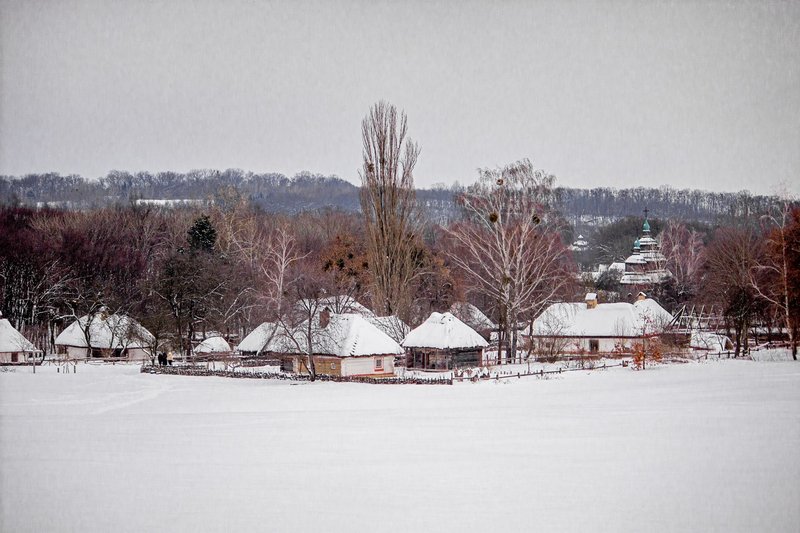
Hutsuls live in the highest Carpathian terrain, around Ivano-Frankivsk and Chernivtsi. They’re known for elaborately embroidered sheepskin coats, wood-carved furniture, and a folk-music tradition built around the trembita, a wooden alpine horn several meters long. Hutsul villages are also where most of Ukraine’s remaining wooden church architecture survives, some of it UNESCO-listed.
Boykos occupy the middle Carpathians, between the Hutsuls and Lemkos, and historically built distinctive wooden churches with three-tiered towers rising from a square base — a style architects still call the Boyko type.
Lemkos lived furthest west, straddling what’s now the Ukraine-Poland-Slovakia border area. Most Lemkos were forcibly relocated out of their historic homeland after World War II, first to Soviet Ukraine and then, in Poland’s 1947 Operation Vistula, scattered across former German territory — meaning the Lemko community today is more diaspora than homeland population.
None of these groups shows up as a separate line in any census. They’re a reminder that “Ukrainian” as a census category flattens regional identities that took centuries to form.
Why the census is lying to you, gently
Every number above comes from 2001. Since then: two Chechen-style deportation waves haven’t happened, but a slower, subtler reshuffling has. Urban Ukrainians have had 20+ more years to intermarry across the old ethnic lines that mattered more to their grandparents. Zakarpattia’s Hungarian villages have seen younger residents move to Budapest or Vienna for work, thinning a community that was never counted at more than a few hundred thousand to begin with. And self-identification — always a soft measure, since a census asks what you consider yourself, not what your ancestry certificate says — has shifted with two decades of politics that gave “Ukrainian” a very different weight in 2022 than it had in 2001.
Any article, including this one, that presents 2001 percentages as Ukraine’s current ethnic makeup is repeating a number nobody has verified in a generation. Treat the table above as a historical baseline, not a live read.
What the war actually changed
The 2022 invasion produced the fastest, largest displacement in Europe since World War II: roughly 5.9 million people crossed into neighboring countries and another 3.7 million were internally displaced, per the UNHCR’s Ukraine operational data portal. That displacement wasn’t ethnically neutral. Russian-speaking cities in the east and south — Kharkiv, Mariupol, Mykolaiv — took the heaviest shelling and produced the largest refugee outflows, meaning the war disproportionately emptied out exactly the regions where Ukraine’s Russian minority was most concentrated.
At the same time, occupied territory tells the opposite story. In Crimea and the occupied strips of Donetsk, Luhansk, Kherson, and Zaporizhzhia, Russia has issued Russian passports, relocated Russian citizens into vacated housing, and deported Ukrainian children — a demographic engineering campaign, not a natural shift. Whatever ethnic count exists in those territories now bears little resemblance to 2001, and no international body has been able to verify it independently.
The honest answer to “what does Ukraine’s ethnic makeup look like today” is that the country won’t know until it can run a real census again — and that won’t happen while a quarter of its territory is occupied and its population is still moving.