Table of Contents
- The Short Answer
- Dominica: The Only One That Counts
- The Near Misses (And Why They Don’t Qualify)
- Why Purple and Black Are Both Rare on Flags
- Flag Color Reference Table
- Related Flag Trivia
The Short Answer
Exactly one national flag combines purple and black as actual design elements: Dominica. Its flag centers on a purple Sisserou parrot ringed by a circle of ten green stars, sitting on a cross of yellow, black, and white bands over a green field. That’s it. That’s the list.
Every other country you’ll see mentioned in a “purple and black flags” roundup — Nicaragua, El Salvador, Spain — gets there through a technicality: purple shows up buried in a coat of arms, not in the flag’s actual color field, and black usually doesn’t show up at all. If you came here wanting a real answer instead of a padded list, that’s the whole story. The rest of this piece is about why.
Dominica: The Only One That Counts
Dominica adopted its current flag in 1978, the year it gained independence from Britain, and it’s the only national flag in the world built around a purple bird. The Sisserou parrot (Amazona imperialis) is endemic to Dominica — it exists nowhere else on Earth — and its natural plumage really does run toward a deep, dusky purple on the chest and belly, which is why the designers didn’t have to invent the color scheme. They just painted the bird.
The parrot sits inside a circle of ten five-pointed green stars, one for each of the island’s parishes, all mounted on a cross of three colors: yellow (the sun and the indigenous Kalinago people), black (the island’s rich soil and African heritage), and white (rivers, and purity). That cross sits on a green background representing Dominica’s rainforest cover — the country is roughly 60% forested, more than almost anywhere else in the Caribbean.
So the black isn’t decorative filler here. It’s one-third of the central cross, doing real symbolic work, sitting directly adjacent to a purple national bird. That combination — purple as a primary emblem color, black as a structural stripe — is what nobody else on the internet’s flag lists actually has, even though plenty of them get filed under “purple and black flags” anyway.
The Near Misses (And Why They Don’t Qualify)
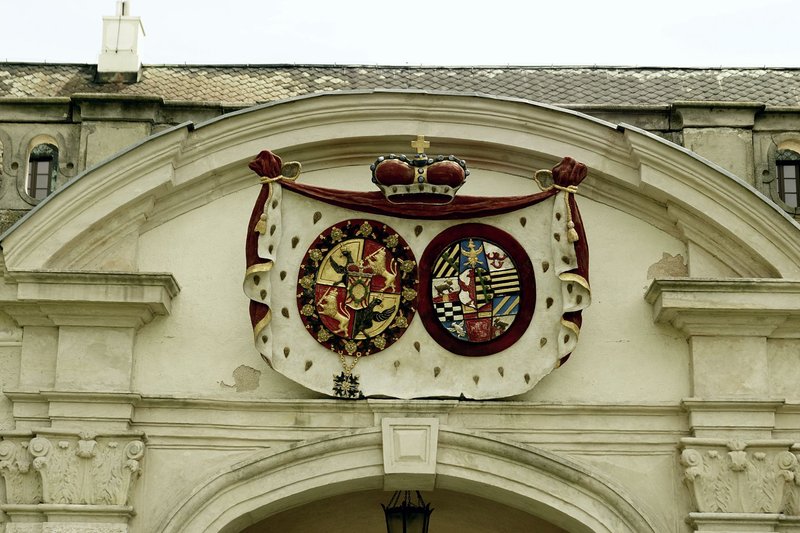
Nicaragua. The flag itself is two horizontal blue bands with a white band between them — no purple, no black in the field. What people are pointing at is the coat of arms centered on the white stripe, which includes a rainbow. Rainbows have purple in them by definition (Roy G. Biv), so technically, yes, there’s a sliver of purple in there. But calling Nicaragua a “purple flag country” because of a rainbow in its coat of arms is like calling a flag “orange” because there’s a sunset painted on a stamp somewhere on it.
El Salvador. Same story, different emblem. The flag is blue-white-blue with a coat of arms in the center that includes a rainbow and some floral detail with hints of purple. Again: it’s in the emblem, not the field, and there’s no black anywhere on the flag.
Spain. The Spanish flag is red and yellow — no purple in the field at all. The confusion comes from Spanish Republican history: the flag of the Second Spanish Republic (1931–1939) used a purple stripe instead of the lower red one, as a nod to the historic crown of Castile. That flag isn’t in use today. If someone tells you Spain has purple in its flag, they’re thinking of a government that hasn’t existed since Franco.
Bolivia’s Wiphala. Worth a mention because it does have purple, alongside six other colors in a checkerboard pattern representing Andean indigenous nations. It’s an official co-flag of Bolivia, flown alongside the tricolor, and it has real purple in real use — but it’s a checkerboard of the full color wheel, not a purple-and-black combination, and no black appears in it at all. Similar rarity issues affect other flag color combinations, such as those featured in countries with purple, black, and white flags.
None of these are wrong to bring up in a broader conversation about purple on flags. They’re just wrong to call “countries with purple and black flags,” which is a more specific claim than the color-rundown articles usually admit. The same precision issue applies to other rare flag color combinations, such as those discussed in countries with red and purple flags.
Why Purple and Black Are Both Rare on Flags
Purple’s rarity on flags traces back to money, not taste. For most of pre-industrial history, purple dye came from Tyrian purple, extracted from the mucus glands of Mediterranean sea snails — it took thousands of snails to dye a single garment, which is why historical accounts describe it as more valuable than gold by weight. Flags are functional objects meant to be mass-produced and flown outdoors; nobody was going to bankroll a national symbol out of the most expensive pigment in the ancient world. By the time synthetic purple dye existed in the 19th century, most national flag designs were already locked in around cheaper, high-contrast colors: red, white, blue, green, yellow.
Black has a different problem: association, not cost. Black shows up constantly in non-national flags — pirate flags, anarchist flags, the mourning bands on flags flown at half-mast — which made 19th and 20th century flag designers wary of it as a primary field color for a country that wanted to project sovereignty and optimism rather than menace or grief. It survives on national flags mostly as an accent: stripes, borders, or small emblem elements, which is exactly the role it plays on Dominica’s flag.
Put those two rarities together and you get a color combination so uncommon it effectively narrows to one country. It’s not that purple-and-black flags are undervalued or hiding somewhere on a list nobody’s compiled — the constraint is real.
Flag Color Reference Table
| Country | Purple? | Black? | Where |
|---|---|---|---|
| Dominica | Yes | Yes | Purple Sisserou parrot; black band in central cross |
| Nicaragua | Technically | No | Rainbow in coat of arms only |
| El Salvador | Technically | No | Rainbow in coat of arms only |
| Spain | No (historically, yes) | No | Purple only in the defunct 1931–39 Republican flag |
| Bolivia (Wiphala) | Yes | No | Checkerboard of full spectrum, no black |
Related Flag Trivia
If purple-and-black turned out to be a dead end, the color question gets more interesting from a few angles nearby. Countries with purple flags broadens the search past the strict combination and picks up Nicaragua, El Salvador, and Bolivia properly. Flags with black stripes is a longer list than you’d expect, since black shows up as a border or divider color on flags from Germany to Kenya to the UAE. And if you want the flip side of the rarity question, Dominica’s parrot is also the answer to “which flag has a real, living animal instead of a stylized one” — most flag birds (eagles, phoenixes) are heraldic inventions, not actual identifiable species.