TLDR
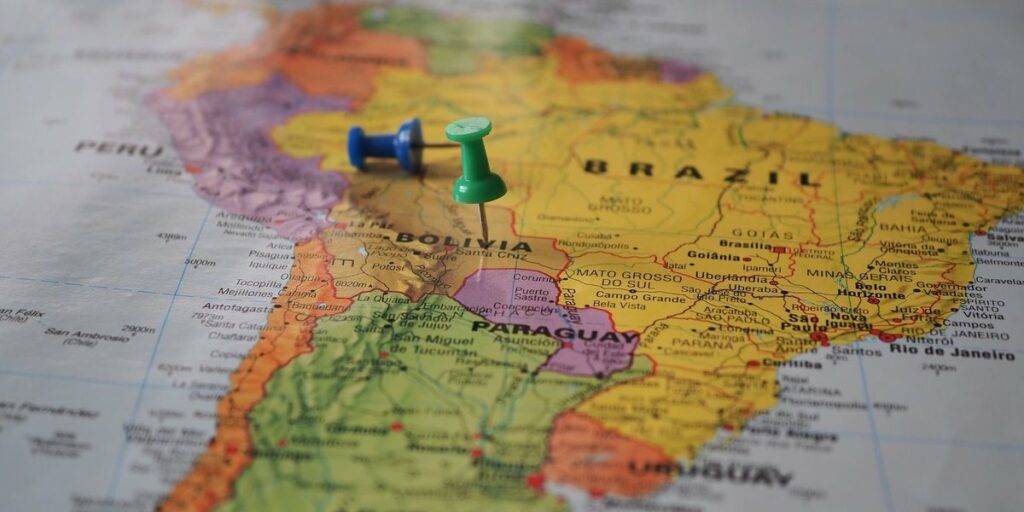
Bolivia shares a border with five countries. Ranked longest to shortest:
- Brazil — north and east, roughly 3,400 km
- Peru — northwest, roughly 1,075 km
- Chile — west, roughly 940 km
- Argentina — south, roughly 830 km
- Paraguay — southeast, roughly 750 km
That’s it — five neighbors, zero coastline. Keep reading for the terrain, the history, and which crossings actually see foot traffic.
Table of Contents
- Quick facts
- Brazil
- Peru
- Chile
- Argentina
- Paraguay
- Best border crossings for travelers
- Why Bolivia has no coastline
Quick facts

| Neighbor | Direction | Approx. border length | Main crossing |
|---|---|---|---|
| Brazil | North & east | 3,400 km | Puerto Suárez – Corumbá |
| Peru | Northwest | 1,075 km | Desaguadero |
| Chile | West | 940 km | Tambo Quemado – Chungará |
| Argentina | South | 830 km | Villazón – La Quiaca |
| Paraguay | Southeast | 750 km | Infante Rivarola |
Bolivia and Paraguay are the only two landlocked countries in South America, and they happen to share a border with each other — a detail almost nobody clocks until they see it on a map.
Brazil
Bolivia’s longest border by a wide margin, tracing the edge of the Amazon basin and the Pantanal wetlands before dipping south toward the Chaco. Most of it runs through terrain too remote to fence, let alone patrol — thick lowland forest in the north, seasonal floodplain in the south.
The border’s shape owes a lot to rubber. In the late 1800s, Brazilian rubber tappers pushed into Bolivia’s Acre territory faster than La Paz could govern it, and after a short armed standoff, Bolivia ceded the region to Brazil in the 1903 Treaty of Petrópolis. Bolivia got cash and a promise of a railway; Brazil got a rubber-rich province roughly the size of England. The line on the map today still traces that deal.
Peru
The Peru border runs northwest, splitting the Altiplano and cutting straight through Lake Titicaca — the highest navigable lake in the world sits half in each country, and the town of Copacabana on the Bolivian shore is the reason most Titicaca boat tours originate there rather than on the Peruvian side.
Before either country existed, this stretch of the Andes was Tiwanaku and then Inca territory, which is why Aymara and Quechua communities straddle the border today with more cultural continuity across it than most national boundaries allow. Modern Peru and Bolivia settled their shared line without a war — a rarity on this list.
Chile

Bolivia’s western border runs along the spine of the Andes and the edge of the Atacama Desert, one of the driest places on Earth. It’s also the border with the heaviest history: this used to be Bolivian coastline.
The War of the Pacific (1879–1884) pitted Chile against Bolivia and Peru over nitrate-rich desert territory. Chile won, and Bolivia lost its entire Pacific coast — around 400 km of it — along with the port city of Antofagasta. Bolivia has never fully let it go: the country still funds a navy with no ocean to patrol, and in 2013 it took the dispute to the International Court of Justice, asking the court to force Chile into negotiating sovereign coastal access. The ICJ ruled against Bolivia in 2018 — Chile has no legal obligation to negotiate — but the claim remains a fixture of Bolivian politics.
Argentina
The southern border sits at lower elevation than the others, transitioning from Andean foothills into the scrubby Gran Chaco. It’s the quietest of Bolivia’s five borders in terms of headline history, but the most heavily used for everyday cross-border life — Villazón and La Quiaca function almost as a single binational town split by a bridge.
Colonial-era silver from Potosí, once the richest mine in the world, moved south through this corridor toward Buenos Aires and the Atlantic. That old trade route is part of why Bolivia’s south has stronger commercial ties to Argentina than to any other neighbor.
Paraguay
The shortest border, and the one most travelers never see, cuts through the Gran Chaco — a hot, dry, thinly populated scrubland that Bolivia and Paraguay went to war over in the 1930s.
The Chaco War (1932–1935) started partly on the belief that the Chaco sat on oil. It didn’t, or not enough to matter, but the war still killed close to 100,000 soldiers on both sides before Bolivia ceded most of the disputed territory to Paraguay. It remains the deadliest interstate war fought in South America in the 20th century, and the border it produced is now one of the least-trafficked in the country.
Best border crossings for travelers
Not all five borders see equal foot traffic. If you’re actually planning a route rather than just settling a trivia question, here’s what matters:
- Peru (Desaguadero or Kasani/Copacabana) — the busiest of the five for tourists, thanks to the Titicaca circuit between Puno and La Paz. Expect long bus queues at Desaguadero; Kasani, near Copacabana, is calmer.
- Chile (Tambo Quemado – Chungará) — the standard route between San Pedro de Atacama and the Uyuni salt flats, popular with the overland 4×4-tour crowd.
- Argentina (Villazón – La Quiaca) — a classic backpacker crossing on the route between Salta and southern Bolivia, generally straightforward on foot.
- Brazil (Puerto Suárez – Corumbá) — used mainly by travelers riding the train between Santa Cruz and the Brazilian Pantanal; slower and less touristed.
- Paraguay (Infante Rivarola, on the Trans-Chaco Highway) — the outlier. Remote, sparsely served by transport, and rarely used by anyone who isn’t specifically trying to cross the Chaco.
Visa requirements for Bolivia vary by nationality and change often enough that any specific rule printed here could be outdated by the time you read it — check your own country’s current requirement before booking, rather than relying on a blog post.
Why Bolivia has no coastline
Every one of Bolivia’s five neighbors border a country that, at some point, has drawn a line closer to the Pacific than Bolivia would like. Only Chile’s border actually used to touch salt water, and only Chile’s border is the one Bolivia still argues about in international court decades later.
That’s the real trivia hiding under “which countries border Bolivia”: it isn’t six borders, it’s five — because the sixth one, the coastline, got negotiated away in 1904. According to the CIA World Factbook, Bolivia and Paraguay remain the continent’s only two landlocked nations, out of thirteen. Everyone else on this list has an ocean. Bolivia has the Andes, the Amazon, and the Chaco instead — which, depending on who you ask, is either a loss or the whole reason the country looks the way it does.