
Ask most reference pages who lives in Sri Lanka and you get the same five-row table: Sinhalese 75%, Tamil 11%, and a few leftovers. Accurate, mostly. But the table hides the interesting part. Two of those “Tamil” populations arrived on the island a thousand years apart and still don’t intermarry. One group has been here longer than anyone and is down to a few thousand people. And the whole concept of ethnicity in Sri Lanka runs on two variables most countries treat as separate: what language you speak and which god you pray to.
So here’s the real breakdown. Numbers come from Sri Lanka’s most recent full census, the 2012 enumeration run by the Department of Census and Statistics, still the official baseline until the delayed 2024 count is fully published.
Table of Contents
- The quick demographic picture
- Why language and religion define ethnicity here
- Sinhalese: the majority
- Sri Lankan Tamils vs Indian Tamils: not the same people
- Sri Lankan Moors
- The small communities: Veddah, Burghers, Malays, Kaffirs
- Where everyone lives: the geography of identity
- After the war: a note on reconciliation
The quick demographic picture
Sri Lanka is home to roughly 22 million people. Here’s how they break down by ethnic group, per the 2012 census:
| Ethnic group | Share of population | Primary language | Primary religion |
|---|---|---|---|
| Sinhalese | 74.9% | Sinhala | Buddhism |
| Sri Lankan Tamil | 11.2% | Tamil | Hinduism |
| Sri Lankan Moor | 9.3% | Tamil | Islam |
| Indian (Estate) Tamil | 4.1% | Tamil | Hinduism |
| Burgher | 0.2% | English/Sinhala | Christianity |
| Malay | 0.2% | Malay/Tamil | Islam |
| Sri Lanka Chetty, Bharatha, Veddah, others | <0.2% combined | varies | varies |
A few things jump out of that table once you stare at it. Three separate groups — Sri Lankan Tamils, Moors, and Indian Tamils — all speak Tamil, yet the census counts them as three distinct ethnicities. That’s not a clerical quirk. It’s the whole logic of how identity works here, and it’s worth understanding before you read another word about the place.
Why language and religion define ethnicity here
In a lot of countries, ethnicity tracks ancestry or skin color or a national border someone’s grandparents crossed. In Sri Lanka, the two markers that actually carry the weight are language and religion, and they don’t always line up the way an outsider expects. Other places draw the lines differently again — in Switzerland the dividing marker is overwhelmingly language, with religion a secondary concern — which makes Sri Lanka’s double-variable system all the more distinctive.
Take the Sinhalese and the Sri Lankan Tamils. Genetically, the two populations are close — centuries of living on a small island will do that. What separates them is that the Sinhalese speak Sinhala, an Indo-Aryan language related to Hindi and Bengali, and are overwhelmingly Theravada Buddhist. Sri Lankan Tamils speak Tamil, a Dravidian language with no relation to Sinhala at all, and are mostly Hindu. Same island, often the same physical type, two completely different linguistic and religious worlds.
Now flip it. The Sri Lankan Moors also speak Tamil — the same language as the Hindu Tamils — but they’re Muslim, and they’ve spent generations insisting they are a separate ethnic group, not “Tamil-speaking Muslims.” During the civil war that distinction became a matter of survival, and the census honors it. Religion, in their case, overrides shared language as the line that defines the group.
That’s the key to the whole demographic map. When you see “Tamil-speaking” used to describe Sri Lanka’s population, it covers Hindus, Muslims, and Christians who would never consider themselves one people. Language groups them; religion divides them.
Sinhalese: the majority
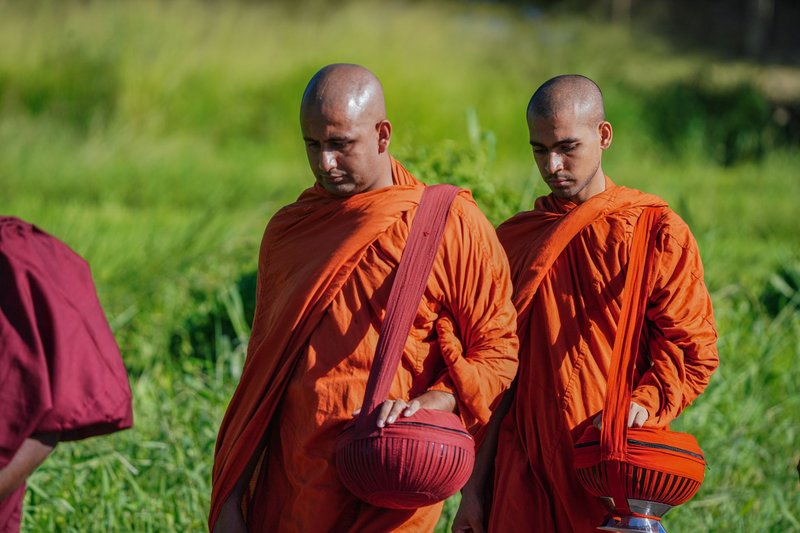
Roughly three in four Sri Lankans are Sinhalese. They speak Sinhala, write in a rounded, looping script that looks nothing like Tamil’s angular one, and are mostly Theravada Buddhist, with a Christian minority concentrated along the western coast where Portuguese and Dutch missionaries once worked.
The origin story, as the Sinhalese tell it, runs through the Mahavamsa — a chronicle written by Buddhist monks around the 5th century CE that traces the people to Prince Vijaya, a north-Indian exile said to have landed on the island around 543 BCE. Historians treat the specifics as legend with a kernel of migration history inside it: Indo-Aryan speakers did arrive from northern India, and Sinhala did develop from that branch of languages. The Mahavamsa matters less as literal history than as the founding text of Sinhalese Buddhist identity, which is exactly why it still gets invoked in political arguments today.
The Sinhalese are spread across the south, west, and center of the island — basically everywhere except the northern and eastern coastal belts. Colombo, Kandy, the southern beach towns, the hill-country tea estates: Sinhala-speaking territory.
Sri Lankan Tamils vs Indian Tamils: not the same people
This is the distinction nearly every short article botches, so it’s worth getting right.
There are two Tamil populations in Sri Lanka, and they are genuinely different communities with different histories, different geography, and — until recently — different legal status.
Sri Lankan Tamils (about 11% of the population) are the older group. Their ancestors have been in the north and east of the island for well over a thousand years, with some Tamil settlement and Tamil-speaking kingdoms reaching back to the early centuries CE. They’re concentrated on the Jaffna Peninsula and along the northern and eastern coasts. They’re predominantly Hindu, with a significant Christian minority. This is the community at the center of the long independence struggle and the civil war.
Indian Tamils (about 4%), also called Estate Tamils or Hill Country Tamils, are a completely separate story. The British brought their ancestors over from southern India in the 19th and early 20th centuries as indentured labor to work the coffee and later tea plantations in the central highlands. They’ve been here for several generations, but they arrived centuries after the Sri Lankan Tamils and they live in a different part of the country — the hill-country tea estates around Nuwara Eliya, not the northern coast.
The two groups don’t really mix. They have distinct dialects, distinct social structures, and historically distinct political organizations. The starkest difference was legal: after independence in 1948, the new government effectively stripped most Indian Tamils of citizenship, leaving hundreds of thousands stateless for decades. It took agreements with India and a series of laws stretching into the 2000s before that was fully resolved. So when someone collapses “Tamil” into one bucket, they’re erasing a group that was, for fifty years, treated as foreigners in the only country they’d ever known.
Sri Lankan Moors
The Moors make up a little over 9% of the population — more than the Indian Tamils, and the largest Muslim community on the island.
The name comes from the Portuguese, who called all Muslims “Mouros” when they arrived in the 1500s. The community itself traces back further, to Arab traders who worked the Indian Ocean spice and gem routes from roughly the 8th century onward, married local women, and settled along the coasts. So the ancestry is a blend of Arab merchant and local South Asian, layered over a thousand years. Those same trade routes seeded Muslim communities across the region — the neighboring Maldives ended up almost entirely Muslim through much the same Indian Ocean contact — though Sri Lanka’s far greater diversity left its Moors as one group among many rather than the whole population.
Moors speak Tamil as their home language, which is why colonial administrators and later Tamil nationalists sometimes tried to fold them in with the Tamils. The Moors have consistently refused the label. Their identity is built on religion — Sunni Islam — not language, and they’ve guarded their status as a separate ethnic group through every census and every political upheaval. During the civil war, the Tamil Tigers expelled tens of thousands of Muslims from the north at gunpoint in 1990, which permanently hardened the line between the two Tamil-speaking communities.
You’ll find Moor communities all over the island rather than in one bloc — trading towns on the east coast, pockets in Colombo, settlements scattered through the south and central regions. Commerce, historically, kept them mobile.
The small communities: Veddah, Burghers, Malays, Kaffirs
Here’s where the standard table goes quiet. These groups are each well under 1% of the population, but they carry more history per capita than anyone.
The Veddah are the island’s indigenous people — the descendants of its earliest hunter-gatherer inhabitants, here long before the Sinhalese or Tamils arrived. Their numbers are now tiny, a few thousand at most, and even that figure is soft because so many have assimilated into Sinhalese or Tamil village life and stopped identifying as Veddah on the census. The traditional Veddah lived by hunting and gathering in the eastern forests, spoke their own language (now nearly extinct and heavily mixed with Sinhala), and practiced an animist religion centered on ancestor spirits. A handful of communities, around Dambana in the east, still maintain elements of the old way of life — partly out of genuine continuity, partly because cultural tourism now gives them a reason to.
The Burghers are the descendants of European colonists — mainly Portuguese and Dutch — who intermarried with locals during three centuries of colonial rule. They’re Christian, historically English-speaking, and once formed a small but influential professional and administrative class, especially under the British. Many emigrated to Australia and elsewhere after independence as English lost its official footing, which is why the community is much smaller now than it was a century ago. Dutch and Portuguese surnames around Colombo — your de Silvas, your Van der Poortens — often trace back here.
The Malays came from the Indonesian and Malay archipelago, brought over largely by the Dutch (and some by the British) as soldiers, exiles, and convicts from the 1700s onward. They’re Muslim, like the Moors, but ethnically and linguistically distinct: many still speak a form of Malay at home alongside Tamil. The community concentrated historically around military garrisons and the Colombo area.
The Kaffirs are the smallest and least-known group — descendants of African slaves and soldiers brought to the island by Portuguese, Dutch, and British colonizers, mostly from the Mozambique coast. A few hundred remain, concentrated around Puttalam on the northwest coast. They’re Catholic, and their most striking cultural survival is manja, a music-and-dance tradition with audible African roots that has influenced Sri Lankan baila music. The name comes from the Arabic kafir; in Sri Lanka the community uses it as a straightforward ethnic label without the slur connotations it carries elsewhere.
Where everyone lives: the geography of identity
Ethnicity in Sri Lanka isn’t evenly spread — it maps onto the land in a way that explains a lot of the country’s modern history.
Draw a rough line and it looks like this. The north — the Jaffna Peninsula and the dry coastal districts — is Sri Lankan Tamil and largely Hindu. The east coast is the most mixed region on the island, a patchwork of Sri Lankan Tamils, Moors, and Sinhalese living in adjacent towns, which is exactly why it saw some of the war’s hardest fighting. The central highlands, the tea country around Nuwara Eliya, are where the Indian Tamils were settled to work the estates. And the south, west, and central lowlands — Colombo, Kandy, Galle, the beach belt most travelers see — are predominantly Sinhalese and Buddhist.
For a traveler, this is the difference between a temple-bell morning in Kandy and the call to prayer in a Moor trading town on the east coast and a Hindu kovil festival on the Jaffna Peninsula. Move across the island and you move across religions, scripts, and cuisines, all inside one country roughly the size of West Virginia.
After the war: a note on reconciliation
You can’t write honestly about Sri Lanka’s ethnic groups and skip the civil war, but it doesn’t have to be the whole story either.
The short version: tensions between the Sinhalese majority and the Tamil minority — fed by post-independence language laws, university quotas, and settlement policies that Tamils experienced as discrimination — escalated through the 1970s. Anti-Tamil riots in July 1983, remembered as Black July, killed hundreds and pushed the conflict into open war. The separatist Liberation Tigers of Tamil Eelam fought the government for control of a Tamil homeland in the north and east. The war ran for 26 years and ended in 2009 with a military defeat of the Tigers and a brutal final phase that drew international scrutiny. The UN High Commissioner for Human Rights has documented accountability concerns from that period that remain unresolved.
What’s the situation now? More than fifteen years on, the island is at peace, and travel is open across all of it, including the once-closed north. But reconciliation is uneven. Questions of accountability, land returns, the fate of the disappeared, and meaningful political devolution to the Tamil regions are still live and still contested. The delayed national census of 2024 is itself part of this — an accurate ethnic count after years of displacement carries political weight that a census in most countries simply doesn’t.
For a visitor, none of this means staying away. It means showing up with some context: understanding that the temple, the kovil, and the mosque you pass in a single afternoon belong to communities with deep, separate, and sometimes painful histories — and that the people living them out today are, for the most part, ready to share the island with anyone curious enough to ask.