Icelandic is the official language, and roughly 97% of the population speaks it natively. But here’s the part that matters if you’re packing a bag: nearly everyone in Iceland also speaks English, often well enough to debate you on it. You can land at Keflavík, rent a car, order dinner, and hike a glacier without learning a single word of Icelandic.
That’s the short answer. The longer one is more interesting, because Iceland’s relationship with language is unlike anywhere else in Europe. This is a country that decided centuries ago to keep its language frozen in the 9th century, invents new native words instead of borrowing foreign ones, and recently absorbed a wave of Polish, Ukrainian, and Lithuanian speakers that’s quietly reshaping who actually talks what.
Table of Contents
- The short version
- What languages are actually spoken in Iceland
- Do tourists really get by on English?
- The language that refused to change
- Icelandic Sign Language
- Basic Icelandic phrases worth knowing
- Is Icelandic hard to learn?
- FAQ
The short version
- Official language: Icelandic (Íslenska), spoken natively by about 97% of residents.
- English: Widely spoken, especially by anyone under 60 and anyone in tourism. You will not get stuck.
- Immigrant languages: Polish is the largest, by a wide margin, followed by Lithuanian, Ukrainian, and others. Immigrants now make up around 18–20% of the population.
- Officially recognized: Icelandic Sign Language (Íslenskt táknmál) is recognized in law as the first language of the deaf community.
What languages are actually spoken in Iceland
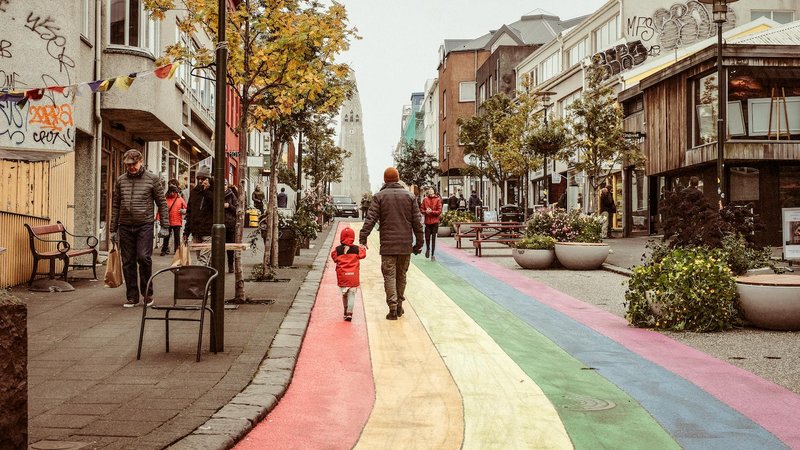
Iceland looks linguistically simple from the outside: one tiny nation, one ancient language. The reality on the ground in 2025 is more layered, because immigration has changed the picture fast.
Here’s the breakdown of the main languages by speaker community:
| Language | Status / who speaks it | Approximate share |
|---|---|---|
| Icelandic | Official, native tongue | ~97% native |
| English | Near-universal second language | The large majority of adults |
| Polish | Largest immigrant language | Around 31% of all immigrants |
| Lithuanian | Significant immigrant community | A few percent of immigrants |
| Ukrainian | Fast-growing since 2022 | Rising sharply |
| Danish | Taught in school (Nordic ties) | Many can read it |
| German | Common third language | Smaller group |
The numbers worth sitting with: Iceland’s foreign-born population has roughly doubled over the past decade, and Polish nationals are by far the biggest group. In Reykjavík neighborhoods and in towns built around fish processing or tourism, you’ll hear Polish on the street as readily as Icelandic. Schools in the capital area now report children speaking more than 100 different home languages, a fact that would have sounded absurd in Iceland thirty years ago.
Danish deserves a footnote. Iceland was under Danish rule until 1944, and Danish is still a mandatory subject in schools as part of Iceland’s Nordic ties. Most Icelanders won’t volunteer to speak it, but they can usually read a Scandinavian menu without trouble. If you want a closer look at how these tongues sit alongside each other in law and daily life, this rundown of the official languages in Iceland breaks down what’s legally recognized and how language shapes schooling and media.
Do tourists really get by on English?
Yes. Comprehensively, almost suspiciously so.
Iceland consistently ranks near the top of global English proficiency indexes for countries where English isn’t an official language. The EF English Proficiency Index regularly places Iceland in its highest “very high proficiency” band. In practical terms, that means restaurant staff, hotel desks, tour guides, gas station clerks, and the person at the next table all speak English comfortably.
A few reasons it’s this good:
- Subtitles, not dubbing. Icelandic kids grow up watching English-language film and TV with subtitles rather than dubbed audio. They hear English constantly from childhood.
- A small language needs a big one. With only around 370,000 native Icelandic speakers worldwide, English is the bridge to the rest of the world — for higher education, science, business, and the internet.
- Tourism economy. Iceland gets far more annual visitors than it has residents. The service industry runs on English.
The honest caveats: in remote villages in the Westfjords or the eastern fjords, an older farmer or shopkeeper may have limited English. And road signs, supermarket labels, and official notices are in Icelandic, so a translation app earns its keep. But you will never be stranded by a language barrier on the Ring Road or in any town a tourist realistically visits.
The language that refused to change
This is where Icelandic gets genuinely unusual. A modern Icelander can pick up the medieval sagas — texts written in the 12th and 13th centuries — and read them with far less difficulty than an English speaker reading Chaucer, let alone Beowulf. The language has changed remarkably little in a thousand years.
That isn’t an accident. Iceland practices what’s called linguistic purism: instead of importing foreign words for new things, it builds new words out of old Icelandic roots. There’s even an official body, the Árni Magnússon Institute, that helps coin and standardize this vocabulary.
The famous example is the word for computer: tölva. It’s a blend of tala (number) and völva (prophetess or seeress) — literally something like “number prophetess.” Instead of adopting “computer” the way most languages did, Icelandic invented its own word and made it stick. Other coinages follow the same logic:
- sími — telephone (from an old word for “thread” or “cord”)
- þota — jet aircraft (from a verb meaning to zoom or whoosh)
- skjár — screen/monitor
The result is a language that feels self-contained and deliberate. It also means loanwords that have crept into other European languages mostly bounced off Icelandic. That purism is a point of national pride, and it’s a big part of why the sagas remain readable today.
Icelandic Sign Language
One language gets skipped on almost every “languages of Iceland” page: Íslenskt táknmál, or Icelandic Sign Language (ÍTM).
It matters because Iceland recognized it in law. Legislation passed in 2011 established Icelandic Sign Language as the first language of those who need it to communicate, and obligated the state to support and develop it — putting it on a notably strong legal footing compared to how many countries treat their sign languages. ÍTM is its own full language with its own grammar, descended historically from Danish Sign Language but distinct from it today. The deaf community in Iceland is small, but the language’s official status is a real part of the country’s linguistic identity.
Basic Icelandic phrases worth knowing
You don’t need these. But learning a couple of words goes a long way, and takk in particular will earn you a warmer reception. Pronunciation matters more than spelling here, so here’s a rough guide:
| Icelandic | Meaning | Pronunciation (rough) |
|---|---|---|
| Halló | Hello | HA-loh |
| Góðan dag | Good day | GOH-than dahg |
| Takk | Thanks | tahk |
| Takk fyrir | Thank you | tahk FIH-rir |
| Já | Yes | yow |
| Nei | No | nay |
| Bless | Bye | bless |
| Afsakið | Excuse me / sorry | AHF-sah-kith |
| Talar þú ensku? | Do you speak English? | TAH-lar thoo ENS-kuh |
| Skál! | Cheers! | skowl |
Two letters that trip people up: þ (thorn) sounds like the “th” in thing, and ð (eth) sounds like the “th” in this. So Góðan uses the soft this sound, while þú uses the hard thing sound. Don’t sweat it — nobody expects you to nail it, and the effort alone is the point.
Is Icelandic hard to learn?
For an English speaker, honestly, yes. It’s one of the harder European languages to pick up, and it’s worth knowing why before you commit.
Icelandic kept the full grammatical machinery that English shed centuries ago. Nouns have four cases (nominative, accusative, dative, genitive) and three genders, and they decline. Verbs conjugate heavily. Numbers change form depending on what they’re counting. There’s no large pool of shared vocabulary to lean on the way you would with, say, Spanish or French, because the purism kept the loanwords out.
The flip side: the spelling is consistent, so once you learn the sounds, you can read words correctly. And there are far better learning resources now than there were a decade ago, including free university-backed courses.
If your goal is a trip, skip the grammar entirely and learn the ten phrases above. If your goal is fluency, expect a long, rewarding climb.
FAQ
What is the official language of Iceland? Icelandic (Íslenska). It’s spoken natively by about 97% of the population and is a North Germanic language closely related to Old Norse.
Do people in Iceland speak English? Yes. English is spoken widely and fluently across the country, especially by younger people and anyone working in tourism. Iceland ranks among the most English-proficient non-native countries in the world.
What’s the second most common language in Iceland? Among immigrant communities, Polish is the largest by far, making up roughly 31% of immigrants. English functions as the near-universal second language across the whole population.
Can I travel in Iceland without speaking Icelandic? Easily. You can rent a car, book tours, eat out, and navigate the entire Ring Road on English alone. A translation app helps with Icelandic-only signs and labels in rural areas.
Is Icelandic Sign Language official? Yes. A 2011 law recognized Icelandic Sign Language (Íslenskt táknmál) as the first language of the deaf community, with the state obligated to support it.
Is Icelandic similar to any other language? It’s most closely related to Faroese, and more distantly to Norwegian, Danish, and Swedish. But thanks to centuries of linguistic purism, it has stayed far closer to Old Norse than its Scandinavian cousins have.