
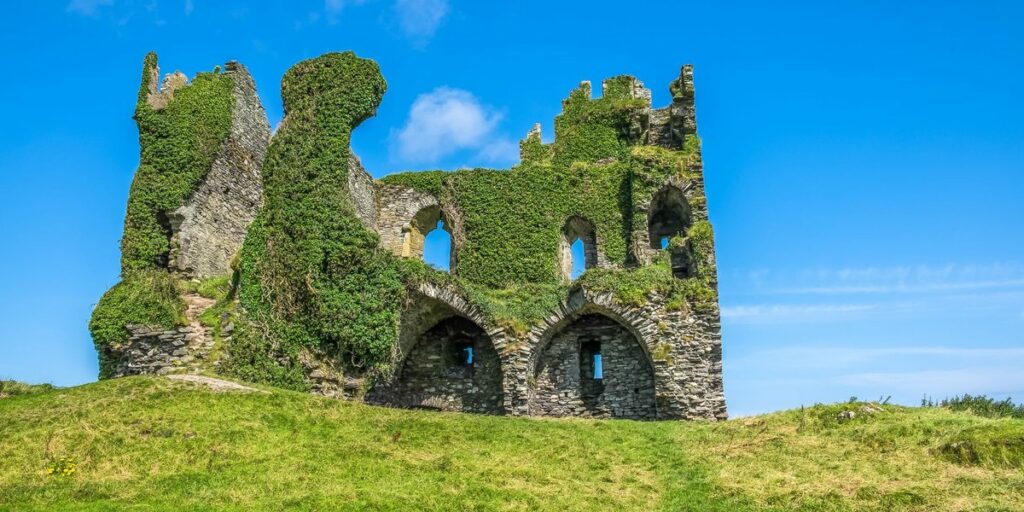
Northern Ireland’s landscape is layered in a way that takes time to read. Vikings, monks, Norman lords, plantation settlers, and the sea itself have all left something standing — or half-standing. The result is a country where you can step off a coastal path and find yourself face-to-face with a medieval wall, a crumbling abbey, or a stone circle that predates written history by thousands of years.
Most lists of ruins here give you Dunluce Castle and call it a day. That’s fair — Dunluce is genuinely dramatic. But it’s also the opening act. Northern Ireland has monastic ruins on tidal islands, Iron Age earthworks, dolmens balanced on hilltops, and castle towers growing out of cliff faces that nobody’s photographed 10,000 times yet.
This guide covers 14 sites across the country, organized loosely by region so you can string them into a route.
Table of Contents
- The Causeway Coast
- 1. Dunluce Castle
- 2. Kinbane Castle
- 3. Bonamargy Friary
- 4. Dunseverick Castle
- County Antrim & the Glens
- 5. Glenarm Castle Demesne
- 6. Layd Church
- Strangford Lough
- 7. Nendrum Monastic Site
- 8. Grey Abbey
- 9. Castle Ward Tower House
- County Down
- 10. Inch Abbey
- 11. Dundrum Castle
- County Tyrone & the Interior
- 12. Beaghmore Stone Circles
- 13. Harry Avery’s Castle
- The Sperrins
- 14. Legananny Dolmen
Causeway Coast
1. Dunluce Castle
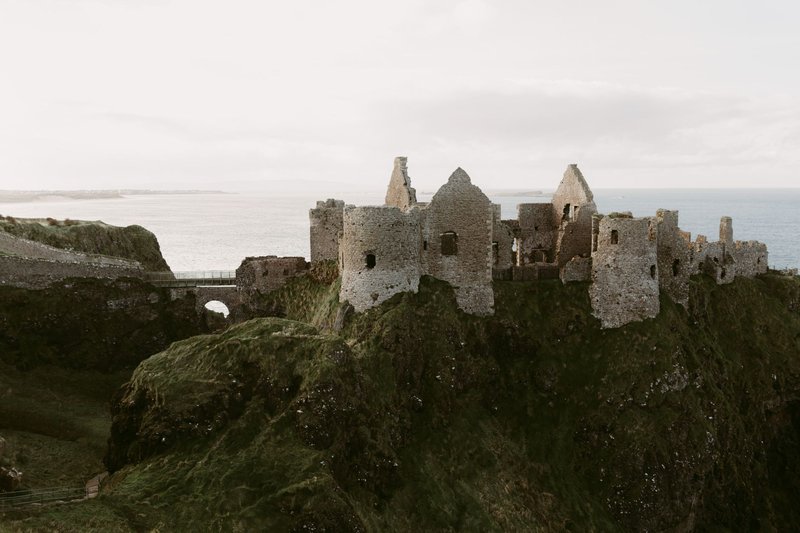
Dunluce gets all the attention, and the attention is deserved. The castle sits on a basalt stack jutting over the Atlantic — you’re looking at ruins that drop sheer into the sea on three sides. Parts of the kitchen literally collapsed into the water during a storm in 1639, taking servants with them.
The castle has been occupied since at least the 14th century, and the MacDonnell clan — the Scottish lords who dominated this coast — rebuilt it substantially in the 1500s. What you see now are the remains of those additions: a great hall, a gatehouse, a Scottish-style loggia. The visitor center on the mainland side has decent exhibits on the MacDonnells without over-dramatizing things.
Practical: On the A2 between Portrush and Bushmills. Paid parking, entry fee applies. Usually less crowded before 10am or after 4pm.
2. Kinbane Castle
Kinbane is what Dunluce would look like if nobody had marketed it for a century. It’s tucked into a headland a few kilometers east of Ballycastle, reached via a steep path down to a chalk promontory. The tower and courtyard walls of a 16th-century MacDonnell stronghold are still standing, if barely.
The walk down involves concrete steps that are slippery when wet. The view from the castle itself — out toward Rathlin Island and, on clear days, the Mull of Kintyre — is one of the best coastal vistas in Northern Ireland, full stop.
Practical: Free access. Limited parking at the road. Not suitable after heavy rain.
3. Bonamargy Friary
Most visitors to Ballycastle spend their time at the harbor or the beach. The friary is a five-minute drive away and usually empty. Founded around 1500 by the MacDonnells as a Franciscan house, it was used as a burial site well into the 19th century — the black stone tomb of Sorley Boy MacDonnell, one of the most storied figures in this part of Ireland’s history, is inside a small vault that you can peer into.
The roofless nave, the gatehouse arch, and the intact vaulted sacristy are all worth walking slowly through. There’s a locked gate to some interior areas, but the main ruins are freely accessible.
Practical: Free entry, open site. Just off the A2 east of Ballycastle town.
4. Dunseverick Castle
A few kilometers west of the Giant’s Causeway, Dunseverick is down to a single wall fragment above a cliff. The original fort here is mentioned in 5th-century Irish annals — it was one of the royal roads of early medieval Ireland. What’s left now is a small tower from a later structure, probably 16th century.
It doesn’t take long to see, but the setting — on a headland with the Causeway coast stretching in both directions — makes it worth the short detour. Combine it with the Causeway Coastal Path walk.
Practical: Free access. Roadside parking nearby. Part of the Causeway Coast AONB.
County Antrim & the Glens
5. Glenarm Castle Demesne
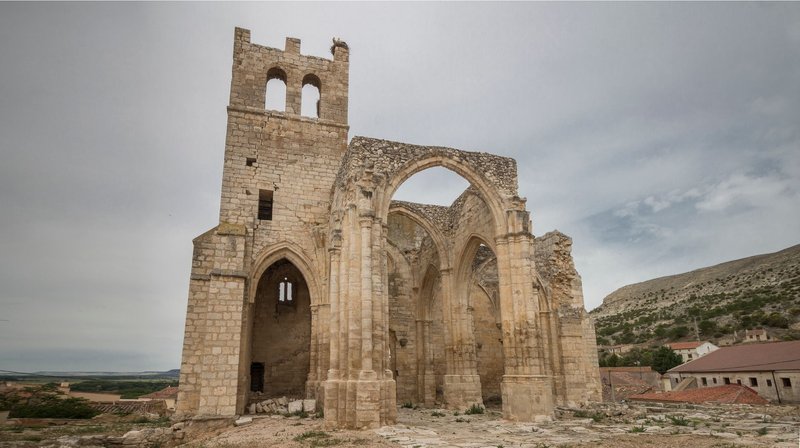
The castle itself is still occupied (it’s the seat of the Earl of Antrim), but the walled garden, towers, and surrounding demesne are open to visitors at certain times of year. The gatehouse — a 19th-century Gothic revival structure built over medieval foundations — is the visual centerpiece. The estate has been in the same family since the 1600s and manages to feel both ornate and genuinely old.
Worth combining with a walk through Glenarm village, which is one of the prettiest towns on the Antrim coast.
Practical: Check opening times at glenarmcastle.com before visiting — the estate has seasonal access.
6. Layd Church
A ruined medieval church in a coastal glen outside Cushendall, reached by a short walk through farmland. Founded by the Franciscans in the 13th century, it served as a parish church until the 19th century, and the graveyard surrounding it is still in use. MacDonnell family graves are here as well — this stretch of Antrim was their domain for a long time.
The ruins are modest, but the setting is exceptional: a stream runs past the graveyard, the glen rises steeply on either side, and the sea is visible from the upper part of the site.
Practical: Free access. Limited parking at the trailhead. About 10 minutes’ walk from the road.
Strangford Lough
7. Nendrum Monastic Site
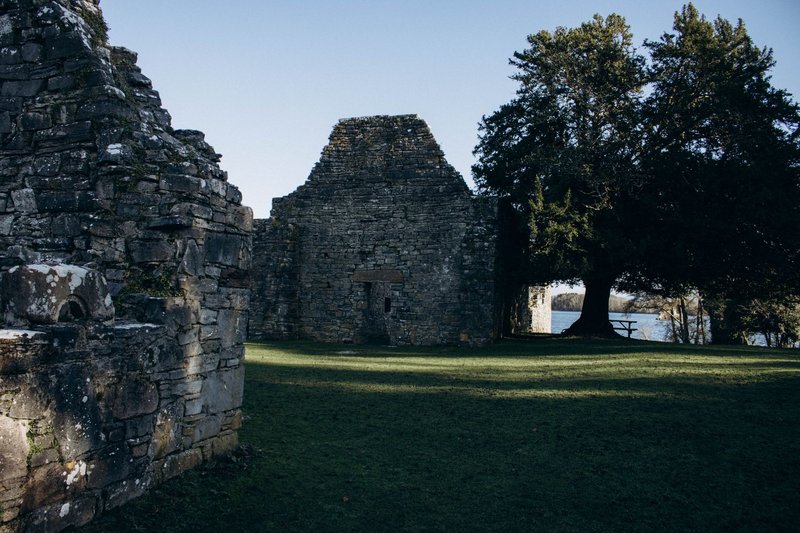
Nendrum is on Mahee Island in Strangford Lough, connected to the mainland by a series of causeways. It’s one of the least-visited significant early Christian sites in Ireland, and that’s genuinely hard to understand given what’s there: three concentric cashel walls, a round tower stump, a reconstructed sundial, and extensive excavated remains of a 5th-century monastic settlement. The Ulster Museum holds many of the finds.
The site has a tidal mill that’s among the earliest recorded in the world — excavated in the 1920s and dated to around 619 AD. That’s a specific enough detail to stop and think about.
Practical: Free access. Small car park on Mahee Island. A site guide board explains the layout well.
8. Grey Abbey
A Cistercian abbey on the eastern shore of Strangford Lough, founded in 1193 by Affreca, daughter of the King of Man, in thanks for surviving a storm at sea. The nave, chancel, and transepts are substantially intact — roofless but complete enough that you can read the full medieval floor plan. It’s the earliest Gothic building in Ireland.
The abbey church still has decorative stonework in reasonable condition, and the physic garden (a reconstruction of a medieval herb garden) is a nice touch. The surrounding graveyard has been in use for centuries.
Practical: Free access, maintained by the state. Car park adjacent. In the village of Greyabbey.
9. Castle Ward Tower House
The Tower House at Castle Ward is a 16th-century tower that was incorporated into the later estate — the 18th-century mansion gets most of the attention, but the tower itself is the older and more interesting structure. Castle Ward’s grounds were used as a filming location for Game of Thrones (Winterfell’s exterior), which has brought more visitors than the tower probably deserves credit for.
The broader Castle Ward estate on the Strangford shore is worth an afternoon in its own right: foreshore walks, a Victorian laundry, and views across the lough.
Practical: National Trust property — admission applies for the estate. The grounds are extensive.
County Down
10. Inch Abbey
A Cistercian ruin on the banks of the Quoile River, near Downpatrick. Founded in the 1180s by John de Courcy after his conquest of Ulster, it replaced an earlier monastery he’d destroyed — reportedly his attempt at an apology to the church. The ruins are well-preserved and set in a flat, green river landscape that makes the abbey feel more isolated than it is.
The site is managed by the state and kept clear enough that you can walk through the nave and chancel without obstruction.
Practical: Free access. Short drive from Downpatrick town center. Usually quiet.
11. Dundrum Castle
A Norman motte-and-bailey castle built by John de Courcy around 1177, Dundrum sits on a hill above the village of the same name with views over Dundrum Bay and the Mourne Mountains. The circular keep is 13th century and still stands to near-full height — you can climb inside and look out over the coast.
This is one of the best-preserved Norman castle complexes in Ireland. The concentric walls, the gatehouse, and the keep together give a clear sense of medieval military architecture without the crowds of Dunluce.
Practical: Free access, state maintained. Parking in Dundrum village.
County Tyrone & the Interior
12. Beaghmore Stone Circles
Seven stone circles (six in paired sets, one standalone) arranged across a boggy upland near Cookstown, alongside stone rows and cairns, all Bronze Age — roughly 2000–1200 BC. The site was hidden under peat until the 1940s when turf cutting exposed it. If prehistoric monuments are on your radar, the island has no shortage of them — Ireland’s historical places span everything from Neolithic tombs to Norman strongholds.
No one knows exactly what the site was for. The circles contain hundreds of small upright stones called “Dragon’s Teeth” filling one of them entirely. It’s a strange, windswept place that gets far fewer visitors than the Callanish stones in Scotland or Stonehenge, despite being comparably atmospheric.
Practical: Free access, open site. Signposted from Cookstown and the A505. Bring waterproof boots.
13. Harry Avery’s Castle
A 14th-century Irish tower castle in County Tyrone, built by Henry Aimhreidh O’Neill, lord of Tyrone. Most Irish tower houses are rectangular; Harry Avery’s has two unusual D-shaped towers flanking the entrance, which is what makes it worth the detour. It’s a form that echoes Anglo-Norman gatehouses but was built by a Gaelic lord — a sign of how architectural ideas moved across what were supposedly hard cultural boundaries.
The site is on a hill outside Newtownstewart with decent views over the Mourne Valley.
Practical: Free access. Limited roadside parking. Managed by the state; no interpretive center on site.
The Sperrins
14. Legananny Dolmen
A Neolithic portal dolmen on the southern slopes of the Slieve Croob hills in County Down — technically just outside the Sperrins, but worth including for its contrast with the stone circles further west. Three standing stones support a massive capstone, creating the tripod silhouette that dolmens are known for. It dates to around 4000 BC.
The dolmen sits in open farmland with a view toward the Mourne Mountains. There’s nothing around it. The scale only becomes apparent when you stand next to it and realize the capstone is well above head height.
Practical: Free access, open site. Narrow road to the parking area — not suitable for large vehicles.
Planning a Route
Northern Ireland is small enough that you can reach most of these sites in a long weekend. The Causeway Coast sites (Dunluce, Kinbane, Bonamargy, Dunseverick) string together naturally along the A2 and are a logical first day. Strangford Lough — Nendrum, Grey Abbey, Castle Ward — works as a second day circuit from Belfast or Downpatrick. County Tyrone and the stone circles require a separate push west, or a dedicated day from Derry.
The National Trust and the Historic Environment Division of the Northern Ireland Executive maintain many of these sites, and both are worth checking before you travel for seasonal access and any temporary closures.