Estonia is the richest of the three Baltic states and a poster child for digital governance. It is also a country where, in a handful of border towns, more than a third of people live at risk of poverty. Both of those things are true at once, and the gap between them runs almost entirely along one geographic seam: the northeast, the Russian-speaking belt, and the small lakeside towns that lost their reason for existing when the Soviet economy folded.
This is a ranked look at the poorest cities and towns in Estonia. Not a doom list. A map of where the money didn’t go, why, and what the numbers actually mean once you separate “relative poverty” from “absolute poverty.”
Table of Contents
- The quick version
- How “poor” is measured here
- 1. Narva
- 2. Kohtla-Järve
- 3. Kallaste
- 4. Sillamäe
- 5. Mustvee
- 6. Valga
- 7. Räpina
- 8. Põlva
- 9. Võru
- 10. Maardu
- The comparison table
- The part the doom lists leave out
The quick version
Estonia’s poverty is regional, not national. The county of Ida-Viru in the northeast carries the heaviest load, with an at-risk-of-poverty rate around 35% against roughly 15.5% in wealthy Harju county (home to Tallinn). The poorest places are old industrial cities built around oil shale and a cluster of tiny towns on the western shore of Lake Peipus, where the official poverty figures are startling — Kallaste and a couple of its neighbors have measured over 40%.
The throughline: these were Soviet single-industry towns or ethnic-Russian settlements, and when the factory closed or the border hardened, the economy and the young people left together.
How “poor” is measured here
A word on what the numbers mean, because the difference matters.
Relative poverty (the “at-risk-of-poverty rate”) counts people earning below 60% of the national median income. It is a measure of inequality as much as hardship — a person can be “at risk of poverty” in Estonia and still have a roof, heat, and healthcare. Absolute poverty counts people who can’t afford a basic minimum basket of goods, and that figure is far lower nationally, in the low single digits.
When you see a town at “40% poverty,” it almost always means the relative measure. That is still a real signal of a struggling local economy, but it is not the same as 40% of people going hungry. Estonia’s overall at-risk-of-poverty rate has actually trended downward over the past decade, even as perceived deprivation stayed sticky. The rankings below lean on regional and municipal data from Statistics Estonia (Statistikaamet); the smallest towns rely on older census-era figures because fresh town-level breakdowns are thin.
1. Narva
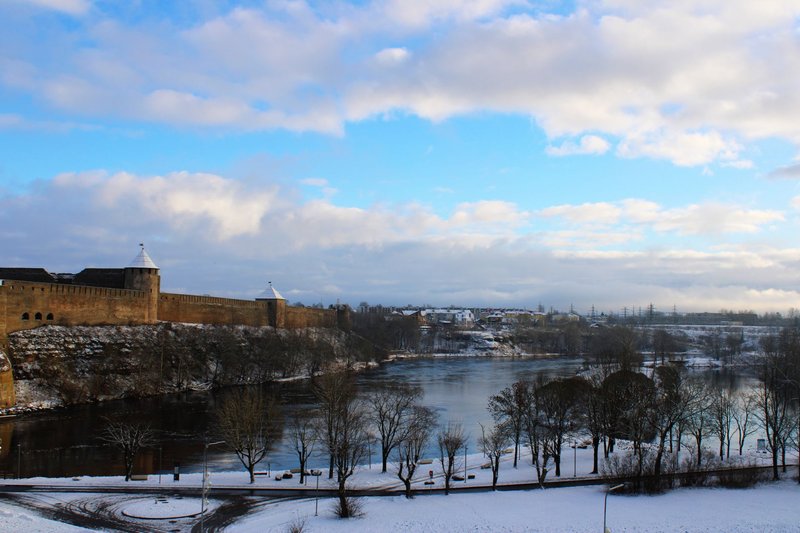
Narva is the obvious headliner and the most interesting case. It sits on the literal edge of Estonia, separated from Russia by a river and two staring-contest castles. Around 95% of its roughly 53,000 residents are Russian-speaking, and a large share held grey “alien” passports for decades after independence, neither Estonian nor Russian citizens.
The economy here was wired into the Soviet system — the Kreenholm textile mill, once one of the largest in Europe, employed thousands and then collapsed in the 2000s. Unemployment in the Ida-Viru region has run well above the national average for years, and Narva’s median income trails Tallinn’s badly. The language barrier compounds it: a generation of older workers who never needed Estonian now struggle to qualify for jobs that require it.
It is not a place without life. Narva has a striking baroque-meets-Stalinist cityscape, a genuinely good art residency scene, and the cheapest cost of living of any sizeable Estonian city. But on income, employment, and demographic decline, it ranks at or near the bottom.
2. Kohtla-Järve
If Narva is the famous one, Kohtla-Järve is the structural one. It is barely a single city — more a string of disconnected districts stitched together across the oil-shale fields, the result of Soviet planners bolting mining settlements into one administrative unit.
Oil shale is the whole story. Estonia is one of the only countries on earth that runs on it, and Kohtla-Järve was the processing heart of that industry. As Estonia decarbonizes and the oil-shale sector winds down, the town’s reason for being is shrinking in real time. Population has fallen from a Soviet-era peak above 90,000 to under 33,000, one of the steepest declines in the country. Whole apartment blocks sit half-empty. The at-risk-of-poverty rate tracks the broader Ida-Viru figure near the top of the national range.
3. Kallaste
Now the small towns, where the percentages get extreme. Kallaste is a speck on the western shore of Lake Peipus, the big lake that forms Estonia’s eastern border with Russia. Fewer than 800 people live here. It was founded by Russian Old Believers — a religious community that fled persecution centuries ago — and that heritage still defines it: onion-domed churches, fishing boats, lakeside dachas.
In the same statistics release that flagged the region, Kallaste has posted an at-risk-of-poverty rate above 40%, among the highest measured anywhere in Estonia. The town has almost no industry, an aging population, and young people who leave for Tartu or Tallinn and don’t come back. What it has instead is one of the prettiest lakeshores in the country and a culture you won’t find elsewhere in the Baltics.
4. Sillamäe
Sillamäe is the strangest entry on the list and the best preserved. For most of the Soviet era it was a closed city — sealed off, unmarked on maps — because it processed uranium for the Soviet nuclear program. You needed a permit to enter. As a result, its core is a near-perfect ensemble of Stalinist neoclassical architecture, grand staircases and colonnades dropped onto the Baltic coast.
The secrecy that built it also stranded it. Almost everyone here is Russian-speaking, the uranium and metals plant downsized hard, and the town shares Ida-Viru’s high unemployment and low incomes. Population has slid below 12,000. It is poor by the regional measure, but it is also one of the most architecturally coherent towns in Northern Europe, which is a sentence that surprises everyone who visits.
5. Mustvee
Another Lake Peipus town, a little south of Kallaste, with a similar profile and a similar fate. Mustvee is split between Estonian and Russian-speaking communities — it famously has Orthodox, Old Believer, and Lutheran churches within walking distance of each other — and around 1,200 residents.
Its at-risk-of-poverty figures sit in the same elevated band as its lakeside neighbors. The fishing and small-trade economy that sustained these settlements never scaled into anything that could hold a young workforce. The result is the quiet, weathered feel common to the whole Peipsiääre stretch: beautiful, calm, and economically thin.
6. Valga
Valga is poverty of a different flavor — not post-Soviet industrial, but border-town drift. It sits on the Latvian frontier and is literally fused with the Latvian town of Valka; the border once ran down the middle of streets, and you can cross from one country’s pizzeria to the other’s pharmacy on foot.
Valga county consistently ranks among the lower-income parts of Estonia, second only to Ida-Viru in some measures. Being a divided border town meant neither side ever became a real regional center; the economy got split and then both halves got bypassed by the main Tallinn–Riga flows. Population has fallen below 12,000. The upside, increasingly leaned into, is the novelty itself: “one town, two countries” tourism.
7. Räpina
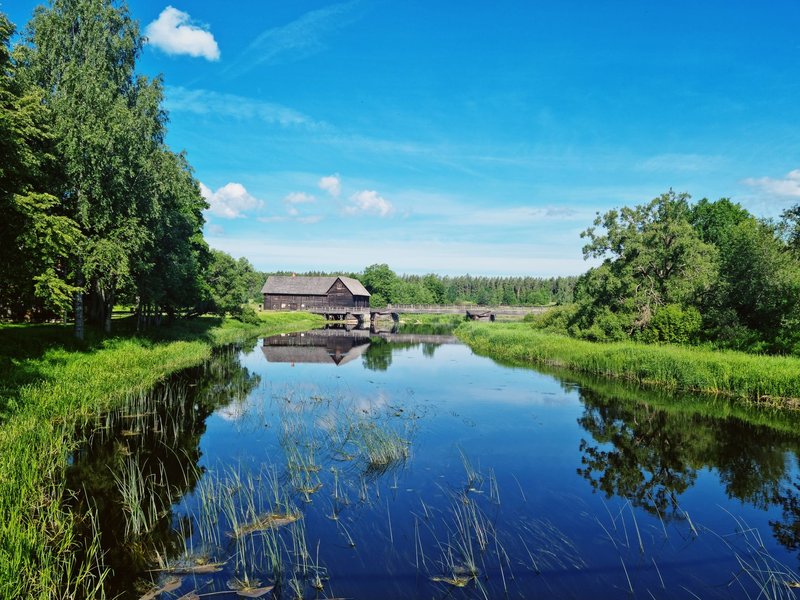
Räpina is a small town in the southeast, near the Russian border and the southern tip of Lake Peipus, known for one genuinely distinctive thing: a paper mill founded in 1734, the oldest in the Baltics and still running. That mill is also a clue to the problem — when a town of around 2,500 people leans on a single historic employer, there isn’t much of a cushion.
The wider Põlva and southeastern region carries below-average incomes and the steady outmigration that defines rural Estonia. Räpina isn’t destitute, but it is firmly in the bottom tier on income and opportunity, and its school-leavers overwhelmingly head for Tartu.
8. Põlva
Põlva is the county seat of the southeastern Põlva region, and it makes the list less for any dramatic collapse than for slow, grinding rural decline. Around 5,000 people. No major industry, a farming-and-forestry hinterland, and a demographic curve bending the wrong way.
Southeast Estonia — Põlva, Võru, Valga — is the rural counterweight to the industrial northeast: lower incomes, older populations, fewer jobs, and a long, quiet drain of working-age people toward the cities and abroad. Põlva is the tidy, livable face of that trend, which is exactly why it’s easy to overlook how far its average income trails the national line.
9. Võru
Võru anchors Estonia’s far southeast, near the highest hills in the Baltics and the country’s deepest forests. With about 11,000 residents it is the largest town in a thinly populated, lower-income corner. The economy is wood, small manufacturing, and a bit of tourism built around the lakes and the Setomaa cultural region nearby.
Võru county’s incomes sit below the national median, and like its neighbors it loses young people to Tartu, an hour north. It lands lower on this list than the Ida-Viru cities because the poverty here is milder and more diffuse — rural modest rather than industrial-collapse — but on the raw income numbers it still belongs in the bottom tier.
10. Maardu
Maardu is the curveball, and it’s here to make a point about geography. It sits right next to Tallinn, inside wealthy Harju county, and yet it has long carried one of the higher poverty and unemployment profiles in the capital region. Around 15,000 people, a majority Russian-speaking, in a town built around Soviet-era chemical and phosphorite industry that has largely gone quiet.
Maardu shows that the poverty pattern isn’t purely about distance from Tallinn — it tracks the old Soviet industrial footprint and the Russian-speaking communities tied to it. A struggling town can sit ten minutes from one of Europe’s wealthiest digital economies. The proximity helps, which is why Maardu ranks last here rather than higher, but it doesn’t erase the gap.
The comparison table
| Rank | City/Town | County | Approx. population | What hollowed it out |
|---|---|---|---|---|
| 1 | Narva | Ida-Viru | ~53,000 | Textile mill collapse, language barrier, border isolation |
| 2 | Kohtla-Järve | Ida-Viru | ~33,000 | Oil-shale industry decline |
| 3 | Kallaste | Tartu (Peipsiääre) | <800 | No industry, aging Old Believer community |
| 4 | Sillamäe | Ida-Viru | ~12,000 | Former closed uranium city, plant downsizing |
| 5 | Mustvee | Jõgeva | ~1,200 | Thin fishing/trade economy, outmigration |
| 6 | Valga | Valga | ~12,000 | Divided border town, bypassed by main routes |
| 7 | Räpina | Põlva | ~2,500 | Single-employer dependence, rural drain |
| 8 | Põlva | Põlva | ~5,000 | Slow rural decline, aging population |
| 9 | Võru | Võru | ~11,000 | Remote southeast, below-median incomes |
| 10 | Maardu | Harju | ~15,000 | Defunct Soviet chemical industry |
Population figures are approximate and drawn from recent municipal data via Statistics Estonia; poverty rankings combine regional at-risk-of-poverty data with town-level census figures, which for the smallest towns are older and should be read as directional.
The part the doom lists leave out
Here’s what a clean ranking can flatten: being a “poor city in Estonia” is not the same as being a poor city in most of the world.
Estonia has universal healthcare. Tallinn runs free public transport for registered residents, and several regions have followed. Education is free through university. The relative-poverty figures that put Kallaste at 40% are measuring distance from the national median in a country where the median keeps rising — the bar itself is moving up. A pensioner in Narva on a modest fixed income gets counted as “at risk of poverty” while living in a paid-off Soviet flat with heating subsidies and a hospital down the road.
None of that erases the real problems. The Ida-Viru unemployment numbers are real. The depopulation is real — Kohtla-Järve losing two-thirds of its peak population is a genuine crisis, and the oil-shale wind-down threatens what jobs remain. The language divide that locks older Russian-speakers out of the formal economy is a structural failure that’s taken thirty years and counting to address.
But the honest version of this story is two-sided. Estonia’s poorest places are poor in a specific, regional, post-Soviet way — concentrated in the northeast and the lakeside east, tied to dead industries and hardened borders — inside a country whose overall poverty rate is falling and whose safety net is real. If you go, you’ll find the cheapest, strangest, and arguably most interesting corners of the country. The architecture in Sillamäe, the lake in Kallaste, the two-country streets of Valga: this is where Estonia keeps its most unusual stories, precisely because the money and the crowds went elsewhere.