Every site that ranks for “Bahamas ethnic groups” runs the same CIA World Factbook line — African descent 90.6%, White 4.7%, mixed 2.1% — and calls it a day. That stat is accurate. It’s also the least interesting part of the story, and it hides the community that arguably shapes daily life in Nassau and Freeport more than any single number suggests.
Table of Contents
- TL;DR
- The Breakdown, By the Numbers
- Afro-Bahamians: The Loyalist-Era Majority
- White Bahamians: Loyalists, Land, and a Class Divide
- Haitian Bahamians: The Community the Census Undercounts
- Greek Bahamians: Sponge Money and Nassau’s Diner Culture
- The Lucayans: Gone Before Anyone Wrote It Down
- How It Shows Up Day to Day
TL;DR
- Afro-Bahamians make up roughly 90% of the population, tracing back mostly to enslaved Africans brought over during the Loyalist migration of the 1780s.
- White Bahamians are about 5%, split between old Loyalist families and newer British, American, and Canadian expats.
- Haitian Bahamians are officially 11% by the 2010 census, but unofficial estimates run as high as 25-30% — the biggest gap between what the data says and what’s actually true.
- Greek Bahamians are a small but culturally loud community descended from 1880s sponge divers.
- The Lucayans, the original inhabitants, were wiped out by Spanish slave raids within 30 years of Columbus’s arrival — none survive today.
- Religion tracks ethnicity closely: Baptist is the largest denomination by a wide margin, with Anglican, Catholic, and a growing non-denominational bloc behind it.
The Breakdown, By the Numbers
| Group | Share of population | Primary origin |
|---|---|---|
| Afro-Bahamian | ~90.6% | Enslaved Africans, mainly post-1783 |
| White Bahamian | ~4.7% | British colonists, American Loyalists |
| Mixed | ~2.1% | Intermarriage across all groups |
| Haitian Bahamian | ~11% (official), up to 25-30% (unofficial) | 20th-century and ongoing migration from Haiti |
| Greek Bahamian | Small, concentrated in Nassau | 1880s sponge trade migration |
| Lucayan | 0% (extinct as a distinct people) | Original Taíno-descended inhabitants |
The Haitian figure is the one worth sitting with. It’s counted separately in some tallies and folded into “Black” or “other” in others, which is exactly why it’s so easy to undercount.
Afro-Bahamians: The Loyalist-Era Majority
The story most sites tell — Afro-Bahamians arrived through the transatlantic slave trade — is true but incomplete. The bigger jump happened in a five-year window. Between 1783 and 1785, an estimated 5,000 to 7,000 Loyalists fled the newly independent United States for the Bahamas, bringing enslaved workers from Georgia and the Carolinas with them. That single wave tripled the colony’s population and pushed the Black share of it from roughly half to three-quarters, turning three permanently settled islands into a dozen almost overnight.
Plantation agriculture on New Providence and the Out Islands never took off the way it did in Jamaica or Barbados — the soil was too thin — so many enslaved Bahamians ended up in fishing, wrecking, and boatbuilding instead. That labor history is part of why Bahamian Black culture developed such a strong maritime and seafaring identity, distinct from the plantation-belt cultures of the wider Caribbean.
White Bahamians: Loyalists, Land, and a Class Divide
White Bahamians split into two groups that don’t always get along historically: the old Loyalist families who arrived with the 1780s migration and held political power for nearly two centuries, and a newer wave of British, American, and Canadian residents drawn by tax advantages and the boating lifestyle.
The Loyalists discriminated against free Black Bahamians in colonial politics for generations — voting rolls and assembly seats were stacked in white favor well into the 1800s even though Black residents were the clear majority in Nassau by then. That imbalance didn’t fully break until the 1967 election that brought Lynden Pindling and the Progressive Liberal Party to power, often called the “Quiet Revolution.” The demographic split from 1783 basically shaped Bahamian politics for the next 180 years.
Haitian Bahamians: The Community the Census Undercounts
Here’s the gap nobody’s top-ranking article covers well. The 2010 census counted 39,144 Haitians, about 11% of the population. But that number only captures documented residents willing to answer a government survey. Estimates from immigration researchers put the real figure — including undocumented residents — anywhere from 10% to 30% of the population, concentrated on New Providence, Grand Bahama, and Great Abaco.
That range matters because it’s not a rounding error. It’s the difference between “notable minority” and “roughly a quarter of the country,” and it changes how you’d write about Bahamian demographics, labor markets, or education policy. According to Minority Rights Group, Haitian Bahamians and Haitian migrants represent the largest and most visible ethnic minority in the country, many of them second- or third-generation residents who were born in the Bahamas but still face barriers to citizenship under the country’s nationality law, which doesn’t grant automatic birthright citizenship the way the U.S. does.
Haitian communities have their own churches, Creole-language radio segments, and neighborhoods — Pinder’s Point in Freeport and parts of Abaco among them — that function culturally closer to Port-au-Prince than to Nassau, even after generations in the country.
Greek Bahamians: Sponge Money and Nassau’s Diner Culture
This one’s genuinely fun and almost nobody covers it well. Greek Bahamian history starts in 1887, when buying agents for the Vouvalis Company — a Greek sponge-trading firm — began settling in Nassau to source Bahamian sponge for European markets. Divers from the Dodecanese islands followed, bringing helmet diving suits that let them work deeper water than free-divers ever could, and for about fifty years the Bahamas was one of the world’s major sponge exporters.
Then, in late 1938, a fungal blight wiped out an estimated 99% of the sponge population in Bahamian waters almost overnight. Thousands of workers lost their livelihood in a single season. Many Greek Bahamian families pivoted hard into restaurants, retail, and hospitality — which is a big part of why Nassau’s diner and food-service scene has a disproportionate Greek imprint to this day, right down to an annual Greek Fest that’s become one of the city’s bigger cultural events. A journal study from the University of Crete traces the community’s shift from maritime labor to small business ownership as the through-line of its identity in the Bahamas.
The Lucayans: Gone Before Anyone Wrote It Down
The Lucayans were Taíno-descended people who settled the Bahamian archipelago, and they were the first Indigenous Americans Columbus encountered, in October 1492. What happened next was fast and brutal even by the standards of European contact: Spanish colonizers began raiding the islands for slave labor to work gold mines and pearl beds in Hispaniola and Cuba, taking an estimated 40,000 Lucayans off the islands within a few decades.
By around 1520, the Bahamas were functionally depopulated of their original inhabitants — a near-total erasure that happened faster than almost any other Indigenous population collapse in the Americas, according to research highlighted by Smithsonian Magazine. No direct Lucayan descendants remain in the Bahamas today. What’s left is archaeological — pottery shards, cave sites, and place names — and a slow-growing body of research trying to reconstruct a culture that had almost no chance to leave written records of its own.
How It Shows Up Day to Day
Ethnicity in the Bahamas isn’t just a census category — it plays out in language, religion, and one very specific holiday tradition.
Language. Bahamian Creole didn’t exist before 1783; it emerged directly out of the Loyalist migration, when enslaved people brought speech patterns closely related to Gullah, spoken today in coastal Georgia and South Carolina. The vocabulary is largely English, but the grammar carries clear West African structural influence, and features like dropping the “r” sound at the end of words (non-rhoticity) mark it audibly as distinct from American or British English.
Religion. Faith maps closely onto the country’s ethnic history. Baptist is by far the largest denomination — over 135,000 adherents in the 2022 census — a legacy of Loyalist-era Black church traditions. Anglican and a fast-growing non-denominational Christian bloc follow, and notably, Roman Catholicism — long tied to earlier European Catholic settlement and later Haitian migration — actually dropped out of the top three denominations in the 2022 count for the first time, overtaken by non-denominational churches.
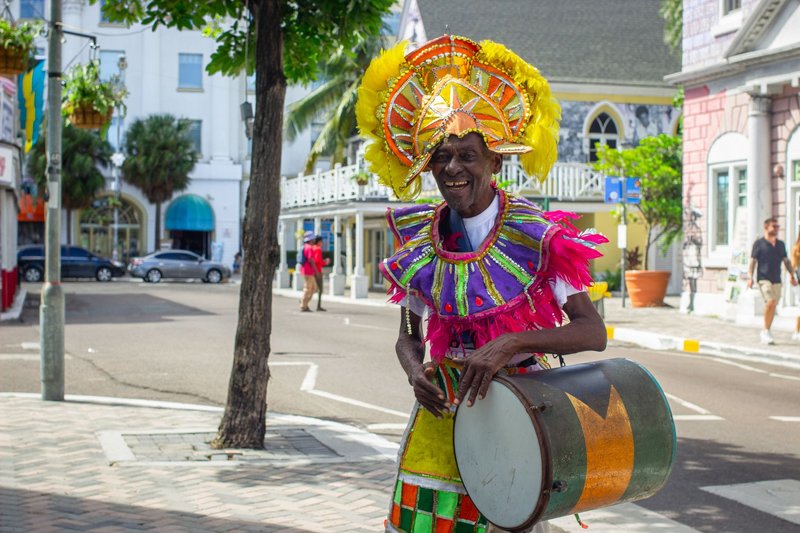
Junkanoo. If you want the clearest visible expression of Afro-Bahamian identity, it’s Junkanoo: the Boxing Day and New Year’s Day street parade of costumed groups, goatskin drums, cowbells, and horns that traces back to enslaved Africans’ limited holiday freedoms in the 18th century. It’s not a tourist show staged for cruise ships — it’s a competitive, community-organized tradition that Bahamian families spend all year building costumes for, and it’s the single best place to see how the country’s ethnic history turned into a living culture instead of a museum piece.