Table of Contents
- TLDR
- Why the confusion in the first place
- Laos: the deepest French footprint left in Asia
- Cambodia and Vietnam: the rest of French Indochina
- Puducherry, India: a French address inside a Tamil city
- The edge cases everyone gets wrong: Lebanon and Vanuatu
- French-speaking Asia at a glance
TLDR {#tldr}
No independent country in Asia has French as an official national language today. What’s left is a colonial residue, strongest in the old French Indochina — Laos, Cambodia, Vietnam — and in Puducherry, a former French territory now part of India. Laos and Cambodia each have French-speaking populations around 3%; Vietnam is closer to 1%. Puducherry keeps French as one of five official languages on paper, but Tamil runs daily life. Lebanon and Vanuatu show up on some “French-speaking Asia” lists, but geographically neither belongs there — Lebanon sits in Western Asia and gets grouped with the Middle East, and Vanuatu is a Pacific island nation, not an Asian one.
Why the confusion in the first place {#why-the-confusion}
Most roundups of “Francophone countries” treat Asia as an afterthought — one short paragraph tacked onto the end of a list that’s really about Europe and Africa. That’s how a myth survives: nobody spends enough time on the region to correct it.
Here’s the correction. French colonialism in Asia was real, but comparatively narrow. It touched three countries in mainland Southeast Asia under the umbrella of French Indochina, plus a scattering of small trading posts in India, of which Puducherry (formerly Pondicherry) is the only one that still carries the language in any official capacity. Independence movements in the 1940s and 50s pushed French out of government, schools, and street signs almost everywhere it had been planted. What’s left today is generational — older speakers, legal documents, loanwords, and university programs — not a living national language.
Laos: the deepest French footprint left in Asia {#laos}
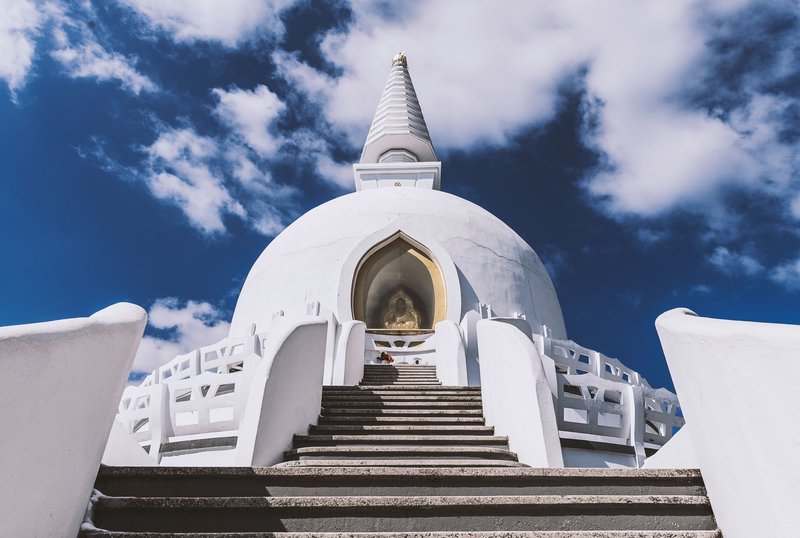
Laos was folded into French Indochina as a protectorate in 1893 and stayed there until 1953, when it gained full independence. Unlike Vietnam, where the French built out administration aggressively, colonial rule in Laos was thinner on the ground — French only really took hold as a language of schooling in Vientiane and Luang Prabang in the early 1900s, and it never reached the majority of the population.
That history still shows up in the numbers. Laos has roughly 204,000 French speakers, about 3% of the population, which makes it the country with the largest Francophone share in mainland Southeast Asia relative to its size. French isn’t an official language, but it survives in the Lao legal system, in some university instruction, and in the way older, urban, and elite Laotians were educated. Laos is also a member of the Organisation internationale de la Francophonie, the international body that groups countries with a historical or institutional tie to the French language — membership Laos has kept even without French holding any legal status domestically.
Cambodia and Vietnam: the rest of French Indochina {#cambodia-and-vietnam}
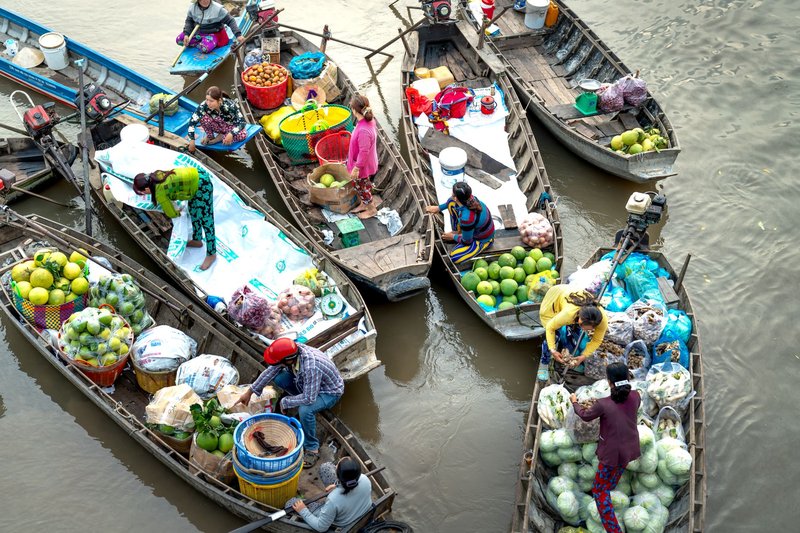
Cambodia became a French protectorate in 1863, three decades before Laos, and stayed under French administration until 1953. Today it counts around 463,000 French speakers — also about 3% of the population — concentrated among older generations, the legal profession, and academia. Cambodia joined the Organisation internationale de la Francophonie as an observer in 1991 and became a full member in 1993, a move driven more by diplomatic and educational ties than by any daily use of the language.
Vietnam, the largest and most administratively developed piece of French Indochina, was under French control from 1887 until the French defeat at Dien Bien Phu in 1954. It has the biggest raw number of French speakers of the three — about 693,000 — but the smallest share of its population, around 1%, because Vietnam’s population dwarfs its neighbors’. French loanwords still surface in Vietnamese vocabulary (bánh mì owes its bread to French baguettes; a Vietnamese “cà phê” traces straight back to “café”), and the Organisation internationale de la Francophonie keeps a regional office in Hanoi. But French is not spoken as a first or working language by any meaningful share of Vietnamese people under 60.
Puducherry, India: a French address inside a Tamil city {#puducherry}
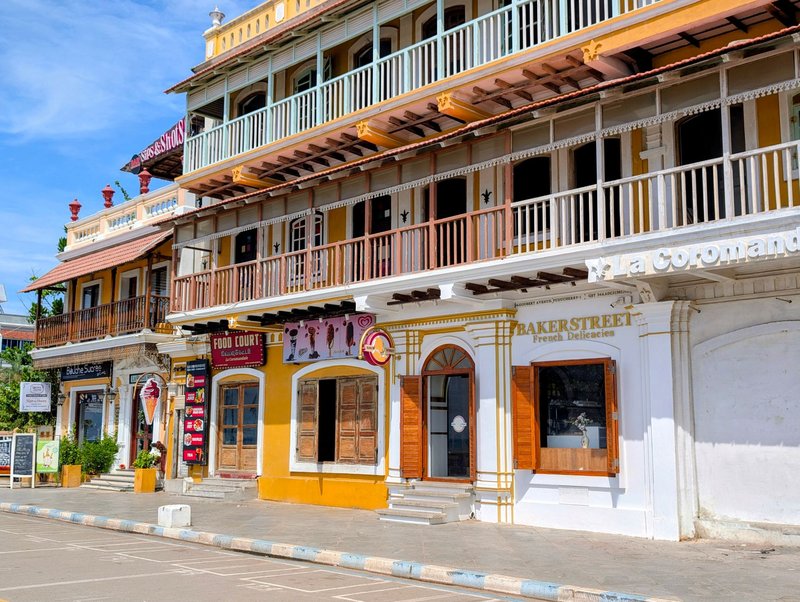
Puducherry (Pondicherry under French rule) was one of several French trading posts on the Indian coast, held from the 17th century until it was formally ceded to India through a 1956 treaty, ratified in 1962. It’s the one place in Asia where French genuinely holds legal standing today: it’s one of five official languages of the union territory, alongside Tamil, English, Malayalam, and Telugu.
That official status is closer to ceremonial than functional. Tamil is the language of daily life for roughly 88% of the population, and it dominates administration, commerce, and street-level communication. French persists in colonial-era architecture, some legal and educational institutions, a resident French consulate, and a small community that still holds French citizenship under agreements dating back to the handover — a legacy nobody else in Asia can claim in quite the same form.
The edge cases everyone gets wrong: Lebanon and Vanuatu {#edge-cases}
Two countries keep sneaking onto “French-speaking Asia” lists, and neither one earns the spot the way most searchers mean it.
Lebanon sits in Western Asia by strict continental geography, which is technically true and also misleading — almost nobody searching for French-speaking countries in Asia is picturing the Levant. Lebanon fell under the French Mandate for Syria and Lebanon from 1920 until independence in 1943, and the linguistic legacy stuck harder there than almost anywhere else on this list: an estimated 40% of Lebanese are considered Francophone, with French still taught widely in secondary schools. On the ground, what you’ll actually hear in Beirut is often a multilingual mix. It’s a genuinely French-speaking country — just one that belongs in a Middle East list, not a Southeast or South Asia one.
Vanuatu has the opposite problem. It’s a Pacific island nation in Melanesia, roughly 1,750 miles east of Australia, and it’s nowhere near Asia by any geographic standard. French is co-official there alongside English and Bislama, a holdover from the Anglo-French Condominium that jointly governed the islands from 1906 to 1980. It’s a legitimate Francophone country. It’s just not an Asian one, and grouping it with Laos or Vietnam is a category error some “global Francophone” roundups make by lumping “Asia-Pacific” into a single bucket.
French-speaking Asia at a glance {#comparison-table}
| Place | Francophone Share | Colonial Period | Status Today |
|---|---|---|---|
| Laos | ~3% (~204,000) | French protectorate, 1893–1953 | No official status; used in law, academia, older generations |
| Cambodia | ~3% (~463,000) | French protectorate, 1863–1953 | No official status; OIF full member since 1993 |
| Vietnam | ~1% (~693,000) | French Indochina, 1887–1954 | No official status; loanwords persist, OIF regional hub in Hanoi |
| Puducherry, India | Official but minority use (Tamil ~88% dominant) | French colonial post until 1954/1962 | One of 5 official languages of the union territory |
| Lebanon (Western Asia) | ~40% Francophone | French Mandate, 1920–1943 | Not official; widely used in schools and business |
| Vanuatu (Pacific, not Asia) | Official language | Anglo-French Condominium, 1906–1980 | Co-official with English and Bislama |
The pattern holds across every row: colonial French arrived, independence pushed it out of government, and what survives is proportional to how deeply the language got embedded in schools and administration before the French left. Laos and Cambodia held on to roughly the same 3% share despite very different colonial timelines. Puducherry kept the legal label without the daily use. And the two countries most often miscategorized as “Francophone Asia” — Lebanon and Vanuatu — turn out to be the most genuinely French-speaking places on the list, just not in Asia at all.