TLDR: How Many Countries Are in North Africa?
By the UN’s definition, six: Algeria, Egypt, Libya, Morocco, Sudan, and Tunisia. Add the disputed territory of Western Sahara and you get seven — which is where most of the confusion online comes from. Neither answer is wrong. They’re just counting different things.
Table of Contents
- How Many Countries Are in North Africa?
- Why the Count Keeps Changing
- The Countries of North Africa
- North Africa at a Glance
- North Africa vs. the Maghreb
- FAQ
How Many Countries Are in North Africa? {#how-many-countries}
Here’s the list the UN Statistics Division uses to define Northern Africa, and the one most atlases default to:
- Algeria
- Egypt
- Libya
- Morocco
- Sudan
- Tunisia
That’s six sovereign, UN-recognized states. Western Sahara sits on the map right between Morocco and Mauritania, and it’s where every list writer has to make a judgment call. Morocco administers most of the territory and considers it part of its own kingdom; the Sahrawi Arab Democratic Republic claims it as an independent state; the UN classifies it as a non-self-governing territory awaiting a resolution that’s been pending since 1975. It’s not a member state of the UN, so it doesn’t get counted in the official UN geoscheme total — but plenty of geography references list it as a seventh North African entry anyway, because functionally, it’s there on the map and it’s not part of any other country either.
Why the Count Keeps Changing {#why-the-count}
Three things drive the disagreement, and it’s worth naming them instead of glossing over them.
Western Sahara’s status. Covered above — disputed territory, not a UN member, but geographically and culturally part of the region.
Sudan’s classification. The UN puts Sudan in Northern Africa. The African Union splits the difference differently — it drops Sudan from the region and adds Mauritania instead, grouping Sudan with East or Central Africa depending on the source. Sudan’s own history bridges both: Arabic-speaking and Islamic in the north, closer to Sub-Saharan Africa culturally and ethnically in the south (before South Sudan split off as its own country in 2011).
The Maghreb vs. North Africa mix-up. “Maghreb” gets used as a synonym for North Africa constantly, but it’s a narrower term — traditionally Morocco, Algeria, Tunisia, and Libya, with Mauritania and Western Sahara folded in after the 1989 Arab Maghreb Union. Egypt and Sudan are North African by any definition, but they’re not Maghreb countries. More on that below.
None of these are errors in the sources that disagree. They’re using different classification systems for different purposes — political geography, cultural geography, and international administrative boundaries don’t always draw the same lines.
The Countries of North Africa {#the-countries}
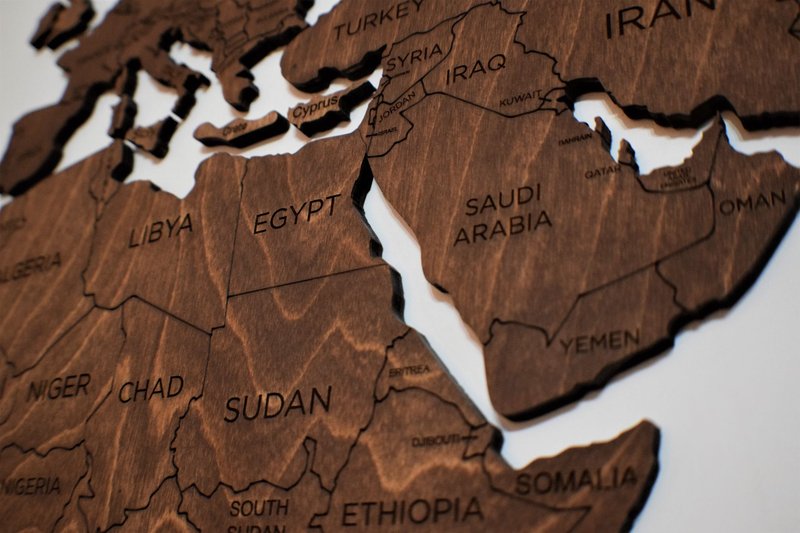
Six profiles, one distinguishing fact each — the kind of detail that actually separates these countries instead of blurring them together.
Algeria
Capital: Algiers · Population: ~47.4 million · Official languages: Arabic, Tamazight (Berber); French widely used in business and government
Algeria is the largest country in Africa by land area, a fact that surprises people who default to picturing the continent’s size charts topped by Congo or Egypt. Most of that territory is Sahara — the population clusters tightly along the Mediterranean coast, where over 90% of Algerians actually live. The CIA World Factbook lists natural gas and petroleum as the backbone of the economy, and Algeria remains one of Europe’s largest gas suppliers via undersea pipelines to Spain and Italy.
Egypt
Capital: Cairo · Population: ~118.4 million · Official language: Arabic
Egypt is the most populous country in North Africa by a wide margin, and nearly all of that population is squeezed into the Nile Valley and Delta — a sliver of green that covers less than 5% of the country’s total land area. The Suez Canal, connecting the Mediterranean to the Red Sea, moves roughly 12% of global trade and remains one of the country’s largest sources of foreign currency, a detail the CIA World Factbook tracks closely given how sensitive global shipping is to any disruption there.
Libya
Capital: Tripoli · Population: ~7.5 million · Official language: Arabic
Libya holds Africa’s largest proven oil reserves, which is a strange thing to be true of a country most people can’t place on a map beyond “somewhere between Egypt and Tunisia.” Politically, it’s been split since 2014 between rival governments based in Tripoli and the east, and travel advisories from most Western governments still warn against nonessential visits. It’s the emptiest country on this list in practical terms — over 90% Saharan desert, with nearly the entire population living along a narrow coastal strip.
Morocco
Capital: Rabat · Population: ~38.4 million · Official languages: Arabic, Tamazight
Morocco is the only North African country never colonized by the Ottoman Empire, which shows up in everything from its architecture to its monarchy — the current dynasty traces back to the 17th century. It’s also the world’s largest exporter of phosphate rock, controlling the majority of global reserves, a fact that matters more than it sounds since phosphate is a core ingredient in fertilizer production worldwide. Casablanca, not the capital, is the country’s largest city and economic engine.
Sudan
Capital: Khartoum · Population: ~51.7 million · Official languages: Arabic, English
Khartoum sits at the literal confluence of the Blue Nile and White Nile, the two rivers that merge here before continuing north through Egypt as a single Nile. Sudan lost roughly a quarter of its territory and most of its oil reserves when South Sudan seceded in 2011, and the country has been in active civil conflict since 2023, making it currently one of the hardest countries in the region to visit or report on with any regularity.
Tunisia
Capital: Tunis · Population: ~12.3 million · Official language: Arabic
Tunisia is geographically the smallest of the six by a wide margin, and the birthplace of the 2011 Arab Spring, which started with a single street vendor’s protest in Sidi Bouzid and toppled the government within a month. It’s also home to the ruins of Carthage, the ancient city-state that fought Rome for control of the Mediterranean and lost — badly enough that the phrase “Carthaginian peace” still means total, unconditional defeat.
North Africa at a Glance {#comparison-table}
| Country | Capital | Population (2026) | Area (km²) |
|---|---|---|---|
| Algeria | Algiers | ~47.4 million | 2,381,741 |
| Egypt | Cairo | ~118.4 million | 1,001,450 |
| Libya | Tripoli | ~7.5 million | 1,759,540 |
| Morocco | Rabat | ~38.4 million | 446,550 |
| Sudan | Khartoum | ~51.7 million | 1,861,484 |
| Tunisia | Tunis | ~12.3 million | 163,610 |
Population figures are current estimates and shift year to year — treat them as a snapshot, not a fixed count.
North Africa vs. the Maghreb {#maghreb}
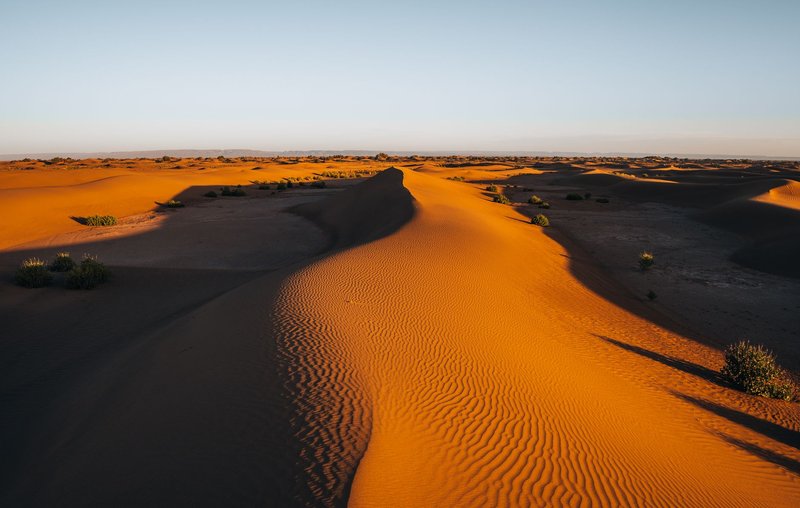
These terms get used interchangeably online, and it causes real confusion, so it’s worth drawing the line clearly.
North Africa is a geographic region: six (or seven, with Western Sahara) countries stretching from the Atlantic to the Red Sea.
The Maghreb is narrower, culturally and historically. It comes from the Arabic word for “west” — the western part of the Arab world, as seen from Baghdad or Damascus. Core Maghreb countries are Morocco, Algeria, Tunisia, and Libya, with Mauritania and Western Sahara often included since the Arab Maghreb Union formed in 1989. Egypt and Sudan sit outside the Maghreb entirely — they’re North African, but they’re considered part of the Mashriq (the “east”) in Arab geography, not the Maghreb.
If you’re researching “Maghreb countries” specifically, you want four to six countries centered on Morocco, Algeria, Tunisia, and Libya — not the full six-to-seven-country North Africa list.
The Sahara Desert itself doesn’t respect either boundary. It spans parts of nearly every country covered here plus Mauritania, Mali, Niger, Chad, and Western Sahara — roughly 9 million square kilometers, making it the largest hot desert on Earth.
FAQ {#faq}
How many countries are in North Africa? Six by the standard UN count: Algeria, Egypt, Libya, Morocco, Sudan, and Tunisia. Seven if you include Western Sahara, which is a disputed, non-self-governing territory rather than a UN member state.
Is Sudan part of North Africa or East Africa? Both classifications exist. The UN geoscheme places Sudan in Northern Africa. The African Union’s regional groupings place it outside North Africa. Culturally and linguistically, northern Sudan aligns closely with Egypt and the Arab world, which is the strongest argument for the North Africa classification.
Are Mauritania and Western Sahara North African countries? Mauritania is more commonly classified as West African, though it’s a member of the Arab Maghreb Union alongside the core North African states. Western Sahara is geographically part of North Africa but isn’t a UN member state, so most official counts exclude it while informal lists often include it.
What’s the difference between the Maghreb and North Africa? North Africa is the full regional term. The Maghreb is a narrower cultural and historical subset — Morocco, Algeria, Tunisia, and Libya at its core — that excludes Egypt and Sudan.
What is the largest country in North Africa? Algeria, both by population among the smaller nations relative to Egypt, and by land area — it’s the largest country in Africa overall at just under 2.4 million square kilometers.