Burmese is the official language of Myanmar, and it’s the language almost everyone uses to talk across ethnic lines. But it’s far from the only one. Roughly 100 languages are spoken inside the country’s borders, from Shan and Kachin in the hills to Mon on the southern coast.
TLDR
- Official language: Burmese (also called Myanmar), the first language of about 32 million people and a second language for roughly 10 million more.
- Number of languages: Nearly 100, depending on where you draw the line between a language and a dialect.
- Biggest minority languages: Shan (about 3.2 million speakers), Karen languages, Kachin (about 900,000) and Mon (about 750,000).
- Foreign languages: English is the main one, followed by Chinese, Tamil, Hindi and Urdu.
- For travelers: Burmese plus English will cover Yangon, Mandalay, Bagan and Inle Lake. Learn a few Burmese phrases and you’ll be fine nearly everywhere.
Table of Contents
- The Major Languages at a Glance
- Burmese: The Official Language of Myanmar
- Ethnic Minority Languages
- Tamil, Chinese and Other Languages from Abroad
- Do People Speak English in Myanmar?
- Scripts: Why Many Languages Look Alike on the Page
- Which Language to Expect Where
- Why Minority Languages Are Under Pressure
The Major Languages at a Glance
Speaker numbers for Myanmar are estimates. The country hasn’t had a trustworthy language census in decades, and the 2014 census was incomplete in conflict areas. Treat the figures below as rough orders of magnitude.
| Language | Family | Approx. speakers | Main region |
|---|---|---|---|
| Burmese | Sino-Tibetan | 32 million first language, 10 million second | Central plains, Yangon, Ayeyarwady |
| Shan | Kra-Dai | 3.2 million | Shan State |
| Karen (Sgaw, Pwo and others) | Sino-Tibetan | Several million across the group | Kayin State, Ayeyarwady Delta |
| Kachin (Jingpho) | Sino-Tibetan | About 900,000 | Kachin State |
| Mon | Austroasiatic | About 750,000 | Mon State, Tanintharyi |
| Chin languages | Sino-Tibetan | Dozens of distinct languages | Chin State, Sagaing, Rakhine |
| Wa | Austroasiatic | Several hundred thousand | Northeastern Shan State |
| Rakhine | Sino-Tibetan | Over a million | Rakhine State |
| Rohingya | Indo-Aryan | Disputed, large diaspora | Northern Rakhine State |
The CIA World Factbook entry for Burma lists Burmese as the official language and names the main minority languages. It also shows how thin the data is on the smaller ones.
Burmese: The Official Language of Myanmar
Burmese belongs to the Sino-Tibetan family, the same broad group as Chinese and Tibetan. It’s tonal, with three tones plus a short, clipped “checked” syllable, so a word’s meaning shifts with pitch. Word order is subject-object-verb, and the language leans heavily on particles at the ends of sentences to carry politeness and mood.
The spoken and written forms diverge. Formal written Burmese, used in newspapers, textbooks and official documents, has its own grammatical markers that people rarely use in conversation. Think of the gap between a legal contract and a text message.
Regional varieties exist, and the full list of Myanmar dialects covers each one’s parent language and where it’s spoken. Arakanese (Rakhine) is close enough to Burmese that many linguists call it a dialect, though Rakhine speakers see it as their own language, with sound differences Burmese speakers pick up on right away. Intha, spoken by the leg-rowing fishermen of Inle Lake, and Tavoyan, spoken around Dawei, are other close relatives.
Ethnic Minority Languages
The government officially recognizes 135 ethnic groups, a number that’s politically loaded and linguistically messy. Many groups share a language, and some single groups speak several. Here are the ones you’re most likely to run into, and the regional guide to ethnic groups in Southeast Asia shows how they fit alongside peoples in neighboring countries.
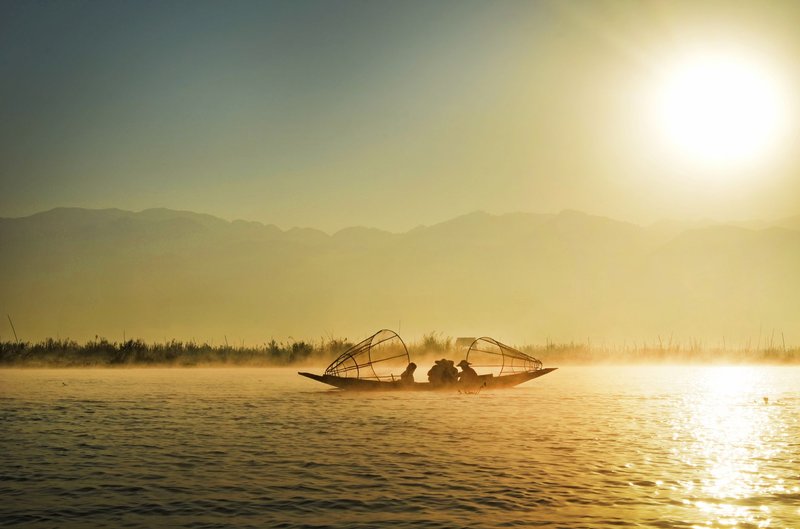
Shan is a Tai language, closely related to Thai and Lao. If you’ve learned some Thai, you’ll recognize bits of Shan vocabulary and the tonal patterns. It dominates eastern Myanmar around Inle Lake, Kengtung and Lashio.
Karen isn’t one language but a cluster. Sgaw Karen and Pwo Karen are the largest, and they aren’t mutually intelligible. Speakers live in Kayin State, the Ayeyarwady Delta and across the Thai border.
Kachin in everyday use usually means Jingpho, spoken in the far north. Kachin State also has speakers of Lisu, Rawang, Zaiwa, Lashi and others. Jingpho is written in the Latin alphabet, a legacy of American Baptist missionaries in the 19th century.
Mon is one of the oldest documented languages in mainland Southeast Asia, and it belongs to the Austroasiatic family, which also includes Khmer and Vietnamese. Mon-language inscriptions in the region date back well over a thousand years, and Mon scholars shaped the early Burmese writing system.
Chin is the label for a large set of related but mutually unintelligible languages, including Hakha, Falam, Mara and Tedim. The hills of Chin State are some of the most linguistically fragmented ground in the country. Villages a day’s walk apart can speak different languages.
Wa is spoken in the northeast, much of it inside the semi-autonomous Wa Self-Administered Division, where Chinese is also widely used for trade.
Other languages worth naming: Pa’O, Palaung (Ta’ang), Kayah (Karenni), Akha, Lahu and Kokang, a Chinese variety spoken near the border.
Tamil, Chinese and Other Languages from Abroad
Colonial-era migration under British rule left a lasting mark. Yangon, then called Rangoon, had a population in which South Asians were a substantial share by the early 20th century. Tamil, Telugu, Hindi, Urdu and Bengali are still spoken by descendants of those communities, mostly in Yangon, Mandalay and Bago. You’ll hear Tamil in the temples and tea shops of Yangon’s Little India.
Chinese has two main groups of speakers. Hokkien and Cantonese come from older trading communities in the cities. Mandarin is heard in Mandalay, which has seen heavy Chinese migration, and along the border with Yunnan.
Do People Speak English in Myanmar?
In tourist areas, yes. Hotel staff, tour operators, and guides in Yangon, Bagan, Mandalay and Inle Lake handle English well enough for bookings and directions. British rule made English a language of administration and elite education for generations, and street signs and older people sometimes preserve that history.
Outside those circuits it thins out fast. Taxi drivers, market vendors and bus station staff often have little English. Menus in small towns may only be in Burmese script. Download an offline translation pack for Burmese before you go, and carry your hotel’s name written in Burmese.
Scripts: Why Many Languages Look Alike on the Page
Burmese script is made of rounded characters, derived from the Mon script, which in turn came from South Indian Brahmic writing. The circles come from the old practice of writing on palm leaves, where straight lines would split the leaf.
Shan, Mon and several Karen languages use adapted versions of this script, adding letters for sounds Burmese lacks. That’s why a Shan sign and a Burmese sign can look similar to a visitor while saying completely different things. Kachin, Chin and Kayah languages mostly use the Latin alphabet, and some groups, such as Lisu, use scripts developed in the 20th century.
Which Language to Expect Where
| Place | Languages you’ll hear |
|---|---|
| Yangon | Burmese, English, Tamil, Hindi, Chinese |
| Mandalay | Burmese, Mandarin, Shan |
| Bagan | Burmese, English (tourist sites) |
| Inle Lake | Shan, Intha, Pa’O, Burmese |
| Hpa-An and Kayin State | Karen languages, Burmese, Mon |
| Mawlamyine | Burmese, Mon |
| Myitkyina and the north | Jingpho, Burmese, Lisu |
| Hakha and Chin State | Chin languages, Burmese |
Be aware that travel to some border regions is restricted or unsafe because of ongoing conflict. Check your government’s travel advisory before you plan a route into Shan, Kachin, Chin, Kayah or Rakhine areas.
A few Burmese phrases go a long way. Mingalaba (mingg-uh-LAH-bah) is the standard greeting. Chay zu tin ba deh means thank you. Ba-lau-lè? asks how much something costs. Being understood is less important than being polite, and people appreciate the attempt.
Why Minority Languages Are Under Pressure
After the 1962 military coup, Burmese became the main language of schooling and government. Minority languages were taught in some states only through limited or community-run programs, and several were barred from use in public education for decades. Many children in non-Burmese-speaking regions started school in a language they didn’t speak at home.
The result is bilingualism with a one-way slope. Minority speakers learn Burmese out of necessity, but Burmese speakers rarely learn the minority languages. Younger Mon and Karen speakers in particular have drifted toward Burmese, and linguists classify some of the smaller languages as endangered.
Ethnic organizations and local schools have worked to teach their languages, often independent of the state system, and recent education reforms have allowed more mother-tongue teaching in the early grades. How much of that holds depends on the political situation, which has been unstable since the 2021 military takeover. For background on the country’s recent history, the BBC’s Myanmar country profile is a good starting point.
Myanmar’s language map and its ethnic map are close to the same thing. Understanding one goes a long way toward understanding the other.