
If you’re searching for “airports in Djibouti,” you’ve probably already run into a problem: the lists don’t agree. One site says five airports, another says nine. Some count military airstrips, some don’t, and almost none of them tell you the thing you actually want to know — which of these can you, a passenger with a ticket, fly into.
Here’s the short version: for all practical purposes, there is exactly one. The rest are domestic airstrips, military fields, or runways that haven’t seen a scheduled commercial flight in years. This guide gives you the full list anyway, because the reference matters, and then walks through the one airport that does the work.
Table of Contents
- Quick Answer: How Many Airports Does Djibouti Have?
- Full List of Airports in Djibouti
- Djibouti-Ambouli International Airport (JIB)
- Airlines and Routes
- Getting From the Airport Into the City
- The Domestic Airstrips
- The Military Picture
- FAQ
Quick Answer: How Many Airports Does Djibouti Have?
Djibouti has around nine airfields with runways, depending on what you count. But only one handles scheduled commercial passenger flights: Djibouti-Ambouli International Airport, code JIB, in the capital city of Djibouti.
Everything else is either a short domestic airstrip serving remote towns (Obock, Tadjoura, Ali-Sabieh), a tiny island field (Moucha), or part of the dense foreign military footprint that makes this small country one of the most militarized stretches of coastline on Earth. So when a booking site shows you a dropdown of “Djibouti airports,” nearly every option routes back to JIB.
That’s the whole confusion in one paragraph. Now the details.
Full List of Airports in Djibouti
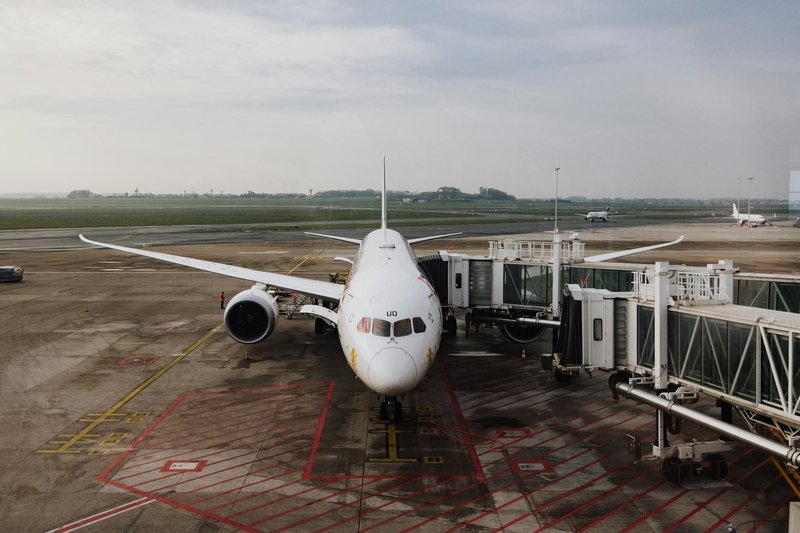
Here’s the complete picture, sorted by what you can actually do with each one.
| Airport | City / Location | IATA | ICAO | Type |
|---|---|---|---|---|
| Djibouti-Ambouli International | Djibouti City | JIB | HDAM | International (commercial + military) |
| Obock Airport | Obock | OBC | HDOB | Domestic airstrip |
| Tadjoura Airport | Tadjoura | TDJ | HDTJ | Domestic airstrip |
| Ali-Sabieh Airport | Ali-Sabieh | AII | HDAS | Domestic airstrip |
| Dikhil Airport | Dikhil | — | HDDK | Domestic airstrip |
| Moucha Airport | Moucha Island | MHI | HDMO | Small island airstrip |
| Chabelley Airport | Chabelley | — | HDCH | Military (US drone operations) |
A few notes on reading this table. The IATA code (the three-letter one, JIB) is what you’ll see on a boarding pass and a booking site. The ICAO code (the four-letter one, HDAM) is the one pilots and air traffic control use. Several of the domestic fields have ICAO codes but barely-used or nonexistent IATA codes, which is part of why airport counts vary — some sources only list airports with a working IATA code, and you lose half the list that way.
Note also that none of the airfields outside JIB run a scheduled passenger service you can book online. Djibouti is roughly the size of Massachusetts, and the road network plus the relatively short distances mean domestic air travel never developed into a real commercial market.
Djibouti-Ambouli International Airport (JIB)
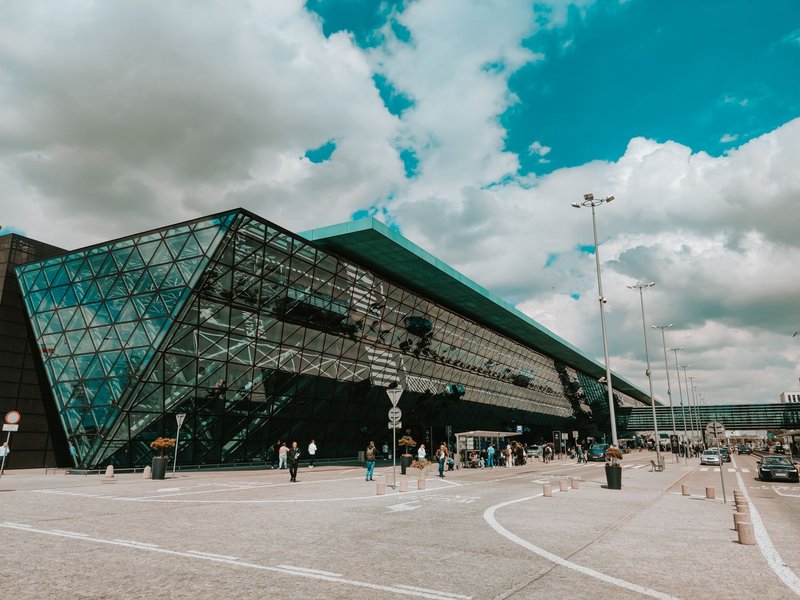
JIB sits about five kilometers south of central Djibouti City, on the edge of the Gulf of Tadjoura. It’s the country’s only international gateway, and it’s an unusual airport for a reason most travelers never realize: civilian passengers are the minority here.
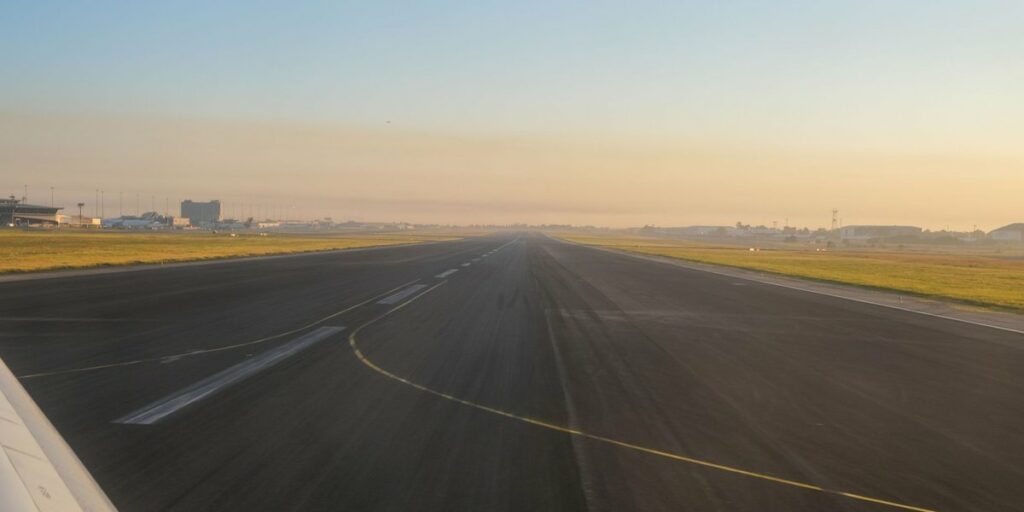
Estimates put military and government flight movements at roughly three-quarters of all traffic. The airport shares its single runway with the Djiboutian Air Force and serves as a logistics anchor for the foreign militaries stationed nearby. So you may taxi past cargo planes and military aircraft that have nothing to do with your flydubai connection to Dubai. That’s normal here.
For the passenger, though, it’s a compact, single-terminal operation. You won’t find sprawling concourses or a dozen lounges. The terminal handles a modest number of daily international departures, and the small footprint means short walks — immigration, baggage, and the exit are all close together. The flip side of “small” is that it can feel crowded when two or three flights bank together, and air-conditioning fights a losing battle against Djibouti’s heat, which regularly tops 40°C (104°F) in summer. A handheld fan in your carry-on helps while you wait.
Djibouti’s strategic position at the mouth of the Red Sea — guarding the Bab-el-Mandeb strait, one of the busiest shipping chokepoints on the planet — is exactly why the airport punches above the weight of a country with under a million people. The traffic isn’t there because of tourism. It’s there because of geography.
Airlines and Routes
For an airport this small, the route map is genuinely useful, thanks mostly to Gulf and African carriers using Djibouti as a feeder into their hubs. The carriers you’ll typically find at JIB:
- Ethiopian Airlines — frequent service to Addis Ababa, the single most useful connection for onward travel across Africa and beyond
- flydubai — direct to Dubai, the easy link into the wider flydubai and Emirates network
- Turkish Airlines — to Istanbul, opening up Europe and a vast onward map
- Qatar Airways — to Doha, another deep-network hub connection
- Air France — historically the link to Paris, reflecting Djibouti’s colonial-era ties to France
The practical takeaway: there’s no shortage of ways in, but almost all of them route through a hub. You’re rarely flying direct to Djibouti from a Western city — you connect through Addis Ababa, Dubai, Istanbul, Doha, or Paris. Build that into your itinerary and your expectations. A trip from North America is usually two flights and the better part of a day.
If you’re a U.S. or EU passport holder, the visa side is straightforward: Djibouti offers an eVisa and visa-on-arrival for many nationalities, but the eVisa applied for in advance is the smoother path — it spares you the on-arrival queue in the heat.
Getting From the Airport Into the City
The five-kilometer hop into central Djibouti City is short, but there’s no rail link and no real airport bus, so it comes down to taxis. Fares are negotiated, not metered, which means you agree on a price before you get in the car — not after. Rates climb at night and for the larger, newer taxis. Have small denominations of Djiboutian francs ready, though drivers serving the airport will often take US dollars or euros at a worse rate.
If you’re staying at one of the larger hotels, arrange a pickup in advance. It removes the negotiation entirely and, given that arrivals can land late, it’s worth the small premium to have a named driver waiting rather than haggling outside the terminal at midnight.
The Domestic Airstrips
The smaller fields — Obock, Tadjoura, Ali-Sabieh, Dikhil, and Moucha — exist mostly on paper as far as the average traveler is concerned. There’s no scheduled passenger airline hopping between them. When they see use, it’s typically charter flights, government and aid operations, occasional medical or logistics runs, or light aircraft.
Tadjoura and Obock sit across the gulf from the capital and are reachable by road and ferry, which is how nearly everyone actually gets there. Moucha Island, a small dive-and-beach destination, has an airstrip but is realistically reached by boat from Djibouti City. If a route-planning tool offers you a “flight” to one of these, treat it with heavy skepticism — it’s almost certainly pulling airport data rather than real, bookable schedules.
The Military Picture
You can’t write honestly about airports in Djibouti without addressing the elephant on the tarmac. This tiny country hosts the densest concentration of foreign military bases in the world, and several of them touch the aviation map.
Camp Lemonnier, adjacent to JIB, is the only permanent U.S. military base in Africa and a major hub for regional operations. Chabelley Airport, a short distance away, became a key U.S. drone-operations field after flights were moved off JIB itself. France maintains its largest overseas military presence here, a legacy of Djibouti’s independence in 1977. Japan operates its only overseas base in Djibouti, and Italy and other nations maintain footholds too. China opened its first overseas military base here in 2017.
For a traveler, none of this affects your trip directly — you won’t tour any of it, and you shouldn’t photograph military areas, including from the air. But it explains the heavy traffic share, the cargo aircraft you’ll see, and why a country this small has an airport infrastructure built for far more than its tourist numbers would suggest.
FAQ
What is the main airport in Djibouti? Djibouti-Ambouli International Airport, IATA code JIB, ICAO code HDAM, located about five kilometers south of Djibouti City. It’s the only airport with scheduled commercial passenger service.
What is the Djibouti airport code? The IATA code is JIB and the ICAO code is HDAM. JIB is the code you’ll use when booking flights.
How many airports are there in Djibouti? Around nine airfields exist, but only one (JIB) handles scheduled commercial flights. The rest are domestic airstrips or military fields.
Can you fly domestically within Djibouti? Not on scheduled commercial airlines. The country is small, and people travel between towns by road and ferry. The domestic airstrips see charter, government, and aid flights rather than bookable passenger service.
Which airlines fly to Djibouti? Ethiopian Airlines (Addis Ababa), flydubai (Dubai), Turkish Airlines (Istanbul), Qatar Airways (Doha), and Air France (Paris) are the main carriers. Most international trips connect through one of these hubs.
Do I need a visa to enter Djibouti? Most visitors do, but Djibouti offers an eVisa and visa-on-arrival for many nationalities. Applying for the eVisa online before you travel is the smoother option.
How do I get from Djibouti airport to the city? By taxi — it’s a short five-kilometer trip. There’s no train or airport bus, so agree on the fare before getting in, or arrange a hotel pickup in advance.