
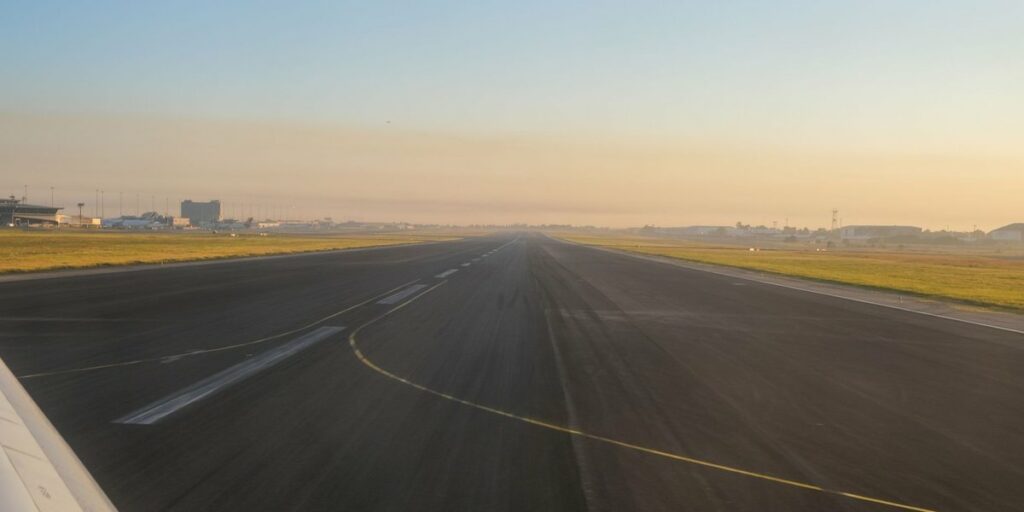
Eswatini has exactly one airport you can book a commercial flight to: King Mswati III International, code SHO. Everything else on the map — and there are roughly a dozen entries — is a grass strip, a private estate runway, or an old military field. So if you are trying to fly into the kingdom, the answer is short. If you are doing it for geography homework, a quiz, or you just like aviation trivia, the full picture is more interesting than that one-line answer suggests.
This guide gives you both: the headline answer for travelers, and the complete inventory for everyone else.
Table of Contents
- The short answer
- Every airport in Eswatini at a glance
- King Mswati III International Airport (SHO)
- Matsapha Airport: the one it replaced
- The smaller airfields
- How to actually fly to Eswatini
- Getting from the airport to Manzini and Mbabane
The short answer
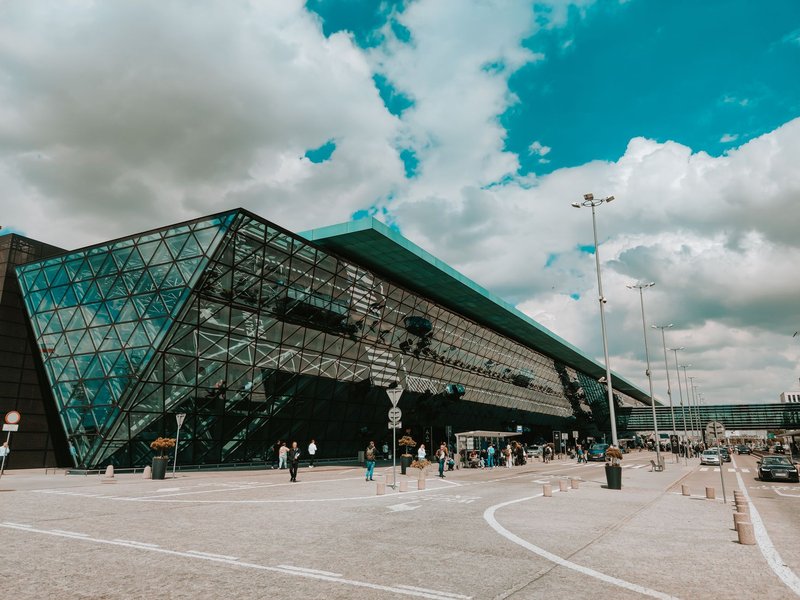
Eswatini — the southern African kingdom formerly called Swaziland — runs one commercial international airport: King Mswati III International Airport (IATA: SHO, ICAO: FDSK). It opened in 2014, sits near Sikhuphe in the eastern Lubombo region, and has a single 3,600-metre runway long enough to handle wide-body jets. It replaced Matsapha Airport, the old Manzini airfield that handled scheduled flights until the new airport took over.
Beyond those two, the country’s airports are small. Reference databases list somewhere between 12 and 17 facilities depending on how you count private strips and disused fields, but almost all are unpaved and serve agricultural estates, game reserves, or general aviation rather than passengers. There is no second commercial airport, no domestic airline network, and no scheduled flights to anywhere except King Mswati III International.
That gap — one busy international airport and a long tail of grass strips — is the whole story.
Every airport in Eswatini at a glance
Here is the practical inventory. Codes, region, and surface come from civil aviation records; “status” reflects whether the field sees scheduled or only private traffic.
| Airport | Location | Region | Codes (IATA/ICAO) | Surface | Status |
|---|---|---|---|---|---|
| King Mswati III International | Sikhuphe | Lubombo | SHO / FDSK | Paved (3,600 m) | International, scheduled |
| Matsapha (Manzini) | Matsapha | Manzini | MTS / FDMS | Paved | General aviation, military |
| Big Bend | Big Bend | Lubombo | BBK / FDBB | Paved | Private / charter |
| Nhlangano | Nhlangano | Shiselweni | — / FDNH | Unpaved | General aviation |
| Piggs Peak | Piggs Peak | Hhohho | — / FDPP | Unpaved | General aviation |
| Lavumisa | Lavumisa | Shiselweni | — / FDNG | Unpaved | General aviation |
| Mahamba | Mahamba | Shiselweni | — / FDMH | Unpaved | General aviation |
| Tshaneni (Mhlume) | Tshaneni | Lubombo | — / — | Unpaved | Estate / private |
The remaining entries in encyclopedic lists are mostly small private or estate strips — sugar plantations near the Lubombo lowveld and a few game-reserve fields — that rarely appear in passenger planning. The two paved fields that matter are at the top: SHO for arriving, MTS for the history.
King Mswati III International Airport (SHO)
King Mswati III International is the only airport in Eswatini a traveler will ever set foot in. It sits about 70 km east of Manzini, near the small town of Sikhuphe in the hot, low-lying Lubombo region — closer to the Mozambique border than to the capital.
The airport was one of the most controversial infrastructure projects in the country’s modern history. It cost an estimated several hundred million US dollars and took the better part of two decades to complete, and critics — including international lenders who declined to fund it — questioned whether a nation of just over a million people needed a runway built to handle the largest aircraft flying. The BBC reported on the skepticism around the project, which was sometimes nicknamed a “vanity” airport before it opened. It was eventually named after the reigning monarch and began operations in March 2014.
Whatever the politics, the facility itself is genuinely large for the traffic it carries. The single runway runs 3,600 metres, the terminal is modern and rarely crowded, and arrivals are quick precisely because so few flights come through on a given day. For a traveler, that means easy immigration and almost no queues — the upside of an airport built bigger than its schedule.
Matsapha Airport: the one it replaced
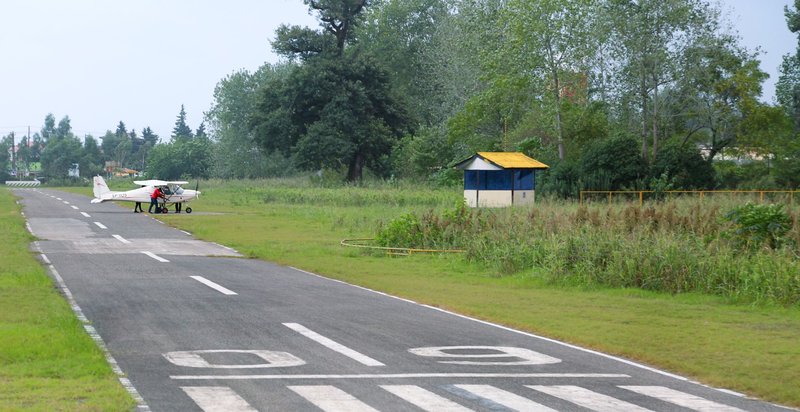
Before 2014, every scheduled flight to the kingdom landed at Matsapha Airport (MTS / FDMS), just outside Manzini in the industrial belt that shares its name. It was small, central, and convenient — a short drive from both Manzini and the capital, Mbabane.
When King Mswati III International opened, scheduled passenger service moved out to Sikhuphe and Matsapha lost its commercial role. It did not close, though. The field still operates for general aviation, charter flights, and the Umbutfo Eswatini Defence Force, which keeps a presence there. For travelers, the practical takeaway is simple: Matsapha is where flights used to land, and old guidebooks or booking systems that mention “Manzini airport” are pointing at a field that no longer takes scheduled traffic. Book SHO, not MTS.
The smaller airfields
The rest of Eswatini’s airports are the kind you only encounter if you are flying a private plane, running a charter to a game lodge, or working on an agricultural estate. Big Bend, in the southern lowveld sugar country, has a paved strip used for charters. Fields at Nhlangano, Mahamba, and Lavumisa in the Shiselweni region, and Piggs Peak up in the northern Hhohho highlands, are mostly short, unpaved general-aviation strips.
None of these handle ticketed passengers. They exist on aviation maps because they have ICAO identifiers and registered coordinates, which is why a “list of airports in Eswatini” can show a dozen-plus entries while the answer to “where do I fly in?” stays at one. The disconnect is the single most common point of confusion about Eswatini’s aviation — the count is high, the usable number is one.
How to actually fly to Eswatini
Here is the part the reference databases leave out. Getting to Eswatini almost always means connecting through Johannesburg’s O.R. Tambo International (JNB) in neighboring South Africa, the region’s main hub.
Two carriers do the heavy lifting:
- Eswatini Air, the national carrier relaunched in 2023, flies routes connecting King Mswati III International with regional cities including Johannesburg and, at times, Cape Town, Durban, and Harare. Schedules have grown gradually since the relaunch, so check current routes before assuming a direct flight exists.
- Airlink, a South African regional airline, operates the dependable short hop between Johannesburg and SHO that has anchored Eswatini’s air links for years.
There are no direct intercontinental flights to Eswatini. From Europe, the Americas, or Asia, you fly to Johannesburg first, then take the roughly one-hour Airlink or Eswatini Air connection east into the kingdom. Many overland travelers skip flying entirely and drive or take a shuttle across the South African border, since Eswatini is small and the road crossings are straightforward.
On entry, most visitors from the US and many other countries can get a visa on arrival or enter visa-free for short stays, but confirm the current rules for your passport before you travel.
Getting from the airport to Manzini and Mbabane
King Mswati III International’s biggest practical drawback is its location. It sits about 70 km from Manzini and farther still from Mbabane, with no rail link and no regular public bus to the terminal. That distance is the trade-off for the airport’s open-country site.
Your realistic options:
- Pre-arranged transfer or lodge shuttle. The most reliable choice. Hotels and game lodges will arrange pickup if you ask ahead, and given the thin public-transport options, this is what most arriving visitors do.
- Car rental. A handful of agencies operate at the airport. The drive west to Manzini takes roughly an hour on good road, and renting makes sense if you plan to explore the country, which rewards having your own wheels.
- Taxi. Available but not always waiting in numbers, so arrange one in advance rather than assuming a rank of cars at arrivals.
Plan the ground leg before you land. The airport is calm and efficient inside, but it is genuinely out in the lowveld, and “I’ll figure out transport when I get there” works far better at a city airport than at this one.
The headline holds: one airport to fly into, a dozen on the map, and a one-hour hop from Johannesburg standing between you and the kingdom.