
Table of Contents
- TLDR
- What Blue and Green Symbolize in Flag Design
- Africa
- The Americas
- Asia and the Middle East
- Europe
- Oceania
- Quick Reference Table
TLDR {#tldr}
There are 24 sovereign nations whose national flags include both blue and green. They span every inhabited continent, with Africa having the largest concentration. The combination almost always points to the same thing: water and land — sea and earth — sky and forest.
What Blue and Green Symbolize in Flag Design {#symbolism}
Blue is the most common color in national flags worldwide. It represents the sky, the sea, rivers — essentially any water. In some traditions it also carries connotations of peace, freedom, and loyalty. The shade matters: lighter blues tend to evoke open skies and calm; darker navy reads as strength or maritime power.
Green is the second most common flag color, and its meaning is nearly universal: the land. Agriculture, forests, fertility, natural abundance. In many Muslim-majority nations, green also has religious significance — it’s associated with the Prophet Muhammad and with paradise in Islamic tradition. In post-independence African flags designed in the 1960s and 70s, green often symbolizes hope and the promise of prosperity after colonialism. When green pairs with other earth tones instead of blue, the emphasis shifts entirely to terrain — as seen in the small set of countries with green, brown, and black flags, where water rarely enters the picture.
Put the two together and you almost always get: water and land, sky and earth, ocean and forest. It’s no accident that island nations and coastal countries are heavily represented in this list.
Africa {#africa}
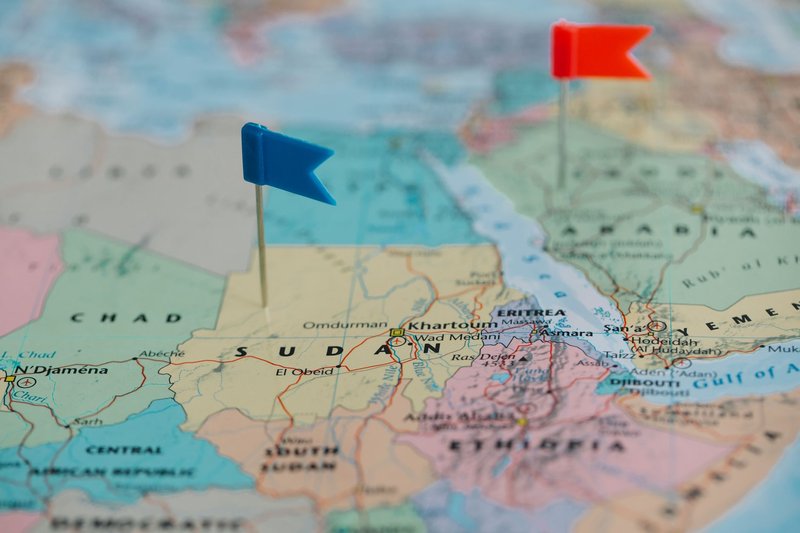
Africa has the densest cluster of blue-and-green flags, reflecting both the continent’s geography and the influence of pan-African design traditions.
Comoros The Comoros flag features a green triangle at the hoist with a white crescent and four stars, set against horizontal bands of yellow, white, and red — with a blue stripe at the bottom. The blue represents the Indian Ocean surrounding this island archipelago; the four stars represent the four main islands (including Mayotte, still administered by France, which the Comoros government claims).
Djibouti Two horizontal bands — light blue on top, green on bottom — with a red triangle at the hoist containing a white star. The blue represents the sky and the sea; the green represents the earth. Djibouti sits at the mouth of the Red Sea, so the maritime reference is literal.
Eritrea A red triangle divides the flag, with green above and blue below. The green represents the country’s agricultural land; the blue stands for the Red Sea coast, which gave Eritrea economic and strategic independence after it separated from Ethiopia in 1993. The flag design reflected the hard-won meaning of that coastline.
Ethiopia Three horizontal bands of green, yellow, and red — the classic pan-African tricolor — with a blue circle at the center bearing a gold star. The blue represents peace and the sky. Ethiopia is one of the longest-standing nations to use these colors, and its flag directly inspired dozens of others across the continent.
Kenya Black, red, and green horizontal bands separated by narrow white stripes, with a Maasai shield and two crossed spears at the center. The green stands for Kenya’s agriculture and natural landscape. The flag draws from the colors of the Kenya African National Union, the party that led independence.
Mauritius Four equal horizontal bands: red, blue, yellow, and green. Each color maps to a distinct meaning — blue for the Indian Ocean, green for the island’s lush vegetation and agriculture. It’s one of the more colorful flags in the world, with no dominant color claiming the field.
Rwanda Three horizontal bands of blue, yellow, and green, with a golden sun in the blue section. The blue represents happiness and peace; the green represents prosperity and natural resources. Adopted in 2001, the design was a deliberate political break from the previous flag — the one that had become associated with the genocide in 1994.
São Tomé and Príncipe Three horizontal bands of green, yellow, and green, with a red triangle at the hoist and a black five-pointed star on the yellow band. The two green stripes represent the country’s tropical vegetation and the two islands themselves. The flag echoes the pan-African tradition with its bold primary palette.
South Africa A distinctive Y-shaped green band runs horizontally through the center, bordered by narrow white and gold stripes, with red above and blue below. The design is officially non-symbolic — it was meant as a convergence of different political traditions rather than a coded message — but the green is broadly associated with the land.
Tanzania Two diagonal bands divide the flag: green in the upper left triangle, blue in the lower right, separated by a black band edged in yellow. Green represents the land; blue represents the lakes, rivers, and the Indian Ocean coast. The black stands for the Swahili people.
Uganda Six equal horizontal stripes alternating black, yellow, and red, with a white circle at the center containing a grey crowned crane — the national bird. No blue is present; this one doesn’t make the list, though it’s sometimes mistakenly included.
Zimbabwe Seven horizontal stripes of green, yellow, red, black, red, yellow, and green, with a white triangle and a red star bearing a Zimbabwe bird at the hoist. No blue in this flag either.
The Americas {#americas}
Belize A blue field with a narrow red stripe at top and bottom, and a white circle at the center containing the national coat of arms. The coat of arms — which features two woodcutters flanking a shield depicting tools and a mahogany tree — is heavily green. The blue and red represent Belize’s two major political parties. The arms’ green connects to the country’s defining industry: logging.
Bolivia Three horizontal bands of red, yellow, and green. No blue.
Brazil A green field with a large yellow diamond at the center, containing a blue circle with the national motto Ordem e Progresso on a white band and stars representing Brazil’s states. The green represents the forests; the yellow represents mineral wealth (specifically gold); the blue circle represents the sky over Rio de Janeiro on the morning of independence — November 15, 1889.
Guyana A green field with a white-bordered red arrowhead pointing inward from the hoist, over a gold triangle. The green represents forests and agriculture. No blue in this flag.
Jamaica Gold and black diagonal cross on a green field. No blue.
Suriname Five horizontal bands of green, white, red, white, and green, with a yellow star at center. No blue.
Asia and the Middle East {#asia}
Azerbaijan Three equal horizontal bands of blue, red, and green, with a white crescent and an eight-pointed star centered on the red. The blue represents the Turkic heritage and the Caspian Sea; the green represents Islam; the red represents progress. It’s one of the few flags where the symbolism of each color is explicitly documented by the government.
Pakistan A dark green field with a white crescent and star, and a white vertical stripe at the hoist. No blue.
Turkmenistan A green field with a vertical red stripe near the hoist containing five traditional carpet guls (geometric patterns representing the five major tribes) and an olive branch below them. A white crescent and five stars appear on the green portion. No blue in the flag’s main stripes.
Uzbekistan Three horizontal bands — blue on top, white in the middle, and green on the bottom — separated by thin red stripes. A crescent and twelve stars appear in the blue band. The blue represents the sky and water; the green represents nature and fertility. Post-Soviet Central Asian flags often returned to natural symbolism when breaking from Soviet design.
Yemen Three horizontal bands of red, white, and black. No blue or green.
Europe {#europe}
This is the thinnest category. No major European nation uses both blue and green in its national flag’s main field. Some coats of arms on flags include green (like the UK’s various territories), but as a strict pairing of blue and green on the flag itself, Europe comes up empty.
This isn’t accidental — European heraldic tradition historically avoided combining green and blue as they were considered too similar in tone, particularly under older printing conditions where the two could be hard to distinguish. The preference for red, white, blue, and yellow in European flag design reflects centuries-old heraldic conventions.
Oceania {#oceania}
Kiribati A red field with a yellow frigatebird in flight over a yellow rising sun, all above blue and white wavy stripes representing the Pacific Ocean. Green isn’t a formal field color, but the overall design depicts the sea and sky setting the island nation apart.
Marshall Islands A blue field with two diagonal stripes — orange and white — and a white star in the upper hoist corner. No green.
Micronesia (Federated States of) A light blue field with four white five-pointed stars in a diamond arrangement. No green.
Palau A light blue field with a yellow circle slightly left of center. No green.
Solomon Islands A diagonal stripe divides the flag: blue in the upper triangle, green in the lower, with a thin yellow stripe along the diagonal and five white stars arranged in an X on the blue section. The blue represents the ocean; the green represents the land. The Solomon Islands flag is one of the most visually direct expressions of the water-and-land symbolism in all of vexillology.
Vanuatu Two horizontal bands of green and red, divided by a black triangle at the hoist with a yellow Y-shape. A black boar’s tusk and two crossed fern fronds appear in the triangle. No blue in the flag’s main stripes.
Quick Reference Table {#table}
| Country | Region | Colors in Flag |
|---|---|---|
| Azerbaijan | Asia | Blue, Red, Green |
| Belize | Americas | Blue, Red, Green (in crest), White |
| Brazil | Americas | Green, Yellow, Blue |
| Comoros | Africa | Green, Yellow, White, Red, Blue |
| Djibouti | Africa | Blue, Green, Red, White |
| Eritrea | Africa | Green, Blue, Red |
| Ethiopia | Africa | Green, Yellow, Red, Blue (circle) |
| Kenya | Africa | Black, Red, Green, White |
| Mauritius | Africa | Red, Blue, Yellow, Green |
| Rwanda | Africa | Blue, Yellow, Green |
| São Tomé and Príncipe | Africa | Green, Yellow, Red, Black |
| Solomon Islands | Oceania | Blue, Green, Yellow, White |
| South Africa | Africa | Green, Gold, White, Black, Red, Blue |
| Tanzania | Africa | Green, Yellow, Black, Blue |
| Uzbekistan | Asia | Blue, White, Green |
The exact count varies in different sources depending on one methodological question: do you count green or blue that appears only inside a coat of arms or emblem depicted on the flag? Belize is the classic example — the flag is blue and red, but the coat of arms at the center is rich with green. Strict counters exclude it; broader counters include it. The 24-country figure typically applies the broader standard. The 15-country count above applies a stricter one.
For a geography quiz, the strict count is more defensible. For a trivia night, clarify your rules up front.
The blue-and-green combination is the most geographically honest pairing in flag design. These countries aren’t hiding behind abstract symbolism — they’re pointing directly at the water that feeds their people and the land they stand on. That’s not a coincidence. It’s cartography in color.