Table of Contents
- Prague’s Historical Core
- Day Trips Worth the Train Ticket
- Under-the-Radar Picks
- How to Plan Around These Sites
Most lists of historical places in Czech Republic hand you a catalogue of everything from Prague Castle to some obscure monastery and leave you to figure out the rest. That’s not useful when you have eight days and a rail pass.
This guide breaks the sites into tiers: the ones in Prague you genuinely shouldn’t skip, the day trips that reward the effort of getting on a train, and the regional towns that most visitors never reach — which is exactly why you should.
Czech history layers unusually fast. You can stand in a medieval square, look at a Baroque fountain, notice a Soviet-era housing block on the edge of town, and realize all three periods happened within a mile of each other. That layering is what makes the country worth more than a long weekend.
Prague’s Historical Core
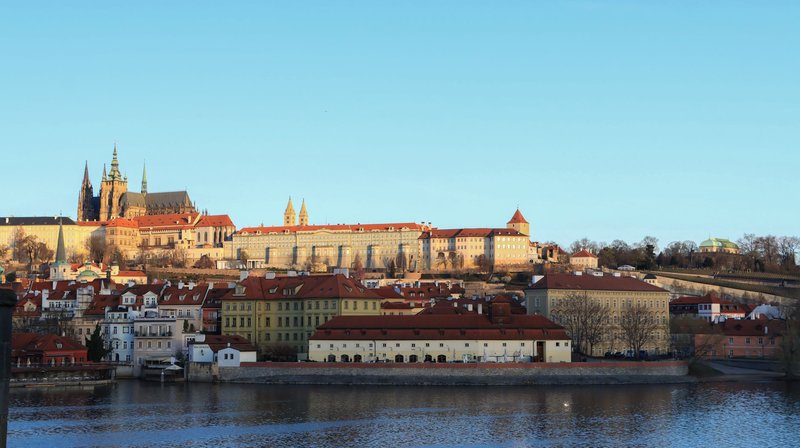
Prague’s historic center is a UNESCO World Heritage Site covering roughly 900 hectares — one of the largest protected historic zones in Europe. The medieval street grid survived both World War II and the kind of postwar redevelopment that gutted comparable cities in Germany and Poland. That intact quality is what you’re actually seeing when you walk through Staré Město: not a reconstruction, but the real thing.
Prague Castle (Pražský hrad)
The castle complex sits on a ridge above the Vltava and has been the seat of Bohemian kings, Holy Roman Emperors, and Czech presidents in an unbroken line since the 9th century. It’s the largest ancient castle complex in the world by area — around 70,000 square meters — which means most visitors underestimate how long it takes.
What actually matters here: St. Vitus Cathedral took nearly 600 years to complete. The foundation stone was laid in 1344; the western facade wasn’t finished until 1929. You can see the join if you look at the stonework closely. The Old Royal Palace contains the Vladislav Hall, a late Gothic vaulted space so large that knights used to ride horses inside it for tournaments.
Practical: The outer grounds are free. A standard ticket covering the key interiors costs around 250 CZK. Get there before 9am to avoid the worst of the tour groups. Budget 3–4 hours minimum.
Old Town Square and the Astronomical Clock
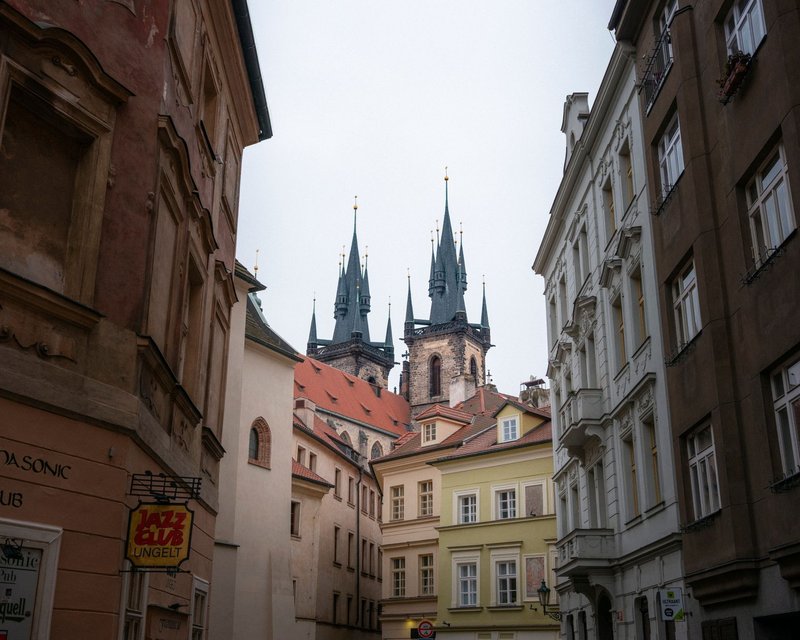
The Orloj — the astronomical clock on the Old Town Hall — was first installed in 1410, making it the world’s oldest still-functioning astronomical clock. Every hour on the hour, the Death figure rings a bell and a procession of apostles appears. It’s theatrical. It’s also a bit of a letdown if you’ve built it up too much, because the figures are small and the crowd is large.
The clock itself is the point, not the show. Look at the face: it tells the time in three different systems simultaneously (Bohemian, Babylonian, and Central European), tracks the position of the sun and moon, and shows the zodiac. The 15th-century astronomer who designed it was reportedly blinded afterward so he couldn’t replicate it elsewhere. That story is almost certainly apocryphal. The clock’s complexity is not.
The square itself holds the Jan Hus Memorial, marking the spot where the Czech reformer was burned at the Council of Constance in 1415 — a century before Luther. Czech Protestantism has deep roots here.
Practical: Free to visit the square. Tower admission around 250 CZK. Come early morning or after 6pm for fewer people.
Josefov — the Jewish Quarter
Six synagogues, a cemetery where bodies were buried in layers up to 12 deep because the community couldn’t expand their burial ground, and a history that tracks Jewish life in Central Europe from the 13th century through the Holocaust. The Old Jewish Cemetery alone — with its layered headstones tilting at odd angles after centuries of ground movement — tells you something about space, exclusion, and persistence that no text panel can match.
The Pinkas Synagogue functions as a memorial: the walls are inscribed with the names of 77,297 Bohemian and Moravian Jews murdered during the Nazi occupation. Reading the names takes longer than most people expect.
Practical: A combined ticket covering all six synagogues and the cemetery costs around 500 CZK. Skip the queue by booking online.
Vyšehrad
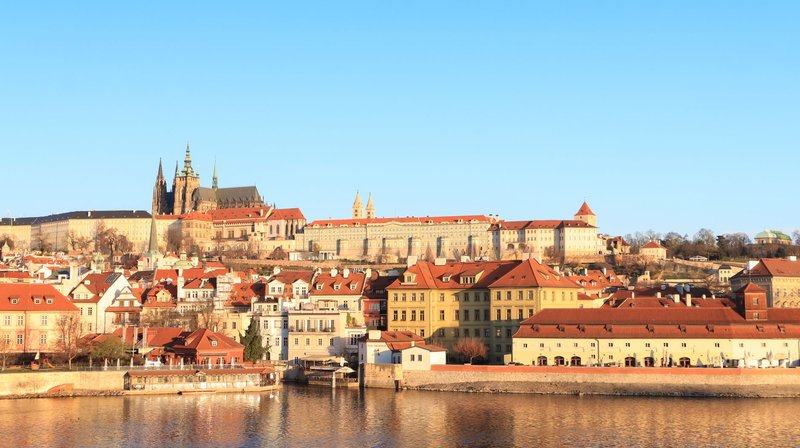
Most tourists don’t make it to Vyšehrad, the fortress that predates Prague Castle and sits on a rocky promontory above a bend in the Vltava. That’s your reason to go. The views back toward the city are better than anything you get from the Castle side, and the cemetery here — the Slavín — holds the graves of Dvořák, Smetana, and Mucha, among others. It’s quiet in a way central Prague isn’t.
Historically, Vyšehrad is where Czech national mythology begins. The legendary princess Libuše supposedly stood here and prophesied the founding of Prague. The Romanesque rotunda of St. Martin — the oldest intact building in Prague, from the 11th century — is still standing in the complex.
Practical: Free to enter the grounds. The basilica and galleries charge a small fee. About 20 minutes by tram from the city center.
Day Trips Worth the Train Ticket
Kutná Hora — Medieval Silver and Bones
Kutná Hora, 70km east of Prague, was the second most important city in Bohemia in the 14th century, and its silver mines funded the construction of Prague’s Gothic architecture. The wealth is visible: the Cathedral of St. Barbara, built by the miners themselves, is the only Gothic cathedral in Central Europe that was never a bishop’s seat. The ribbed vaulting rivals anything in Prague.
The Sedlec Ossuary — the bone church — gets the attention, and it earns it. The bones of 40,000 to 70,000 people, many of them victims of the Black Death and the Hussite Wars, are arranged into chandeliers, garlands, and a family coat of arms. A local woodcarver named František Rint assembled the current arrangement in 1870. He also signed his name in bones near the entrance.
What most visitors miss is the Italian Court, the former royal mint where the Prague Groschen was struck. It’s a 10-minute walk from the bone church and almost always uncrowded.
Practical: Direct trains from Prague’s main station run hourly, about 55 minutes. The ossuary and St. Barbara’s Cathedral are separate tickets, each around 100–150 CZK. A half-day covers it; a full day lets you breathe.
Český Krumlov — Baroque Excess in South Bohemia
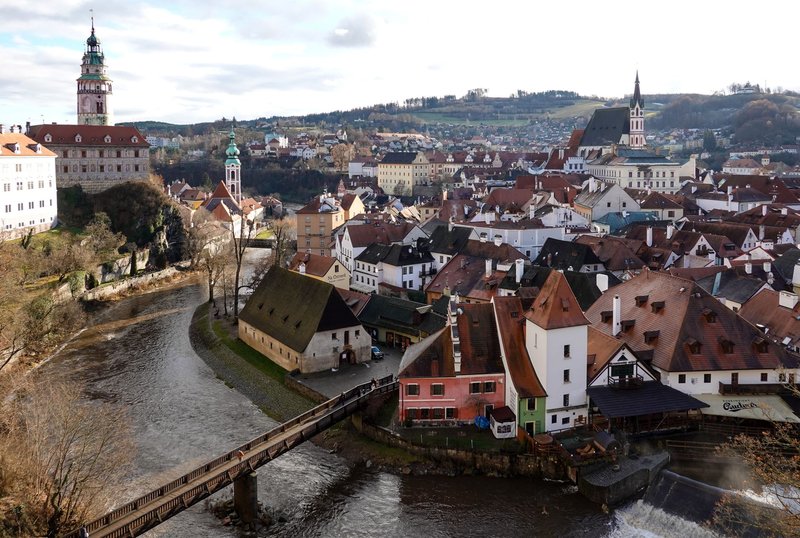
Český Krumlov’s castle is the second largest in the Czech Republic, its tower visible from anywhere in the town below. The Vltava loops almost completely around the historic core, which means the medieval street plan is still intact because there was no room to expand — the river kept everything in place.
The Rosenbergs, the Eggenbergs, and eventually the Schwarzenbergs each left their mark on the castle. The last major addition was an 18th-century Baroque theater, still with its original stage machinery and costumes, one of the best-preserved in Europe. Performances still happen here occasionally on period instruments.
The town gets crowded in summer — very crowded. Day-trippers from Prague pack the main square. Come on a weekday, or arrive before 9am, and you’ll have the streets largely to yourself for an hour.
Practical: About 3 hours by bus from Prague (no direct train). Buses from Florenc bus station. Castle grounds free; interior tours 100–380 CZK depending on circuit. Budget a full day.
Terezín — The History That Gets Skipped
Terezín doesn’t appear on most “best historical sites” lists because it’s not comfortable. That’s precisely why it should be on yours.
The fortress town, 60km north of Prague, was built by Emperor Joseph II in the 1780s as a military garrison — hence the name Theresienstadt. During the Nazi occupation, it was converted into a Jewish ghetto and transit camp. Around 150,000 Jews passed through; 33,000 died there, and the rest were transported to Auschwitz and other extermination camps.
The Nazis used Terezín as a propaganda showpiece, producing a film called Der Führer schenkt den Juden eine Stadt (“The Führer Gives the Jews a City”) to deceive international observers. The Red Cross visited in 1944 and filed a positive report. Understanding how that deception worked is part of understanding how genocide happens.
The Terezín Memorial includes the Small Fortress (used as a Gestapo prison), the Ghetto Museum, and the Magdeburg Barracks. The art and children’s drawings produced in the camp — now preserved — are some of the most affecting historical documents in Europe.
Practical: About 1 hour by bus from Prague’s Holešovice station. Combination ticket around 220 CZK. Plan 4–5 hours minimum; this isn’t a place to rush.
Under-the-Radar Picks
Telč — Renaissance in the Middle of Nowhere
Telč is a UNESCO World Heritage town in southern Moravia, and its main square is one of the most intact Renaissance ensembles in Central Europe. The houses along the square were rebuilt in Renaissance style after a fire in the 16th century; they’ve barely changed since. The arcades, the gabled facades, the fish ponds surrounding the historic core — it looks like a film set, except it’s real and still inhabited.
Most people who know about Telč visited on a detour between Brno and Český Krumlov. It deserves an overnight. The castle is small but the interior decorations are genuinely fine — the coffered ceilings in the Golden Hall took craftsmen years.
Practical: Reachable by bus or car from Brno (about 1.5 hours). Limited direct connections from Prague. Population around 10,000, so accommodation books fast in summer.
Olomouc — The Baroque City Prague Forgot
Olomouc was the capital of Moravia for centuries and the site of the coronation of multiple Habsburg kings. It has six Baroque fountains, a UNESCO-listed Trinity Column that’s the largest plague column in Central Europe, and an astronomical clock that rivals Prague’s (rebuilt in Communist-era style in 1955, which is itself historically interesting). If you’re curious how the dialects in the Czech Republic shift as you move east from Bohemia into Moravia, Olomouc is a good place to notice the difference in everyday speech.
Most visitors to Czech Republic never go east of Prague, which means Olomouc gets a fraction of the tourist traffic it warrants. The city center is compact and walkable. The cheese — Olomoucké tvarůžky, a pungent fermented cheese that’s been made here since the 15th century — is worth trying once. Just once.
Practical: About 2 hours by fast train from Prague. A full day is enough for the historic center. Combine with Kroměříž (30 minutes away) for a two-day Moravia circuit.
Kroměříž — Archbishop’s Gardens and a Flemish Art Collection
Kroměříž holds the Archbishop’s Palace and its gardens, a UNESCO site that most people could not locate on a map despite being genuinely extraordinary. The Flower Garden (Květná zahrada) is a formal Baroque garden on a scale that seems impossible for a small Moravian town. The palace’s art collection includes Titian’s The Flaying of Marsyas, which some art historians consider among the most psychologically complex paintings of the 16th century.
The painting was acquired by the Olomouc bishop in 1673 and has been here ever since, which is notable only because paintings of that quality have an uncanny tendency to end up in major museums. This one stayed.
Practical: 30 minutes from Olomouc by train. Combined palace and garden ticket around 200 CZK. Easy half-day.
How to Plan Around These Sites
The practical reality of visiting Czech Republic’s historical sites comes down to one decision: how much time in Prague versus how much time in the regions.
Prague can absorb three to four days and still leave things unfinished. But the day trips and regional cities are where the crowds thin out and the history gets less curated. Kutná Hora and Terezín are both reachable in a single day from Prague. Český Krumlov is better as an overnight. Telč, Olomouc, and Kroměříž work best as a three-day Moravia loop, ideally at the end of a longer trip.
A few logistics worth knowing:
- Czech trains are generally reliable and affordable. The main Prague–Brno–Olomouc corridor is fast. Buses (RegioJet, FlixBus, Student Agency) cover routes the trains don’t.
- Most castle and museum sites are closed on Mondays. Plan accordingly.
- UNESCO sites in Czech Republic include Prague Historic Centre, Český Krumlov, Telč, Kutná Hora, Litomyšl Castle, Kroměříž, Olomouc Trinity Column, Holašovice, Lednice–Valtice, and Brno’s Villa Tugendhat. That last one — a 1930 Mies van der Rohe house — is a completely different kind of historical site worth knowing about if modernist architecture is your thing.
The Czech Republic punches above its weight for historical density relative to its size. The question isn’t whether there’s enough to see — it’s whether you give yourself enough time to see it properly.