
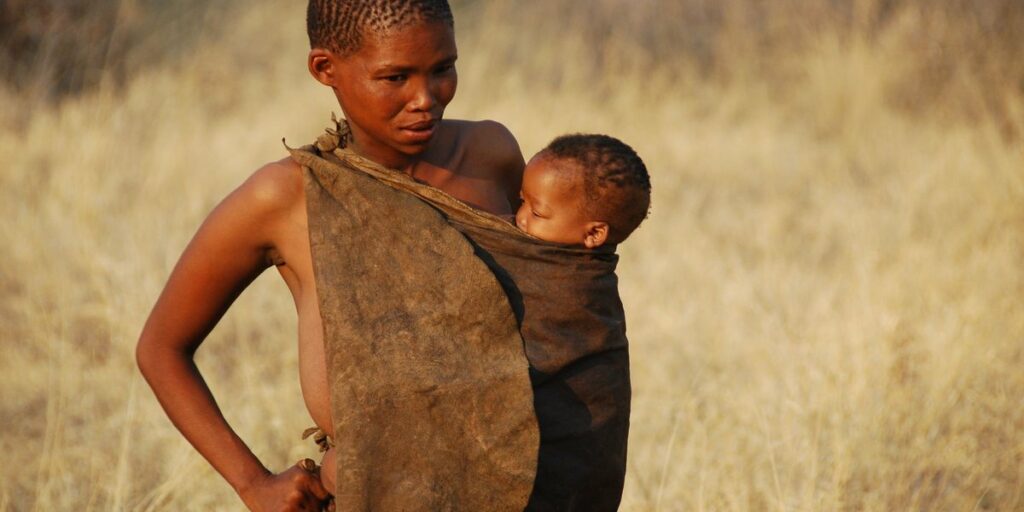
Most pages about Botswana’s languages hand you the same census table — Setswana 77 percent, a few Bantu minorities, a footnote about “click languages” — and call it a day. That table is real, but it’s also where the story usually stops. Botswana is home to 26 living indigenous languages drawn from three unrelated language families, and the gap between the one everyone speaks and the ones nobody is teaching their children is the part worth understanding.
Here’s the thing that changed recently: in 2025, state broadcasters started airing news in indigenous languages other than Setswana for the first time at scale. After decades of a one-language-on-air policy, that’s a real shift. So this guide does two things — it gives you the clean taxonomy and the speaker numbers, and it tells you which of these languages are alive, which are holding on, and which are nearly gone.
Table of Contents
- The three language families
- Setswana: the language that runs the country
- The Bantu minorities
- The Khoe and San languages
- Which languages are endangered
- The 2025 broadcast milestone
- What a traveler actually needs to know
The three language families
Forget the idea that Botswana’s languages are variations on a theme. They come from three families that are about as related to each other as English is to Mandarin.
Bantu is the big one. It’s a branch of the vast Niger-Congo family that spread across sub-Saharan Africa over the last two thousand years, and it includes Setswana, Ikalanga, Shekgalagari, Shiyeyi, Thimbukushu, and Sesubiya. If you’ve heard the prefix system — Motswana (one person), Batswana (the people), Setswana (the language) — that’s Bantu grammar at work, and it’s shared across the whole branch.
Khoe (formerly lumped under “Khoisan”) is older and unrelated. These are the languages of cattle-herding and foraging peoples of the Kalahari, and they include Naro, Khwe, and the Tshwa varieties. They use click consonants, but clicks are a feature, not a family — borrowed languages have them too.
Tuu (the southern “Khoisan” group) is the smallest and most endangered, hanging on in the far southwest. This is where you find the languages with the most extreme sound inventories on earth, and also the ones closest to disappearing.
The “Khoisan” label you’ll still see everywhere is a convenience term, not a genetic grouping. Linguists keep it around because it’s useful shorthand for “the click languages of southern Africa,” but Khoe and Tuu are not a single family. The Endangered Languages Project tracks several of these separately for exactly that reason.
Setswana: the language that runs the country
Setswana is the national language and the mother tongue of roughly 77 percent of Botswana’s population. English is the official language — the one used in courts, secondary schools, and government paperwork — but Setswana is what people actually live in. It’s on the radio, in the markets, in Parliament’s informal moments, and it’s the one language nearly everyone in the country shares regardless of their first one.
That dominance is the central fact of Botswana’s language landscape, and it cuts both ways. On one hand, a single widely-spoken national language has been part of Botswana’s stability and national identity since independence in 1966. On the other, the policy of teaching only Setswana and English in schools is the main reason the other 24 indigenous languages have been losing ground for two generations. A child who grows up speaking Shiyeyi or Naro at home does all their formal learning in two languages that aren’t it.
Setswana is also spoken by far more people outside Botswana than inside it — there are several million speakers in South Africa, where it’s one of the eleven official languages. So if you learn a few phrases for a trip, you’re picking up a regional language, not a Botswana-only one.
The Bantu minorities
Below Setswana sit a handful of Bantu languages, each tied to a particular region and community. These are the ones with real speaker numbers — tens of thousands to over a hundred thousand — but no official footing.
Ikalanga is the largest minority language, spoken by around 7 to 8 percent of the population, concentrated in the northeast around Francistown and the border with Zimbabwe — where the same Kalanga community and its language continue across the line, part of a broader picture of Zimbabwe’s own indigenous languages. The Kalanga have the strongest language-rights movement in the country; groups have pushed for years to get Ikalanga into schools, and it’s one of the languages most likely to survive the squeeze because of that organized advocacy.
Shekgalagari (the language of the Bakgalagadi) is spoken across the central and southern Kalahari by roughly 3 percent of the population. It’s closely related to Setswana — close enough that it’s sometimes dismissed as a dialect, which its speakers reject.
Shiyeyi belongs to the Wayeyi people of the Okavango Delta and Ngamiland in the northwest. This is a striking case: most ethnic Wayeyi have shifted to Setswana, and Shiyeyi is now spoken fluently mostly by older people. The Kamanakao Association was formed specifically to document and revive it.
Thimbukushu is spoken by the Hambukushu in the Okavango panhandle near the Namibian border, and it’s one of the healthier minority languages partly because the community straddles the border and maintains ties on both sides — the Namibian side, where it sits among the country’s official and indigenous languages, reinforces it.
Sesubiya (Chikuhane) is spoken by the Basubiya in the far north around the Chobe and Linyanti rivers — the same wetland-and-floodplain country you pass through on a Chobe safari.
The Khoe and San languages
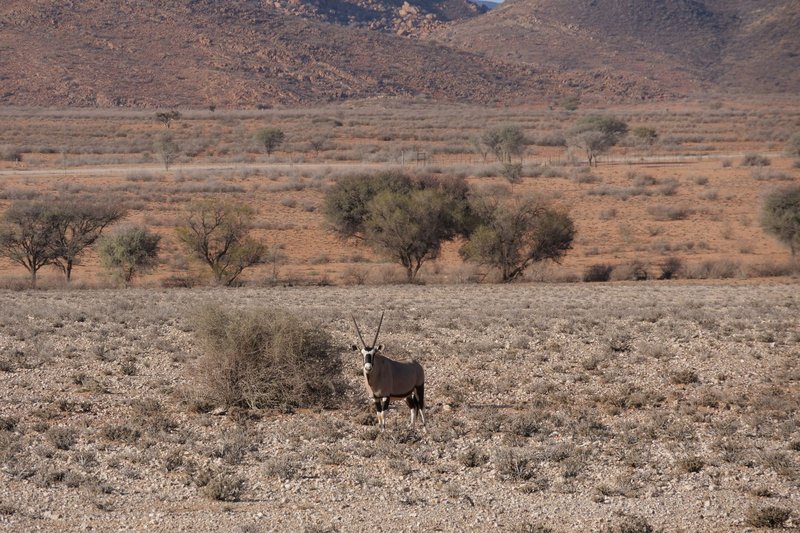
This is where Botswana gets linguistically unique. The Khoe and San (Khoisan) languages are spoken by the descendants of southern Africa’s oldest inhabitants, and Botswana holds the largest concentration of these languages of any country.
Naro is the most documented and arguably the most stable San language in Botswana, spoken in the Ghanzi district in the west. It’s the one with the most developed writing system and dictionary work, largely thanks to decades of effort by a small group of linguists and the Naro community itself. If any San language has a fighting chance, it’s this one.
Khwe and the various Tshwa (Kua) varieties are scattered across the Kalahari and the eastern fringes, with smaller and more fragmented speaker communities.
The San peoples — sometimes called Basarwa in Botswana, a term many find pejorative — have historically been the country’s most marginalized communities, and their languages reflect that. Speaker numbers for individual varieties often run in the hundreds or low thousands, and the social pressure to assimilate into Setswana-speaking life is enormous. The UNESCO Atlas of the World’s Languages in Danger classifies a number of these as definitely or severely endangered.
Which languages are endangered
The honest summary: of Botswana’s 26 living indigenous languages, roughly 17 are considered at risk to some degree. The reasons are the same ones that erode minority languages everywhere, just concentrated.
The mechanics are straightforward. School happens in Setswana and English. Government happens in Setswana and English. Getting a job, moving to a town, marrying outside your community — all of it rewards Setswana and quietly penalizes the language you grew up with. So parents make a rational choice: they raise their kids in the language that opens doors. Two generations of that, and a language that was a community’s daily speech becomes something only grandparents use.
The languages furthest along this path are the Tuu varieties of the southwest and the smaller San communities, where speaker counts have dropped low enough that the language may not survive the current generation of elders. Shiyeyi sits in the middle — endangered but with an active revival movement. At the safer end are Ikalanga and Thimbukushu, which have either the numbers, the cross-border reinforcement, or the organized advocacy to hold on. The same pressures play out across the region — neighboring Zambia counts 38 indigenous languages under similar strain — so Botswana’s pattern is less an exception than a local version of a wider story.
What’s missing, and what every report on the subject points out, is policy support. Botswana long resisted mother-tongue education on the theory that one national language keeps the country unified. That theory has costs, and they’re now visible in the language data. Researchers at the Association of Commonwealth Universities have documented how the absence of these languages from schools and media translates directly into their decline.
The 2025 broadcast milestone
For decades, if you turned on Botswana TV or Radio Botswana, you got Setswana and English. That was the whole menu. For a country with 26 indigenous languages, having state media broadcast in two of them sent a clear message about which languages counted.
In 2025, that started to change. State broadcasters began airing news in indigenous languages beyond Setswana — putting Ikalanga, Shekgalagari, and other minority languages on the air for the first time as a matter of policy rather than a one-off. It sounds modest, and in raw broadcast hours it is. But media presence is one of the strongest signals of whether a language has a future. Kids who hear their home language delivering the actual news — not folklore, not a cultural segment, but the news — absorb the idea that it’s a real, current, useful language and not a relic.
Whether this becomes durable policy or fades into a gesture is the open question. But it’s the first time in Botswana’s history that the answer to “which languages does the state speak in?” has a number bigger than two, and that’s why it belongs in any current account of the country’s languages.
What a traveler actually needs to know
If you’re heading to Botswana, the practical picture is simpler than the linguistic one. English will get you through hotels, lodges, tour operators, and most of Gaborone and Maun without trouble. Learn a little Setswana and you’ll connect with almost anyone, anywhere in the country.
A few that pay off:
- Dumela (doo-MEH-lah) — hello, to one person. Add mma for a woman or rra for a man: Dumela mma.
- Dumelang — hello, to a group.
- Ke a leboga (keh ah leh-BOH-ha) — thank you.
- Go siame (ho see-AH-meh) — okay / it’s fine / goodbye.
Greetings carry real weight here. Launching straight into a question without a dumela reads as rude in a way it might not back home, so lead with the greeting even when you’re in a hurry.
If you travel into the Okavango, the Kalahari, or up to Chobe, you’re moving through the home regions of Shiyeyi, Naro, and Sesubiya. You won’t need them, but knowing the language under your feet has a name, a family, and in some cases a fight to survive — that’s the kind of context that turns a game drive into a place. The languages are the oldest thing in the landscape, older than the borders, and a few of them may not be here in another generation.