TLDR
Bhutan has one official and national language: Dzongkha. English is not official, but it’s the language of schools, government paperwork and most business. Nepali and Tshangla are widely spoken without official status. Roughly 20 languages are in use across the country, so “official languages” (plural) is the wrong frame.
Table of Contents
- Dzongkha is the only official language
- Official, national and working language
- Why people think Bhutan has three languages
- Languages spoken in Bhutan at a glance
- How Dzongkha is written and taught
- What travelers actually need
- FAQ
Dzongkha is the only official language
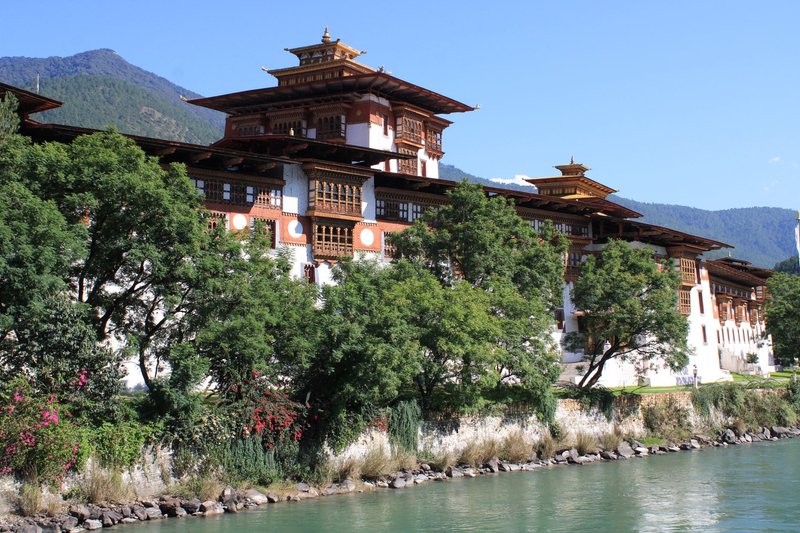
The official languages in Bhutan come down to a single entry. Dzongkha, literally “the language of the dzong” (the fortress-monasteries that serve as administrative centers), was declared the national language in 1971, and the constitution still names it that way. The CIA World Factbook lists it first among the country’s languages, and it’s the only one with legal standing.
Dzongkha is a Tibetic language native to the western valleys around Thimphu and Paro. Most Bhutanese speak it as a second language, because their mother tongue is something else entirely.
Official, national and working language
Three labels get mixed up, and the mix-up produces most of the wrong answers online.
- Official and national language: Dzongkha. It’s the language of the state’s identity, taught in every school and used for ceremonial and legal purposes.
- Working language: English. It’s the medium of instruction for most school subjects other than Dzongkha itself, and it dominates government documents, media and business. It has no formal official status.
- Everything else: regional and community languages with no legal standing but millions of everyday uses.
So is English an official language in Bhutan? No. But a Bhutanese schoolchild learns math and science in it, and a Thimphu office worker emails in it. Practically, it behaves like one.
Why people think Bhutan has three languages
Search results sometimes claim Bhutan has three official languages: Dzongkha, English and Nepali. Two things feed that.
First, English really is everywhere in education and administration, so it feels official. Second, Nepali was once taught in schools in the south of the country, where the Lhotshampa community, Bhutanese of Nepali origin, lives. That instruction ended in the late 1980s as part of a national push for a single cultural identity, and it remains one of the most politically sensitive chapters in modern Bhutan. Nepali is still spoken at home by a sizable minority, but it has no official role.
Languages spoken in Bhutan at a glance
Bhutan is small but linguistically dense. Mountain valleys kept communities apart, and each developed its own speech. The main ones:
| Language | Main region | Family | Notes |
|---|---|---|---|
| Dzongkha | Western Bhutan (Thimphu, Paro, Punakha) | Tibeto-Burman (Tibetic) | Official and national language |
| Tshangla | Eastern Bhutan (Trashigang, Mongar) | Tibeto-Burman | Most widely spoken first language, about 138,000 speakers |
| Nepali | Southern lowlands | Indo-Aryan | Lhotshampa community, no official status |
| Bumthangkha | Bumthang valleys, central Bhutan | Tibeto-Burman | Small community language |
| Khengkha | Zhemgang, south-central Bhutan | Tibeto-Burman (Bodish) | Small community language |
| Dzalakha | Far east, around Dungsam | Tibeto-Burman (Bodish) | Very small speaker base |
Tshangla is the surprise for most readers. It has more native speakers than Dzongkha, yet it holds no official role. Speaker counts for the smaller languages are rough estimates, and none of them has anywhere near Tshangla’s numbers.
How Dzongkha is written and taught
Dzongkha uses the Tibetan script. Its written form borrows heavily from Chhokey, the classical Tibetan used for centuries in Buddhist monasteries and scripture, which is why monks and scholars can read texts that everyday speakers of other Bhutanese languages can’t.
Every public school teaches Dzongkha as a subject, and students sit exams in it. The government treats it as the carrier of Bhutanese identity, which is why it shows up in official dress codes, signage and architecture rules as much as in classrooms. Look at a shop sign in Thimphu and you’ll see Dzongkha script alongside English, by design.
What travelers actually need
You don’t need to speak Dzongkha. Licensed guides, which most visitors travel with because of Bhutan’s tourism rules, speak good English, and so do hotel staff, drivers and most people in towns. The Tourism Council of Bhutan is the government body behind that licensing system, if you want to understand how it works.
Outside towns, in farming valleys and on remote roads, English thins out. A few phrases fix that quickly:
- Kuzuzangpo la: hello (the “la” is a politeness marker, add it to everything)
- Kadrinche la: thank you
- La: yes, or just “I hear you”
- Mi-la: no
Learning two or three of these earns more goodwill than you’d expect. Locals tend to answer with surprise and a smile, because few visitors try.
FAQ
What is the official language of Bhutan? Dzongkha. It’s the only official and national language.
Is English an official language in Bhutan? No. English is the working language of education and government, but it has no formal official status.
Is Nepali an official language in Bhutan? No. It’s spoken mainly in the south by the Lhotshampa community and was removed from school teaching in the late 1980s.
What language do they speak in Bhutan? It depends on the valley. Dzongkha in the west, Tshangla in the east, Nepali in the south, and English as the shared bridge for official and tourist contexts.
Can I get by with only English in Bhutan? Yes, in towns, hotels and with guides. Learn a few Dzongkha greetings for everything else.