How the golden hour calculator works
The calculator works out where the sun is in the sky, minute by minute, for the place and date you choose. It then finds the moments when the sun crosses the angles that define blue hour, golden hour, sunrise and sunset, and shows them in the local time of that place.
The sun's position comes from the NOAA solar calculation (based on Jean Meeus's Astronomical Algorithms), the same method behind the US National Oceanic and Atmospheric Administration's own sunrise and sunset calculator. It is accurate to about one minute for any place between the polar circles. Everything runs in your browser. Your location never leaves your device, except for the rounded coordinates sent to Open-Meteo for the 7-day cloud forecast.
The results show:
- Morning and evening windows for blue hour and golden hour, with how long each lasts.
- The day bar, a 24-hour strip colored by light: night, twilight, blue hour, golden hour and full daylight.
- The sun elevation chart, which plots the sun's height through the day against the golden and blue bands. Tap or hover anywhere on it to read the sun's height and direction at that minute.
- The compass, with the sun's path across the sky and the direction it rises and sets.
- A 7-day table with cloud cover, so you can pick the evening most likely to give good light.
What is golden hour?
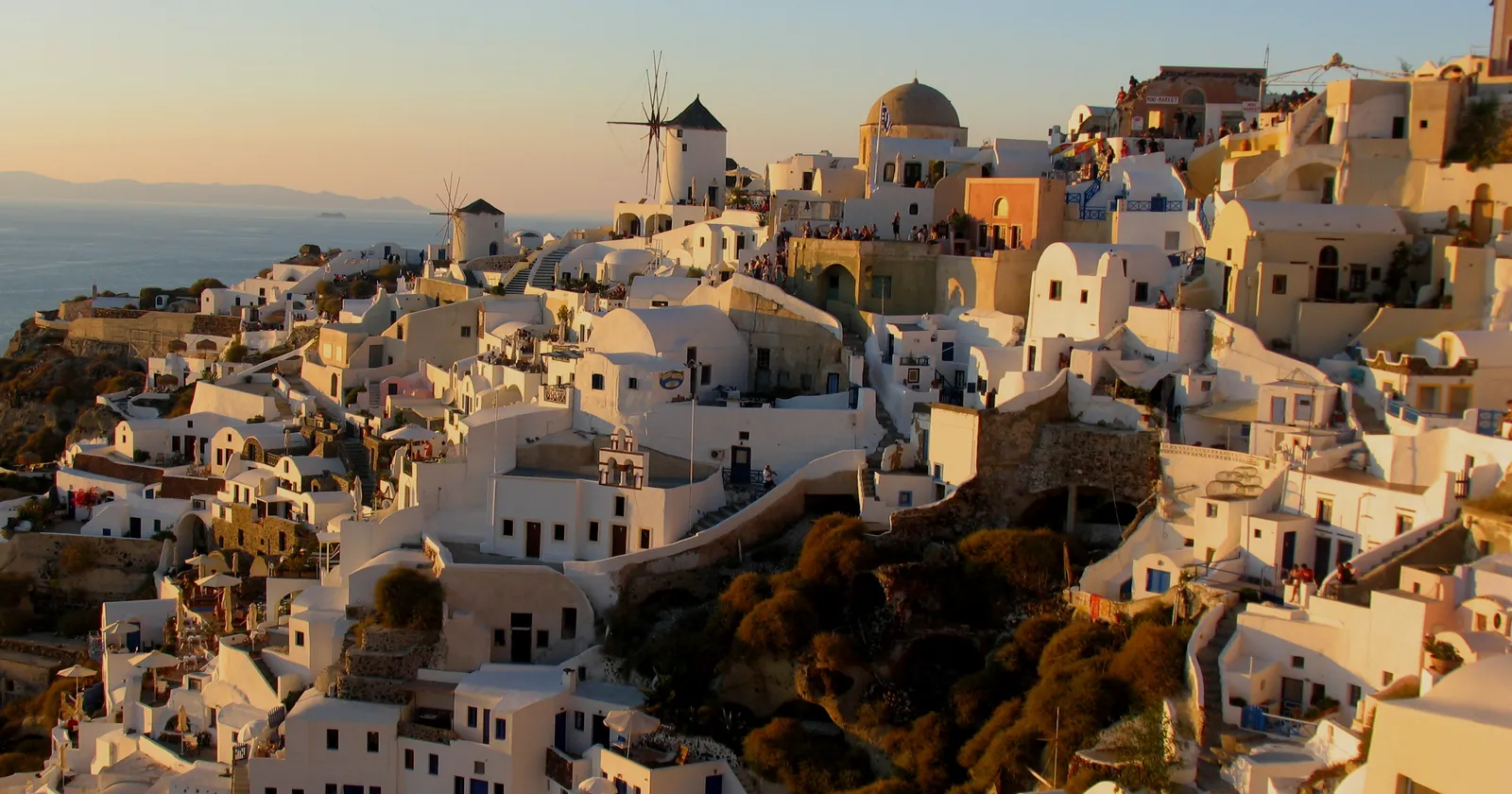
Golden hour is the time just after sunrise and just before sunset when the sun is low in the sky. Sunlight passes through more of the atmosphere at a low angle. The air scatters most of the blue light away, and what reaches the ground is warm, soft and directional. Shadows are long, faces need no squinting and stone buildings turn orange.
Photographers define it by the sun's elevation rather than by the clock. The standard definition, used by this calculator by default, is the sun between 4° below and 6° above the horizon. Blue hour is the band just below it, from 6° to 4° below the horizon.
Because the definition is an angle, golden hour is rarely an hour. Near the equator the sun drops almost straight down and the window lasts about 40 minutes. In London the sun slides along the horizon at a shallow angle and the window lasts about an hour and a half. In Iceland in June it lasts all night.
Golden hour vs blue hour
| Golden hour | Blue hour | |
|---|---|---|
| Sun elevation | 4° below to 6° above the horizon | 6° to 4° below the horizon |
| Evening order | Before and just after sunset | After golden hour ends |
| Morning order | Just before and after sunrise | Before golden hour starts |
| Light | Warm, orange, directional, long shadows | Cool, even, deep blue sky, no shadows |
| Typical length (mid-latitudes) | 50 to 65 minutes | 10 to 15 minutes |
| Best subjects | Portraits, landscapes, old towns, sand and stone | Cities with lights on, bridges, harbors, landmarks |
| Tripod | Optional | Usually needed |
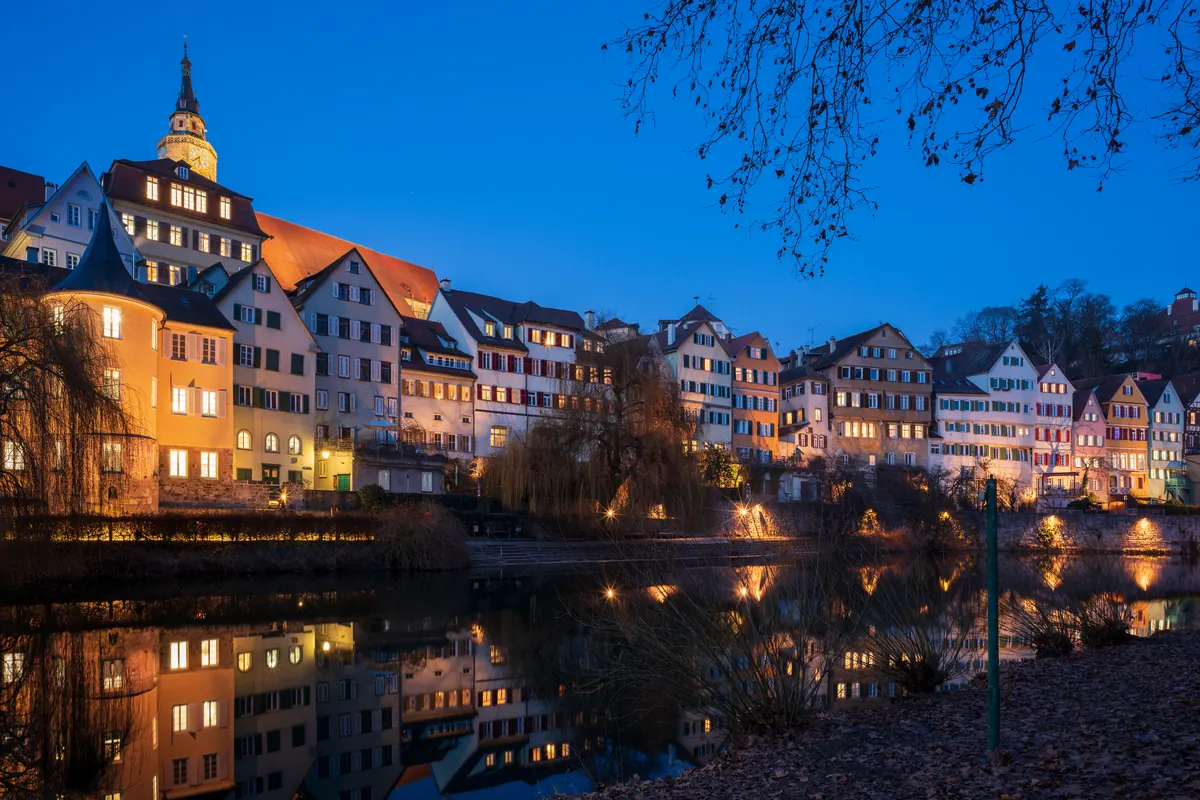
In the evening the order is golden hour, sunset, the last part of golden hour, then blue hour. In the morning it runs the other way: blue hour, golden hour, sunrise, then the rest of golden hour. For city photos, blue hour is often better than golden hour. The sky and the street lights reach similar brightness, so one exposure holds both.
Why golden hour times differ between sites
There is no official definition of golden hour, so different apps and websites use different angles. Two calculators can disagree by 15 minutes for the same place and date.
| Definition | Golden hour | Used by |
|---|---|---|
| Standard | 4° below to 6° above | Most photography calculators and apps |
| Wide | 6° below to 6° above | timeanddate.com |
| Tight | 4° below to 2° above | Sites that count only the warmest light |
The calculator uses the standard definition. Switch to the other two under Light definition to compare. Sunrise and sunset themselves are fixed: they are the moments the top edge of the sun touches the horizon, with the bending of light by the atmosphere included.
How long golden hour lasts
The length of golden hour depends on latitude and season. The farther you are from the equator, the shallower the angle at which the sun meets the horizon, and the longer it takes to cross the golden band. Evening golden hour lasts this long under the standard definition, on the March equinox and the June and December solstices:
| Latitude | March | June | December |
|---|---|---|---|
| 0° Quito, Singapore | 40 min | 44 min | 44 min |
| 25° N Miami, Dubai | 44 min | 49 min | 49 min |
| 40° N New York, Madrid | 52 min | 1 h 01 min | 1 h 02 min |
| 52° N London, Amsterdam | 1 h 05 min | 1 h 24 min | 1 h 29 min |
| 65° N Northern Iceland | 1 h 35 min | All night | About 5 h 30 min, around noon |
Above about 63° north in late June, the sun never sinks more than 4° below the horizon, so golden light lasts all night. Between about 61° and 63° north, the short night is one long blue hour. Inside the Arctic Circle in December the sun never rises, but on many days it comes close enough to the horizon to give a few hours of blue light around noon. The calculator shows these cases in words instead of empty times.
Here is evening golden hour at popular photo destinations on the June and December solstices:
| Destination | June 21 evening | December 21 evening |
|---|---|---|
| Oia, Santorini | 8:02 to 8:58 PM (57 min) | 4:27 to 5:24 PM (58 min) |
| Reykjavik | From 10:07 PM, all night | No sunset golden hour; about 5 h 50 min of low golden light around noon |
| Ubud, Bali | 5:39 to 6:24 PM (44 min) | 6:05 to 6:50 PM (44 min) |
| New York | 7:49 to 8:51 PM (1 h 02 min) | 3:48 to 4:51 PM (1 h 03 min) |
| Sydney | 4:16 to 5:11 PM (55 min) | 7:29 to 8:23 PM (55 min) |
| Cape Town | 5:07 to 6:02 PM (55 min) | 7:20 to 8:15 PM (55 min) |
Which way to face during golden hour
The sun rises and sets due east and due west only around the equinoxes in March and September. In the northern hemisphere summer it rises in the northeast and sets in the northwest. In winter it rises in the southeast and sets in the southwest. The swing is larger the farther you are from the equator. In New York the sunset point moves about 60° along the horizon between June and December.
The compass in the calculator shows the exact bearing for your date, so you can check before you go whether the sun will set behind that bridge, into the sea or behind a hill.
- Front light: stand with the sun behind you. Buildings and faces glow in warm, even light.
- Side light: keep the sun to one side. Long shadows show texture in landscapes, sand dunes and old walls.
- Back light: face the sun. You get silhouettes, rim light around people and a bright sky.
Hills, buildings and trees end the golden light earlier than the calculated times. In a valley or a city street the sun can disappear 20 to 30 minutes before sunset. On a mountain top or a beach facing the sunset, the light lasts until the calculated end.
Golden hour photo tips for travelers
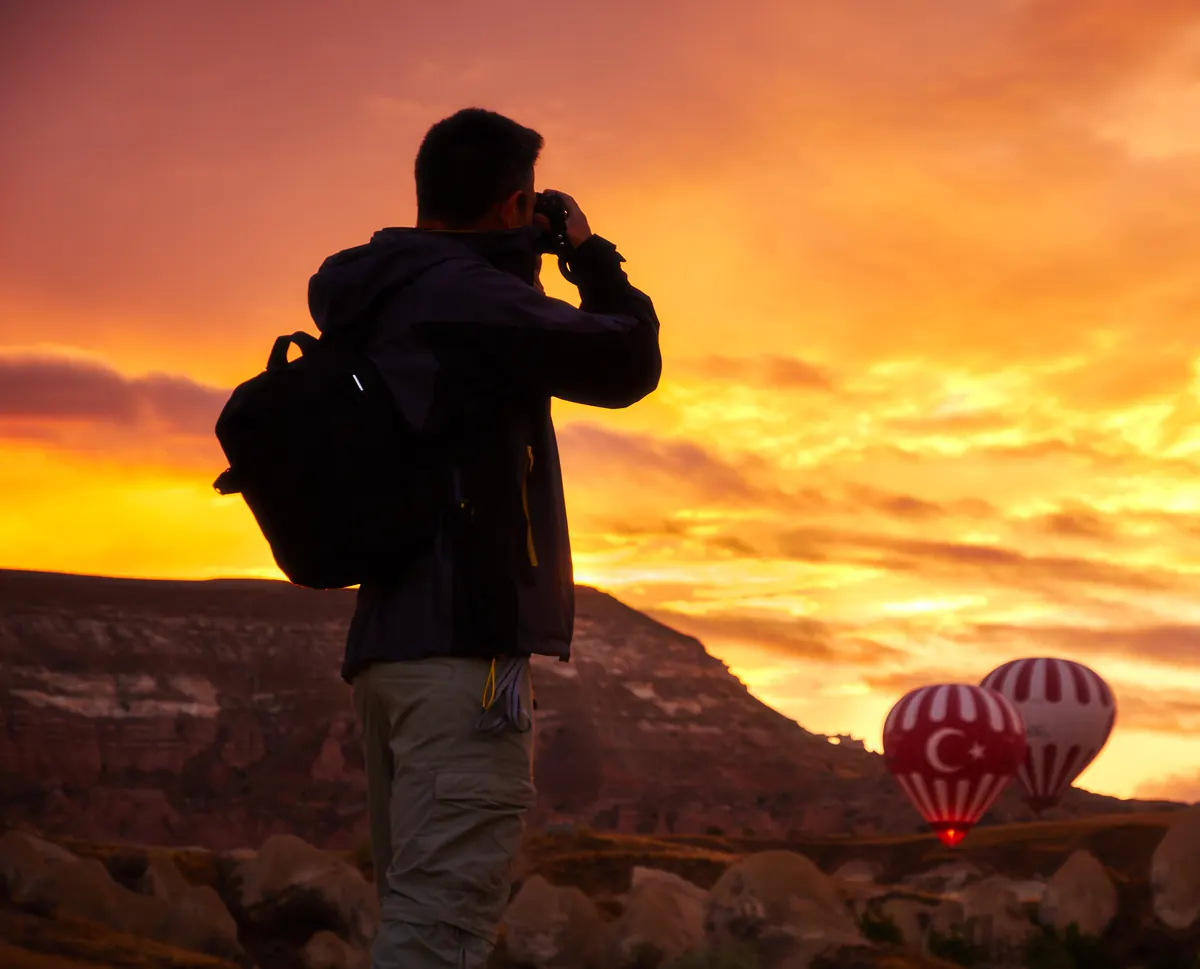
- Arrive 30 minutes early. The best light at a famous viewpoint lasts minutes, and the good spots fill up. At Oia in Santorini, people claim a place on the castle walls an hour before sunset in summer.
- Stay after sunset. Most people leave when the sun touches the horizon. The color in the clouds often peaks 10 to 20 minutes later, then blue hour starts.
- Check the clouds. High, thin clouds catch the color best. A low, thick cloud bank on the horizon blocks the sun before golden hour ends. The 7-day table rates each evening from the forecast.
- Plan your first morning. Jet-lagged travelers flying east often wake before dawn. Use it: morning golden hour at popular landmarks is far emptier than the evening one.
- Use the right settings. Set white balance to daylight or cloudy, not auto, so the camera keeps the warm color. Expose for the bright sky and lift the shadows later.
Gear for golden hour travel photos
Golden hour needs no special gear. These four items make the most difference when you travel light:
- A compact travel tripod for blue hour, when exposures run to a second or longer. Look for one that folds under 45 cm and weighs under 1.5 kg.
- A circular polarizer to cut glare on water and deepen the sky when the sun is to your side.
- A phone tripod with a Bluetooth remote if you shoot on your phone. Night modes need the phone to stay still for several seconds.
- A headlamp with a red light for walking to a sunrise viewpoint in the dark and back from a sunset one.
Frequently asked questions
What time is golden hour today?
It depends on where you are. The calculator at the top of this page shows today's golden hour for your area as soon as it loads. Choose another place or date to see its times. As a rule of thumb, evening golden hour starts 35 to 60 minutes before sunset at mid-latitudes and ends 15 to 25 minutes after it.
How long does golden hour last?
About 40 minutes near the equator, 50 to 65 minutes at mid-latitudes such as New York, Rome or Tokyo, and about 1.5 hours in London. In Iceland and northern Norway in June it lasts all night. These figures count the part before and after sunset.
Is golden hour before or after sunset?
Both. Evening golden hour starts when the sun is 6° above the horizon, which is before sunset, and ends when it is 4° below, which is after. Most of it falls before sunset.
Is morning golden hour the same as evening golden hour?
It lasts about as long and has the same warm, low light. Morning air is often calmer and clearer, with less haze and fewer people at popular viewpoints. Evening light tends to be warmer because the air holds more dust and moisture after the day.
What is the difference between golden hour and blue hour?
Golden hour is when the sun is just above or just below the horizon (6° above to 4° below), and the light is warm and directional. Blue hour comes when the sun is lower still (4° to 6° below), the sky turns deep blue and there are no shadows. In the evening blue hour follows golden hour. In the morning it comes first.
Which way should I point my camera during golden hour?
Point it away from the sun for warm light on your subject, across the sun for long shadows and texture, or toward it for silhouettes. The compass in the calculator shows the sun's direction for your date and place.
What camera settings work best for golden hour?
Set white balance to daylight or cloudy so the camera keeps the warm color. Start around ISO 100 to 400 and f/8 for landscapes, or a wide aperture such as f/2.8 for portraits. Light fades fast after sunset, so check the exposure every few minutes.
Do I need a tripod for blue hour?
For a camera, usually yes: exposures at ISO 100 run from 1 to 10 seconds. Recent phones can handhold blue hour in night mode, but a small tripod still gives sharper photos.
How accurate are the golden hour times?
The sun's position is accurate to about one minute. The real limits are the horizon and the weather. Hills and buildings end the direct light earlier, and haze or clouds near the horizon can cut golden hour short.
Can I check golden hour for a future date?
Yes. Pick any past or future date in the date field. The month table under the results lists golden hour for every day of that month, which helps when you plan a trip.
Sources
- NOAA Global Monitoring Laboratory, Solar Calculator and calculation details.
- Jean Meeus, Astronomical Algorithms, 2nd edition, Willmann-Bell, 1998.
- timeanddate.com, What is the golden hour?
- US Naval Observatory, Rise, set and twilight definitions.
- Open-Meteo, Weather forecast API (cloud cover by layer).