Slovenia has one official national language: Slovene (Slovenščina). That’s the short answer. But two other languages — Italian and Hungarian — carry official status in specific border municipalities, and as a traveler you’ll get by with English in most places you’d actually visit. The full picture is more interesting than a single line, and it explains a lot about how this small Alpine country sees itself.
Table of Contents
- The quick answer
- Slovene: the national language
- Co-official minority languages: Italian and Hungarian
- Immigrant and community languages
- Is English spoken in Slovenia?
- Slovene language facts worth knowing
- A traveler’s cheat sheet
The quick answer {#the-quick-answer}
Slovene is the sole official language of Slovenia at the national level. It’s the language of government, courts, schools, road signs, and the morning news. Around 88% of the population speaks it as a mother tongue, according to the 2002 census, the last one to ask the question in detail.
Then there are two exceptions, both written into the constitution. In a handful of municipalities along the Italian border and in the Prekmurje region near Hungary, Italian and Hungarian respectively are co-official alongside Slovene. Not nationwide. Just where those communities have lived for centuries. Slovenia also recognizes Slovene as one of the 24 official languages of the European Union, a status it gained when the country joined the bloc in 2004.
So when people ask “what language do they speak in Slovenia,” the honest answer is: Slovene, almost everywhere, with two pockets of official bilingualism and a population that’s surprisingly good at English.
Slovene: the national language {#slovene-the-national-language}
Slovene belongs to the South Slavic branch of the Slavic language family, alongside Croatian, Serbian, and Macedonian. If you’ve heard Croatian, you’ll notice a family resemblance, though the two aren’t mutually intelligible the way some people assume. A Croatian speaker catches the gist of a Slovene sentence; they don’t follow a conversation.
What makes Slovene stand out, even among its Slavic cousins, is the dual. Most languages have singular and plural. Slovene has a third grammatical number for exactly two of something. “One book” (ena knjiga), “two books” (dve knjigi), “three or more books” (tri knjige) — three different forms. It’s a feature that’s vanished from almost every other living European language, and Slovenes are quietly proud of keeping it.
The language also runs on six grammatical cases, which means nouns change their endings depending on their role in the sentence. For a learner, that’s the steep part of the climb. For the roughly two million native speakers, it’s just how you talk.
Slovene is one of the smaller national languages in Europe by speaker count, which is part of why the country guards it so carefully. A language spoken by two million people, wedged between Italian, German, Croatian, and Hungarian, doesn’t survive a thousand years by accident.
Co-official minority languages: Italian and Hungarian {#co-official-minority-languages}
This is where Slovenia gets genuinely unusual. The 1991 constitution grants special rights to two “autochthonous” (historically rooted) national communities: Italians and Hungarians. In the areas where they live, their language isn’t just tolerated — it’s official.
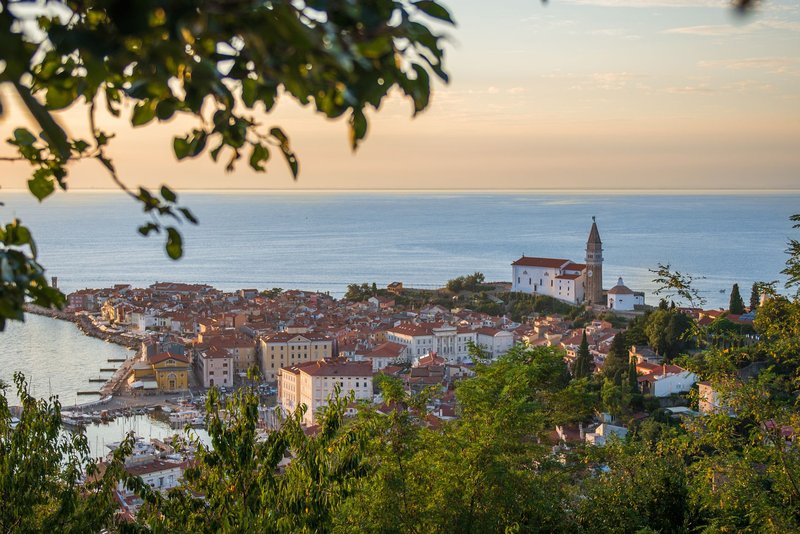
Italian is co-official along the short Adriatic coast, in Slovenian Istria. The towns of Koper, Izola, and Piran run bilingually. Street signs come in both languages, you can file paperwork in Italian, and local schools teach in it. Piran in particular wears its Venetian heritage openly — the architecture, the piazza, the name of the main square (Tartini Square, after a composer born there) all point across the water to Italy.
Hungarian holds the same status in Prekmurje, the flat farmland in the country’s northeast corner, in and around Lendava. It’s a region that spent centuries inside the Kingdom of Hungary, and the language stuck. Bilingual signage, Hungarian-language schooling, and official documents work the same way they do on the coast.
Both communities are small — together they’re a fraction of a percent of the national population — but their constitutional protection is robust. Each is guaranteed a seat in the National Assembly regardless of population size. The approach echoes across the border, too, where Austria likewise extends official recognition to its own autochthonous minority languages. For a country that fights hard to protect its own language abroad, extending the same courtesy at home is a point of principle.
Romani is also spoken by Slovenia’s Roma community and receives some legal recognition and support, though it doesn’t hold the co-official territorial status that Italian and Hungarian do.
Immigrant and community languages {#immigrant-and-community-languages}
Beyond the official picture, Slovenia is home to sizable communities who arrived mostly from elsewhere in the former Yugoslavia. Croatian, Serbian, and Bosnian are the most widely spoken of these, the legacy of decades of shared statehood and migration. You’ll hear them in cities, in workplaces, and across the older generation especially.
These languages don’t carry official status, but they’re a real part of the country’s everyday soundscape. Because they’re all South Slavic, the linguistic distance from Slovene is small enough that communities tend to be functionally multilingual without much effort. A Slovene of a certain age likely understands Serbo-Croatian from the Yugoslav era; younger Slovenes often don’t, and reach for English instead.
Is English spoken in Slovenia? {#is-english-spoken-in-slovenia}
Yes — widely, and well. English is the dominant foreign language taught in Slovenian schools, usually starting in primary grades, and German runs a steady second. The result is a country where most people under 50 speak conversational English, and many speak it fluently.
In Ljubljana, Bled, Piran, and the other places travelers actually go, you can navigate hotels, restaurants, museums, and transport in English without friction. Menus come in English. Staff switch to it the moment they clock your accent. Slovenia consistently ranks among the stronger non-native English-speaking countries in Europe, a function of small-language pragmatism: when your mother tongue is spoken by two million people, you learn the languages of your neighbors and the world.
German has deep historical roots here too, from the Habsburg centuries, and remains useful given the steady flow of Austrian and German tourists. Italian is common on the coast for the same reason it’s official there.
Slovene language facts worth knowing {#slovene-language-facts}
A few things that make the language distinctive:
- The dual number. Slovene marks “exactly two” as its own grammatical category, separate from singular and plural — one of the very few living European languages to keep it.
- Six cases. Nouns, adjectives, and pronouns change form depending on their grammatical role.
- Over 40 dialects. For a country smaller than New Jersey, the dialectal variety is remarkable — linguists group Slovene into roughly seven major dialect regions and dozens of local varieties, some barely intelligible to speakers from across the country. The mountainous terrain kept valleys linguistically isolated for centuries, much the same way the peninsula next door splintered into the dozens of distinct regional dialects of Italy.
- An EU official language since 2004. Slovene documents are produced in Brussels alongside French, German, and the rest.
- A literary anchor in a poet. France Prešeren, the 19th-century Romantic whose verse helped standardize the modern language, is the only national poet whose work supplies a country’s anthem — a stanza of his “Zdravljica” is Slovenia’s national hymn.
For a deeper reference on the language’s structure and history, the Encyclopaedia Britannica entry on Slovene is a solid starting point.
A traveler’s cheat sheet {#a-travelers-cheat-sheet}
You don’t need to learn Slovene to visit. But a few words go a long way, and locals genuinely appreciate the effort — partly because so few visitors bother.
- Hello — Živjo (informal) / Dober dan (good day, formal)
- Thank you — Hvala
- Please / you’re welcome — Prosim
- Yes / No — Ja / Ne
- Goodbye — Nasvidenje
- Do you speak English? — Govorite angleško?
- Cheers — Na zdravje
A practical note on the ground: in Ljubljana and the main tourist spots, lead with a Slovene greeting and then switch to English — you’ll get a warmer reception than opening cold in English. On the coast around Piran, Italian works too. Up in Prekmurje near Lendava, you’ll see Hungarian on the signs alongside Slovene.
The takeaway is simple. Slovene is the language of Slovenia, full stop, with Italian and Hungarian holding official status in the border communities that have spoken them for generations. Add a population that handles English with ease, and you’ve got a country that’s both fiercely protective of its own small language and remarkably easy to travel in.