
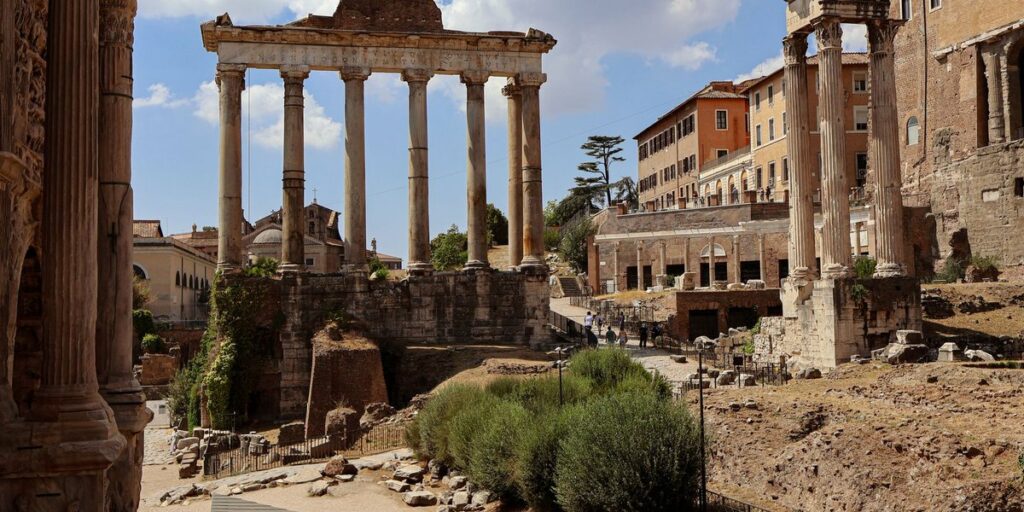
Most “ruins in Croatia” lists hand you the same three sites in a slightly different order: Diocletian’s Palace, the Pula Arena, Salona. They earned it. But if you’ve already got those bookmarked, you’re missing the better half of the story — the medieval ghost town no one lives in anymore, the Roman fort sitting in a national park, the cave where they found Neanderthal teeth.
This guide covers 11 ruins, grouped by region so you can actually plan a route. Each one comes with the practical stuff the glossy listicles skip: where it is, how to get there, what it costs, and how long you’ll really spend. Croatia packs Roman amphitheatres, abandoned hilltop towns, and a 130,000-year-old prehistoric site into a country you can drive across in a day. The trick is knowing which ones reward the detour.
Table of Contents
- The quick verdict
- Dalmatia: the Roman heavyweights
- 1. Diocletian’s Palace, Split
- 2. Salona (Solin)
- 3. Burnum, Krka National Park
- 4. Roman Forum, Zadar
- Istria: arenas and abandoned towns
- 5. Pula Arena
- 6. Dvigrad
- 7. Nesactium (Nezakcij)
- Beyond the coast: rivers, ports, and prehistory
- 8. Narona (Vid)
- 9. Andautonia (Ščitarjevo)
- 10. Krapina Neanderthal Site
- 11. Asseria (Podgrađe)
- Roman vs. medieval vs. prehistoric: how to pick
- Comparison table
The quick verdict
Short on time and just want the highlights? Here’s the bottom line:
- First-timer with one day: Diocletian’s Palace in Split, then a 20-minute drive to Salona. That’s the Roman story in a single morning, lived-in and ruined side by side.
- Want the single most impressive structure: The Pula Arena in Istria — one of the six largest surviving Roman amphitheatres, and you can walk its underground passages.
- Want something nobody else photographed: Dvigrad, a fully abandoned medieval town in inland Istria. Free, atmospheric, and usually empty.
- Traveling with a history nerd or a kid who likes “the cave people”: The Krapina Neanderthal Museum, a 45-minute drive from Zagreb, built right on the dig site.
The rest of this list fills in the route between those.
Dalmatia: the Roman heavyweights
The Dalmatian coast was the heart of Roman Dalmatia, and it shows. Within about an hour’s drive of Split you’ve got an inhabited palace, a flattened provincial capital, a fort hidden in a national park, and a forum a city built itself around.
1. Diocletian’s Palace, Split
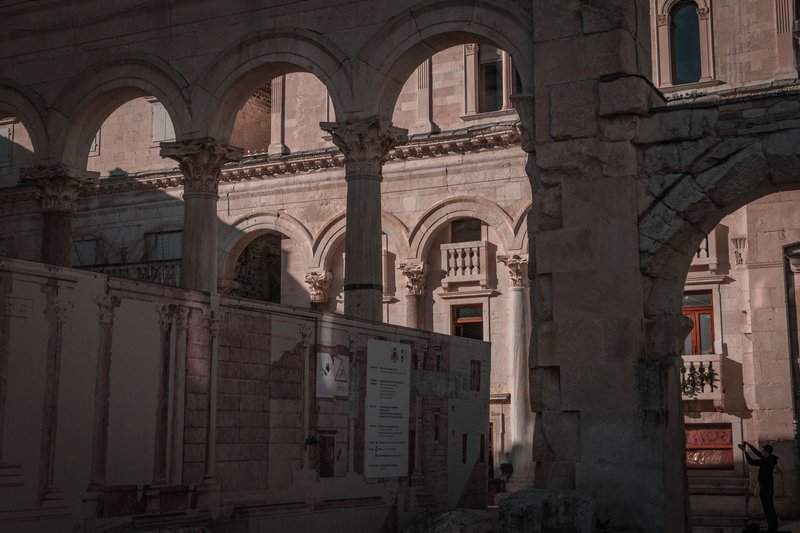
This isn’t a ruin you visit so much as one you walk through on your way to dinner. Emperor Diocletian built his retirement compound here around 305 AD, and when the nearby city of Salona collapsed centuries later, refugees moved into the palace walls and never left. Today roughly 3,000 people still live and work inside it. The cellars (the substructures) are the best-preserved part — vast vaulted halls that held up the emperor’s apartments above, later used as a wine cellar, a dumping ground, and a Game of Thrones filming set.
The peristyle, the central courtyard ringed with columns, is the photo everyone takes. Go at 8 AM or after sunset to get it without the crowd. Diocletian’s mausoleum became the cathedral — a strange twist, since the emperor was one of Christianity’s most aggressive persecutors and his tomb now sits under a Christian altar.
- Where: Old town Split, on the harbor.
- Getting there: Split is the second-largest city in Croatia, with an airport, ferry port, and direct buses from Zagreb (about 5 hours) and Dubrovnik (about 4.5 hours).
- Cost: Walking the palace streets is free. The cellars cost around €7; the cathedral bell tower is a separate small fee.
- Time needed: 1.5 to 2 hours, more if you climb the bell tower.
- Best season: Spring or autumn. July and August are brutally crowded and hot.
2. Salona (Solin)
If Diocletian’s Palace is the Roman city that survived, Salona is the one that didn’t. This was the capital of Roman Dalmatia and a city of tens of thousands before the Avars and Slavs sacked it in the early 7th century. The survivors fled to Diocletian’s Palace down the road — so the two sites are two halves of one story.
What’s left is sprawling and quiet: the amphitheatre’s foundations, an early Christian basilica complex at Manastirine, city walls, and a necropolis. It’s far less polished than Split’s old town, which is the point — you wander overgrown fields of stone with almost no barriers between you and the history. Bring water and decent shoes; there’s little shade. If Salona whets your appetite, it’s worth scanning a fuller rundown of the historical places scattered across Croatia to see how the Roman remains here fit into the country’s longer story.
- Where: Solin, about 5 km northeast of Split.
- Getting there: Local bus #1 from Split’s old town drops you near the entrance in about 20 minutes; a taxi or car is faster.
- Cost: Around €5.
- Time needed: 1.5 to 2 hours to do it justice.
- Best season: Spring or autumn — summer offers no shelter from the sun.
3. Burnum, Krka National Park
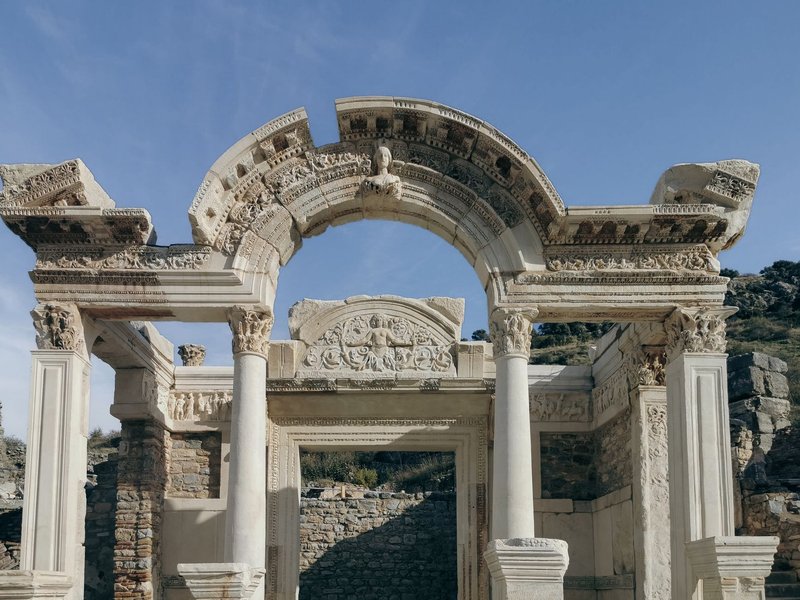
Most people come to Krka National Park for the waterfalls and never realize there’s a Roman military camp on the way. Burnum was a legionary fortress on the Krka river frontier, and its surviving arches — part of the camp’s command building, the praetorium — stand alone in open scrubland with the river canyon behind them. There’s also an amphitheatre excavation nearby, one of the few Roman military arenas found in Croatia.
It’s the kind of place you have largely to yourself because the crowds are chasing the falls. The Puljani eco-campus visitor center nearby displays finds from the dig.
- Where: Northern edge of Krka National Park, near Kistanje, inland from Šibenik.
- Getting there: Easiest by car. It’s off the main tourist loop of the park, so check access with the park before you go — the arches and amphitheatre are sometimes reachable only via park transport or specific entrances.
- Cost: Falls within Krka National Park entry, which varies sharply by season (roughly €10 to €40).
- Time needed: About 1 hour for the Roman sites alone.
- Best season: Late spring or early autumn for park access and lighter crowds.
4. Roman Forum, Zadar
Zadar’s forum is the largest on the eastern side of the Adriatic, laid out in the 1st century BC under Augustus. It sits open-air in the middle of the old town, so you stroll across it for free on your way to the famous Sea Organ. The standout piece is a single tall Corinthian column that was later used as a “pillar of shame” — a public spot to chain and humiliate wrongdoers in the medieval period.
Right beside it stands the 9th-century Church of St. Donatus, a hulking round Byzantine-era building partly built from recycled Roman stone you can still spot in its foundations. The forum plus the church plus the Sea Organ makes for an efficient half-day in Zadar.
- Where: Old town Zadar, on the peninsula.
- Getting there: Zadar has an airport and is a major bus hub; it’s roughly 1.5 hours from Split by motorway.
- Cost: Free to walk the forum. St. Donatus charges a small entry fee.
- Time needed: 45 minutes for the forum and church.
- Best season: Any — it’s exposed but central and quick.
Istria: arenas and abandoned towns
Istria, the heart-shaped peninsula in the northwest, has a different flavor — closer to Italy in food and feel, and home to both Croatia’s grandest Roman monument and its most haunting medieval one.
5. Pula Arena
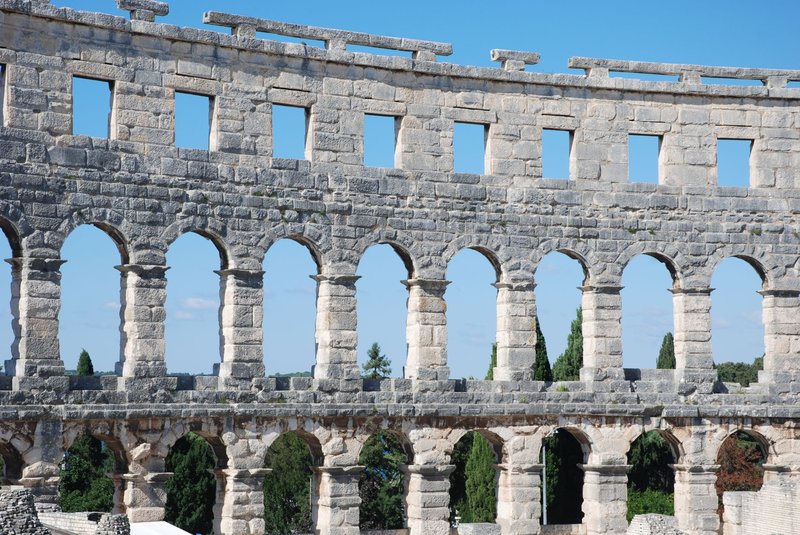
This is the one that out-impresses Split for sheer scale. The Pula Arena is among the six largest surviving Roman amphitheatres in the world, built in the 1st century AD to seat around 23,000 spectators for gladiator fights. What makes it rare is how complete the outer ring is — three storeys of arches still standing, where most surviving amphitheatres lost their outer walls to stone-robbing.
Go underground: the passages beneath the arena, where animals and fighters once waited, now hold an exhibit on Roman olive oil and wine production in Istria. The arena still hosts concerts and a film festival every summer, so you might catch it lit up at night.
- Where: Pula, southern tip of Istria.
- Getting there: Pula has an airport and bus connections; it’s about a 1-hour drive from Rovinj, 3.5 hours from Zagreb.
- Cost: Around €10.
- Time needed: 1 to 1.5 hours.
- Best season: Spring through early autumn. Check the events calendar — a concert night closes daytime visits but is a sight in itself.
6. Dvigrad
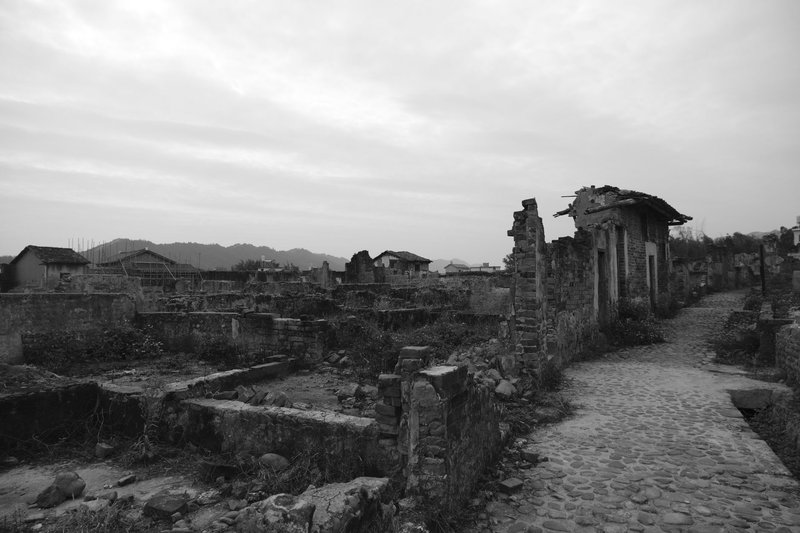
Here’s the one that no big listicle covers properly. Dvigrad is a completely abandoned medieval town in inland Istria — not a managed ruin with a ticket booth, but a real ghost town. Its residents fled in the 17th century after plague and the malaria-carrying mosquitoes of the nearby valley made life impossible, and the town has stood empty ever since.
You walk up through the old gate and find roofless stone houses, a ruined church, and lanes overgrown with vegetation. There’s no soundtrack but birds and wind. It’s the closest thing Croatia has to walking into a place where time simply stopped. Bring sturdy shoes — the footing is uneven and there are no railings.
- Where: Near Kanfanar, central Istria, in the Lim valley area.
- Getting there: Car only, realistically. It’s a short drive from the Pula–Rovinj corridor, signposted from Kanfanar.
- Cost: Free.
- Time needed: 45 minutes to an hour.
- Best season: Spring or autumn — summer vegetation can overgrow the paths, and there’s no shade or facilities.
7. Nesactium (Nezakcij)
Before the Romans, Istria belonged to the Histri, the Illyrian people the peninsula is named after. Nesactium was their capital and last stronghold, which the Romans besieged and took in 177 BC — according to the Roman account, the Histri leaders threw themselves from the walls rather than surrender. What you see today is mostly the Roman town built on top, with foundations of two forums, basilicas, and temples, plus the older Histrian layers beneath.
It’s an archaeological site for people who like reading the ground rather than admiring standing walls. The on-site display helps make sense of what you’re looking at.
- Where: Near Valtura, southeast of Pula.
- Getting there: About a 15-minute drive from Pula; car is easiest.
- Cost: Small entry fee, around €4.
- Time needed: 45 minutes.
- Best season: Spring or autumn.
Beyond the coast: rivers, ports, and prehistory
The famous ruins cluster on the coast, but some of Croatia’s most interesting sites sit inland — including the one that predates the Romans by a hundred thousand years.
8. Narona (Vid)
Narona was a major Roman port city on the Neretva river delta, and its star attraction is the Augusteum — a temple dedicated to the cult of the emperor Augustus. The Archaeological Museum Narona was built directly over the excavated temple foundations, so you walk on a glass floor above the original Roman floor, surrounded by a recovered group of larger-than-life imperial statues found right there. It’s one of the only in-situ Roman temple museums of its kind in the region.
- Where: Vid, near Metković, in the far south of Croatia inland from the coast.
- Getting there: Car is best; it’s roughly between Split and Dubrovnik, a short detour off the coastal route near the Neretva delta.
- Cost: Around €4 to €5.
- Time needed: 45 minutes to an hour.
- Best season: Any — it’s an indoor museum, a good rainy-day option.
9. Andautonia (Ščitarjevo)
If you’re flying in or out of Zagreb, Andautonia is the Roman site almost no tourist knows about. It was a Roman town on the Sava river, and the excavated remains — streets, a bathhouse with a hypocaust heating system, and drainage — sit in an open-air archaeological park in the village of Ščitarjevo. It’s modest, but it’s the rare chance to see Roman daily-life infrastructure rather than monuments, and you’ll likely have it to yourself.
- Where: Ščitarjevo, about 15 km southeast of Zagreb.
- Getting there: Short drive from Zagreb; limited public transport, so a car helps.
- Cost: Small, around €3 to €4.
- Time needed: 45 minutes.
- Best season: Spring through autumn — it’s an outdoor park.
10. Krapina Neanderthal Site
This is the wild card, and arguably the most important site on the list. In 1899, a hillside at Hušnjakovo near Krapina yielded one of the richest collections of Neanderthal remains ever found — hundreds of bone fragments from dozens of individuals, dated to roughly 130,000 years ago. The modern Krapina Neanderthal Museum is built into the hill at the actual dig site, with life-sized reconstructions and a walk-through of human evolution.
It’s not a “ruin” in the Roman sense, but it’s the oldest trace of humans you can stand on in Croatia, and it’s genuinely one of the best-designed museums in the country. Great for families.
- Where: Krapina, in the Zagorje region north of Zagreb.
- Getting there: About a 45-minute to 1-hour drive from Zagreb; Krapina is also reachable by train.
- Cost: Around €8.
- Time needed: 1.5 to 2 hours.
- Best season: Any — it’s a modern indoor museum.
11. Asseria (Podgrađe)
For the completist, Asseria is a Liburnian and later Roman hilltop town near Benkovac in the Dalmatian hinterland. Its massive megalithic defensive walls — some of the oldest and best-preserved Liburnian fortifications in the region — predate the Romans, who later added a forum, gates, and a triumphal arch. It’s remote, unfenced, and rarely visited, which is exactly the appeal if you’ve had your fill of ticketed sites.
- Where: Podgrađe, near Benkovac, inland from Zadar.
- Getting there: Car only; it’s off the main routes in the Ravni Kotari hinterland.
- Cost: Free.
- Time needed: 45 minutes to an hour.
- Best season: Spring or autumn — exposed hilltop with no shade.
Roman vs. medieval vs. prehistoric: how to pick
Croatia’s ruins fall into three rough buckets, and which you chase depends on what you’re after.
Roman is the deepest bench: Diocletian’s Palace, the Pula Arena, Salona, Burnum, Zadar’s forum, Narona, Andautonia, and the Roman layers at Nesactium and Asseria. If you want standing monuments and recognizable architecture — arches, columns, amphitheatres — start here.
Medieval is thinner but more atmospheric. Dvigrad is the standout: an abandoned town with no curation, no crowds, and a genuine ghost-town silence you won’t get at the polished Roman sites.
Prehistoric means Krapina, in a category of its own — 130,000 years of human history on a single hillside, packaged in a museum that does the science justice. There’s also the Histrian foundation at Nesactium and the Liburnian walls at Asseria for those who want the pre-Roman layer.
A balanced trip mixes eras: pair Split’s living Roman palace with the dead Roman city at Salona, then break the pattern with abandoned Dvigrad up in Istria. That contrast — inhabited, destroyed, abandoned — tells you more about how these places lived and died than three Roman temples in a row ever could.
Comparison table
| Site | Region | Era | Cost | Time | Car needed? |
|---|---|---|---|---|---|
| Diocletian’s Palace | Split | Roman | Free / €7 cellars | 1.5–2 hr | No |
| Salona | Split | Roman | ~€5 | 1.5–2 hr | No (bus #1) |
| Burnum | Krka NP | Roman | Park entry | ~1 hr | Yes |
| Roman Forum | Zadar | Roman | Free | 45 min | No |
| Pula Arena | Istria | Roman | ~€10 | 1–1.5 hr | No |
| Dvigrad | Istria | Medieval | Free | 45–60 min | Yes |
| Nesactium | Istria | Histrian/Roman | ~€4 | 45 min | Yes |
| Narona | Neretva | Roman | ~€4–5 | 45–60 min | Yes |
| Andautonia | Zagreb | Roman | ~€3–4 | 45 min | Helps |
| Krapina | Zagorje | Prehistoric | ~€8 | 1.5–2 hr | Train or car |
| Asseria | Zadar hinterland | Liburnian/Roman | Free | 45–60 min | Yes |
Prices and access change seasonally, so confirm current tickets and opening hours before you go — especially for the national-park sites, where entry fees swing hard between low and high season. But the route is the constant: Croatia gives you 2,000 years of ruins, from a Neanderthal hillside to an emperor’s palace people still live in, all within a country you can cross in an afternoon. The big-three sites are worth it. The other eight are why you bothered to rent the car.