
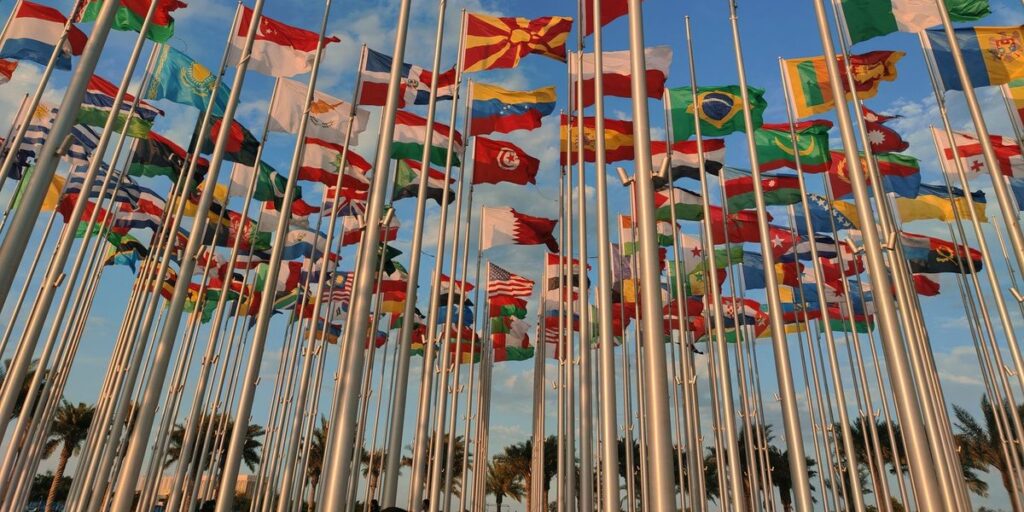
No country flies an all-black flag. That’s the first thing worth settling, because half the people searching this are really asking whether some nation out there runs a solid black banner. None does. The closest anyone came was New Zealand, which floated an all-black option during its 2015–16 flag referendum before voters kept the existing one.
What plenty of countries do have is black as one of their flag colors — and once you start counting, the number climbs past forty. The black almost never means “dark” or “ominous.” It usually points to something specific: Abbasid and Pan-Arab heritage, the African people and their resilience, the blood of fallen fighters, or a nation’s mineral wealth. Below is the full list, grouped so you can actually find what you’re after.
Table of Contents
- Is there an all-black country flag?
- Pan-Arab flags (red, white, black, green)
- Pan-African flags (red, black, green)
- Other national flags with black
- What does black symbolize on a flag?
- Quick reference table
Is there an all-black country flag?
No sovereign nation uses a fully black flag. Black shows up as a stripe, a triangle, a canton, or a charge — never the whole field.
The all-black flag people picture is usually one of three things: a pirate’s Jolly Roger, the anarchist black flag, or the motorsport “race over” flag. None are national. The one real brush with an all-black national flag came from New Zealand. During the public process to possibly replace the Union Jack design, an all-black flag (a nod to the All Blacks and the silver fern) drew serious support but lost out, and New Zealand voted to keep its current flag in March 2016.
So when this list says “black flags,” it means national flags that contain black. There are a lot of them.
Pan-Arab flags (red, white, black, green)
This is the single biggest cluster. The four Pan-Arab colors — red, white, black, and green — trace back to a verse by the 14th-century poet Safi al-Din al-Hilli and to the historic Arab dynasties: black for the Abbasids, white for the Umayyads, green for the Fatimids, red for the Hashemites. The black almost always carries that Abbasid-era weight. Red, in fact, turns up far more often than black across the world’s banners — it’s on roughly three-quarters of all national flags, which is why so many of these designs read as red-and-black at a glance.
- Jordan — Adopted 1928. Horizontal black, white, and green stripes with a red triangle and a seven-pointed star. Black represents the Abbasid Caliphate.
- Palestine — Adopted 1964 (raised over Palestinian areas widely from 1988). Same horizontal bands and red triangle as Jordan, minus the star. Black for the Abbasids.
- United Arab Emirates — Adopted 1971. Red vertical bar beside horizontal green, white, and black. Black stands for the defeat of enemies and the strength of the mind.
- Kuwait — Adopted 1961. Green, white, and red horizontal stripes with a black trapezoid at the hoist. The black is drawn from al-Hilli’s poem.
- Sudan — Adopted 1970. Red, white, and black horizontal stripes with a green triangle. The classic Arab Liberation arrangement.
- Syria — The 2025 transitional flag returned to green, white, and black stripes with three red stars; black again signals the Abbasid period.
- Egypt — Adopted 1984. Red, white, and black with the gold Eagle of Saladin. Black symbolizes the end of oppression.
- Iraq — Adopted 2008. Red, white, and black with the green takbir script. Black for the line of the Prophet and the Abbasids.
- Yemen — Adopted 1990. Plain red, white, and black horizontal bands. Black recalls the dark days of the past.
- Libya — Adopted 2011. Red, black, and green with a white star and crescent. The black band represents the Cyrenaica region and the struggle against occupation.
- Western Sahara (SADR) — Black, white, and green stripes with a red triangle, star, and crescent. Same Pan-Arab logic; black for the oppression the people endured.
Pan-African flags (red, black, green)
The Pan-African palette — red, black, green — comes from Marcus Garvey’s Universal Negro Improvement Association flag of 1920. Here the black means the people themselves: Black Africans and the broader diaspora. Red is the blood shed for liberation, green the land.
- Kenya — Adopted 1963. Black, red, and green stripes with a Maasai shield and spears. Black represents the people of Kenya.
- Malawi — Adopted 1964. Black, red, and green with a rising red sun. Black for the African people.
- South Sudan — Adopted 2011. Black, red, and green stripes with a blue triangle and gold star. Black for the people of South Sudan.
- Trinidad and Tobago — Adopted 1962. Red field with a diagonal black stripe edged in white. Black represents the dedication and strength of the people.
- Papua New Guinea — Adopted 1971. Diagonally split red and black, with a gold bird-of-paradise and the Southern Cross. Black is a traditional color of the people.
- Saint Kitts and Nevis — Adopted 1983. A broad black diagonal band with two white stars. Black symbolizes the African heritage of the population.
Other national flags with black
Plenty of flags use black for reasons that have nothing to do with the Arab or Pan-African traditions — coal, soil, the night sky, or a specific historical loss. Black also pairs more often with muted tones than you’d expect; if you’re sorting by color, it’s worth seeing how it overlaps with the countries that combine brown, black, and white, where the line between a dark stripe and a true black one gets genuinely blurry.
- Germany — The modern tricolor dates to 1949 (and to 1848). Black, red, and gold, tied to the uniforms of the Napoleonic-era Lützow Free Corps.
- Belgium — Adopted 1831. Vertical black, yellow, and red, derived from the arms of the Duchy of Brabant.
- Estonia — Adopted 1918 (restored 1990). Blue, black, and white. The black band stands for the soil of the homeland and the dark past of the Estonian people.
- Angola — Adopted 1975. Red over black with a gold machete-and-cog emblem. Black represents the African continent.
- Mozambique — Adopted 1983. Green, black, and yellow with a red triangle. Black for the African continent; this is also the only national flag with a modern firearm on it.
- Botswana — Adopted 1966. Light blue with a central black band edged in white. The black-and-white stripes represent racial harmony, mirrored in the country’s zebra.
- Tanzania — Adopted 1964. Green and blue split by a black diagonal stripe. Black represents the Swahili people.
- Uganda — Adopted 1962. Six black, yellow, and red bands with the grey crowned crane. Black symbolizes the African people.
- South Africa — Adopted 1994. A Y-shaped design joining six colors, black among them, in the central pall and the green-bordered black triangle at the hoist.
- Brunei — Adopted 1959. Yellow field with black and white diagonal stripes representing the country’s two chief ministers.
- Afghanistan — The black, red, and green tricolor was used through 2021; the black band recalled the country’s troubled past and foreign occupations.
- Bahrain and Qatar — Both use white and a deep maroon/red rather than true black, so they’re often mistaken for black-flag countries. Worth knowing if you’re sorting flags by color and the eye plays tricks.
What does black symbolize on a flag?
Black on a national flag almost never means death in the Western, funereal sense. The meaning splits cleanly along a few lines:
- The people. In Pan-African flags, black is the population — Black Africans and the diaspora. Kenya, Malawi, South Sudan, Trinidad and Tobago all read this way.
- Dynastic and religious heritage. Across the Arab world, black is the color of the Abbasid Caliphate and appears in the Pan-Arab scheme drawn from al-Hilli’s poem. The layered identities behind that scheme are easy to flatten, but a place like Algeria, with its Arab and Berber roots, shows how much history a single color can stand in for.
- Endurance and the dark past. Estonia, Yemen, and Afghanistan use black to mark hardship survived — occupation, suffering, the years before independence.
- The land and its wealth. Some flags read black as soil or mineral resources rather than people or history.
If you want the deeper rabbit hole on color meanings across hundreds of flags, the Flag Institute, Britain’s national flag charity, is a credible place to start rather than the usual content-mill galleries.
Quick reference table
| Country | Adopted | Group | What black means |
|---|---|---|---|
| Jordan | 1928 | Pan-Arab | Abbasid Caliphate |
| Palestine | 1964 | Pan-Arab | Abbasid Caliphate |
| UAE | 1971 | Pan-Arab | Strength, defeat of enemies |
| Kuwait | 1961 | Pan-Arab | Pan-Arab heritage |
| Sudan | 1970 | Pan-Arab | Arab liberation |
| Syria | 2025 | Pan-Arab | Abbasid period |
| Egypt | 1984 | Pan-Arab | End of oppression |
| Iraq | 2008 | Pan-Arab | Prophet’s line / Abbasids |
| Yemen | 1990 | Pan-Arab | The dark past |
| Libya | 2011 | Pan-Arab | Cyrenaica region |
| Western Sahara | — | Pan-Arab | Oppression endured |
| Kenya | 1963 | Pan-African | The people |
| Malawi | 1964 | Pan-African | The African people |
| South Sudan | 2011 | Pan-African | The people |
| Trinidad & Tobago | 1962 | Pan-African | Strength of the people |
| Papua New Guinea | 1971 | Pan-African | The people |
| Saint Kitts & Nevis | 1983 | Pan-African | African heritage |
| Germany | 1949 | Other | Lützow Free Corps |
| Belgium | 1831 | Other | Arms of Brabant |
| Estonia | 1918 | Other | Soil / the dark past |
| Angola | 1975 | Other | The African continent |
| Mozambique | 1983 | Other | The African continent |
| Botswana | 1966 | Other | Racial harmony |
| Tanzania | 1964 | Other | The Swahili people |
| Uganda | 1962 | Other | The African people |
| South Africa | 1994 | Other | Part of the unity design |
| Brunei | 1959 | Other | A chief minister |
| Afghanistan | (to 2021) | Other | The troubled past |
The pattern, once you see it, is hard to unsee. Group a flag by its color scheme and the black almost tells you the rest — Pan-Arab red-white-black-green points east to the Abbasids, the red-black-green tricolor points to Garvey and the African diaspora, and the odd ones out usually trace black back to their own soil or their own history. No solid black flag anywhere, but plenty of nations that put black front and center for reasons worth knowing.