
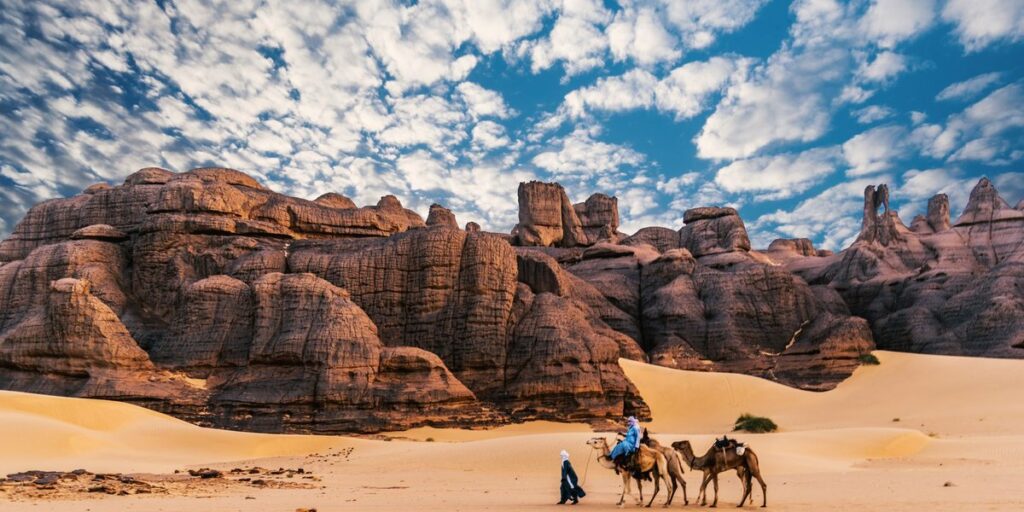
Table of Contents
- The Demographic Picture
- The Arab-Berber Identity Paradox
- The Kabyle: Algeria’s Most Assertive Minority
- The Shawia: Highlands, Resilience, and Relative Quiet
- The Mozabites: Isolated by Choice
- The Tuareg: Desert Nomads at the Crossroads
- Smaller Communities and Historical Minorities
- Ethnicity and Politics Today
- Summary Table: Algeria’s Ethnic Groups
Algeria is the largest country in Africa by area, and its population reflects the layered history that comes with that territory. Desert empires, Roman provinces, Arab conquests, Ottoman rule, French colonization — each left its mark on the people who live there today. But the standard summary you’ll find in most textbooks — “99% Arab-Berber” — tells you almost nothing useful. That single hyphenated category contains communities with distinct languages, geographies, and political grievances that are very much alive in 2026.
Here’s what Algeria’s ethnic landscape actually looks like.
The Demographic Picture
Algeria’s population sits at roughly 46 million people. Official government data doesn’t break down ethnicity in fine-grained terms — a politically sensitive choice — but estimates from academic sources and organizations tracking North African demographics consistently paint a similar picture:
| Ethnic Group | Approximate Share | Primary Region |
|---|---|---|
| Arab (culturally) | ~70% | Northern plains, cities |
| Kabyle Berber | ~14–15% | Kabylie mountains |
| Shawia Berber | ~3–5% | Aurès mountains |
| Mozabite Berber | ~1% | M’zab valley |
| Tuareg Berber | ~1% | Saharan south |
| Other (Chenoua, Zenati dialects) | ~2–3% | Various |
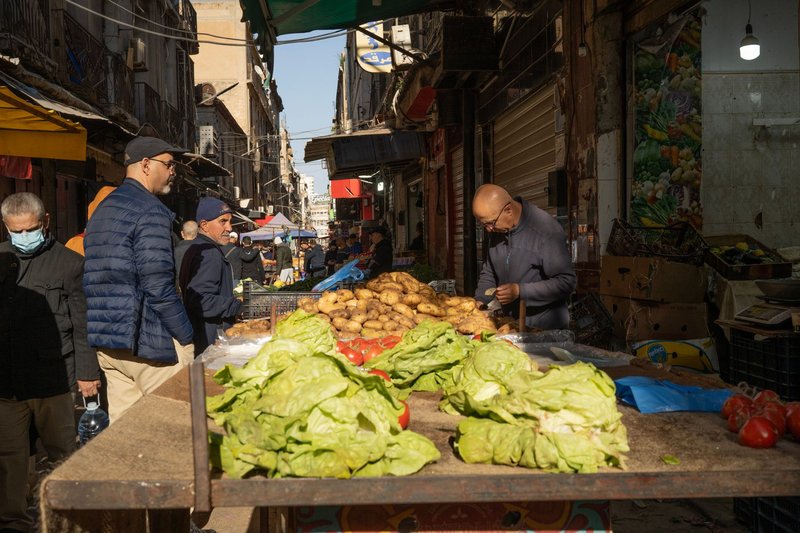
The key caveat: “Arab” in the Algerian context is more of a cultural and linguistic identity than a genetic one. The genetic picture looks quite different.
The Arab-Berber Identity Paradox
This is the part that most demographic summaries skip, and it’s arguably the most important thing to understand about Algeria’s ethnic makeup.
Berbers — properly called Imazighen (singular: Amazigh) — are the indigenous population of North Africa, predating Arab arrival by thousands of years. The Arab conquest of the 7th and 8th centuries brought Islam and the Arabic language, but it did not replace the population. What happened over the following centuries was a process of cultural Arabization: Berber communities gradually adopted Arabic as their primary language, intermarried with Arab settlers, and came to identify as Arab in cultural and religious terms — even though genetically, most Algerians carry predominantly Berber ancestry. Algeria is one of several Arabic-speaking countries in Africa where this pattern of linguistic Arabization ran far ahead of actual population replacement.
A 2000 study published in the European Journal of Human Genetics found that North African populations, including Algerians, show genetic profiles that are primarily indigenous — distinct from both Arabian Peninsula Arab populations and sub-Saharan African groups. By most genetic analyses, the majority of people who identify as culturally Arab in Algeria have ancestry that is overwhelmingly Berber in origin.
This matters because it reframes the entire “Arab vs. Berber” framing. Most Algerians who call themselves Arab are, genetically speaking, Berbers who underwent linguistic and cultural assimilation over roughly fourteen centuries. The Berbers who maintained their distinct languages and identities are not a minority who survived despite the Arabs — they’re the segment of the same population that resisted cultural absorption.
The Kabyle: Algeria’s Most Assertive Minority
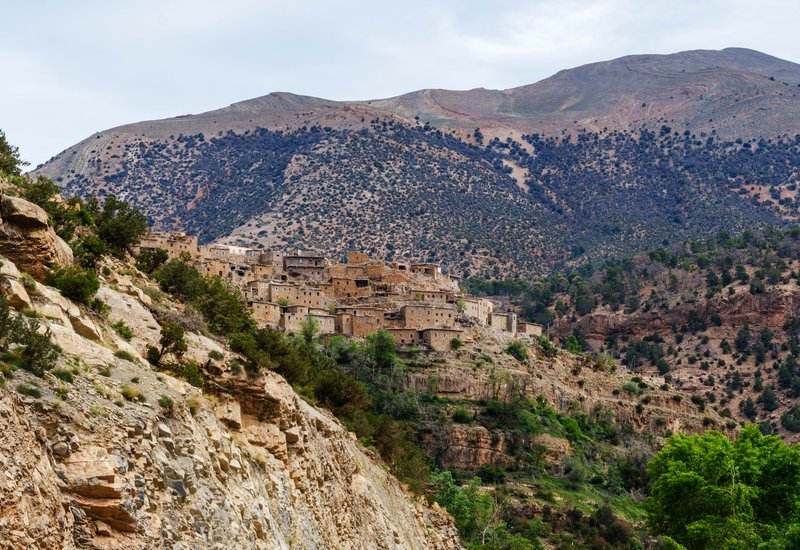
The Kabyle are the largest Berber subgroup in Algeria, concentrated in the Kabylie region — a rugged mountain area roughly 100 kilometers east of Algiers. Their language, Taqbaylit, is one of the most widely spoken Berber languages in the world, and Kabyle identity is deeply tied to that linguistic and cultural continuity.
The Kabyle have historically been one of the most educated and politically active groups in Algeria. Their mountainous terrain made full Arabization difficult — the same geographic isolation that kept Ottoman and French control relatively light also preserved Berber language and customs. Today, Kabylie has a strong civil society, a significant diaspora in France, and a history of organized political resistance.
The most significant recent chapter is the Black Spring of 2001. Following the death of a young Kabyle man in gendarmerie custody, protests swept the region, resulting in over 120 deaths and a political standoff with the Algerian government. The outcome included a 2002 constitutional amendment recognizing Tamazight (the collective term for Berber languages) as a national language — a significant concession, though Kabyle activists pushed further for official status, which came in 2016.
Kabyle culture is also notable for its relatively strong tradition of gender equality compared to other Algerian communities — a legacy of pre-Islamic customary law that gave women property rights and a voice in village assemblies.
The Shawia: Highlands, Resilience, and Relative Quiet
The Shawia (also spelled Chaoui or Chawi) inhabit the Aurès mountain range in northeastern Algeria, a region that held out against Arab, Roman, and French control with striking stubbornness. Their language, Tachawit, is related to Kabyle but distinct enough that speakers of the two languages often struggle to understand each other.
Numbering somewhere between 1.5 and 2.5 million, the Shawia are the second-largest Berber group in Algeria. Unlike the Kabyle, they’ve been less politically mobilized around Berber identity — partly because the Aurès has a stronger tradition of integration with Arab-Algerian national identity (the region was a crucible of the independence war against France), and partly because Shawia communities are more dispersed across rural areas.
That said, Tachawit remains a living language. You’ll hear it in markets, in homes, and on local radio stations in the Aurès, even as younger generations increasingly shift to Arabic in cities.
The Mozabites: Isolated by Choice
The M’zab valley in central Algeria — a five-town oasis cluster about 600 kilometers south of Algiers — has been home to the Mozabite community for roughly a thousand years. The Mozabites are ethnically Zenati Berber and religiously Ibadi Muslim, a sect that split from mainstream Islam in the 7th century and today survives primarily in Oman and in isolated North African enclaves like M’zab.
Their religious distinctiveness has always set them apart. Ibadi Islam prohibits mixing with Maliki Sunni Muslims — the majority school in Algeria — so the Mozabites built their settlements to be defensible and self-contained, with strict rules about outsider settlement. The pentapolis (five cities: Ghardaïa, Beni Isguen, Melika, Bounoura, and El-Atteuf) was designed as a unified religious and civic system, with Beni Isguen still requiring non-residents to leave before sundown.
UNESCO recognized the M’zab valley as a World Heritage Site in 1982 for precisely this reason — it’s a remarkably intact medieval Berber urban system, designed by the 11th-century scholar Abu Bakr ibn Saïd according to principles that predate modern urban planning by nine centuries.
The Mozabites number around 400,000 to 500,000 people. They’ve experienced periods of serious sectarian tension with Arab settlers in the region, most recently in 2015 when riots in Ghardaïa resulted in deaths and property destruction on both sides.
The Tuareg: Desert Nomads at the Crossroads
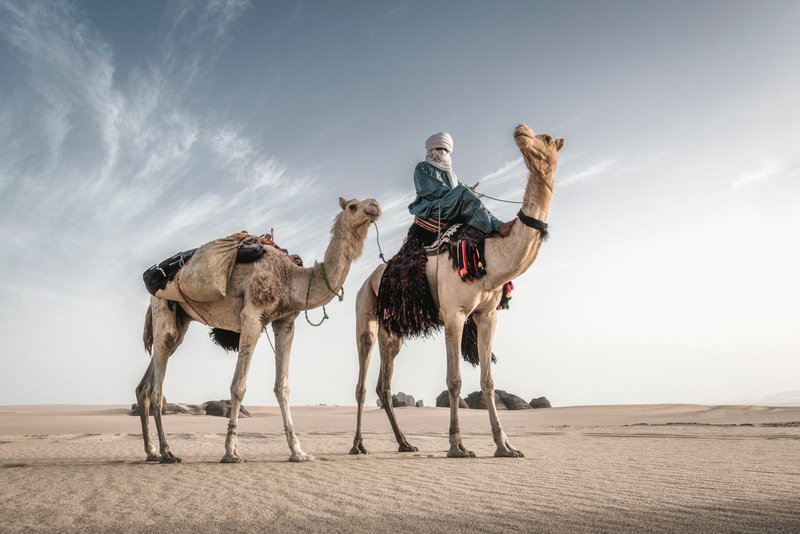
The Tuareg are the most geographically spread of Algeria’s Berber groups — their traditional territory, called Kel Tamasheq after their language, spans the central Sahara across Algeria, Mali, Niger, Burkina Faso, and Libya. In Algeria, they’re concentrated in the far south, particularly around the Tamanrasset region.
Tuareg culture is built around the camel and the desert. Historically, they controlled trans-Saharan trade routes, taxing and protecting merchants moving gold, salt, and slaves across the desert. The caravanning economy collapsed with colonization, but the Tuareg maintained their nomadic and semi-nomadic lifestyle far longer than most African groups — many Algerian Tuareg continued seasonal migrations until the droughts of the 1970s and 1980s forced a shift toward settled life.
One striking cultural feature: Tuareg society is matrilineal in property transmission, and unusually for a Muslim society, it’s the men — not the women — who traditionally wear face veils. The Tagelmust, a blue or indigo cloth wrapped around the head and face, is worn by men as a marker of adulthood and social status.
Algeria’s Tuareg population is small relative to the total — perhaps 40,000 to 60,000 people — but they matter disproportionately in terms of regional security. The destabilization of Mali and Niger following the fall of Muammar Gaddafi in 2011 (who had used Tuareg mercenaries extensively) sent armed men and weapons flowing through Tuareg corridors in southern Algeria. The Algerian military has invested heavily in controlling these routes.
Smaller Communities and Historical Minorities
Beyond the major Berber subgroups, Algeria has several smaller communities worth noting:
Chenoua Berbers live in the coastal hills west of Algiers, particularly around Tipaza. Their language, Tachenitt, is linguistically distinct and spoken by perhaps 100,000 people — making it one of the smaller surviving Berber languages in North Africa.
Zenati dialect speakers are scattered across northeastern Algeria and the Algerian-Moroccan border region, representing a transitional linguistic group between Kabyle and Moroccan Riffian Berber.
Haratine are Black Algerians, historically associated with oasis agriculture in the Sahara and often descendants of slaves brought through trans-Saharan trade networks. Their exact numbers are uncertain, but they represent a distinct community facing documented discrimination in southern Algeria.
European-descended Algerians — predominantly French, Spanish, and Italian — numbered over a million before independence in 1962. The overwhelming majority left during and after the War of Independence. A small number of harkis (Algerians who fought for France) and their descendants remain, but European ethnicity is no longer a meaningful demographic category in Algeria.
Ethnicity and Politics Today
Algeria’s constitution recognizes three official components of national identity: Arab, Amazigh (Berber), and Islamic. In practice, the relationship between these categories has been contested since independence.
The post-independence government under the FLN pursued aggressive Arabization — replacing French with Arabic in schools and government, which often meant replacing local Berber languages as well. The Berber Cultural Movement, which emerged in the 1970s, pushed back. The Berber Spring of 1980 — when the government cancelled a lecture by Kabyle writer Mouloud Mammeri on ancient Berber poetry — triggered strikes and protests that became a founding moment of organized Amazigh activism.
Tamazight was added as a national language in 2002 and an official language in 2016 — significant milestones, though critics note that official status without robust implementation in schools and government doesn’t change much on the ground. Algeria’s 2020 constitutional revision retained Tamazight as a co-official language alongside Arabic, while making clearer that Arabic holds primacy in state functions.
The Hirak protest movement of 2019–2021, which pushed out long-serving president Abdelaziz Bouteflika, drew heavily from Kabyle regions and carried Amazigh flags prominently — a visible signal that Berber identity and democratization demands have become intertwined in Algerian civil society.
Summary Table: Algeria’s Ethnic Groups
| Group | Language | Region | Population (est.) | Key Notes |
|---|---|---|---|---|
| Arab-Algerian | Algerian Arabic (Darija) | Northern plains, all cities | ~32–35 million | Largely Berber genetic ancestry; culturally Arabized |
| Kabyle | Taqbaylit | Kabylie mountains | ~6–7 million | Most politically active Berber group; 2001 Black Spring |
| Shawia | Tachawit | Aurès mountains | ~1.5–2.5 million | Strong connection to independence war identity |
| Mozabite | Tumzabt | M’zab valley | ~400,000–500,000 | Ibadi Muslim; UNESCO heritage sites |
| Tuareg | Tamasheq | Tamanrasset, far south | ~40,000–60,000 | Matrilineal; key in Saharan security context |
| Chenoua | Tachenitt | Tipaza coastal hills | ~100,000 | One of smallest surviving Berber languages |
| Haratine | Arabic/Tamasheq | Southern oases | Uncertain | Historically associated with trans-Saharan slavery |
Algeria’s ethnic picture isn’t as simple as the census data suggests. The “Arab-Berber” hyphen in official statistics papers over a genuinely complex history of assimilation, resistance, and rediscovery — one that’s actively shaping Algerian politics today. For travelers heading to Algeria, understanding this context makes the country considerably more legible: why Kabylie feels different from Algiers, why the south feels like a different country entirely, and why the Amazigh flag appears alongside the Algerian national flag at protests. These aren’t minor subcultures. They’re the substrate the whole country is built on.