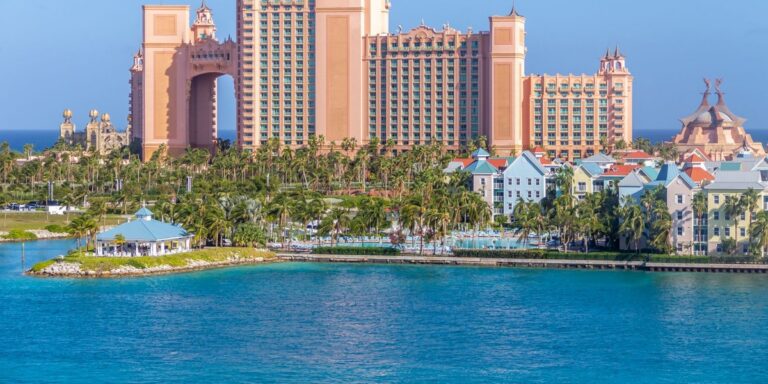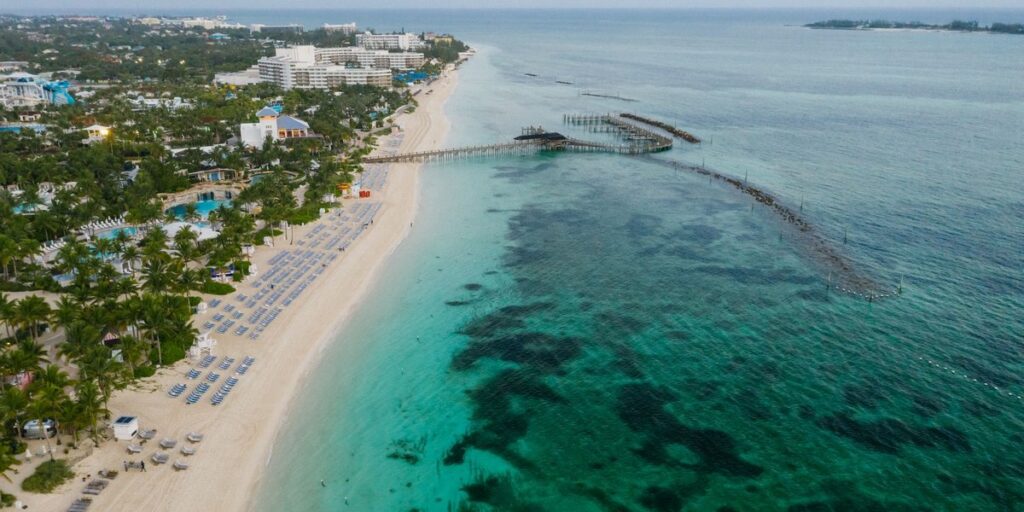
You’ll hear English the moment you land in Nassau. Then you’ll hear something that sounds like English but moves faster, drops letters and bends words into new shapes. That second thing is Bahamian Creole, and it’s the language most Bahamians use with each other. Add Haitian Creole, spoken by a large immigrant community, and you have the full list of languages spoken in the Bahamas.
Table of Contents
- TLDR
- Languages spoken in the Bahamas at a glance
- English: the official language
- Bahamian Creole: the everyday language
- Bahamian phrases worth knowing
- Haitian Creole in the Bahamas
- Spanish and French
- Why the numbers don’t agree
- What travelers need to know
TLDR
- English is the official language, used in government, schools, media, signage and tourism.
- Bahamian Creole (locals call it “talking Bahamian”) is the everyday spoken dialect, closely related to English.
- Haitian Creole is the main immigrant language, concentrated on Abaco, Grand Bahama and New Providence.
- English is enough for any trip. A few local phrases will get you smiles.
Languages spoken in the Bahamas at a glance
| Language | Status | Who speaks it | Where |
|---|---|---|---|
| English | Official | Nearly everyone | Nationwide, in all formal settings |
| Bahamian Creole | Unofficial, native vernacular | Most Bahamians, in informal speech | Every island, with regional variation |
| Haitian Creole | Immigrant language | Haitian-born residents and many of their children | Abaco, Grand Bahama, New Providence |
| Spanish | School subject, tourist and migrant language | Students, some resort staff, some visitors | Nassau, Paradise Island, resort areas |
| French | School subject | Students, mainly | Classrooms |
English: the official language
The Bahamas was a British colony until independence in 1973, and English stayed. Long before that, the Lucayan Taíno spoke their own languages, which were largely lost after European contact. The CIA World Factbook lists English as the official language, and that’s what you’ll find on road signs, menus, ferry schedules, bank forms and the evening news.
Bahamian English is its own flavor, though. It leans toward American English in vocabulary because of the proximity to Florida, which is about 50 miles from Bimini, and it keeps British spellings in print. You’ll see “harbour” on a sign and hear “gas station” in conversation.
Bahamian Creole: the everyday language
Ask a Bahamian what they speak and you’ll often get “English.” Ask them to talk to a friend and you’ll get Bahamian Creole. Linguists treat it as a distinct variety, and in practice most people switch between it and standard English depending on who’s listening.
Its roots go back to the late 1700s, when Loyalists fleeing the American Revolution settled in the islands and brought enslaved people from the Carolinas and Georgia. Their speech mixed with the English already spoken in the Bahamas, and with West African influences, to form the base of what you hear now, part of a wider Caribbean mix of peoples and cultures. That’s why Bahamian Creole sounds closer to Gullah and African American Vernacular English than to the Creoles of Jamaica or Haiti.
A few features give it away:
- “Th” becomes “d” or “t.” “This” turns into “dis,” “that” into “dat,” “thing” into “ting.”
- Plurals use “dem.” “The boys dem” means “the boys.”
- Verbs stay simple. “He gone store” is a full, correct sentence.
- Old-timers swap “v” and “w.” “Wery” for “very” survives in older speakers, especially on the Out Islands.
Speech also varies by place. Nassau Bahamian is faster and more mixed with standard English and American slang. Out Island speech, in places like Eleuthera or Andros, tends to keep older rhythms and expressions that younger Nassau speakers have dropped.
Bahamian phrases worth knowing
You don’t need these. Using one will still change how a conversation goes.
| Phrase | Meaning |
|---|---|
| “Wha gwan?” / “Sup?” | What’s going on? A casual hello. |
| “Dis ya” | This here. “Dis ya conch salad is good.” |
| “Bey” | Man, guy, dude. |
| “Sip sip” | Gossip. |
| “Mudda sick!” | An exclamation of surprise or disbelief. |
| “Jitney” | A public bus in Nassau. |
| “Sky juice” | A drink of gin, coconut water and condensed milk. |
| “Conchy Joe” | A white Bahamian. |
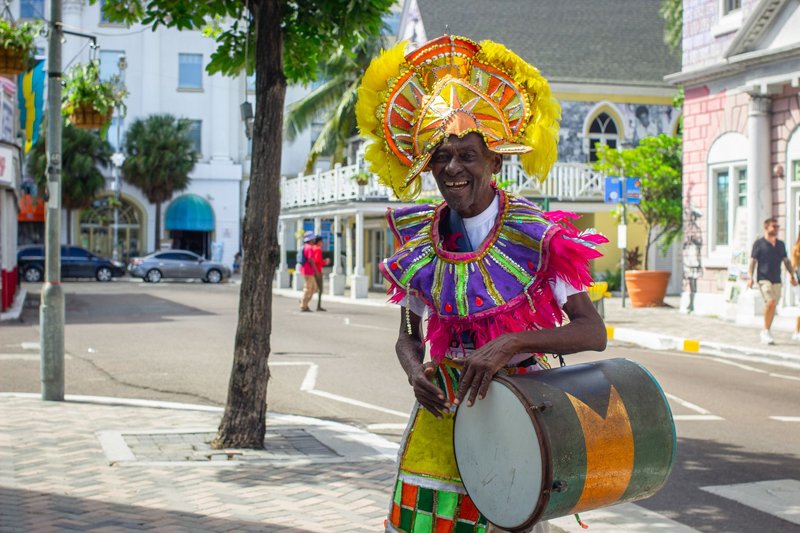
| “Junkanoo” | The street parade held on Boxing Day and New Year’s Day. |
Some of these, like “wha gwan,” overlap with Jamaican speech, and visitors often assume the two Creoles are the same. They aren’t. Jamaican Patois has far more African-language and Irish-English influence in its grammar and vocabulary, while Bahamian speech sits closer to the American South. A Jamaican and a Bahamian can follow each other, but not without effort.
Haitian Creole in the Bahamas
Haitian Creole (Kreyòl ayisyen) is the third language of the country in real terms. Haitians have migrated to the Bahamas for decades, and the community is large on Abaco, Grand Bahama and New Providence. In Nassau you’ll hear it in the markets and in neighborhoods such as Farm Road and Bain Town. On Abaco it was heard for years in informal settlements such as The Mud and Pigeon Peas near Marsh Harbour, which Hurricane Dorian flattened in 2019.
It’s a separate language, built on French vocabulary with West African grammar, and it isn’t mutually intelligible with Bahamian Creole. Many Haitian Bahamians, especially children born in the islands, speak both Haitian Creole at home and Bahamian English outside it.
If you want to greet someone in it, three phrases cover most situations:
- Bonjou: good morning
- Sak pase?: what’s up?
- Mèsi: thank you
Don’t assume anyone you meet speaks it, and don’t use it as a guess about someone’s background. Many people of Haitian descent are Bahamian citizens, and many Bahamians have no Haitian roots.
Spanish and French
Both are taught as foreign languages in Bahamian schools, so you’ll find students who can manage a basic conversation. Neither is a community language. Spanish has the more practical use: tourism draws visitors from Latin America and Spain, and some resort and cruise-related staff speak it. French shows up mostly in classrooms and in Haitian Creole’s vocabulary.
Why the numbers don’t agree
Look up Bahamian language statistics and you’ll hit contradictions fast. One source says about 400,000 people speak Creole. Another says the entire population is about 392,718. Both can be quoted, but they can’t both be a count of Creole speakers.
The likely explanation is that the 400,000 figure treats nearly every Bahamian as a speaker, since almost all of them use the vernacular at least some of the time. It’s a rough estimate, and not a census result. Bahamian Creole also blends into English on a spectrum, so there’s no clean line between “speaks Creole” and “speaks English.”
The “25% speak Haitian Creole” claim is shakier. Censuses don’t ask about spoken language in a way that supports it. The CIA World Factbook gives the share of Haitian Creole speakers as about one in ten, and the 2010 census counted around 39,000 Haitian-born residents, roughly 11% of the population. Unofficial estimates that include Bahamian-born people of Haitian descent run higher, but they’re estimates. For anything citable, check the Bahamas Department of Statistics census reports directly.
What travelers need to know
English is enough. Hotels, restaurants, taxis, tour operators, ferries and airports all run in English, and you won’t need a phrasebook.
A few practical notes:
- Tipping: 15% to 20% is standard. Many restaurants add a 15% gratuity to the bill automatically, so check before you add more.
- Tours: Guides speak English and often tell stories in a mix of standard English and Bahamian. Ask them to repeat anything you miss. They’ll enjoy it.
- Signage: English throughout, in the US-style format you’d expect. Out Island roads have fewer signs, so ask for directions.
- Currency: The Bahamian dollar is pegged one-to-one to the US dollar, and both are accepted everywhere.
- Understanding locals: Fast Bahamian between two locals can be hard to follow. Slow down the conversation and speak plainly, and they’ll switch to standard English for you.
The languages spoken in the Bahamas tell the country’s history in one sentence: British rule left English, Loyalist plantations and West African heritage built Bahamian Creole, and migration from Haiti added a third voice. As a visitor you need only the first. The other two are what make a conversation at a fish fry worth having.