
TLDR
Kazakhstan has around 20 airports handling scheduled traffic, but you only need to know two names: Almaty (ALA) and Astana (NQZ). Together they handle roughly 85% of the country’s international arrivals. Fly into Almaty for the mountains, Charyn Canyon, and the old Silk Road cities in the south. Fly into Astana for the capital’s architecture, government business, or onward connections north. Everything else — Shymkent, Aktau, Atyrau, Karaganda — exists to serve a specific region, not to be your entry point, unless your trip is specifically about that region.
Table of Contents
- Almaty International Airport (ALA)
- Astana International Airport (NQZ)
- Which Airport Should You Fly Into?
- Secondary and Regional Airports
- Visa and Entry Rules at Kazakh Airports
- Domestic Flights vs. Trains and Buses
- Quick Reference: Every Kazakhstan Airport
Most guides to Kazakhstan’s airports read like a Wikipedia table — codes, coordinates, annual passenger counts, no opinion. That’s fine if you’re building a spreadsheet. It’s useless if you’re actually booking a flight next week. Here’s the version with an opinion attached.
Almaty International Airport (ALA)
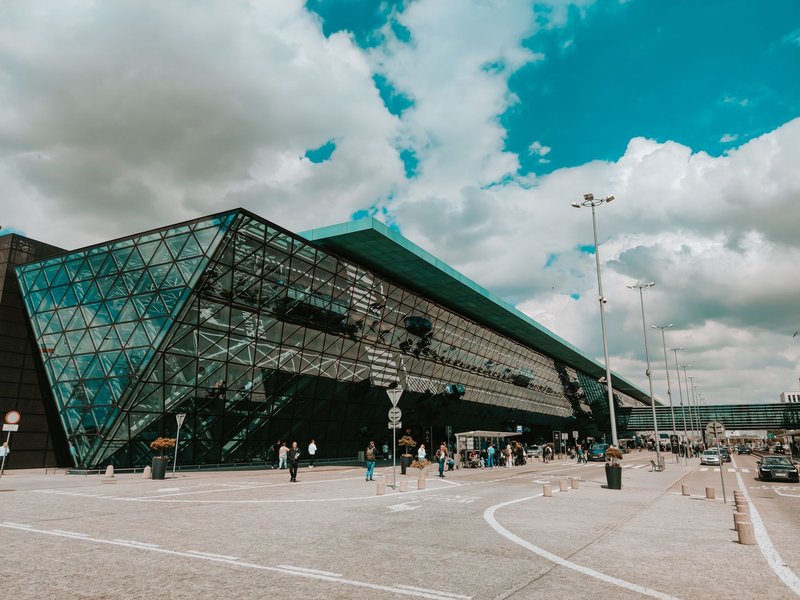
Almaty is Kazakhstan’s aviation workhorse. It’s not the capital — that’s been Astana since 1997 — but it’s still the country’s largest city and the airport that carries the most international traffic by a wide margin. If you’re flying in from Europe, the Gulf, Turkey, or elsewhere in Central Asia, there’s a good chance your itinerary routes through here by default.
The airport sits about 20 kilometers northeast of the city center, and the ride in takes 30–45 minutes depending on traffic, which builds up fast on the approach roads during weekday rush hour. A metered taxi or a Yandex Go ride (the regional Uber equivalent, and by far the easiest way to get a fair price) runs roughly 3,000–5,000 tenge into downtown. Avoid the drivers waiting right outside arrivals hawking flat rates — they’ll quote double what the app charges.
Terminal-wise, ALA finished a major reconstruction in 2023 that consolidated what used to be a cramped, dated facility into a single modern terminal with more gates and actual breathing room at immigration. SIM cards are sold just past customs — Beeline, Kcell, and Tele2 all have counters, and a tourist SIM with a few gigabytes of data costs a few thousand tenge. ATMs are plentiful; card payment is standard in the city, so you don’t need to load up on cash the moment you land.
Almaty is your gateway if your trip leans toward the Tian Shan foothills — Big Almaty Lake, Shymbulak ski resort, Charyn Canyon (often billed as Central Asia’s answer to the Grand Canyon, about a 3-hour drive east) — or if you’re continuing overland toward Bishkek, Kyrgyzstan, which is a straightforward 4-hour drive across the border.
Astana International Airport (NQZ)
Astana’s airport kept the code NQZ even after the city itself reverted from “Nur-Sultan” back to “Astana” in 2022 — a small but genuinely confusing detail for anyone booking flights and wondering why the city and airport names don’t match on some booking engines. It’s the country’s second-busiest airport and the one you want if your business is with the capital itself: government meetings, conferences at the Expo 2017 grounds, or simply wanting to see the city’s aggressively futurist skyline (the Bayterek Tower, the Palace of Peace and Reconciliation, the Khan Shatildy tent-shaped mall) rather than take someone’s word for it.
The airport is closer to town than Almaty’s — about 17 kilometers from the center, a 20–25 minute drive. Taxi and Yandex pricing is similar to Almaty’s, in the 3,000–5,000 tenge range. Astana’s climate is the detail that catches people off guard: this is one of the coldest capital cities on Earth, with winter lows regularly dropping below -30°C, so factor that into what you’re wearing off the jet bridge, not just what you packed for the trip.
Astana works best as your entry point if you’re headed toward northern Kazakhstan, the Burabay (Borovoye) lake district — often called “Kazakhstan’s Switzerland,” about 2.5 hours north — or connecting onward into Russia or further along Trans-Siberian rail routes.
Which Airport Should You Fly Into?
Skip the paralysis. Run through this in order:
- Is your trip centered on the south — Almaty, Charyn Canyon, Turkistan, the Silk Road cities, or a Kyrgyzstan add-on? Fly into Almaty (ALA).
- Is it centered on the capital, Burabay, or a northern/Trans-Siberian connection? Fly into Astana (NQZ).
- Is it centered on the Caspian coast — Mangystau’s lunar canyons, Bozzhira, or oil-industry business? Fly into Aktau (SCO), the only realistic gateway to that region.
- Are you doing a full west-to-east or south-to-north crossing? Fly into one hub and out the other. Domestic flights between Almaty and Astana run multiple times daily and take about 2 hours — often cheaper and always faster than the alternative overland routes.
- Everything else (Atyrau, Karaganda, Shymkent as a standalone entry) only makes sense if you already have business or family there. These airports aren’t set up for a first-time visitor with no local contacts.
Secondary and Regional Airports
Beyond the two majors, Kazakhstan runs a tier of regional airports that mostly serve domestic routes and a handful of connections to Russia, Turkey, or the Gulf. None of them are built for a tourist arriving cold — expect smaller terminals, fewer English signs, and taxi stands that aren’t app-integrated the way Almaty’s and Astana’s are.
Shymkent (CIT) is the third-largest city and the practical jumping-off point for Turkistan, home to the Mausoleum of Khoja Ahmed Yasawi — a UNESCO World Heritage Site and one of the most significant pieces of Timurid architecture outside Samarkand. If Turkistan is your main draw, flying into Shymkent and driving 1.5 hours north beats routing through Almaty and backtracking.
Aktau (SCO) sits on the Caspian Sea and serves the Mangystau region’s otherworldly chalk canyons and rock formations — Bozzhira, Sherkala, the underground mosques at Beket-Ata. It’s also a hub for the oil and gas industry, which means a chunk of its traffic is corporate rotations rather than tourism.
Atyrau (GUW), further north on the Caspian, is almost entirely an oil-industry airport. Unless you have a reason tied to that sector, there’s little pulling a traveler here.
Karaganda (KGF) serves Kazakhstan’s industrial heartland and the grim, essential history of the Karlag Gulag museum — a sobering stop for anyone interested in Soviet-era history, and one most Kazakhstan itineraries skip entirely.
Smaller fields at Aktobe, Pavlodar, Oskemen (Ust-Kamenogorsk), Kyzylorda, and Taraz round out the network, handling almost exclusively domestic traffic with occasional seasonal international routes.
Visa and Entry Rules at Kazakh Airports
Kazakhstan runs one of Central Asia’s more relaxed visa regimes. Citizens of a long list of countries — including the US, UK, EU member states, Japan, South Korea, and most of the Gulf — can enter visa-free for up to 30 days under a program the government has repeatedly renewed since it launched in 2017. If your nationality isn’t on that list, or you plan to stay longer, Kazakhstan’s e-visa system lets you apply online in advance rather than dealing with paperwork at the border. Check your specific nationality’s requirements before you fly, since the visa-free list and validity periods are updated periodically and vary by passport — a mistake here can mean being turned back at the gate.
Immigration lines at Almaty and Astana move faster than their Soviet-era reputation suggests, especially since the Almaty terminal reconstruction. Regional airports without regular international arrivals may not have a permanently staffed immigration desk, another reason not to route an international arrival through a secondary airport unless a local can confirm it’s set up for it.
Domestic Flights vs. Trains and Buses
Kazakhstan is enormous — roughly the size of Western Europe — which makes the domestic flight network more than a convenience; for some routes it’s the only realistic option. Almaty to Astana by air takes about 2 hours and typically costs less than $100 one-way when booked a few weeks out. The same trip by train, on the fast Talgo service, takes around 12–13 hours overnight, which some travelers actually prefer as an experience rather than a chore — sleeper cabins, a dining car, and a slower look at the steppe.
For shorter regional hops — Almaty to Shymkent, say, or Astana to Karaganda — trains and shared taxis remain genuinely competitive on cost and don’t cost you much time once you factor in airport transfers on both ends. The flight-vs-train call really only tips firmly toward flying once you’re covering 800+ kilometers, which describes most south-to-north or west-to-east itineraries in this country.
Quick Reference: Every Kazakhstan Airport
| Airport | Code | Region | Best For |
|---|---|---|---|
| Almaty International | ALA | South | Main international gateway, mountains, Silk Road south |
| Astana International | NQZ | Capital/North | Capital business, Burabay, northern connections |
| Shymkent (Ordabasy) | CIT | South | Turkistan, Silk Road heritage sites |
| Aktau | SCO | West/Caspian | Mangystau canyons, Caspian coast |
| Atyrau | GUW | West/Caspian | Oil and gas industry |
| Karaganda | KGF | Central | Industrial region, Karlag history |
| Aktobe | AKX | West | Domestic/regional |
| Oskemen (Ust-Kamenogorsk) | UKK | East | Altai Mountains gateway |
| Pavlodar | PWQ | North | Domestic/regional |
| Kyzylorda | KZO | South-Central | Baikonur Cosmodrome access |
| Taraz | DMB | South | Domestic/regional |
Kyzylorda is worth flagging separately: it’s the closest commercial airport to the Baikonur Cosmodrome, still the launch site for crewed missions to the International Space Station and a genuine bucket-list stop if space history is part of your trip.
The pattern holds across all of it — Almaty and Astana are built for visitors who’ve never set foot in the country before. Everything past that tier is built for the region it sits in, not for you, unless that region is specifically why you’re going.