
Here’s the short version: no sovereign nation flies a flag that combines orange and purple. Not one. If you came here hoping to find a clever pairing nobody talks about, the answer is genuinely that there isn’t one — and the reason why is more interesting than the question.
Purple is the rarest color in vexillology, and orange isn’t far behind. The odds of both landing on the same flag are slim to begin with, and so far, history has held the line at zero.
But “no” is a boring place to stop. The real payoff is in the near-misses, the handful of flags that sneak purple in through a coat of arms, and the surprisingly long list of flags that wave orange proudly. Let’s go through all of it.
Table of Contents
- The verdict: zero
- Why purple almost never shows up on flags
- Countries with purple on their flags
- Countries with orange on their flags
- The flags that come closest
- What orange usually means on a flag
- The takeaway
The verdict: zero {#the-verdict}
To be clear about what “national flag” means here: a current, official flag of a sovereign state recognized by the United Nations. By that standard, the count of flags pairing orange and purple is zero.
You can find the combination if you widen the net to regional flags, indigenous banners, and historical designs — the Wiphala used across the Andes is the obvious example, and we’ll get to it. But among the roughly 195 national flags flying today, none puts orange and purple together.
It’s not a fluke of bad luck. Both colors are statistically unusual on flags, and one of them is unusual for a very specific, very old reason.
Why purple almost never shows up on flags {#why-purple-is-rare}
Purple is the least-used color on national flags, and the story goes back about three thousand years to a snail.
Tyrian purple — the dye the Phoenicians made famous — came from the mucus of the murex sea snail. Producing it was brutal. By many historical accounts it took thousands of snails to dye a single garment, which is why the color became shorthand for emperors and almost nobody else. Roman sumptuary laws at points restricted purple clothing to the ruling class. When a color is literally illegal for commoners and costs a fortune to make, it doesn’t end up on the banner a whole nation has to reproduce thousands of times.
That economic reality lasted into the modern flag era. The first cheap synthetic purple, mauveine, wasn’t discovered until chemist William Perkin stumbled onto it in 1856 while trying to synthesize a malaria drug. By then most of the world’s enduring flag designs — and the conventions behind them — were already set. Flags were meant to be stitched, dyed, and flown cheaply by ordinary people. Purple flunked that test for most of recorded history.
There’s a practical reason too: older textile purples faded fast and unevenly in sunlight, so a purple flag would look shabby within a season. Cheap, lightfast purple is a recent luxury. The flags we fly are old habits. The same economics explain why other “impossible” color combinations like yellow and pink are missing from national flags entirely — the colors that were hardest to make are the ones that never caught on.
The result is a color that survives on flags only in tiny, deliberate doses — and almost always inside a detailed emblem rather than as a main field.
Countries with purple on their flags {#purple-flags}
The list is famously short. Most discussions name Dominica as the only national flag with a meaningful purple element, and even that comes with an asterisk.
| Country | Where the purple appears |
|---|---|
| Dominica | The breast and parts of the Sisserou parrot in the central emblem |
| Nicaragua | A faint purple band in the rainbow inside the coat of arms |
| El Salvador | A trace of purple in the rainbow of its national arms |
| Bolivia (Wiphala) | A full purple square — but on a separate official banner, not the tricolor |
| Spain | A purplish hue in the Royal Crown and shield details, depending on the rendering |
The Dominica case is the cleanest example. Its flag centers on the Sisserou parrot, a bird found nowhere else on Earth, and that parrot’s plumage includes purple. It’s widely cited as the only national flag where purple appears as a defined, intentional color rather than an incidental shade. Even so, the purple lives inside the bird, not as a stripe or background.
Nicaragua and El Salvador share an old Central American design tradition: both feature a triangle containing a rainbow, and a rainbow technically includes violet. Whether you count those depends on how strict you want to be — in practice the purple is so small you’d never notice it from across a plaza.
Then there’s Bolivia. The Wiphala — the seven-color checkered emblem of the Andean peoples — contains a clear purple square and is recognized as a dual official flag of Bolivia alongside the red-yellow-green tricolor. If your definition stretches to include it, Bolivia becomes the strongest “purple flag” in the world. If you stick to the main national tricolor, purple drops out entirely. This is exactly the kind of edge case that makes “the only purple flag” a question people argue about online.
Countries with orange on their flags {#orange-flags}
Orange is rare, but nowhere near as rare as purple. Roughly a dozen-plus national flags carry it, and these are the ones people actually recognize.
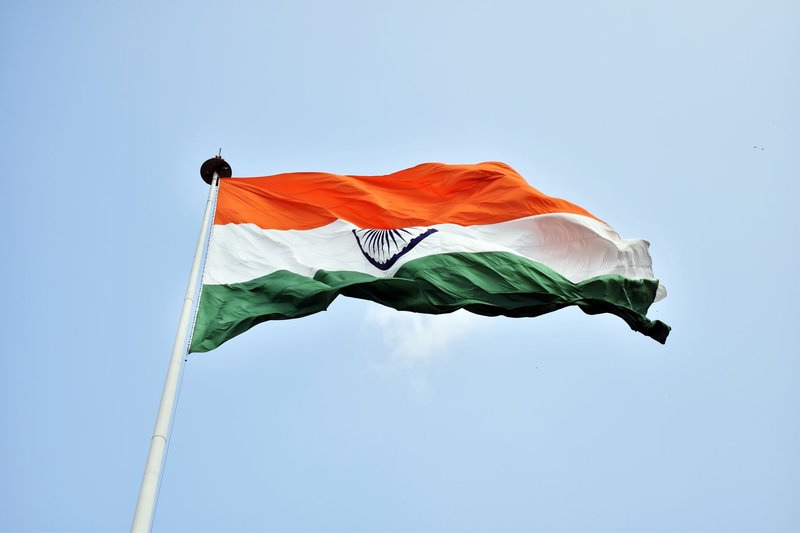
- India — the saffron band at the top
- Ireland — the orange hoist stripe, paired with green and white
- Niger — the orange band and the orange sun disc at center
- Côte d’Ivoire — the orange stripe (essentially Ireland’s flag mirrored)
- Sri Lanka — the saffron border and the saffron vertical band
- Bhutan — the orange (saffron-orange) lower diagonal half
- Armenia — the apricot-orange bottom stripe
- Zambia — an orange eagle in the corner
- Bangladesh — sometimes cited for its orange-red disc, though it reads as red
- India, Niger, Côte d’Ivoire anchor the “saffron family” of orange flags
The standouts are easy to spot. India’s saffron sits at the top of the tricolor and represents courage and sacrifice. Ireland’s orange honors the Protestant population, with the white center meant to symbolize peace between them and the green-associated Catholic tradition. Niger’s flag is unusual for putting a solid orange circle dead center, representing the sun over the Sahara.
A fun bit of trivia: Côte d’Ivoire and Ireland have nearly identical flags — orange, white, green — just flipped. Côte d’Ivoire leads with orange on the hoist; Ireland ends with it on the fly. The two countries have politely disagreed about the resemblance for decades.
The flags that come closest {#closest}
If orange-and-purple is the goal, a few flags get within arm’s reach.
The Wiphala is the real answer if you allow non-tricolor official banners. It contains both a purple square and an orange square among its seven colors, which technically makes it the closest thing on Earth to an orange-and-purple official flag. It just isn’t a single-nation tricolor.
Niger and Dominica are the closest pairing if you imagine combining two separate national flags — Niger brings the orange, Dominica brings the purple. Lay them side by side and you’ve manufactured the combo that no single flag delivers.
And historically, a handful of subnational and indigenous flags have flirted with both hues, but none rose to national-flag status. The pattern holds: orange and purple stay on opposite sides of the room — and it stays just as firm if you add a third color into the mix, whether you go looking for blue, orange, and purple flags or orange, purple, and black ones.
What orange usually means on a flag {#orange-meaning}
Since orange does the heavy lifting here, it’s worth knowing what it tends to stand for. Unlike red or blue, orange isn’t a default — when a country chooses it, the choice is usually loaded with meaning.
- Saffron / sacrifice and courage — India and Sri Lanka draw on the saffron robes of monks and the color’s spiritual weight
- The land and the sun — Niger’s orange evokes the northern desert and the sun
- A specific community — Ireland’s orange represents Protestants by name, a rare case of a flag color standing for a religious group
- Energy and the harvest — several African flags use orange for mineral wealth or agricultural abundance
That specificity is part of why orange shows up at all. A country doesn’t reach for it casually; it reaches for it because no other color carries the exact meaning. It’s also why orange tends to be the workhorse in these hunts for unusual color trios — the same pattern shows up when you go looking for yellow, orange, and purple flags and find orange present while the other shades go missing.
The takeaway {#takeaway}
No national flag combines orange and purple, and now you know it’s not an accident. Purple priced itself out of vexillology for three thousand years thanks to a snail and a synthetic-dye delay, while orange survives in a select club of flags that each chose it for a pointed reason.
If you need the combination for a quiz answer, the honest response is “none.” If you need it for a thumb-on-the-scale answer, point to the Wiphala — the one official banner where orange and purple actually share the cloth. Everything else is two flags standing next to each other, pretending.
For the related rabbit holes — countries with purple flags and the broader study of how rare each color is across national flags — the pattern stays consistent: the colors that are hard to make are the colors you almost never see flying.