
Last updated: November 2026
Table of Contents
- TLDR: the current list
- EU countries that still have their own currency
- European countries outside the EU with their own currency
- Countries that use the euro without being in the EU
- Why these countries stayed out
- What to carry in each country
- Who could be next
TLDR: the current list
Bulgaria switched to the euro on 1 January 2026, which made it the 21st member of the eurozone and shrank the list of European countries that don’t use the euro. Most articles ranking for this topic still show the old count. Croatia joined in 2023, Bulgaria in 2026, so only six EU countries keep their own money:
| EU country | Currency |
|---|---|
| Czechia | Czech koruna (CZK) |
| Denmark | Danish krone (DKK) |
| Hungary | Hungarian forint (HUF) |
| Poland | Polish zloty (PLN) |
| Romania | Romanian leu (RON) |
| Sweden | Swedish krona (SEK) |
Outside the EU, the biggest names are the UK, Norway, Switzerland, Iceland, Turkey and Ukraine, plus most of the Western Balkans. Six non-EU places use the euro anyway: Montenegro, Kosovo, Andorra, Monaco, San Marino and the Vatican.
EU countries that still have their own currency
Being in the EU doesn’t mean using the euro. The two are separate memberships, and the euro is a commitment each government makes on its own timeline. Of the six holdouts, only one has a legal escape hatch. The rest signed treaties that oblige them to adopt the euro eventually. None has a date.
Denmark negotiated a formal opt-out in 1992 and kept it after voters rejected the euro in a 2000 referendum. The krone is pegged to the euro anyway, so Danish prices track the eurozone closely.
Sweden has no opt-out on paper. Voters said no in a 2003 referendum, and Sweden has stayed out of the exchange-rate mechanism that countries must join for two years before adopting the euro. That keeps it permanently “not yet ready” without anyone formally refusing.
Czechia, Hungary, Poland and Romania are the central and eastern members. They joined in 2004 or 2007 and are obliged to adopt the euro once they qualify. In its 2026 convergence report, the ECB examined these four plus Sweden and found that none meets all the criteria. Denmark isn’t assessed because of its opt-out.
European countries outside the EU with their own currency
This is the longer list, and it’s where most travelers’ money confusion actually happens. Switzerland, one of the countries in Western Europe, and Norway are in Europe, in Schengen, and fully euro-free.
| Country | Currency |
|---|---|
| United Kingdom | Pound sterling (GBP) |
| Norway | Norwegian krone (NOK) |
| Switzerland | Swiss franc (CHF) |
| Liechtenstein | Swiss franc (CHF) |
| Iceland | Icelandic króna (ISK) |
| Turkey | Turkish lira (TRY) |
| Ukraine | Hryvnia (UAH) |
| Moldova | Moldovan leu (MDL) |
| Serbia | Serbian dinar (RSD) |
| Bosnia and Herzegovina | Convertible mark (BAM) |
| North Macedonia | Macedonian denar (MKD) |
| Albania | Albanian lek (ALL) |
| Belarus | Belarusian ruble (BYN) |
| Russia | Russian ruble (RUB) |
Some territories follow their parent country: Gibraltar, Jersey, Guernsey and the Isle of Man use the pound, and the Faroe Islands use the Danish krone. Bosnia’s convertible mark is fixed at 1.95583 per euro, the same rate Bulgaria’s lev was locked to before it adopted the euro.
Countries that use the euro without being in the EU
This is the section most lists skip, and the one that catches people out. Six European countries use the euro as their currency but aren’t EU members. They fall into two groups.
Unilateral adopters. Montenegro and Kosovo switched from the German mark to the euro in the early 2000s without any agreement with the EU. They don’t get a seat at the European Central Bank and can’t issue euro coins or notes of their own. They simply use the currency.
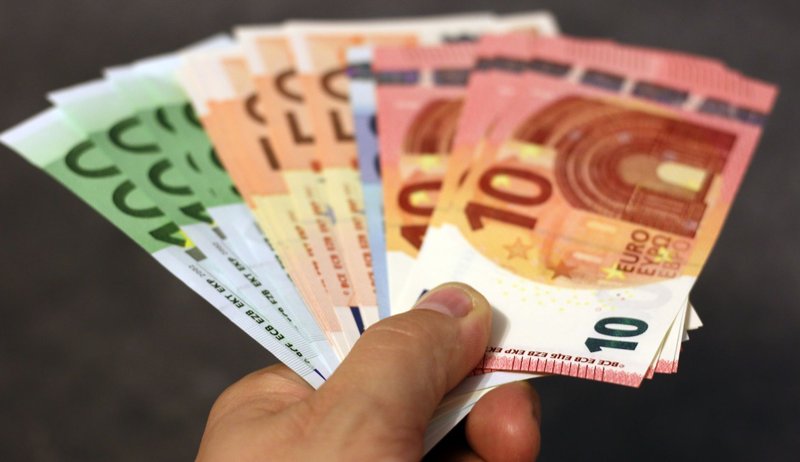
Countries with a monetary agreement. Andorra, Monaco, San Marino and the Vatican City each signed a formal deal with the EU. They’re allowed to mint a limited number of euro coins with their own national designs on the back, which makes them popular with coin collectors. A Vatican or San Marino euro coin is legal tender everywhere in the eurozone.
For a traveler, all six work the same way: bring euros, pay in euros. Andorra, Monaco and the others are tiny and sit inside or beside eurozone countries, so you’ll rarely notice a border.
Why these countries stayed out
Three reasons cover almost every case.
1. A legal opt-out. Only Denmark has one, from the 1992 Maastricht Treaty. (The UK had one too, before leaving the EU.)
2. The convergence criteria. To join, a country has to meet targets on inflation, government deficit (under 3% of GDP), public debt (under 60%), long-term interest rates, and exchange-rate stability. That last one means holding its currency steady against the euro for two years in ERM II. It’s the step that stalls most applicants, because it requires the government to actually choose to enter. The ECB’s 2026 convergence report found that none of the five assessed countries currently participates in it.
3. Political choice. This is the real answer for several of them. Countries with their own currency can adjust interest rates to their own economy. Poland, Hungary and the Czech Republic have run their own monetary policy for decades, and keeping that control is popular. In the Czech case, the country is among the closest to the criteria on paper while its government has shown little appetite for joining, according to eualive.
Non-EU countries have a simpler reason. You can’t join the euro without joining the EU first, and Norway, Switzerland and Iceland have each voted or decided against membership.
What to carry in each country
The best currency to take to Europe depends on where you’re going. In nearly all of these places the answer is a debit or credit card with no foreign transaction fee, plus a small amount of local cash. Two rules apply everywhere:
- Pay in the local currency. When a card terminal or ATM offers to charge you in your home currency, decline. That’s dynamic currency conversion, and the rate is worse than your bank’s.
- Skip airport and street exchange booths. Withdraw from a bank-branch ATM instead.
Denmark. Cards dominate and mobile payments are common. Service is included in prices, so tipping isn’t expected. Carry very little cash.
Sweden. Close to cashless. Many shops, cafés and buses don’t take cash at all, and locals pay with the Swish app. Bring a card that works with a chip and contactless. Round up in restaurants if the service was good.
Norway. Same story as Sweden: cards everywhere, including kiosks and public toilets. It’s expensive, so a card with no foreign fees matters more than any cash.
Iceland. You can pay for a hot dog by tapping a card. Don’t change money before the trip. Tipping isn’t customary.
Switzerland. Cards are widely accepted, but cash is still more common here than in Scandinavia, especially in small mountain restaurants and farm shops. Some tourist-facing shops will take euros, but give change in francs at a poor rate. Service is included, and rounding up is enough.
United Kingdom. Contactless works nearly everywhere, including buses and the London Underground. Check the bill for a 12.5% service charge before adding a tip. Scottish and Northern Irish banknotes are legal but sometimes refused in England.
Czechia. Card acceptance is good in cities. Prague is infamous for exchange booths advertising “0% commission” with a terrible rate. Use a bank ATM. Tipping around 10% is normal in restaurants.
Hungary. Budapest has plenty of independent ATMs in tourist areas with high flat fees, and many push you to accept conversion into your home currency. Use a bank-branch ATM and always choose forint. Check whether a service charge is already on the bill, usually 10 to 12.5%.
Poland. Cards are accepted almost everywhere, and locals use BLIK for phone payments. If you need cash, exchange offices called kantor often beat banks on rate, but compare the “buy” and “sell” prices posted on the board. Tip about 10%.
Romania. Cards work in Bucharest, Cluj and other cities. Villages, markets and rural guesthouses often want cash in lei. ATMs are plentiful. Tip around 10%.
Turkey. The lira has lost value steadily against the euro and dollar for years, so avoid exchanging more than you’ll spend within a few days. Cards work in tourist areas, but small shops and bazaars prefer cash. Tip 5 to 10% in restaurants.
Western Balkans. Serbia, Bosnia, North Macedonia and Albania are more cash-reliant than the rest of this list. Bring a mix of euros and a card, and change small amounts locally. Euros are accepted informally in many tourist spots, but local currency gets you a better price.
Who could be next
Bulgaria shows how the process works. The European Commission and ECB said in 2025 that it met the criteria, and EU finance ministers approved it in July 2025 at a fixed rate of 1.95583 lev per euro, according to the European Parliament’s briefing. The euro became its currency on 1 January 2026, and the lev stopped being legal tender on 1 February.
The remaining five obliged countries (Czechia, Hungary, Poland, Romania, Sweden) have no announced dates, and none is in ERM II, the two-year waiting room. Until one enters it, expect no new euro adoption for at least two years. Denmark is a separate case: it would need to hold another referendum to drop its opt-out.
On the non-EU side, the most plausible near-term candidates are Western Balkan countries that join the EU first, such as Montenegro or Albania. For the six countries that already use the euro unofficially or by agreement, nothing changes.
For a trip planned in 2026 or 2027, treat the list above as stable. If you’re crossing two or three borders on one route, pack a card first and local cash second.