Ask what languages are spoken in Qatar and you’ll get a list a mile long: Arabic, English, Urdu, Malayalam, Tagalog, Farsi, Nepali, Hindi. All true. But that list answers the wrong question. Most of those languages arrived in the last 40 years inside suitcases, carried by the workers who built the skyline. Strip the question down to what’s actually indigenous — native to the land and its people before the oil boom reshaped everything — and the answer gets short fast.
Qatar has one indigenous spoken language: Gulf Arabic, the dialect locals call Khaliji or simply Qatari. Add to that the country’s own Qatari Unified Sign Language, developed natively for its deaf community, and you’ve covered the native linguistic heritage of the peninsula. Everything else is an import.
Table of Contents
- Indigenous vs. Spoken: Why the Distinction Matters
- Gulf Arabic: The Native Dialect
- North vs. South Qatari
- How Qatari Arabic Differs From Standard Arabic
- The Bedouin and Pearl-Diving Roots
- Qatari Unified Sign Language
- A Dialect Under Pressure
- Indigenous vs. Immigrant Languages at a Glance
- A Few Phrases to Carry
- FAQ
TLDR
Qatar’s only indigenous spoken language is Gulf Arabic (Khaliji), specifically the Qatari dialect, split into northern and southern variants. The country also has its own natively developed Qatari Unified Sign Language. Modern Standard Arabic is used in writing and formal settings but isn’t anyone’s native spoken tongue, and the dozens of other languages you’ll hear came with the country’s roughly 88% expatriate population. The native dialect is increasingly squeezed into the home and the family majlis.
Indigenous vs. Spoken: Why the Distinction Matters
Reference articles tend to flatten “spoken in Qatar” and “native to Qatar” into the same paragraph. They’re not the same thing.
A language is spoken in Qatar if enough people use it that you’ll hear it at the grocery store. By that measure Malayalam and Urdu count, and there are days in Doha where you’ll hear more Hindi than Arabic. A language is indigenous if it grew up on this soil, shaped by the people who’ve lived here for generations. Only Gulf Arabic clears that bar.
This matters because Qatar’s demographics are some of the most lopsided on Earth. Qatari nationals make up only around 12% of the population, according to figures compiled by the BBC. The other ~88% are expatriates. So the most audible languages in the country are almost never the native one. That gap is the whole story here.
Gulf Arabic: The Native Dialect

Gulf Arabic, or Khaliji (“of the gulf”), is the spoken Arabic of the Arabian Peninsula’s eastern coast — Qatar, Bahrain, Kuwait, parts of Saudi Arabia, the UAE, and northern Oman. The Qatari version is its own flavor within that family, close enough to Bahraini and Emirati Arabic that speakers understand each other instantly, distinct enough that a Qatari can usually tell where someone’s from after a sentence or two.
This is the language of the home, the market haggle, the late-night majlis, the WhatsApp voice note. It’s what a Qatari child learns first and what families switch into the moment the formal occasion ends. It has never been a written standard — when Qataris write formally, they write Modern Standard Arabic — but it is unambiguously the mother tongue.
North vs. South Qatari
Even inside a country this small, the dialect splits. Linguists generally describe two main sub-dialects of Qatari Arabic, broadly mapping to a northern and a southern variety.
The differences are subtle to an outsider and obvious to a local: shifts in how certain consonants land, a handful of vocabulary choices, intonation patterns that mark someone as coastal-north versus interior-south. The northern variety is associated with the older sedentary and pearling communities clustered around the historic coast; the southern with the more Bedouin, interior-leaning families. Decades of urbanization in Doha have blurred the line — most young Qataris grow up in the capital regardless of family origin — but the markers are still there if you know what to listen for.
How Qatari Arabic Differs From Standard Arabic
Here’s the thing tourists with a phrasebook discover fast: the Arabic you studied isn’t quite the Arabic you’ll hear.
Modern Standard Arabic (MSA, or fusha) is the pan-Arab written and broadcast standard — newspapers, official speeches, the Al Jazeera anchor. It’s nobody’s native spoken language anywhere, including Qatar. Gulf Arabic diverges from it in real ways:
- The “q” sound. MSA’s qaf often becomes a hard “g” in Gulf Arabic. The word for “to say” is qala in MSA but gaal on the street.
- The “j” sound. The MSA jim frequently softens toward a “y” in some Gulf speech, so jiib (bring) can sound like yiib.
- Vocabulary. Everyday Gulf words like shloonak? (“how are you?”, literally “what’s your color?”) have no equivalent in textbook Arabic.
- Grammar shortcuts. Spoken Gulf Arabic drops case endings and simplifies verb forms that MSA preserves rigidly.
A learner who shows up speaking pure fusha will be understood and respected — it signals education — but will also sound a bit like someone speaking in formal written English at a backyard barbecue.
The Bedouin and Pearl-Diving Roots
The Qatari dialect didn’t appear from nowhere. It carries the fingerprints of the two ways of life that defined the peninsula before oil: the desert and the sea.
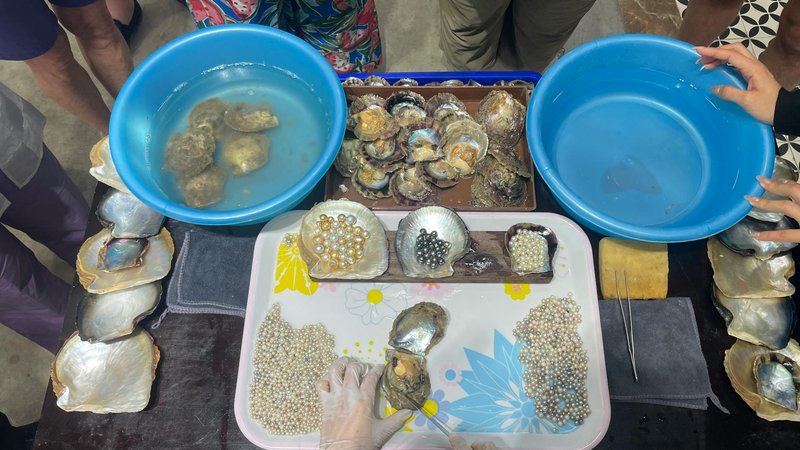
Bedouin heritage shaped a vocabulary rich in words for camels, terrain, weather, and kinship — the granular distinctions a nomadic life depends on. The coastal pearling economy, which sustained Qatar for centuries until Japanese cultured pearls collapsed the market in the 1930s, left its own lexicon: terms for diving, boat parts, pearl grades, and the rhythmic work songs (fjiri) sung aboard the dhows. Some of that pearling vocabulary is now half-remembered, kept alive more by cultural institutions than daily use, but it’s baked into the dialect’s foundation. UNESCO’s documentation of Gulf pearling heritage, recognized as part of the region’s intangible cultural heritage, underlines how tightly language and livelihood were braided together here.
When you hear an older Qatari speak, you’re hearing the desert and the dhow.
Qatari Unified Sign Language
Spoken language gets all the attention, but Qatar has a second indigenous language that’s genuinely its own: the Qatari sign language, part of the broader Unified Arabic Sign Language effort.
This isn’t a translation of spoken Arabic into gestures — sign languages are full languages with their own grammar, and the Qatari deaf community developed signs reflecting local life and culture. Qatar has invested in standardizing and teaching it, including through institutions focused on accessibility and special education. It’s a small community, but it’s a native one, and it belongs on any honest list of the country’s indigenous languages — a thing every competing “languages of Qatar” article quietly skips.
A Dialect Under Pressure
Being the native language doesn’t make Gulf Arabic the dominant one in daily Qatari life. That’s the uncomfortable reality.
With expatriates outnumbering nationals roughly seven to one, the lingua franca of the street, the office, and the construction site is often English — or a pragmatic pidgin of English, Hindi, and Arabic that gets the job done between a Filipino nurse, an Indian shopkeeper, and a Qatari customer. English dominates higher education and most of the private sector. Children of nationals attend international schools where instruction is frequently in English.
The result is a dialect that’s healthy at home and squeezed everywhere else. Qatari Arabic isn’t endangered in the technical sense — it has a stable, prosperous community of native speakers — but its domains of use are shrinking, and educators and cultural bodies have raised real concern about young Qataris who are more fluent in English than in formal Arabic. The state has responded with Arabic-language initiatives and heritage programming. Whether everyday Qatari speech holds its ground against the English tide is one of the country’s quieter cultural questions.
Indigenous vs. Immigrant Languages at a Glance
| Language | Status in Qatar | Origin |
|---|---|---|
| Gulf Arabic (Qatari) | Indigenous, native spoken tongue | Native to the peninsula |
| Qatari Unified Sign Language | Indigenous, native | Developed locally |
| Modern Standard Arabic | Official, written/formal | Pan-Arab standard, not natively spoken |
| English | De facto business & education lingua franca | Imported, colonial/global |
| Urdu, Hindi, Malayalam, Tagalog, Nepali, Farsi | Widely spoken | Brought by expatriate communities |
The top two rows are Qatar’s. Everything below is spoken in Qatar without being of Qatar.
A Few Phrases to Carry
If you want to honor the native dialect rather than default to English, a handful of Gulf Arabic phrases go a long way:
- Shloonak? / Shloonich? — “How are you?” (to a man / to a woman)
- Zain — “Good” / “fine”
- Shukran — “Thank you” (this one’s shared with MSA)
- Yalla — “Let’s go” / “come on”
- Wayid — “A lot” / “very”
- Mashallah — said in admiration or to ward off the evil eye; you’ll hear it constantly
Use shloonak instead of the textbook kayfa haluk and you’ll get a smile — you’ve just signaled that you bothered to learn the real thing.
The Takeaway
Qatar’s linguistic map looks crowded, but its indigenous footprint is precise: Gulf Arabic in its Qatari form, north and south, shaped by Bedouin and pearling life, plus the country’s own sign language. The dozens of other tongues you’ll hear in Doha are the sound of a modern labor migration, not the native heritage. Knowing the difference is the difference between a tourist’s list and an actual understanding of the place.
FAQ
What is the indigenous language of Qatar? Gulf Arabic, specifically the Qatari dialect (Khaliji), is the only indigenous spoken language. Qatar also has its own native sign language for the deaf community.
Is the Arabic spoken in Qatar the same as standard Arabic? No. Qataris natively speak Gulf Arabic, which differs from Modern Standard Arabic in pronunciation, vocabulary, and grammar. MSA is used for writing and formal occasions but isn’t anyone’s spoken mother tongue.
Why do so many languages get listed for Qatar? Because expatriates make up roughly 88% of the population, languages like Urdu, Malayalam, Tagalog, and Farsi are widely spoken. They’re heard in Qatar but aren’t indigenous to it.
Do I need to speak Arabic to visit Qatar? No. English is widely spoken in business, hospitality, and education. Learning a few Gulf Arabic phrases is appreciated but not necessary.
Is Qatari Arabic endangered? Not in the strict sense — it has a stable community of native speakers — but its everyday domains are shrinking as English dominates education and the workplace, which has prompted cultural preservation efforts.