Table of Contents
- Niger’s Linguistic Landscape
- The 10 National Languages at a Glance
- Hausa: The Language of Commerce and Culture
- Zarma-Songhai: Voice of the West
- Tamasheq: The Tuareg Desert Tongue
- Fulfulde: The Language That Crossed Continents
- Kanuri: Ancient Language of the Lake Chad Basin
- Tassawaq, Buduma, and the Languages Most Lists Skip
- Endangered Languages: What’s Being Lost
- Niger’s 2025 Language Policy Shift
- Languages and Education in Niger
Niger’s Linguistic Landscape
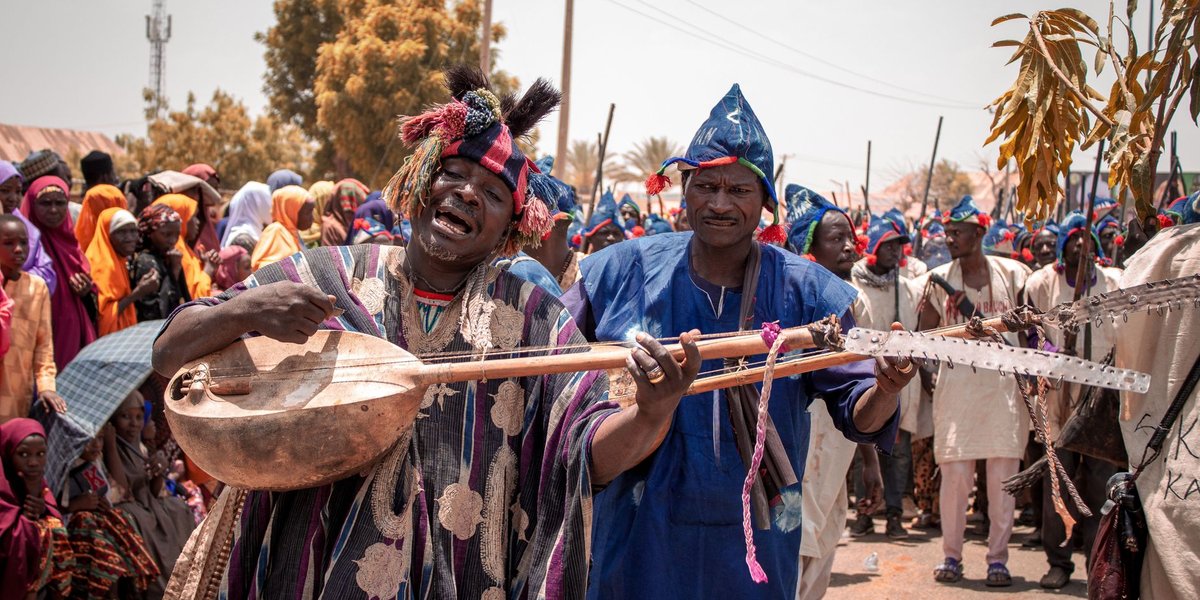
Niger is one of the most linguistically complex countries on earth — and also one of the most overlooked when it comes to African language coverage. The country is home to somewhere between 8 and 20 indigenous languages depending on how you count dialects, spread across three major language families: Afroasiatic, Nilo-Saharan, and Niger-Congo.
French is the official language on paper — though that’s changing (more on that in a moment). In practice, most Nigeriens go their entire lives conducting business, raising families, and participating in public life entirely in one or more indigenous languages. French functions as a language of government administration and formal schooling, but it’s the mother tongue of a tiny fraction of the population.
The country officially recognizes 10 national languages, each with a distinct ethnic community, geographic base, and historical trajectory. Together, they represent one of West Africa’s most layered linguistic environments.
The 10 National Languages at a Glance
| Language | Family | Approx. Speakers | Primary Region |
|---|---|---|---|
| Hausa | Afroasiatic (Chadic) | ~9–11 million | South (Maradi, Zinder, Tahoua) |
| Zarma | Nilo-Saharan (Songhaic) | ~3 million | Southwest (Niamey, Tillabéri, Dosso) |
| Tamasheq | Afroasiatic (Berber) | ~500,000–1 million | North (Agadez, Air Massif) |
| Fulfulde | Niger-Congo (Atlantic) | ~700,000–1 million | Widespread (nomadic distribution) |
| Kanuri | Nilo-Saharan (Saharan) | ~400,000–500,000 | Southeast (Diffa, Lake Chad region) |
| Tassawaq | Nilo-Saharan (Songhaic) | ~50,000 | Central (Aïr region) |
| Tasawaq | Afroasiatic (Berber) | varies | North-central |
| Tubu (Teda-Daza) | Nilo-Saharan (Saharan) | ~100,000–150,000 | Northeast (Kawar, Tibesti) |
| Buduma | Afroasiatic (Chadic) | ~50,000 | East (Lake Chad) |
| Tetserret | Afroasiatic (Berber) | ~500–1,000 | Central (Azawagh) |
Speaker figures are estimates — Niger has no recent, comprehensive linguistic census, and nomadic populations make precise counts difficult.
Hausa: The Language of Commerce and Culture
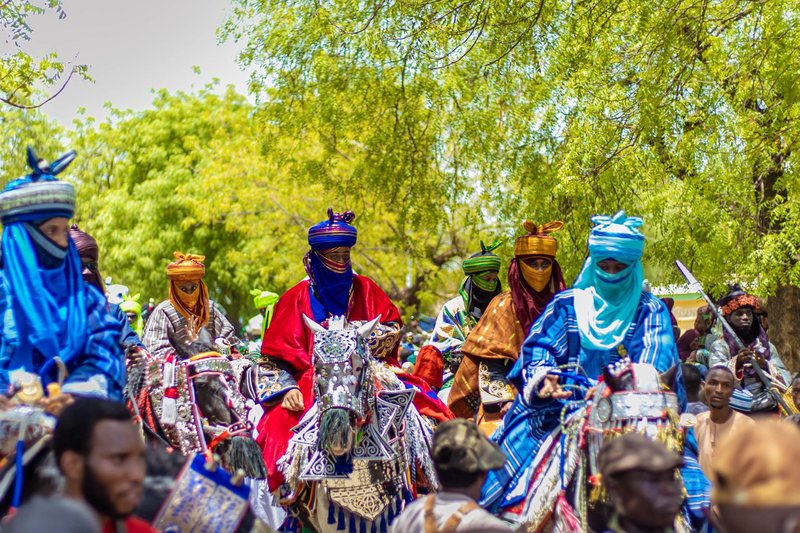
Hausa is the undisputed lingua franca of Niger and much of West Africa. Around 9 to 11 million people in Niger speak it as a first language, concentrated in the southern regions of Maradi, Zinder, and Tahoua. When you add second-language speakers across the country — and across borders into Nigeria, Ghana, Cameroon, and beyond — the global Hausa-speaking community numbers well over 70 million.
What makes Hausa remarkable isn’t just its scale but its spread. It crossed ethnic and religious lines centuries ago to become the trade language of the Sahel, functioning the way Swahili does in East Africa. Merchants from Niger to Kano to Accra could transact in Hausa long before any colonial language arrived.
The language belongs to the Chadic branch of the Afroasiatic family — the same macro-family that includes Arabic, Hebrew, and Amharic. It has a developed written tradition in both the Latin-based alphabet and Ajami, an Arabic-script adaptation that predates European contact.
In 2025, Niger’s government announced plans to replace French with Hausa as the official language. This is a political statement as much as a linguistic one — a deliberate break from the colonial legacy and an acknowledgment of what most Nigeriens already knew: Hausa runs the country at ground level.
Zarma-Songhai: Voice of the West
Zarma (also spelled Djerma or Zerma) is the second most spoken language in Niger, with roughly 3 million first-language speakers in the southwest — including Niamey, the capital. It’s part of the broader Songhai language cluster, a Nilo-Saharan family with deep roots in the old Songhai Empire that controlled much of the West African Sahel between the 15th and 16th centuries.
The Zarma people are predominantly sedentary farmers and traders in the Niger River valley. Historically, there’s been some tension between Zarma and Hausa communities — partly linguistic, partly ethnic — but in urban Niamey, code-switching between Zarma and Hausa is normal and fluent.
One linguistic quirk worth knowing: “Zarma” and “Songhai” are often used interchangeably in casual writing, but they’re not the same thing. Zarma is one dialect within the larger Zarma-Songhai dialect continuum, which also includes Kaado, Koyraboro Senni (spoken in Gao, Mali), and others. A Zarma speaker and a speaker of Koyra Chiini from Timbuktu could probably communicate — slowly. The same Songhai-family roots extend westward into Mali, where the indigenous languages of Mali include several closely related Songhai varieties still spoken along the Niger River bend.
Tamasheq: The Tuareg Desert Tongue
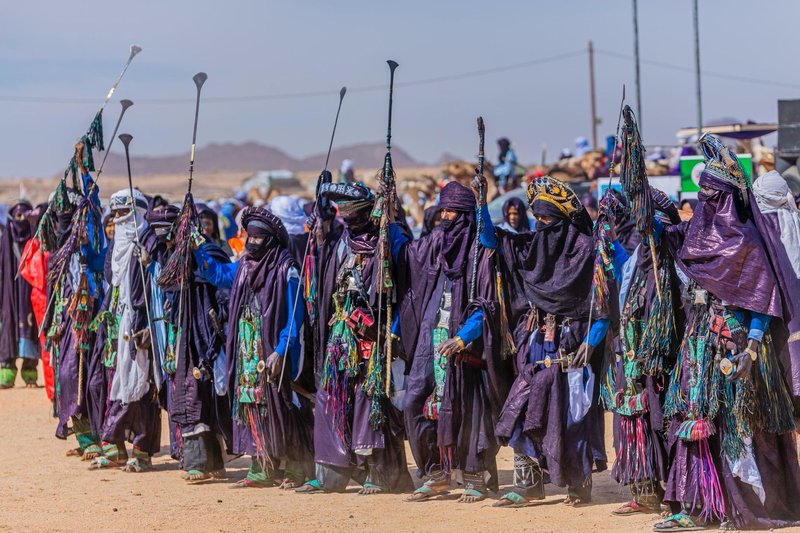
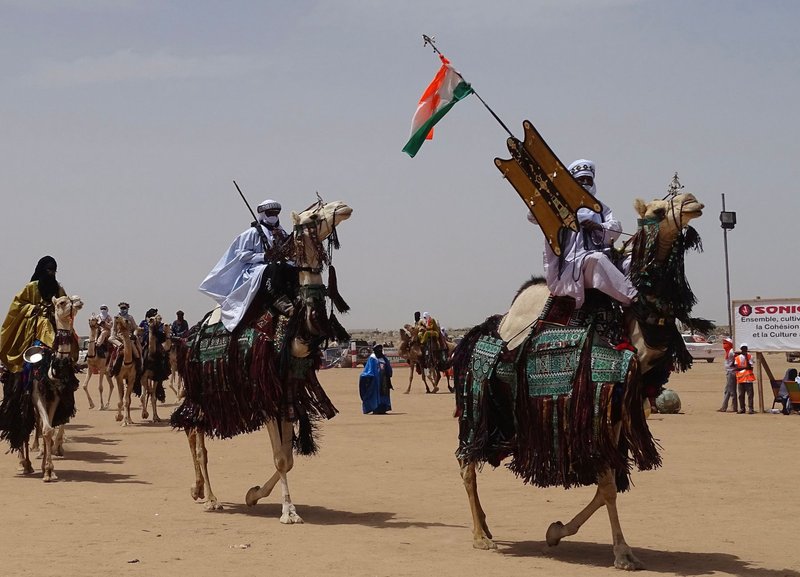
Tamasheq is the language of the Tuareg people, the iconic Saharan nomads whose territory spans Niger, Mali, Algeria, Libya, and Burkina Faso. In Niger, most speakers live in and around the Agadez region and the Aïr Massif — the same area that’s home to some of the Sahara’s most dramatic landscapes.
It’s a Berber language, part of the Afroasiatic family, and one of the few languages in Africa that maintained a pre-colonial writing system into the modern era. That script is called Tifinagh — and you can still see it carved into rocks across the Sahara, though today it’s used more in Mali and in cultural contexts than in everyday Nigerien life.
The Tuareg have historically resisted central government authority, which has made Tamasheq a politically loaded language. The north of Niger has seen several Tuareg rebellions since independence in 1960, and language rights have been part of those disputes — access to education in Tamasheq, recognition of the script, and cultural autonomy. Tuareg communities in neighboring Burkina Faso face similar dynamics; the indigenous languages of Burkina Faso include Tamasheq alongside more than a dozen other languages competing for recognition and educational resources.
Speaker counts in Niger for Tamasheq range widely — estimates run from 500,000 to over 1 million, reflecting both the difficulty of counting nomadic populations and the blurry line between dialects.
Fulfulde: The Language That Crossed Continents
Fulfulde (also called Fula, Fulani, Peul, or Pulaar depending on where you are) is one of West Africa’s most geographically distributed languages — spoken across roughly 20 countries from Senegal to Sudan. In Niger, the Fulani are largely pastoralist cattle herders whose migratory routes crisscross the country, which is why Fulfulde speakers turn up in almost every region rather than being concentrated in a single zone.
Unlike Hausa, Tamasheq, and Zarma, Fulfulde belongs to the Niger-Congo family — specifically the Atlantic branch, making it a relative of Wolof and Serer rather than of its Sahelian neighbors. The language has complex noun class morphology, which trips up learners who aren’t used to it: nouns take different forms depending on their class, and those class prefixes ripple through verbs, adjectives, and pronouns in the sentence.
Fulani oral literature — poetry, genealogical recitation, cattle-praise songs — is considered some of the richest in West Africa. This isn’t trivial context for a traveler: if you spend time with herding communities in Tahoua or Maradi, you’re likely encountering that tradition in daily life, not a museum.
Kanuri: Ancient Language of the Lake Chad Basin
Kanuri is the historical language of the Kanem-Bornu Empire, which controlled the Lake Chad basin for about a thousand years before the colonial period. In Niger, Kanuri speakers are concentrated in the Diffa region in the far southeast, around the Lake Chad shore. It’s a Nilo-Saharan language of the Saharan branch, related to Teda-Daza rather than to Zarma or Songhai.
The Bornu Empire’s longevity — it lasted from roughly the 9th century until the French arrival in the early 20th century — means Kanuri carries significant historical weight. The language was used in diplomacy, trade, and Islamic scholarship across a vast region. Today, Kanuri is spoken by an estimated 400,000 to 500,000 people in Niger, though the broader Kanuri-speaking community across Nigeria, Chad, and Cameroon is considerably larger. Chad in particular is home to an extraordinary range of languages from the same Saharan branch — the indigenous languages of Chad span 88 distinct languages, several of which share deep historical ties with communities on Niger’s eastern border.
Diffa, where most Nigerien Kanuri speakers live, has faced severe security pressures from Boko Haram activity around Lake Chad since the early 2010s, displacing communities and disrupting intergenerational language transmission.
Tassawaq, Buduma, and the Languages Most Lists Skip
Most articles on Niger’s languages stop after Hausa, Zarma, Tamasheq, Fulfulde, and Kanuri. That’s a reasonable shortlist for speaker count, but it misses some linguistically fascinating cases.
Tassawaq is spoken by around 50,000 people in the Aïr region. What makes it unusual is that it’s classified within the Songhaic branch of Nilo-Saharan — but it has absorbed such heavy Tuareg (Berber) and Hausa vocabulary that some researchers have called it a contact language. It’s the native tongue of the Ingelshi people, a group historically associated with the trans-Saharan trade routes through the Aïr Massif.
Buduma (also called Yedina) is spoken along the Niger shore of Lake Chad. It’s a Chadic language like Hausa, but far smaller — around 50,000 speakers in Niger, with more in Chad and Nigeria. The Buduma people are traditionally fishers and island dwellers on Lake Chad, and their language has developed in relative isolation from the dominant Kanuri-speaking communities nearby.
Tubu (or Teda-Daza) is the language of the Toubou people in Niger’s far northeast, in the Kawar oasis strip and along the Chadian border. Like Kanuri, it’s Nilo-Saharan (Saharan branch). The Toubou are desert nomads with a reputation for fierce independence that dates back centuries — they successfully resisted Ottoman, French, and Libyan attempts at incorporation.
Endangered Languages: What’s Being Lost
The most critically endangered language in Niger is Tetserret, a Berber language spoken by a small community in the Azawagh region near the Malian border. Estimates put the number of active speakers at between 500 and 1,000. It’s not closely related to Tamasheq despite being geographically surrounded by Tuareg communities, which suggests the Tetserret-speaking group has a distinct historical origin.
Tetserret is interesting to linguists precisely because of its isolation — it’s preserved archaic features that Tamasheq has lost. But it’s losing ground fast as younger community members shift to Hausa or Tamasheq for education, trade, and broader communication.
UNESCO’s Atlas of the World’s Languages in Danger lists several Niger languages as vulnerable or endangered, with Tetserret among the most precarious. No significant formal documentation or revitalization program was underway as of the mid-2020s.
The pressures are predictable: urbanization, migration, economic incentives to use larger regional languages, and a school system that has historically operated in French rather than mother tongues. The 2025 language policy shift may help some languages, but smaller communities without a political constituency behind them have little protection.
Niger’s 2025 Language Policy Shift
In 2025, Niger’s transitional government — which came to power following the July 2023 military coup — announced the replacement of French with Hausa as the country’s official language. This move followed similar decisions in other Francophone West African countries experiencing political transitions and a rejection of French influence (Mali and Burkina Faso have also been reassessing their relationships with the French language and French institutions).
The choice of Hausa, rather than declaring multiple indigenous languages co-official or promoting Zarma or Tamasheq to equal status, reflects demographic reality: Hausa is what most Nigeriens actually speak. But it also reflects a political choice that benefits the Hausa-speaking majority at the potential expense of other communities who might have hoped for a more pluralistic language policy.
For travelers, the practical implication is limited in the short term — French still functions in formal contexts and the transition will take years to fully implement. For researchers, linguists, and anyone tracking African political shifts, it’s a significant marker of how the post-colonial linguistic order in West Africa is being renegotiated.
Languages and Education in Niger
Niger has one of the lowest literacy rates in the world — consistently ranking in the bottom five countries globally. That’s not coincidental. A school system that taught in French, a language spoken at home by almost no one, created a structural gap between classroom and community.
Since the 1990s, there have been experimental mother-tongue education programs in Hausa and Zarma, the two most widely spoken languages. The evidence from those programs — tracked by researchers at the University of Education Winneba and reported on by organizations like SIL International — consistently shows that children learn to read and do arithmetic faster when instruction starts in their mother tongue.
The challenge is infrastructure, not evidence. Training teachers in multiple indigenous languages, producing textbooks in Tamasheq or Fulfulde, and sustaining programs across a country with limited resources is a genuine operational problem. The 2025 push toward Hausa as the official language may accelerate Hausa-medium instruction, but it doesn’t solve the problem for the tens of thousands of children whose first language is Kanuri, Tamasheq, or Fulfulde.
Niger’s linguistic complexity isn’t a tourist curiosity — it’s directly tied to some of the country’s hardest development problems. Understanding the language map is a prerequisite for understanding almost anything else about how the country works.