
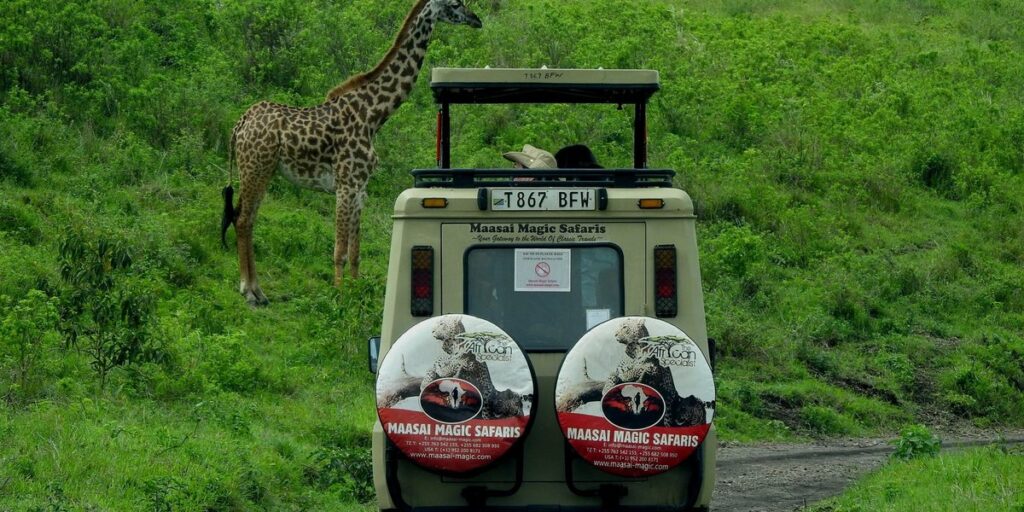
Tanzania has more UNESCO World Heritage Sites than most people realize. Seven, to be exact — a mix of natural wonders and cultural landmarks that span savanna, ocean, mountain, and ancient coastline. Most travelers know the Serengeti. Fewer know about the 3,000-year-old rock paintings hidden in the Kondoa highlands, or the medieval ruins crumbling into the Indian Ocean near Kilwa.
This post covers all seven inscribed sites, with enough context to understand what makes each one significant and what you’d actually experience on the ground. There’s also a section on the six sites currently on Tanzania’s tentative list — a detail almost no travel article covers, but useful if you’re planning ahead.
Table of Contents
- Tanzania’s UNESCO Sites at a Glance
- The 7 Inscribed World Heritage Sites
- Serengeti National Park
- Ngorongoro Conservation Area
- Kilimanjaro National Park
- Stone Town of Zanzibar
- Ruins of Kilwa Kisiwani and Songo Mnara
- Kondoa Rock-Art Sites
- Selous Game Reserve
- Tanzania’s Tentative UNESCO Sites
- Planning Around the Sites
Tanzania’s UNESCO Sites at a Glance {#at-a-glance}
| Site | Year Inscribed | Type |
|---|---|---|
| Serengeti National Park | 1981 | Natural |
| Ngorongoro Conservation Area | 1979 | Mixed |
| Kilimanjaro National Park | 1987 | Natural |
| Stone Town of Zanzibar | 2000 | Cultural |
| Ruins of Kilwa Kisiwani and Songo Mnara | 1981 | Cultural |
| Kondoa Rock-Art Sites | 2006 | Cultural |
| Selous Game Reserve | 1982 | Natural |
Three are primarily cultural, four are natural (with Ngorongoro holding both designations as a mixed site). The natural sites are all in the north or south; the cultural sites cluster on the coast and central highlands.
The 7 Inscribed World Heritage Sites {#inscribed-sites}
Serengeti National Park {#serengeti}
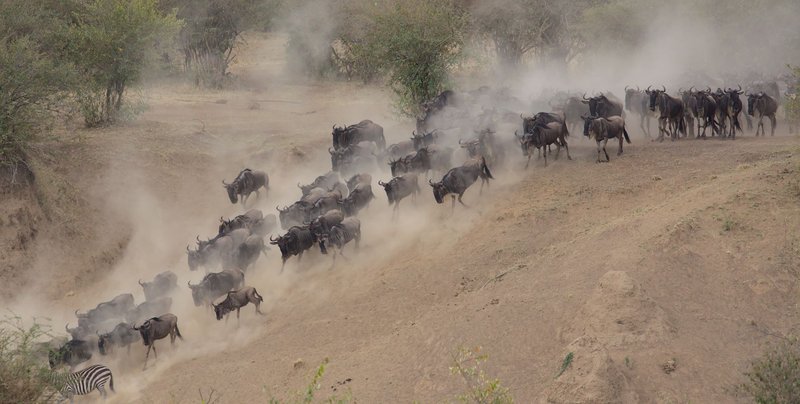
The Serengeti earned its inscription in 1981 for one reason that no other ecosystem on Earth can match: the annual migration of roughly 1.5 million wildebeest, 400,000 zebra, and 200,000 gazelle moving in a continuous loop across the plains and into Kenya’s Masai Mara. According to the IUCN, this is the largest overland migration of mammals on the planet.
The park covers 14,763 square kilometers of open grassland and acacia woodland in northern Tanzania. What UNESCO recognized wasn’t just the migration — it was the intact predator-prey system: lion, leopard, cheetah, hyena, and wild dog all living at densities that have largely disappeared elsewhere in Africa.
Visit tip: The migration’s river crossings happen in the northern Serengeti (Mara River) between July and October. If you’re flying in, Seronera is the central hub with the most lodges; the northern Lamai Wedge gives you the crossings with fewer vehicles.
Ngorongoro Conservation Area {#ngorongoro}
Ngorongoro is the only UNESCO site on Tanzania’s list — and one of the few in the world — that holds both natural and cultural designations. The 260-square-kilometer crater is the world’s largest intact volcanic caldera, and it functions as a self-contained ecosystem: an estimated 25,000 large animals live on the crater floor year-round, including one of Africa’s densest populations of black rhino.
The cultural designation comes from the Maasai, who have lived in the Conservation Area alongside wildlife since colonial-era displacement from the Serengeti. That coexistence — pastoralism and wildlife sharing the same land — was rare enough to earn a special category.
Visit tip: The crater rim sits at 2,300 meters, so nights are genuinely cold. Day visits from Arusha are possible but rushed; staying on the rim gives you early morning access before the day-tripper vehicles arrive.
Kilimanjaro National Park {#kilimanjaro}
Africa’s highest peak at 5,895 meters, Kilimanjaro was inscribed in 1987 for its dramatic ecological zones — you pass through rainforest, heath, moorland, alpine desert, and glacial summit in a single ascent. The glaciers themselves have shrunk dramatically; research published in Nature has tracked over 85% ice loss since 1912.
The mountain is walk-up, no technical climbing required, which makes it accessible to fit hikers without mountaineering experience. That accessibility also makes altitude sickness the main risk — most failed summits come from going too fast, not from physical inability.
Visit tip: The Lemosho Route (8 days) has better acclimatization than the popular Marangu Route (5-6 days) and higher summit success rates. Machame is a solid middle ground at 6-7 days if you want a balance of time and scenery.
Stone Town of Zanzibar {#stone-town}
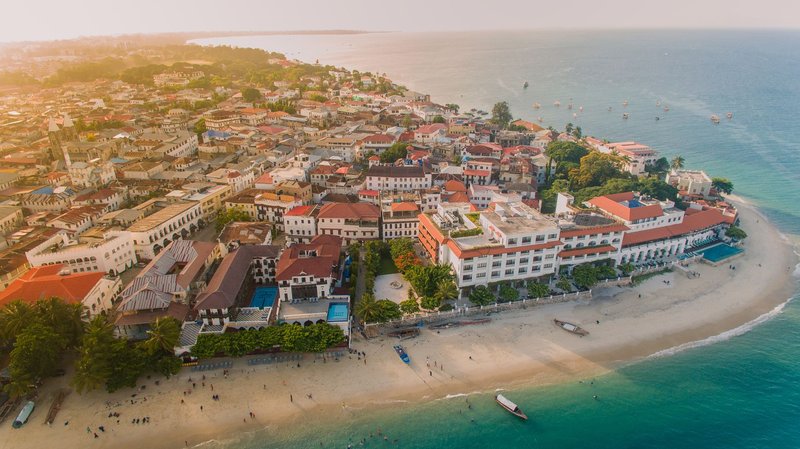
Stone Town is the historic core of Zanzibar City, inscribed in 2000 for its role as the center of Indian Ocean trade for over a millennium. The architecture is the physical record of that trade: Swahili townhouses with carved wooden doors, Arab courtyard designs, Indian merchant facades, and Portuguese colonial fortifications all exist within a few blocks of each other.
The slave trade ran through Zanzibar until the late 19th century, and the Anglican Cathedral now stands on the site of the last open slave market in East Africa. The market’s chambers are preserved underneath. It’s not comfortable to visit, which is exactly why you should.
Visit tip: Stone Town is walkable but deliberately confusing — narrow alleys don’t follow a grid. Most of the carved-door architecture is in the oldest section around the old fort (Ngome Kongwe). The Forodhani night market on the waterfront is the practical choice for eating well without planning.
Ruins of Kilwa Kisiwani and Songo Mnara {#kilwa}
This is Tanzania’s least-visited UNESCO site and arguably its most underrated. Kilwa Kisiwani is a small island off the southern coast, reachable by a short boat ride from Kilwa Masoko town. In the 13th to 16th centuries, it was one of the most important ports in the entire Indian Ocean trading network — the place where gold from Great Zimbabwe moved into Arab and Portuguese hands.
The ruins include the Husuni Kubwa palace (one of the largest pre-colonial buildings in sub-Saharan Africa), the Great Mosque, and several smaller structures. Most are roofless and reclaimed by vegetation, but the scale of what’s still standing makes the former wealth of the sultanate legible.
Songo Mnara, a second island nearby, holds more ruins from the same period and gets even fewer visitors.
Visit tip: Getting to Kilwa Masoko requires either a long bus ride from Dar es Salaam or a short flight. There’s no mass-market tourism infrastructure here — a handful of guesthouses, one or two guides who know the site well, and boats arranged on arrival. That’s what keeps it good.
Kondoa Rock-Art Sites {#kondoa}
The rock paintings of the Kondoa district, inscribed in 2006, represent one of the most significant concentrations of prehistoric art in Africa. The oldest paintings date back roughly 2,000 years, with some researchers placing earlier layers further back still. The images — humans, animals, geometric patterns — are painted in ochre, white, and black on granite overhangs in the Masai Escarpment.
UNESCO recognized both the quality of the art and its continuity: the Sandawe and Hadza peoples who still live in the region maintain oral traditions connected to these sites, meaning the paintings haven’t been severed from living cultural memory.
Visit tip: Kondoa town is the base; the painted sites are spread across the hills and require a guide and a vehicle. Most visitors come as a detour between Arusha and Dodoma. The site sees almost no foreign tourists, which means you’ll usually have the overhangs to yourself.
Selous Game Reserve {#selous}
Selous — now officially renamed Nyerere National Park in most of its protected area, though the broader ecosystem retains the Selous name — was inscribed in 1982. At 50,000 square kilometers, it’s one of the largest protected areas in Africa and holds the largest population of African wild dogs on the continent.
Unlike the northern circuit parks, Selous is boat safari territory. The Rufiji River runs through it, and game viewing from a flat-bottomed boat — hippos, crocodiles, elephants drinking at the bank — is a different experience than anything you get in the Serengeti. It was placed on UNESCO’s List of World Heritage in Danger in 2014 due to poaching pressure on elephant populations; recovery efforts have shown progress but the designation remains. If you’re building a broader case for why Tanzania deserves more time on an itinerary, the 12 reasons to visit Tanzania that go beyond the typical northern circuit are worth reading before you plan.
Visit tip: The reserve is accessible by fly-in from Dar es Salaam (about an hour) or by an overnight train on the TAZARA line. Boat safaris on the Rufiji should be a non-negotiable part of any Selous itinerary.
Tanzania’s Tentative UNESCO Sites {#tentative}
Tanzania has submitted six sites for potential future inscription. None of these are confirmed or officially designated — they’re on the waiting list:
- Mount Kilimanjaro Buffer Zone and Cultural Landscape — the cultural landscape surrounding the national park
- Eastern Arc Mountains and Coastal Forests — a biodiversity hotspot with extremely high endemism
- Lake Natron — an alkaline lake and the sole regular breeding site of the lesser flamingo in East Africa
- Olduvai Gorge and Laetoli — paleoanthropological sites with some of the oldest known evidence of early human ancestors
- Rubondo Island — a remote lake island reserve in Lake Victoria
- Mafia Island Marine Park — a marine protected area in the Indian Ocean
Olduvai Gorge is the one to watch: it’s already a significant scientific site, drawing researchers since Mary and Louis Leakey’s excavations in the mid-20th century, and would be a strong candidate if Tanzania pursues formal nomination. For context on how UNESCO processes work across East Africa, the situation in neighboring island nations — like the World Heritage Sites in Comoros, where no sites have yet been inscribed despite several on the tentative list — illustrates how long the path from nomination to inscription can be.
Planning Around the Sites {#planning}
Most of Tanzania’s UNESCO sites cluster into two practical circuits.
The northern circuit covers the Serengeti, Ngorongoro, and Kilimanjaro. These three can be combined in two weeks without feeling rushed: a week of safari split between the Serengeti and Ngorongoro, followed by a Kilimanjaro climb. Arusha is the base for all of them.
The coastal and southern circuit covers Stone Town, Kilwa, and Selous. Stone Town is a natural arrival point for the Zanzibar ferry from Dar es Salaam. Selous is most easily accessed from Dar. Kilwa is a southern extension that requires commitment — it’s off the main tourist track — but it fits logically between Dar and the southern coast.
Kondoa sits between circuits and works best as a detour for travelers with their own vehicle or extra time.
The dry season — June through October — is the standard recommendation for the northern parks, when game is concentrated near water and the Serengeti migration crossings are happening. The coast and cultural sites work year-round, with the long rains (March–May) being the one period to avoid on unpaved roads.
Tanzania’s seven World Heritage Sites are spread across radically different landscapes, and that variety is what makes a multi-site itinerary worth building. The Serengeti and Kilimanjaro you probably expected. Kilwa and Kondoa are the ones that might actually surprise you.