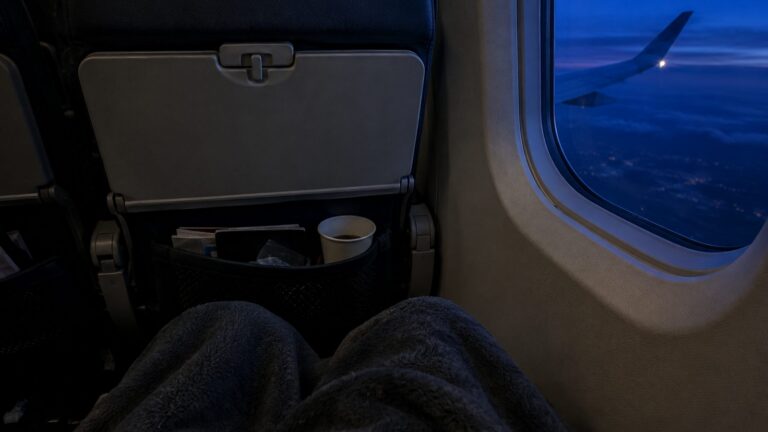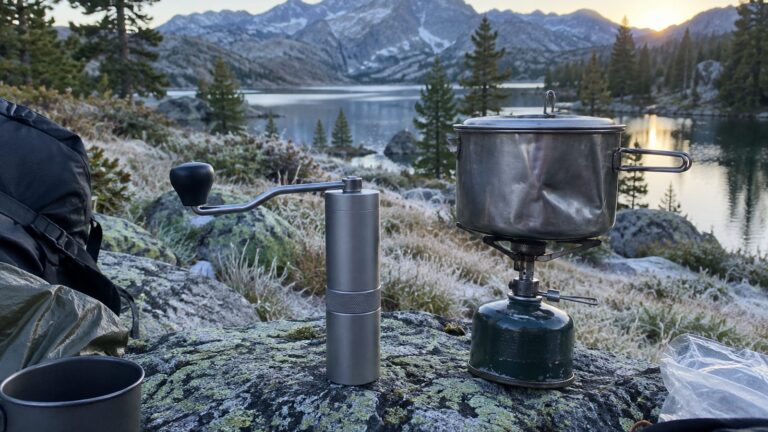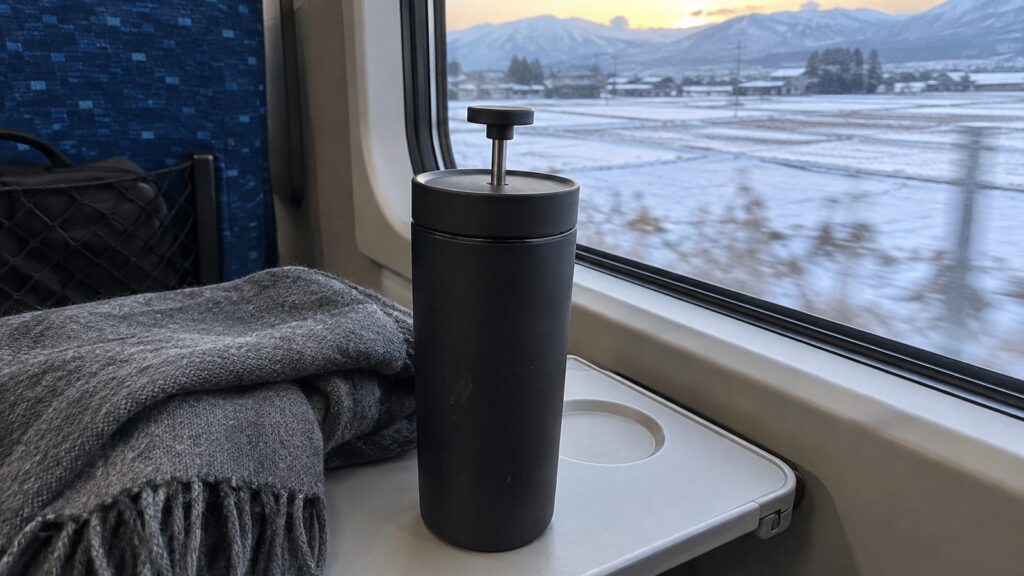
I grew up in Bologna with a moka pot on the stove, so I came to the best travel French press mug late and with suspicion. Then came a January morning in 2023. I pressed coffee in a Kyoto guesthouse at 6:30, boarded the limited express to Kinosaki Onsen and took my last sip two hours later. It tasted like burnt walnut skin.
That cup taught me the one fact most lists leave out. A press mug is two jobs in one body, a brewer and a flask, and the coffee keeps steeping unless the design stops it. Add a lid that has to survive a packed bag and you have the three failures this guide is built around: leaks, grit and bitterness.
The short answer:
- Best overall: ESPRO Go P0, for its double micro-filter and a lid that locks.
- Best budget pick: Bobble PRESSE, for hotel desks and short carries.
- Best classic: Bodum Travel Press in steel, for a 4-minute press you drink right away.
- Best for slow sippers: BruTrek Double Shot, with a plate that walls off the grounds.
- Best for less bitterness: GSI Personal JavaPress, because you pour the coffee off into a separate mug.
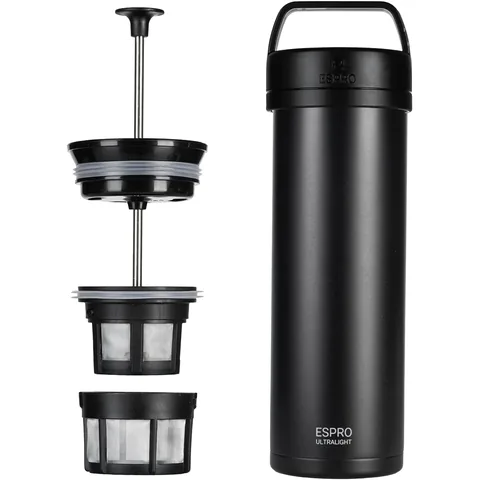 ESPRO Go P0Mid-rangeCheck price on Amazon
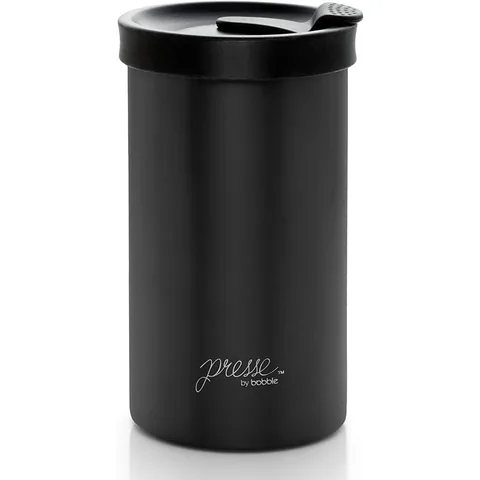 bobble PRESSEBudgetCheck price on Amazon
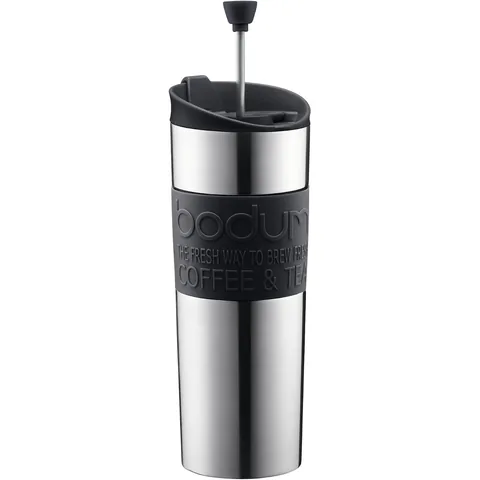 Bodum Travel Press (steel)Mid-rangeCheck price on Amazon
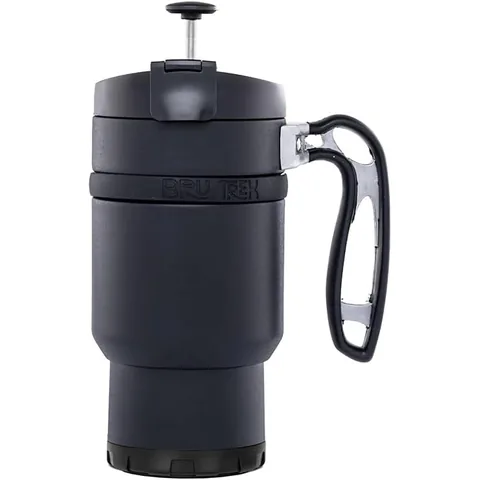 BruTrek Double ShotPremiumCheck price on Amazon
Best Travel French Press Mugs Compared
All but the plastic and copolyester models are insulated steel, so this is also a shortlist of the insulated travel French press options that hold up. Capacity is the number printed on the mug. Expect about 4 oz less in the cup on most of these, since the plunger needs room.
| Mug | Capacity | Body | Filter | Stops brewing? | Lid in a bag |
|---|---|---|---|---|---|
| ESPRO Go P0 | 16 oz | Vacuum steel | Double micro-filter | Yes | Locks |
| Bobble PRESSE | 13 oz | Triple-wall steel | Micro-filter | No | Upright only |
| Bodum Travel Press (steel) | 15 oz | Vacuum steel | Mesh | No | Mixed reports |
| BruTrek Double Shot | 16 oz | Vacuum steel | Bru-Stop plate and mesh | Yes | Spill-proof claim |
| GSI Personal JavaPress | 20 oz | Copolyester, sleeve | Plunger press | Pour off | Upright only |
| Bodum Travel Press (plastic) | 15 oz | Double-wall plastic | Mesh | No | Mixed reports |
| GSI Commuter JavaPress | 15 oz | Copolyester, nylon | Sliding plunger | Not stated | Upright only |
| BruTrek Steel Toe 3.0 | 20 oz | Vacuum steel | Bru-Stop plate and mesh | Yes | Upright only |
| AeroPress Go | 8 oz | Plastic | Paper | Not applicable | Not for carrying coffee |
What Matters in a Travel French Press Mug
Three things decide whether you keep using a travel French press mug past the first week.
Whether the lid holds in a bag
Read the wording on the box. “Spill-resistant” means the mug survives a bump on a desk. It does not mean the mug survives lying on its side for four hours.
I learned the difference in February 2014 on a night bus to Oaxaca. A plastic press mug sold as spill-resistant wept through its lid in my shoulder bag, and by dawn the ink in a week of interview notes had run into one brown cloud.
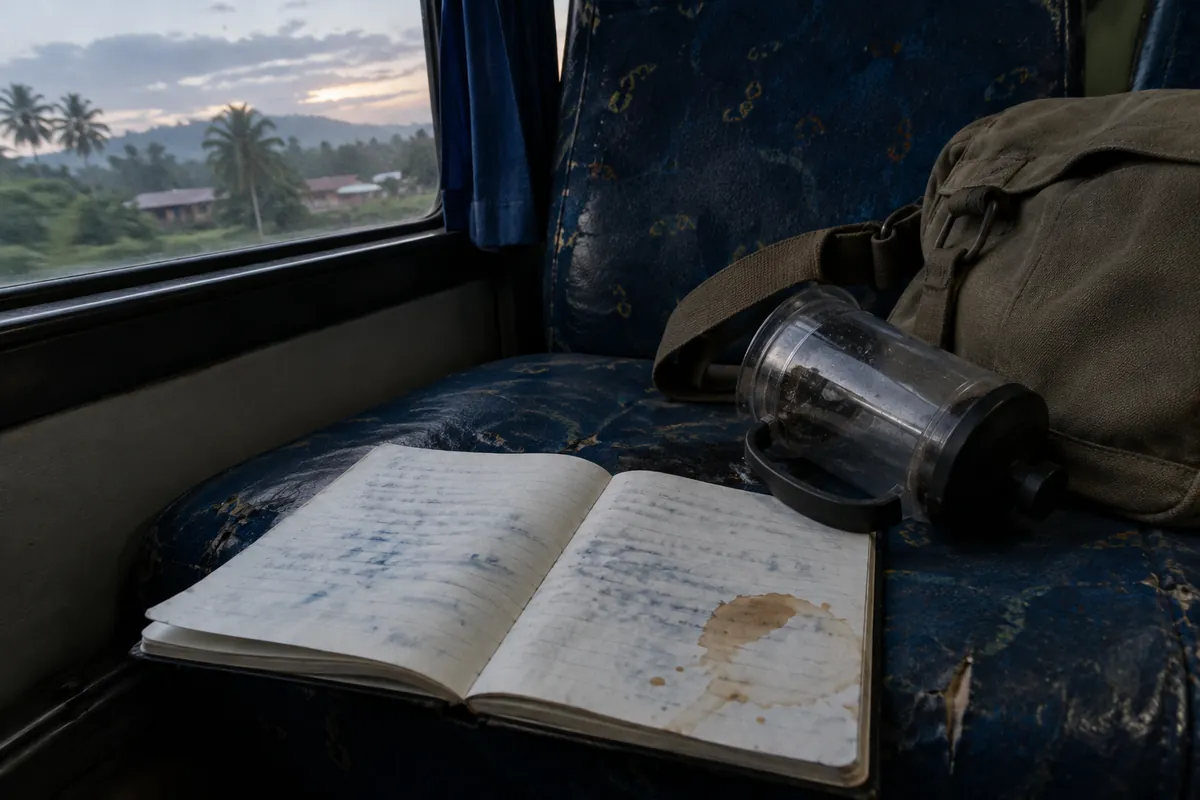
Only pack a mug with coffee inside if the lid locks and owners confirm it holds. On everything else, treat the lid as a sip lid and carry the mug upright in a side pocket or by hand.
Whether the filter stops the grit
A standard mesh press lets fine particles through, and in a mug you drink those particles because there is no decanting. OutdoorGearLab found Espro’s micro-filters 9 to 12 times finer than a standard press filter and reported no sludge in the cup. Plain mesh mugs leave a silty last inch, so stop drinking before it.
Whether the grounds stop steeping
This is the failure from my Kinosaki train. On a basic plunger, pressing pushes the grounds down but leaves them in contact with the coffee. Extraction continues, and a mug that stays hot for hours keeps it going for hours.
There are three fixes. Espro and BruTrek use a filter or plate that separates coffee from grounds after the press. GSI’s Personal JavaPress gives you a second mug to pour into. On a basic mug, the fix is behavioral: drink within 15 to 20 minutes, or use a slightly coarser grind and a 3-minute steep.
Travel French press mug Reddit threads have said the same thing for over a decade. On r/Coffee, owners warn that a plain press mug turns noticeably bitter within minutes and suggest brewing in a press and pouring into a travel mug. On r/CampingandHiking, the camp crowd favors the Planetary Design press, now sold as BruTrek, and the GSI kit, with AeroPress the usual alternative.
The 9 Best Travel French Press Mugs
Best overall: ESPRO Go P0
ESPRO Go P0Mid-range
Two micro-filters, a double-lock lid and a press that separates coffee from grounds. Our top pick for flyers and carry-on travelers.
- 16 oz double-wall steel, brews about 12 oz; maker claims 6 hours hot
- Double micro-filter, optional paper filters; top-rack dishwasher safe
The Go P0 is the one that solves all three failures. Its two nested micro-filters catch far more fines than plain mesh, the double-lock lid is built to ride in a bag and pressing separates the coffee from the grounds so the second half tastes like the first.
It weighs about 10 oz, according to Task & Purpose, which is light for a vacuum steel press. Espro’s heavier travel press came in at 12.3 oz in the OutdoorGearLab write-up, where the vessel earned the word leakproof.
The trade-offs are real. The tall, narrow body makes knocking out grounds slow, both filters need rinsing and owners report a little liquid left behind the filter after pouring. Espro also sells paper filters for this mug. They add one more thing to pack and shorten the cleanup.
Best budget pick: Bobble PRESSE
bobble PRESSEBudget
The lowest-cost steel option here, for hotel desks and office mornings. Keep it upright: the silicone top is a sip lid, not a seal for a packed bag.
- 13 oz stainless tumbler, triple-wall insulation and a built-in micro-filter
- Dishwasher safe; silicone top with a drink hole, not a sealed lid
The PRESSE is a stubby 13 oz French press tumbler at 6.3 inches tall, which makes it the easiest mug here to fill under a hotel coffee machine or a lobby hot water tap. Triple-wall steel keeps the heat in and the micro-filter handles grit better than plain mesh.
Its limit is the lid. The silicone top is a drinking lid, and owners report leaks when the mug tips or the liner lip bends. A new silicone top can also smell rubbery for a few washes, so run it through hot soapy water before the trip.
Best classic: Bodum Travel Press (steel)
Bodum Travel Press (steel)Mid-range
The default press mug: a steel body that takes suitcase knocks and a 4-minute brew. Press it and drink it, because nothing stops the steeping.
- 15 oz double-wall vacuum steel with a silicone-and-mesh plunger filter
- Maker calls the lid spill-resistant, not leak-proof; dishwasher safe
This is the plain stainless steel travel French press. The body is vacuum steel, the plunger is a familiar mesh and silicone design and it goes in the dishwasher when you get home.
Bodum’s instruction is simple: press after 4 minutes and drink. Follow it. There is no stop mechanism, so this suits travelers who finish coffee before the bus leaves. Owner reports on the lid split into two camps, so pack it empty and keep it upright once filled.
Best for slow sippers: BruTrek Double Shot
BruTrek Double ShotPremium
A steel mug with a handle and a Bru-Stop plate that walls off the grounds after pressing, for hikers and slow sippers who want a second hot cup later.
- 16 fl oz 18/8 steel, vacuum insulated, handle and twist-off base for spare grounds
- Bru-Stop mesh plate halts brewing; spill-proof lid; hand wash only
The Bru-Stop plate is a tempered steel disc over an ultra-fine mesh, and it creates a barrier between the coffee and the grounds when pressed. That makes the Double Shot the best choice if a cup lasts you all morning on a trail or a ferry.
The base twists off to store spare grounds, so one mug carries a second brew. Owners report closer to 12 oz of usable coffee than the 16 on the label and it is hand wash only, which matters less in a camp than in a hotel basin.
Best for less bitterness: GSI Personal JavaPress
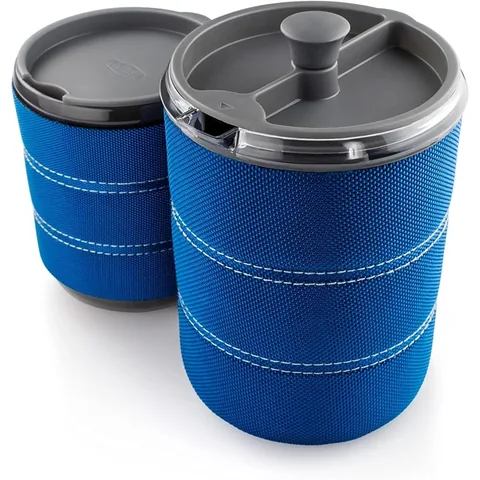
GSI Personal JavaPressMid-range
A press plus a separate mug, which solves the bitterness problem: pour the coffee off the grounds. Light and shatter-resistant for road trips and backpacks.
- 20 fl oz carafe plus 17 fl oz mug, insulating sleeve, two lids; about 10.7 oz
- Copolyester body; the sleeve insulates but it is not a vacuum steel mug
GSI skips the steel and solves bitterness with a pour. You brew in the 20 oz carafe, then decant into the 17 oz mug, and the coffee leaves the grounds behind. At 10.7 oz for the whole kit, it is light for what it holds.
An insulating sleeve is the only heat protection, so coffee cools much faster than in vacuum steel. It is also over 4 inches wide. Campers will not care. Commuters will.
Lightest bag weight: Bodum Travel Press (plastic)
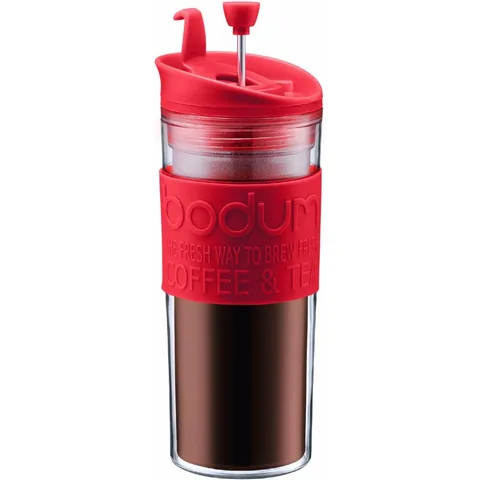
Bodum Travel Press (plastic)Budget
The light way into press-and-go coffee, for travelers who want low bag weight and accept a plastic body with shorter heat retention than steel.
- 15 oz BPA-free double-wall plastic with silicone grip and mesh plunger filter
- Maker calls the lid spill-resistant; dishwasher safe; not vacuum insulated
Same plunger and capacity as the steel Bodum, in a double-wall plastic body. Plastic suits a bag where every item is weighed, and it will not dent. It holds heat for less time than steel and owner reports on durability are mixed, with some bodies cracking early. Pack it inside a shoe or a soft pouch.
Best for commuting and camp: GSI Commuter JavaPress
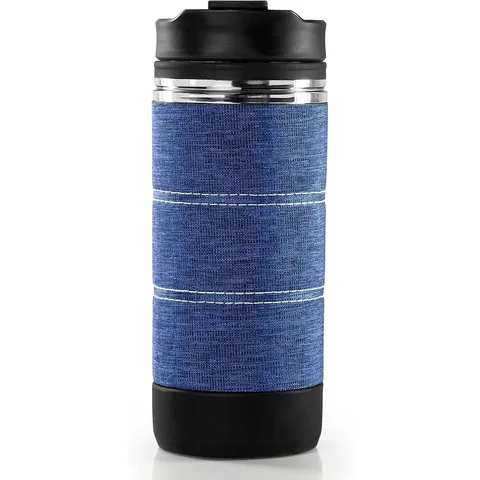
GSI Commuter JavaPressMid-range
A commute-and-campsite mug with no plunger rod sticking up. Heat lasts about 90 minutes, so drink it early.
- 15 fl oz shatter-resistant copolyester with a sliding inner plunger sleeve
- Sealable spill-resistant lid and nylon sleeve; hand wash only
The Commuter has no plunger rod. A sliding inner sleeve does the pressing, which keeps the height under 8 inches, with a nylon outer wrap.
GSI lists 90 minutes of heat, the shortest figure in this group, and some owners report leaks around the top. Use it for a morning at camp or a train platform. Do not expect it to carry coffee to lunch.
Best large mug: BruTrek Steel Toe 3.0
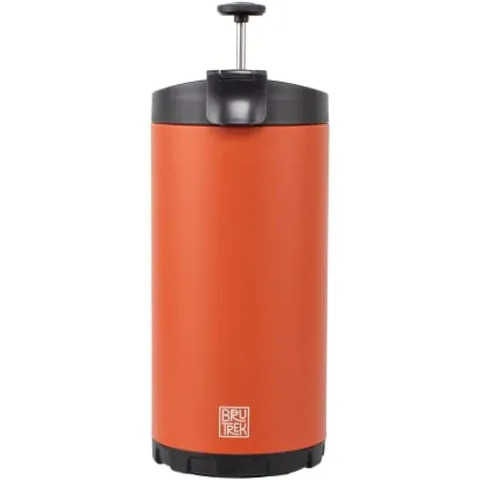
BruTrek Steel Toe 3.0Mid-range
The large option for car trips and campsites: 20 oz, a pour spout and a Bru-Stop plate. Owners report lid drips, so carry it upright.
- 20 fl oz 18/8 steel, double-wall vacuum insulated, with a pour spout
- Threaded no-spill locking lid, Bru-Stop plate to halt brewing, rubber base
If you share coffee with a partner at a campsite, 20 oz matters. The Steel Toe adds a pour spout, a rubber base that stays put on a tailgate and the same Bru-Stop plate as the Double Shot. Several owners report lid leaks, so it belongs in a cup holder or on a table, not in a bag.
The alternative: AeroPress Go
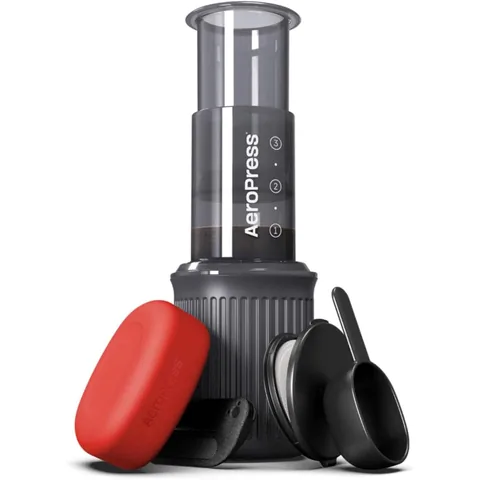
AeroPress GoPremium
Not a press mug, but the brewer many coffee drinkers pack instead: a paper-filtered cup in about 2 minutes, from a kit that nests inside its own mug.
- Brews up to 8 oz in about 2 minutes; packs into its own lightweight mug with a lid
- Paper micro-filters included; plastic mug is not insulated
The AeroPress Go is not a press mug. It brews up to 8 oz in about 2 minutes through a paper filter, into a separate cup, and the whole kit packs inside its own plastic mug. It cannot carry coffee anywhere hot because the mug has no insulation, but cleanup is one push of a puck into the bin.
Coffee-first travelers who drink at the table should buy this one. Anyone who wants hot coffee on the walk to the station should buy a French press travel mug.
Looking for a Stanley? Stanley’s French press on Amazon today is the 48 oz Stay-Hot, a camp and kitchen pot that does not belong in a day bag.
How to Brew in a Travel French Press Mug
The hotel room is the hard part, so plan around water and grind.
- Grind: coarse, like raw sugar. Pre-ground supermarket coffee is too fine and pushes grit through mesh filters. If you buy pre-ground, use a micro-filter mug.
- Ratio: 1 part coffee to about 15 parts water by weight. In a 12 oz brew that is about 24 g, or 4 level tablespoons.
- Water: just off the boil, around 200 F. Pull the kettle and wait 30 seconds.
- Time: 4 minutes, then press slowly. Hard pressing forces fines through the filter.
The whole kit travels in one small pouch:
Travel coffee kit
- A press mug that fits your trip pack it empty
- Coarse-ground coffee in a sealed zip bag about 24 g a mug
- Spoon for measuring and scraping 1 level tablespoon is about 6 g
- Small zip bag for the wet filter travel days
- Thin towel or cloth dries parts overnight
- Paper filters if your mug takes them faster cleanup
For hot water, hotels split by region. Rooms in the UK, Japan and much of Asia usually have a kettle. Rooms in the US usually have a drip machine: run it empty with no pod and you get hot water that tastes faintly of the machine. Rooms in continental Europe are the unreliable ones, so ask at breakfast. Chinese trains have boiling water taps in each carriage, and a press mug is a good companion for those.
Altitude changes the recipe too. In Cusco in September 2018 my usual 4 minutes came out thin, because water boils near 190 F at 3,400 meters. I went to 6 minutes with a slightly finer grind and got my coffee back. The same applies on a Colorado trip above 8,000 feet, with a smaller adjustment.
How to Clean a French Press Mug While Traveling
Never rinse grounds down a hotel basin. I did it at a small guesthouse in Evora in November 2023, and the drain backed up within two mornings. The owner was kind about it. The plumber was not cheap.
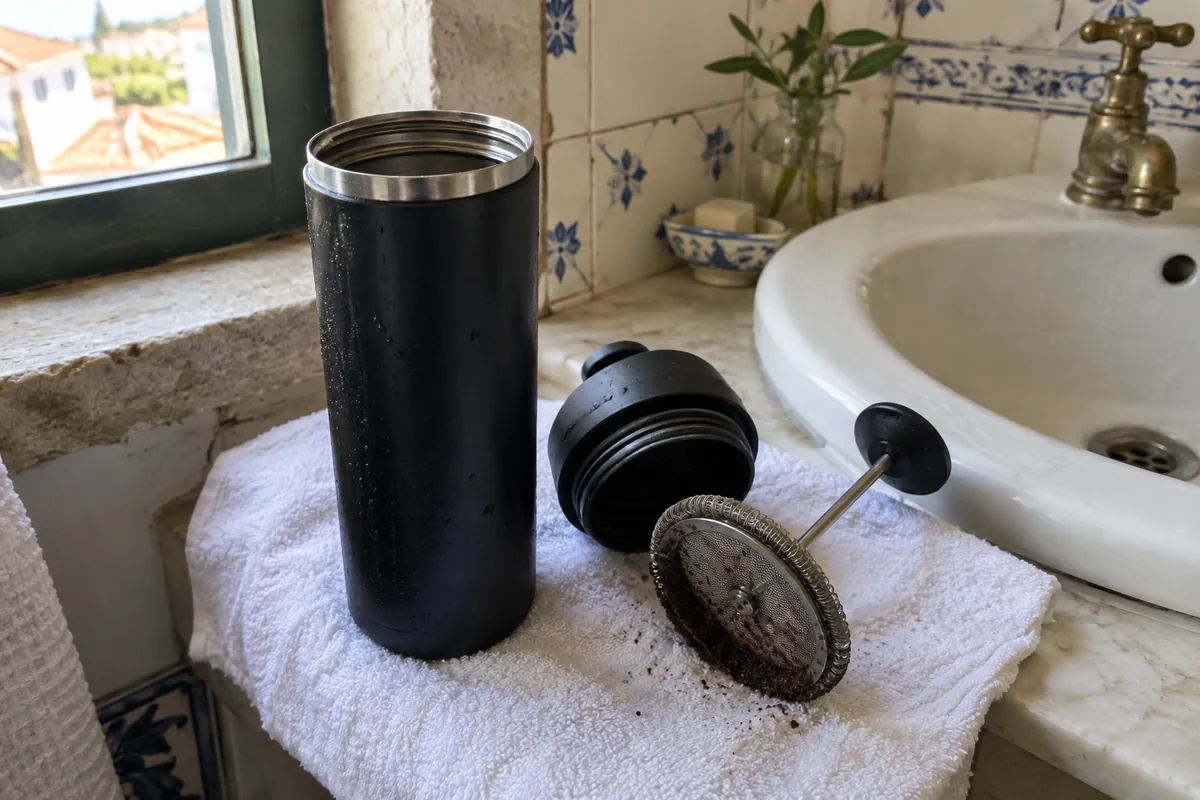
- Knock the grounds into the bin, or scrape them out with a spoon. On tall mugs, add an inch of water, swirl and pour through the plunger into a tissue or napkin.
- Rinse with hot water and a drop of hand soap.
- Unscrew the filter and rinse the mesh and seal apart once a day. Trapped oil is the source of the stale taste that builds up on a long trip.
- Dry parts apart overnight. A closed damp mug in a bag smells bad by the next destination.
Pack a small zip bag for the wet filter on travel days.
Taking a Press Mug Through Airport Security
An empty press mug passes through security in a carry-on with no issue. Coffee counts as a liquid, so anything above 3.4 oz stops at the checkpoint. Finish it or pour it out and fill up airside.
Ground coffee travels fine in a zip bag. On flights bound for the US, powders over 12 oz can get additional screening, but a week of coffee weighs well under that. Keep it in a sealed bag so the smell does not move into your clothes.
FAQ
How much coffee does a 16 oz travel French press mug actually make?
About 10 to 12 oz. The plunger and filter take up space, so a 16 oz vessel never brews 16 oz. ESPRO designs the Go P0 for 12 oz, and OutdoorGearLab reported about 10 oz from the heavier 16 oz Espro it examined. For a full 16 oz cup, buy a 20 oz model such as the BruTrek Steel Toe.
Can you make tea in a travel French press mug?
Yes. Add loose leaf, pour water at the temperature the tea needs and press when it is ready. Silicone seals hold on to flavor, so a mug used for smoky or mint tea can taint the next coffee. Wash the seal in hot water with a little baking soda, or keep one mug for tea.
Can you make cold brew in a travel French press mug?
Yes. Mix one part coarse coffee with about eight parts cold water, leave it in the hotel fridge for 12 to 16 hours, then press. A vacuum steel mug keeps it cold through a hot day: ESPRO lists up to 10 hours for the Go P0. Use a mug with a micro-filter or Bru-Stop plate, or pour it off, so the grounds stop steeping.
Do travel French press mugs fit in a car cup holder?
Slim ones do. The ESPRO Go P0 is 3 inches wide and fits most holders, and the Bobble PRESSE at 3.5 inches fits many. The GSI Personal JavaPress is over 4 inches wide and does not, so it rides on the floor or in a bag pocket on road trips.
Can you add milk or sugar to a travel French press mug?
Sugar goes in with the hot water before you press. Milk is harder, because the filter sits between you and the coffee on most press mugs, so milk added after pressing does not mix well. Pour into a second cup, or stir powdered milk in with the water before pressing.
Is a French press mug better than a regular travel mug?
It is better when you control the beans and the water, and worse when you only need to carry coffee from a cafe. A press mug brews and carries, but it holds less, weighs more and takes longer to clean. Travelers who buy good coffee on arrival do better with a plain vacuum mug.
My own bag settled on a double-filter steel press with a locking lid after the Oaxaca notebook and the Kinosaki train. Pick for the failure you would mind most: a wet bag, a gritty cup or a bitter last sip.