
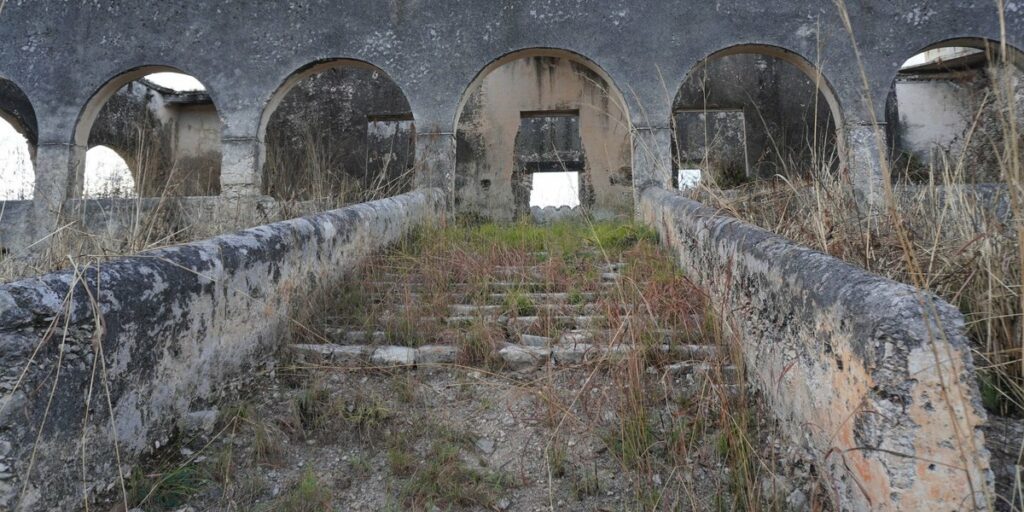
The story goes that an American tycoon built a Roman-style mansion on Jamaica’s northeast coast as a wedding gift, rushed the concrete work by mixing it with seawater, and watched his bride take one look at the crumbling walls and declare “what a folly.” She sailed home and never came back. It’s a great story. It’s also mostly wrong.
That’s Folly Ruins, outside Port Antonio, and it’s the most photographed ruin in Jamaica precisely because the legend is better than the truth — except the truth turns out to be pretty good too. Jamaica is scattered with sites like this: sugar estates gutted by fire and time, fortified great houses swallowed by bush, industrial works left to the rain. Most guides either treat them as academic footnotes or a single stop on a Tripadvisor list. This one covers five of the real ones, with the backstory and the specifics you need to actually stand in front of them.
Table of Contents
- Folly Ruins, Portland
- Kenilworth Ruins, Hanover
- Stewart Castle, Trelawny
- Colbeck Castle, St. Catherine
- Highland Estate, Westmoreland
- Visiting Jamaica’s Ruins: What to Know Before You Go
Folly Ruins, Portland
The saltwater-cement story isn’t quite right, but it isn’t invented either — the ground floor of Folly Mansion really was poured with a concrete mix that used seawater, an engineering shortcut common enough on the coast in 1905, when good lumber and brick were hard to move out to Port Antonio. What the legend leaves out is that the walls have now stood for over a century. Seawater in the mix didn’t doom the place; neglect did.
The real builder was Alfred Mitchell, an American businessman who married Annie Tiffany — yes, that Tiffany, heir to the jewelry fortune — and built her a 60-plus-room winter retreat modeled on a Roman villa, complete with a private steam generator and electric light at a time when most of Jamaica had neither. Mitchell died in 1911. Annie eventually left for good, the property changed hands more than once, and by 1936 the roof had come down entirely. The “Folly” name itself predates the mansion — it traces back to a 19th-century landowner, a Baptist minister named James Service, decades before Mitchell ever bought the point.
Getting there: Folly Point sits about a 10-minute drive east of downtown Port Antonio, past the Folly Point Lighthouse, on a spit of land jutting into the harbor. The road in is paved and easy to find; there’s no admission fee and no gate — you park roadside and walk in across open grass.
Access and condition: Fully open, no fencing, and that’s both the appeal and the risk. Sections of the upper concrete work are unstable, so stick to the ground level and don’t climb the taller archways. Cattle sometimes graze the grounds, which is oddly fitting for a Roman ruin.
Best angle: Shoot from the harbor side in late afternoon, when the light comes in low across the water and catches the arched windows front-on. Pair the trip with Frenchman’s Cove or the Blue Lagoon, both a short drive away, and you’ve got a full Port Antonio day.
Kenilworth Ruins, Hanover
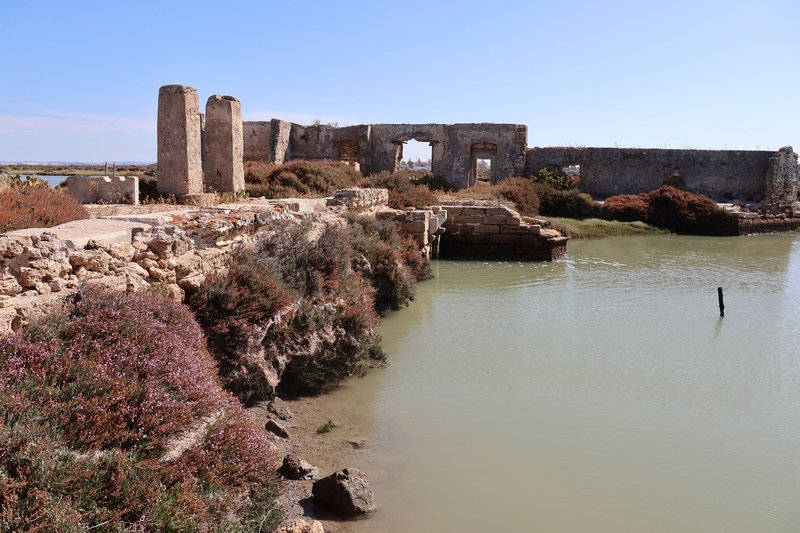
Where Folly is a house, Kenilworth is a factory — and it’s the best-preserved sugar works of its kind on the island. The estate started life in 1757 under the name Maggotty, after the river that still runs past it, owned by a planter named John Blagrove. Crop records from that year show 132 hogsheads of sugar and 43 puncheons of rum coming off the land, a serious operation by 18th-century standards. Production collapsed over the following century — by 1819 output had dropped hard, and the estate wasn’t renamed Kenilworth until the 1880s, by which point it had grown to over 2,500 acres. By 1938 the land had shifted to coconuts and bananas, and the industrial buildings were left standing empty.
What’s left is substantial: a boiling house and distillery, a long rectangular mill building, and a two-story limestone structure with a curved stone staircase leading up to an arched doorway, all cut from stone hauled out of the neighboring Maggotty River. According to the Jamaica National Heritage Trust, it ranks among the country’s most significant surviving examples of 18th-century sugar industry architecture — this wasn’t a modest operation, and the scale of the stonework makes that obvious on sight.
Getting there: Kenilworth sits roughly 9 miles east of Lucea on the main road, well inland from Hanover’s beach resorts. It’s not signposted for tourists, so a GPS pin or a local driver helps more than road signs will.
Access and condition: Open site, unfenced, no staff on hand. The stonework is solid enough to walk through safely at ground level, but the upper stair and mill machinery have deteriorated — treat any elevated section as off-limits.
Best angle: The arched limestone doorway with its curved staircase is the money shot, especially mid-morning when the sun hits the stone face-on rather than backlighting it.
Stewart Castle, Trelawny
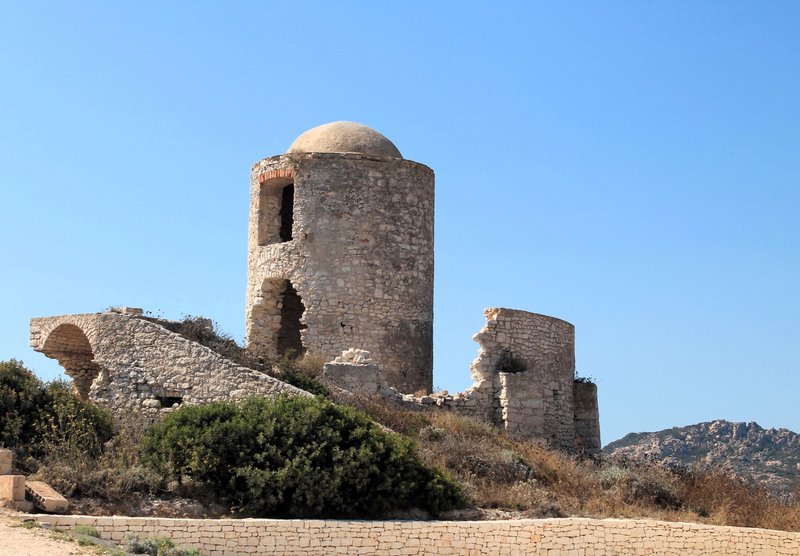
Stewart Castle looks like exactly what a “castle” ruin should look like, and that’s not an accident — it was actually built to be defensible. Established in 1754 by planter James Stewart, the estate grew from 167 acres to 1,200 by the end of the century and ran at peak with over 300 enslaved laborers working the sugar fields. The building itself has square towers at each corner and gun loopholes cut into the stone, a fortification against the very real threat of maroon raids and foreign attack in that period, not decorative flourish. It was later owned by the younger James Stewart, who served as Custos of Trelawny.
The archaeology under the ruin goes back further than the sugar era. A 1957 excavation uncovered a Taino midden on the property — a refuse heap that gave researchers a direct look at what the island’s original inhabitants ate long before Stewart or anyone like him arrived. Few Jamaican ruins carry that kind of layered history in one footprint.
Getting there: Look for the marked turnoff from the North Coast Highway (A1) between Duncans and Coral Spring, a short detour inland from Falmouth and close enough to Silver Sands to fold into a north-coast day trip.
Access and condition: Free to enter, no gate, but genuinely rough — the Jamaica National Heritage Trust holds the site and surrounding land, yet upkeep is minimal and the grounds show it. Watch your footing around the tower bases, where stone has crumbled loose.
Best angle: Stand at the far tower and shoot back across the ruin toward the second tower — the two corner towers in frame together read as “castle” in a way a single wall shot doesn’t.
Colbeck Castle, St. Catherine
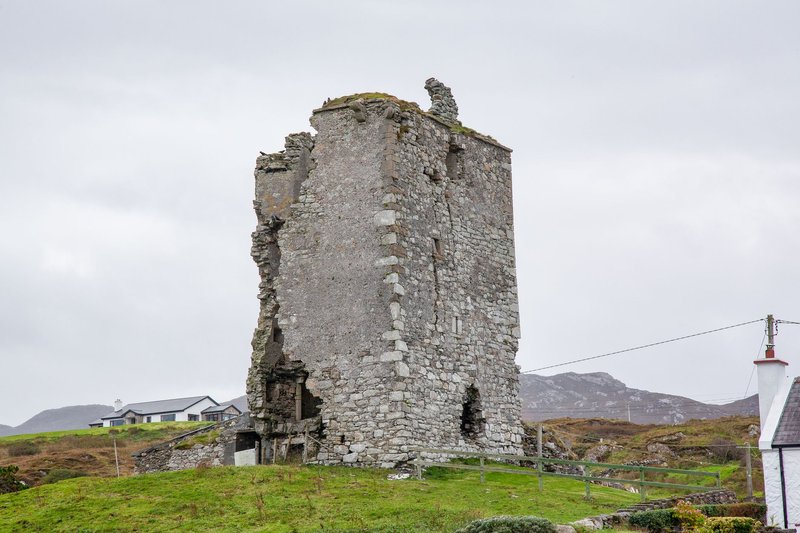
Colbeck predates every other site on this list by decades. Construction started in 1655, the same year the English wrestled Jamaica away from Spain, and finished around 1680 — making it one of the oldest standing ruins on the island and, by most accounts, the largest of its kind. It’s attributed to Colonel John Colbeck, one of the English officers from that 1655 invasion force who stayed on and settled the parish until his death in 1682.
Nobody has fully settled what Colbeck Castle was actually for. Built from red brick and stone in a style closer to a 17th-century Italian mansion than a Caribbean plantation house, with four tower-like corner structures rising around 40 feet, it reads as a defensive fort against a Spanish counterattack that never came — but it’s just as plausible it doubled as an opulent private residence for a man with the money and the ambition to build the biggest house in the parish. Both explanations get argued in the same breath, and the site itself doesn’t settle it either way.
Getting there: It’s about 2 miles northwest of Old Harbour, an easy detour if you’re driving between Kingston and the south coast rather than a destination unto itself.
Access and condition: Declared a national monument in 1990 and now cared for by the Jamaica National Heritage Trust, which makes it one of the more formally protected ruins here — though “protected” still means open grounds with no staff, not a museum with a ticket booth.
Best angle: Shoot the four corner towers from a diagonal, not straight-on — it’s the only angle that gets all four into one frame and actually communicates the scale.
Highland Estate, Westmoreland
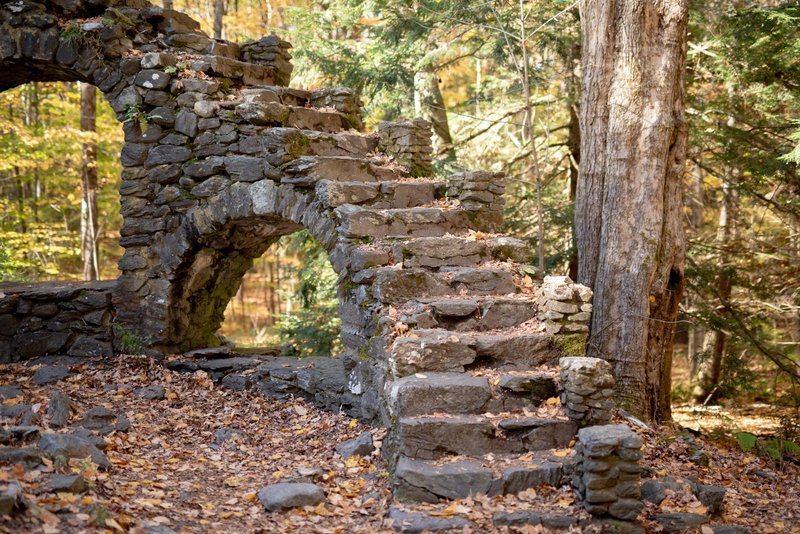
Highland is the site on this list you won’t stumble onto by accident, and that’s the point. The ruins sit inside an old-growth cocoa forest, limestone walls half-swallowed by breadfruit trees growing straight up through what used to be estate ground. Where Folly and Colbeck are open and photogenic, Highland is the version of “ruins in Jamaica” that feels genuinely lost to the bush — less a monument, more something the forest is slowly finishing the job on.
Westmoreland was cane country like Hanover and Trelawny, and Highland fits that broader pattern of parish estates that ran hard through the 18th and 19th centuries and then went quiet. What makes it worth the detour isn’t a single dramatic structure — it’s the setting. Walking a working cocoa walk with stone walls emerging out of the tree line gives a sense of how fast the island’s plantation infrastructure gets reclaimed once nobody’s maintaining it.
Getting there: Highland Estate operates as a working cocoa farm, so visiting the ruins generally means visiting the estate itself rather than pulling off a public road — check ahead for access, since this isn’t an open roadside site the way Folly or Kenilworth are.
Access and condition: Semi-managed by virtue of being part of an active farm, but the ruins themselves are unrestored and left in their natural, overgrown state.
Best angle: Late-morning light filtering through the cocoa canopy onto the limestone is the shot — go for the texture of stone against leaf rather than trying to isolate a clean architectural line.
Visiting Jamaica’s Ruins: What to Know Before You Go
None of these sites charge admission, and none of them have full-time staff, fencing, or safety rails. That’s the trade-off: real, unrestored history instead of a roped-off museum piece, but also loose stone, uneven ground, and the occasional grazing cow to work around.
A few things that make the difference between a good visit and a wasted trip:
- Go with a driver or a solid GPS pin. Kenilworth and Highland especially aren’t signposted for tourism, and rental-car GPS in rural parishes can be unreliable.
- Morning or late afternoon light wins. Most of these ruins face open sky with no tree cover to soften harsh midday sun, so shoot early or late for anything worth keeping.
- Wear shoes you don’t mind getting dirty. Grass, loose stone, and the occasional muddy patch are standard, even in dry season.
- Pair sites by parish, not by list order. Folly and Kenilworth are hours apart on opposite coasts — group Trelawny’s Stewart Castle with north-coast plans, and Colbeck with anything routed through St. Catherine.
The pattern across all five sites is the same one that shows up across Jamaica’s plantation history generally: estates that ran enormous operations on enslaved labor for a century or more, then emptied out fast once sugar stopped paying. What’s left standing is what stone and limestone could survive that nobody’s bothered to tear down. Some, like Colbeck and Stewart Castle, get at least nominal protection from the Jamaica National Heritage Trust. Others, like Highland, are held together mostly by the forest around them. Either way, they’re still standing, still free to visit, and still telling a more complete story than any plaque or brochure gets to.