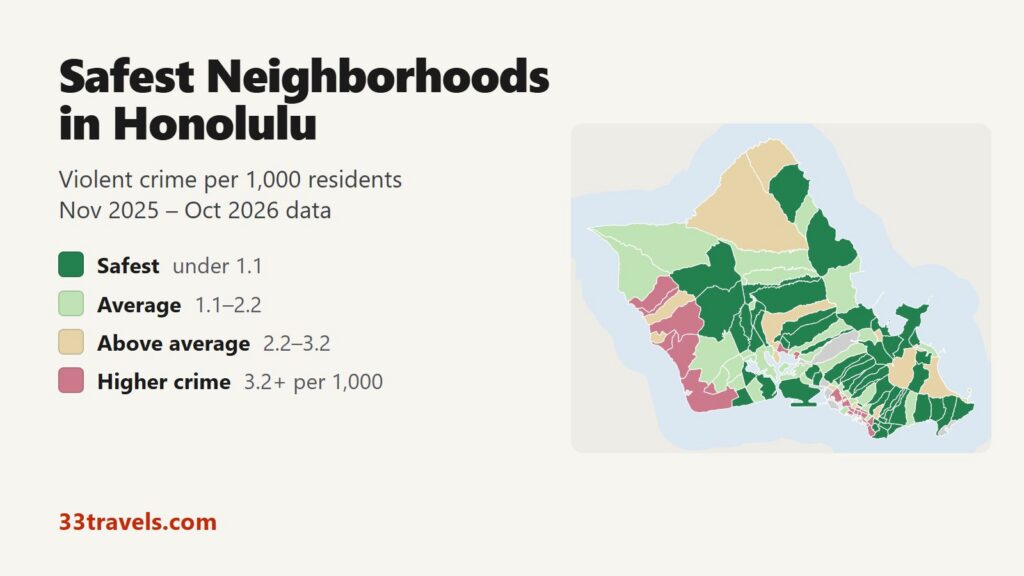
The safest neighborhoods in Honolulu are residential valleys, ridges and planned towns away from the Waikiki hotel district. They run east from Kaimuki to Hawaii Kai, up Manoa and Nuuanu valleys, along the heights above Pearl Harbor, through the planned towns of Mililani and Ewa and up the Windward coast from Waimanalo to Laie. Between November 2025 and October 2026, 40 of the 113 Oahu neighborhoods with at least 2,500 residents recorded fewer than 0.8 violent crimes per 1,000 residents, half the island rate of 1.6. Those neighborhoods hold 36% of the island’s residents and recorded 9% of its violent crime.
Safest neighborhoods in Honolulu: Kaimuki (east), Kaimuki (west), Kaimuki (Wilhelmina Rise), Maunalani Heights, Palolo (upper valley), Palolo (park), Diamond Head-Puupanini, Kahala, Kalani Iki-Waialae Nui, Niu Valley, Hawaii Kai (Kamiloiki-Koko Head), Hawaii Kai (Hahaione) and Kalama Valley-Makapuu in East Honolulu. Manoa (upper), Woodlawn-University, Nuuanu Valley, Pauoa Valley, Puunui and Kamehameha Heights in the valleys above the city center. Aiea Heights, Newtown, Waiau, Pacific Palisades and Salt Lake around Pearl Harbor. Mililani Mauka, Mililani (Melemanu), Waipio Acres (north), Waipio Gentry, Waikele and Royal Kunia-Village Park in Central Oahu. Ewa Gentry-Westloch and Ocean Pointe on the Ewa plain. Waimanalo (north), Coconut Grove-Aikahi, Kaneohe Town, Kaneohe (Hoomaluhia), Puohala Village, Ahuimanu-Temple Valley, Kaaawa-Punaluu and Laie on the Windward side.
Central Oahu and the North Shore together rate 0.9 violent crimes per 1,000 residents, the lowest of the island’s five parts. Island-wide, violent crime fell 8% from the 12 months before. Beats with large military housing areas, such as Schofield Barracks and Hickam, are not ranked because military police handle crime there.
Map of the safest neighborhoods in Honolulu
Each area on the map is an HPD patrol beat named for the neighborhood it covers. Dark green marks the lowest rates, light green those near the island average, beige those above it and rose the highest violent crime rates. Grey beats have too few residents for a rate: beaches, Ala Moana Center, the airport and Hanauma Bay. The view buttons zoom to East Honolulu and the Windward side, Central Oahu and the North Shore, the Leeward coast and Ewa, or Downtown and Waikiki. Switch to Theft & robbery to see where property crime gathers, and tap or hover over a beat for its counts. The list above uses a stricter line, half the island rate, so some dark green beats are not on it.
Violent crime per 1,000 residents
Thefts & robberies per area
Tap or hover a neighborhood to see its crime numbers.
Table of Contents
- Safest neighborhoods in Honolulu
- Best neighborhoods in Honolulu
- Safe areas in Honolulu for tourists
- Is Kailua safe?
- Is Hawaii Kai safe?
- Is Mililani safe?
- Low numbers that mislead
- Where crime is higher
- Safest suburbs of Honolulu
- Tips for choosing a neighborhood
- How this map was made
- FAQ
Safest neighborhoods in Honolulu
The table lists the 15 beats of 2,500 or more residents with the lowest violent crime rates. Each of them recorded five violent crimes or fewer in a year. A single crime moves the rate of a 5,000-resident beat by 0.2, so the top 15 form one tier, not an order.
| Patrol beat (neighborhood) | Neighborhood Board | Violent crimes per 1,000 | vs. city avg | Homicides | Aggravated assaults | Thefts + robberies |
|---|---|---|---|---|---|---|
| Manoa (upper)Manoa | Manoa | 0.0 | 0.0x | 0 | 0 | 20 |
| Aiea HeightsAiea | Aiea | 0.0 | 0.0x | 0 | 0 | 18 |
| Ewa Gentry-WestlochEwa | Ewa | 0.1 | 0.1x | 0 | 1 | 33 |
| WaiauPearl City | Pearl City | 0.2 | 0.1x | 0 | 1 | 20 |
| Maunalani HeightsPalolo | Palolo | 0.2 | 0.1x | 0 | 1 | 27 |
| Palolo (upper valley)Palolo | Palolo | 0.2 | 0.1x | 0 | 0 | 41 |
| Waimanalo (north)Waimanalo | Waimanalo | 0.2 | 0.1x | 0 | 1 | 7 |
| Mililani MaukaMililani Mauka-Launani Valley | Mililani Mauka-Launani Valley | 0.3 | 0.2x | 0 | 4 | 47 |
| Hawaii Kai (Kamiloiki-Koko Head)Hawaii Kai | Hawaii Kai | 0.3 | 0.2x | 0 | 2 | 34 |
| NewtownAiea | Aiea | 0.3 | 0.2x | 0 | 3 | 21 |
| Kalani Iki-Waialae NuiWaialae-Kahala | Waialae-Kahala | 0.3 | 0.2x | 0 | 3 | 21 |
| Niu ValleyKuliouou-Kalani Iki | Kuliouou-Kalani Iki | 0.3 | 0.2x | 0 | 0 | 16 |
| Kaimuki (east)Kaimuki | Kaimuki | 0.3 | 0.2x | 0 | 1 | 104 |
| PuunuiNuuanu-Punchbowl | Nuuanu-Punchbowl | 0.3 | 0.2x | 0 | 1 | 25 |
| Kaneohe (Hoomaluhia)Kaneohe | Kaneohe | 0.3 | 0.2x | 0 | 2 | 20 |
East Honolulu: Kaimuki to Hawaii Kai
East Honolulu has 13 beats under the safe line, more than any other part of the island. Maunalani Heights, on the ridge above Kaimuki around 16th Avenue and Anuhea Street, recorded 1 violent crime in 12 months. The three Kaimuki beats between Kapahulu Avenue and the H-1 rate 0.3, 0.4 and 0.4. Farther east, the valley and ridge subdivisions off Kalanianaole Highway continue the pattern: Kalani Iki-Waialae Nui rates 0.3 and Niu Valley, which includes Hawaii Loa Ridge and Kuliouou Valley, rates 0.3.
Manoa, Nuuanu and the valleys above the city
Upper Manoa, the residential end of the valley along Manoa Road and East Manoa Road, recorded no violent crimes in the 12 months. Woodlawn-University, the lower valley around the University of Hawaii, rates 0.6. West of Manoa, Puunui runs up the Pali Highway along Judd Street and rates 0.3, with Nuuanu Valley at 0.6 and Pauoa Valley at 0.6. Kamehameha Heights and Alewa Heights, on the ridge above Kalihi, share one beat that rates 0.4, under a tenth of the rate in Kalihi-Dillingham below it.
Aiea and Pearl City above Pearl Harbor
Aiea Heights, the hillside beat along Aiea Heights Drive and Ulune Street, recorded no violent crimes. Newtown, with 12,837 residents, rates 0.3, and Waiau, which takes in Momilani and the streets between Moanalua Road and Kaahumanu Street, rates 0.2. Pacific Palisades, higher up in Pearl City, rates 0.6. Salt Lake, on the Honolulu side of the harbor, has 18,843 residents and rates 0.5.
Central Oahu and the Ewa plain
The planned towns of Central Oahu and Ewa supply the largest safe neighborhoods. Ocean Pointe, between Fort Weaver Road and Geiger Road, is the most populous beat on Oahu with 24,028 residents and rates 0.5. Ewa Gentry-Westloch next to it recorded 1 violent crime for 10,410 residents. Inland, Waikele rates 0.4, Waipio Gentry 0.5 and Royal Kunia-Village Park 0.5.
Windward Oahu: Waimanalo to Laie
On the Windward side, Coconut Grove-Aikahi in Kailua rates 0.4. Kaneohe (Hoomaluhia), the inland beat around the Hale Kou and Keapuka subdivisions near the H-3 and Likelike Highway, rates 0.3, and Ahuimanu-Temple Valley along Kahekili Highway rates 0.5. Waimanalo (north) recorded 1 violent crime; its beat covers the farm lots and also the Keolu side of Enchanted Lake. Up the coast, Laie, home of BYU-Hawaii, rates 0.5.
Best neighborhoods in Honolulu
Most of the safe beats are residential and away from Waikiki. The best neighborhoods in Honolulu for a visit, for children or for a first apartment pair a low violent crime rate with a beach, a park, a bus line or a main street.
Best neighborhoods for visitors
Waikiki is Oahu’s main hotel and resort area, and its western end is the calmest part. Waikiki (Ilikai), the beat between Ala Moana Boulevard, Hobron Lane and Kalakaua Avenue, rates 1.1 per 1,000 residents, below the island average, and recorded 39 thefts, slightly above the island rate per resident. Both figures count residents only, not the hotel guests. For a resort stay away from the crowds, Kahala, home of the Kahala Hotel and Resort, rates 0.6 on 3,128 residents, a rate that leaves out hotel guests, with 24 thefts. TheBus Route 13 links Waikiki with the University of Hawaii in Manoa, and Route 2 runs from Waikiki past Diamond Head to Kapiolani Community College. Skyline does not serve East Honolulu or the Windward side, so reach them by TheBus or car.
Best neighborhoods for families
Families find parks, pools and libraries in several safe areas. In Ewa, Ewa Mahiko District Park and Asing Community Park are on Renton Road. Waiau District Park is on Kaahumanu Street, and Pearl City District Park has a 25-yard pool. In Kailua, Kailua District Park has a 50-meter pool, and Kalama Beach Park, a 4.28-acre park around the old Boettcher Estate, is on North Kalaheo Avenue. Manoa families use Manoa Valley District Park, with its own 50-meter pool, and Lyon Arboretum at the top of Manoa Road, with nearly 200 acres and over 7 miles of trails.
Best neighborhoods for young professionals
Kaimuki is the walkable choice. Honolulu Magazine calls Waialae Avenue, its 2.5-mile main street, one of the city’s last, best walking neighborhoods. Kaimuki (east) records about 1.7 times the island theft rate per resident, so lock bikes and cars. The Surfing Pig and Noods Ramen Bar are on Waialae, and Koko Head Cafe is a block off it on 12th Avenue. Manoa adds the University of Hawaii, with 20,028 students in fall 2024, and the Manoa Marketplace shopping center. Kakaako has the Ward Village towers and the shops of SALT at Our Kakaako on Auahi Street, but it rates 2.1, above the island average.
Best affordable safe neighborhoods
Across Honolulu County the median rent is $2,083 a month and the median home value $897,500, in Census Bureau estimates for 2020 to 2024. Two safe areas come in under the county figures: Waimanalo (north), where the main census tract shows a median rent near $1,760, and Ewa Gentry-Westloch, with a median home value near $796,000. Puunui and Niu Valley cost about $1.37 million to $1.39 million for a home. Kahala sits above the top of the Census scale, at more than $3,500 in rent and $2 million in value. These are census tract figures, and tracts do not follow beat lines.
Safe areas in Honolulu for tourists
The safe areas in Honolulu for tourists to stay are the Ilikai end of Waikiki and Kahala. Waikiki Beach, Ala Moana Beach Park, Hanauma Bay and the airport are grey on the map because nobody lives there, not because nothing happens there. Theft is what visitors meet: Ala Moana Center recorded 608, the most of any area on the island. Diamond Head-Puupanini, which holds the crater trail, rates 0.6 for violent crime, yet it recorded 70 thefts, more than twice the island rate per resident, many of them from parked cars.
Is Kailua safe?
Kailua depends on the beat. The town spreads across several beats with different records. Coconut Grove-Aikahi, along Kawainui Street and North Kalaheo Avenue, rates 0.4, and Enchanted Lake rates 1.0. Kailua Town, around the shops on Kailua Road, rates 2.2, above the island average, with 88 thefts. Lanikai, whose beat also holds Kailua Beach Park, rates 1.7, close to the island average. Leave nothing visible in a car at Kailua Beach Park.
Is Hawaii Kai safe?
Yes. Hawaii Kai’s three beats all rank among the safest on Oahu. Kamiloiki-Koko Head, with the Hawaii Kai Library, rates 0.3. Hahaione, which covers Hahaione Valley, Mariners Ridge and the Hawaii Kai Towne Center, rates 0.4, and Kalama Valley-Makapuu rates 0.4. Theft is low too, at 34 in Hahaione, under a third of the island rate per resident. Hanauma Bay, at the edge of Hawaii Kai, has no residents and no rating.
Is Mililani safe?
Yes. Mililani Mauka, on the mauka side of the H-2 Freeway, has 19,333 residents and recorded 5 violent crimes, a rate of 0.3. Mililani (Melemanu) rates 0.6 and Mililani (Mililani Uka) 0.8, just at the safe line. The Mililani Town Association runs seven recreation centers for residents.
Low numbers that mislead
Upper Manoa and Aiea Heights show zero violent crimes, but they recorded 6 and 2 in the 12 months before. At those counts, a year with none is ordinary variation. The University of Hawaii’s campus in Woodlawn-University has campus security officers who refer arrests to HPD, so minor incidents handled on campus alone do not appear.
Military police handle crime on bases and in on-base housing, so beats with many military residents look safer than the record shows. Schofield Barracks, Hickam, Marine Corps Base Hawaii, Aliamanu Military Reservation, the Navy housing at Pearl City, Foster Village and Iroquois Point, Moanalua Gardens, Aliamanu and Wheeler-Wahiawa are left out of the ranking. Halawa Heights, with the state prison, and Kapalama-Sand Island, with the Oahu Community Correctional Center, have too few residents for a rate.
Some safe beats carry a high theft count. Kaimuki (east) recorded 104 thefts, about 1.7 times the island rate per resident.
Where crime is higher
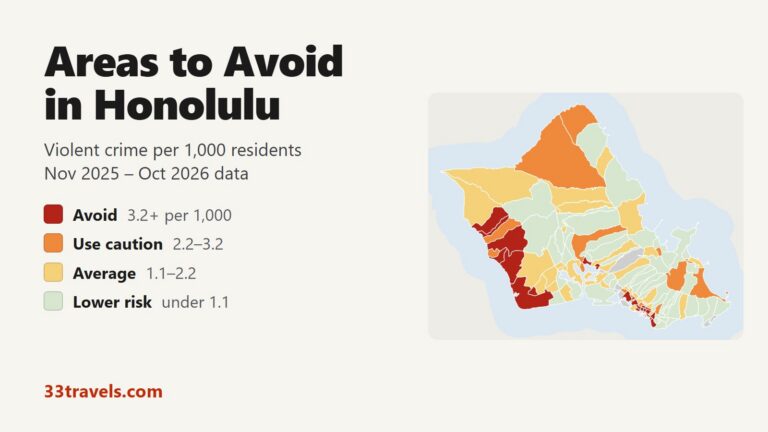
Violent crime on Oahu is highest in the dense strip from Kalihi through Downtown and Ala Moana to Waikiki and on the Waianae Coast. Downtown, Waikiki and Ala Moana together rate 3.8 per 1,000 residents, over twice the island figure. Our areas to avoid in Honolulu guide maps those 23 beats and explains the visitor and worker counts behind them.
Safest suburbs of Honolulu
Honolulu’s suburbs are on the map above, since one police department covers the island. Of the bedroom towns, Hawaii Kai and Mililani have the lowest combined rates, followed by Pearl City, Ewa and Kaneohe. Kapolei has the highest rate of the bedroom towns: Kapolei (east) rates 2.1 and Kapolei (west) 6.2. Against the other Hawaii counties, Oahu reported the lowest violent crime rate in FBI data for 2025, at 1.81 per 1,000 residents; Kauai County was next lowest and Maui County highest.
| County police department | Population | Violent crimes | Per 1,000 | Year |
|---|---|---|---|---|
| Maui County | 162,116 | 499 | 3.1 | 2025 |
| Hawaii County | 210,328 | 603 | 2.9 | 2025 |
| Kauai County | 73,376 | 170 | 2.3 | 2025 |
| Honolulu (Oahu) | 987,000 | 1,789 | 1.8 | 2025 |
Murder, rape, robbery and aggravated assault reported to the FBI by each county police department, per 1,000 residents of the population the department reports. Calendar year 2025; Maui's reporting stops in April 2026. Source: FBI Crime Data Explorer. These are other islands, not suburbs: Oahu has no separate suburban departments.
Tips for choosing a neighborhood
- Look at the beat, not the town name. Kailua and Kaneohe each have beats on both sides of the island average.
- Switch the map to Theft & robbery before choosing a rental with street parking. Kaimuki and Diamond Head are low for violent crime and high for theft.
- For a beach holiday, stay at the Ilikai end of Waikiki or in Kahala and use TheBus Routes 2 and 13 to reach Diamond Head and Manoa.
- For a move, compare Mililani Mauka, Waikele and Ocean Pointe, the largest safe beats, where one crime moves the rate least.
- Call 9-1-1 for emergencies and the Honolulu Police Department’s main line, (808) 529-3111, for anything else.
How this map was made
Offenses come from the Honolulu Police Department’s public crime dashboard for November 2025 through October 2026, grouped by the patrol beat where each one happened. Violent crime counts murder, rape, robbery and aggravated assault, one row per offense. Each beat’s rate divides its count by its 2020 Census population, and beats under 3,000 residents are joined to a neighbor. The ranking covers beats with at least 2,500 residents and leaves out the military-housing beats named above. Crimes taken by military police, the state Sheriff Division at the airport and campus security are not in HPD’s file. The county table uses the FBI’s Crime Data Explorer, and the housing costs come from the Census Bureau’s 2020-2024 American Community Survey.
We ranked the safest neighborhoods in Milwaukee, Houston, San Diego, Austin, San Francisco, Buffalo, Baltimore and Atlanta.
FAQ
What is the safest neighborhood in Honolulu?
Upper Manoa and Aiea Heights recorded no violent crimes in the 12 months. Among the larger neighborhoods, Ewa Gentry-Westloch recorded 1 violent crime for 10,410 residents, and Mililani Mauka, the largest beat in the top 15, rates 0.3 per 1,000 residents.
What is the safest part of Oahu?
Central Oahu and the North Shore, at 0.9 violent crimes per 1,000 residents. East Honolulu and the Windward side follow at 1.1. Downtown and Waikiki rate highest, at 3.8.
What are the best neighborhoods in Honolulu to live in?
Hawaii Kai and Mililani have the lowest combined violent crime rates of Oahu's large towns. Kaimuki has the walking main street, Waialae Avenue, and Manoa puts you near the University of Hawaii. For lower prices, look at Ewa Gentry-Westloch and Waimanalo (north).
Where is the safest place to stay in Honolulu as a tourist?
Kahala, east of Diamond Head, rates 0.6 violent crimes per 1,000 residents and has the Kahala Hotel and Resort. In Waikiki, the Ilikai end near Ala Moana Boulevard rates 1.1, below the island average. Both rates count residents only. Hawaii Kai and Kailua suit a quieter stay with a car.
Is Waikiki safe?
Violent crime in Waikiki is highest in the Kuhio Avenue beat and at the Diamond Head end, which rate 6.8 and 4.6 per 1,000 residents, but those rates count residents only, not the visitors on the street. HPD's Waikiki substation is at 2425 Kalakaua Avenue. Theft is the common crime there, so keep phones and bags in reach on the beach.
Is Kapolei safe?
Kapolei has the highest violent crime rate of Oahu's bedroom towns. Kapolei (east) rates 2.1 and Kapolei (west), around the shopping centers, 6.2. Makakilo, on the hill above it, rates 1.1.
Why do some Honolulu neighborhoods show zero crime?
Upper Manoa and Aiea Heights recorded none this year after a handful the year before, so their zeros rest on small counts. Military bases and on-base housing are a different case: military police take those crimes, so HPD's file shows little and those beats are not ranked.
Is Honolulu safer than Maui and the Big Island?
Yes. In FBI data for 2025, Honolulu County reported 1.81 violent crimes per 1,000 residents, the lowest of Hawaii's four counties. Maui, Hawaii and Kauai counties together reported 2.85.