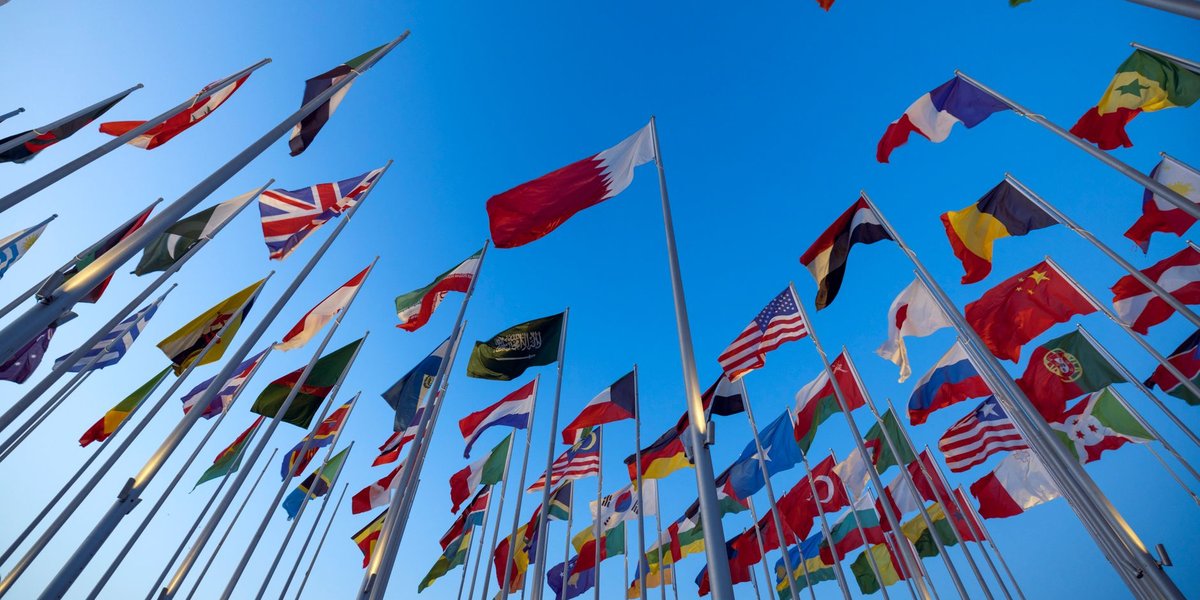
No national flag contains yellow, purple and brown together. Not one. If a quiz question asks for that combination, the answer is that it doesn’t exist, so the useful move is to split the question by color. Yellow is common, purple is almost absent, and brown hides in small emblem details.
Below: each color, the countries that use it, and why the three are so unevenly distributed.
Contents
- Quick answer
- Countries with yellow on their flags
- Countries with purple on their flags
- Countries with brown on their flags
- Quick-reference table
- Why purple and brown are so rare
- FAQ
Quick answer
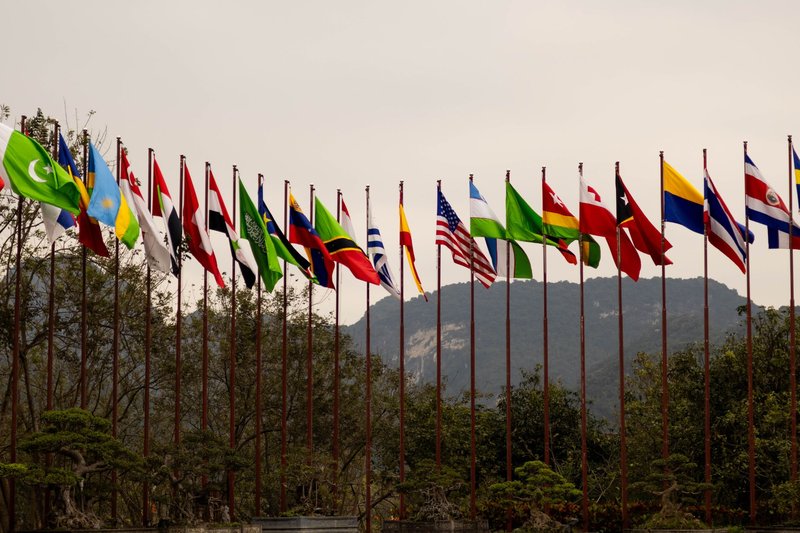
- Yellow: dozens of countries, including Brazil, Colombia, Ethiopia, Germany and Spain.
- Purple: Dominica, Nicaragua and El Salvador (small emblem details), plus Spain’s coat of arms. Bolivia’s co-official Wiphala also carries it.
- Brown: no national flag uses it as a main color. It appears in emblems, such as those of Mexico and Belize.
- All three on one flag: none.
One caveat on method. A flag’s “main colors” are the fields and stripes you see from across a street. Emblem details are the tiny parrots, animals and arms you only notice up close. Most lists blur the two, which is why you’ll see contradictory answers online. This post keeps them apart.
Countries with yellow on their flags
Yellow (or gold, which flag-makers treat as the same color) is the easy one. It stands for sun, wealth or wheat fields, and it shows up in a few recognizable families.
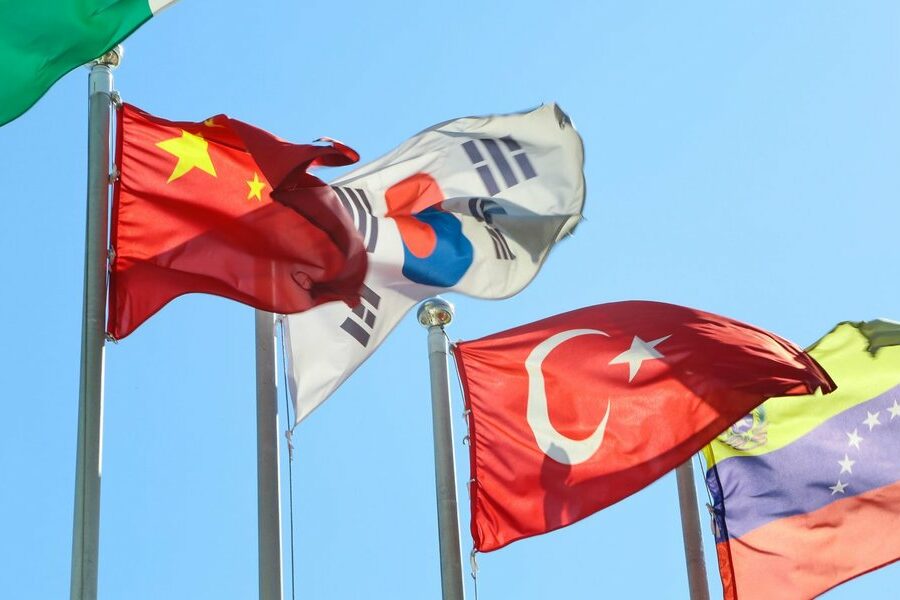
Pan-African and Ethiopian-derived flags. Ethiopia’s green, yellow and red stripes became the template that Ghana, Mali, Senegal, Guinea, Benin, Cameroon, Togo and others adapted after independence. Yellow is a main stripe on all of them.
Latin America. Colombia’s flag is half yellow, with blue and red below. Venezuela and Ecuador use the same yellow-blue-red order. Brazil puts a yellow rhombus on green, and Bolivia runs red, yellow and green in horizontal bands.
Europe. Spain’s flag is red-yellow-red with the yellow band twice the width of each red one. Germany’s black-red-gold uses gold in the bottom stripe. Belgium, Romania, Moldova, Andorra, Chad and Ukraine all use yellow too, and Lithuania’s flag opens with a yellow band at the top.
Asia and elsewhere. Bhutan’s flag splits diagonally into yellow and orange. Sri Lanka frames a lion with a yellow border. Kazakhstan has a golden sun and eagle on sky blue. Jamaica’s gold saltire, Mauritius’s fourth-of-four stripes, Gabon’s central band, Guyana’s Golden Arrowhead, Palau’s yellow moon and the Vatican City’s half-yellow field round out the list.
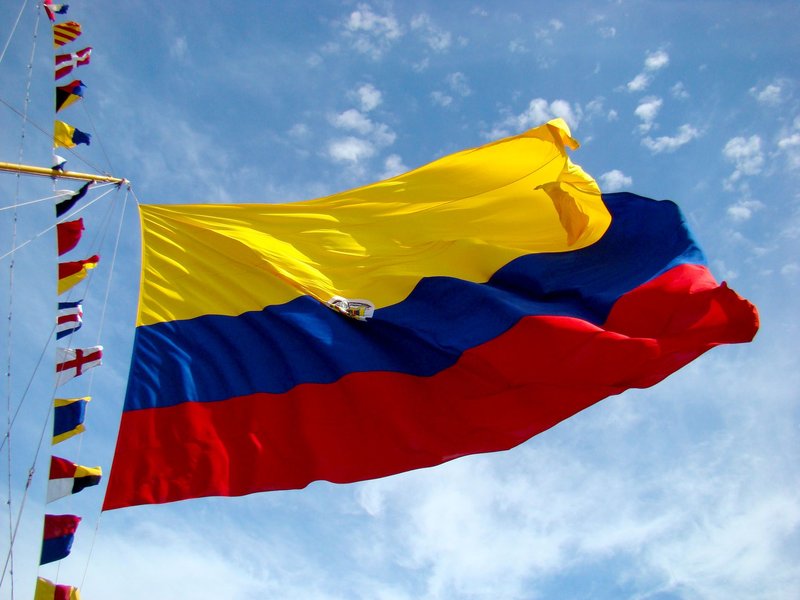
If you only need one detail to win a quiz: yellow is the third most common flag color after red and white, so “does it have yellow?” is a poor way to narrow down a country.
Countries with purple on their flags
Purple is where the question gets interesting. By the strictest reading, no sovereign state has a purple field or stripe. Here is what exists instead.
Dominica. The flag’s central disc holds the Sisserou parrot, the national bird, with a purple breast and head. It is the only national flag where purple is a prominent, deliberate element, and the CIA World Factbook entry for Dominica describes the parrot as part of the flag’s design. Dominica is also why most lists say “one country has purple on its flag,” and it stands alone among countries with red, yellow, and purple flag combinations.
Nicaragua. The coat of arms in the center shows a triangle with a rainbow arching over five volcanoes. The rainbow includes violet, so purple is technically present, though at flag-pole distance you’d never see it.
El Salvador. The emblem on the flag also carries a rainbow, again with a band that reads as purple. Same caveat: small, and only on the version of the flag that includes the coat of arms.
Spain. The state flag’s coat of arms includes a lion in the León quarter. In heraldry that lion is purpure, a purple. It is small, but it’s on the flag, and it’s the reason Spain appears on both the yellow and purple lists.
Bolivia. Bolivia’s red, yellow and green tricolor has no purple. But the country gave the Wiphala, a square seven-color checkerboard of the Andes, co-official status in 2009, and violet is one of its stripes. The CIA World Factbook page for Bolivia lists the national flag, so check which one a quiz means before you answer.
Outside nations, purple is easier to find: regional and municipal flags, political parties, and the flags of many US university teams use it. Wikipedia keeps a categorized list for those.
Countries with brown on their flags
Brown is rarer still, because no national flag uses it as a stripe, field or shape. What exists is brown inside emblems, usually on animals, trees and tools.
- Mexico. The eagle on the cactus, holding a snake, is rendered in brown. It’s the most visible brown on any national flag.
- Belize. The central coat of arms features a mahogany tree and two woodcutters, drawn in earth tones. The CIA World Factbook entry for Belize describes the arms as a central emblem on a blue field with red stripes.
- Andorra. The coat of arms in the center shows two cows and other heraldic symbols, which some lists treat as brown-adjacent.
- Ecuador. The state flag’s coat of arms includes a condor, shown in brown tones. The civil flag leaves the emblem off.
Sources disagree on all of these. A flag database that counts “brown in the emblem” will list more countries than one that counts only the main design, and none will give you a number to rely on. If a quiz asks for brown, the safest answer is Mexico.
Quick-reference table
| Country | Color | Where it appears |
|---|---|---|
| Ethiopia | Yellow | Center stripe |
| Brazil | Yellow | Rhombus |
| Colombia | Yellow | Top half of the flag |
| Spain | Yellow | Wide center band |
| Germany | Yellow (gold) | Bottom stripe |
| Dominica | Purple | Sisserou parrot |
| Nicaragua | Purple | Rainbow in the coat of arms |
| El Salvador | Purple | Rainbow in the coat of arms |
| Spain | Purple | Purpure lion in the arms |
| Bolivia | Purple | Wiphala (co-official flag) |
| Mexico | Brown | Eagle in the emblem |
| Belize | Brown | Mahogany tree in the arms |
| Ecuador | Brown | Condor in the arms (state flag) |
Why purple and brown are so rare
Two reasons, and they stack.
Dye cost. For most of history, purple meant Tyrian purple, extracted from thousands of Mediterranean sea snails for a few grams of dye. Cloth in that color was reserved for emperors, and sailors weren’t flying it from a mast. Cheap synthetic purple dye only arrived in 1856, long after most flag designs were fixed.
Heraldic rules. European flag design inherited the rule of tincture: colors were limited to red, blue, green, black, and purple, with gold and silver as metals, and metal wasn’t placed on metal or color on color. Purple was allowed but seldom used. Brown wasn’t part of the set at all, which is why it only appears when an animal or object is drawn in its natural color.
Newer flags follow the older ones. Designers avoid colors that fade, print badly or look muddy at a distance, and brown fails all three.
FAQ
Is there any country with a purple flag? No sovereign state has a flag whose main color is purple. Dominica comes closest, with a purple parrot at the center.
Does any country use all three colors? No. Spain comes closest, with yellow bands and a purple lion in its coat of arms, but it has no brown.
Which flag has the most colors? Belize is often cited, because its coat of arms is detailed enough to include more than a dozen colors.
Is gold the same as yellow on a flag? In flag classification, yes. Germany’s “gold” stripe and Spain’s “yellow” band count as the same color.
Why does my quiz say a country has brown or purple when I can’t see it? It’s counting emblem details. Check whether the question means the “main design” or “any color at all.”