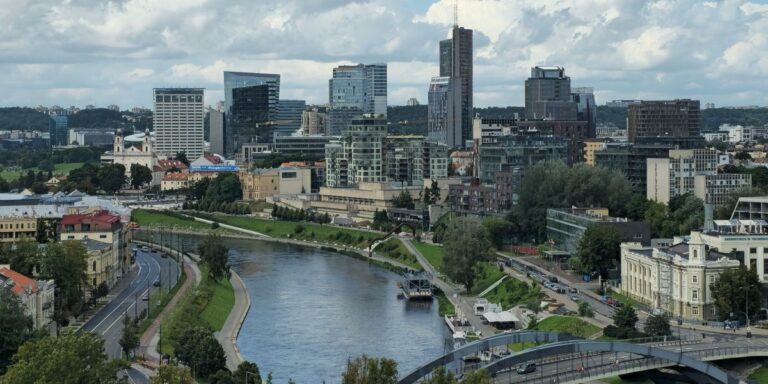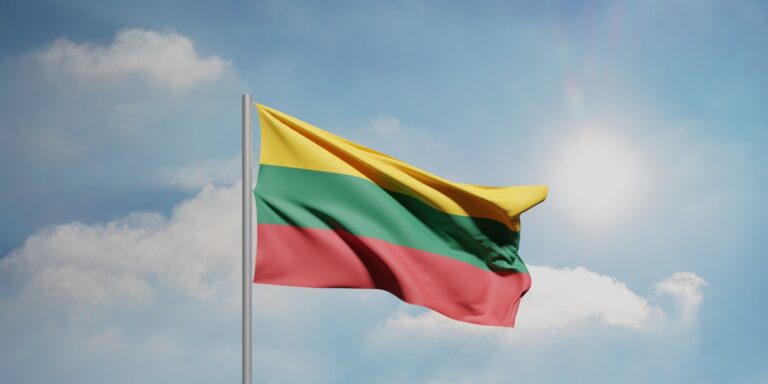
Lithuania has one official language: Lithuanian. Russian, Polish and every other minority language have no official status at the national level, even though hundreds of thousands of people speak them daily.
That single fact hides a more interesting setup. The law is strict about Lithuanian in public life, the street is noticeably multilingual in a few regions, and English fills most of the gaps for visitors.
Table of Contents
- TLDR
- What are the official languages in Lithuania?
- Languages spoken in Lithuania by share of speakers
- What the law actually says
- How Lithuania got here: a short history
- Polish names, bilingual signs and other friction points
- Dialects: Aukštaitian and Samogitian
- Which language to use when you visit
- FAQ
TLDR
- Lithuanian is the sole official language of Lithuania and has been an official EU language since 1 May 2004.
- Russian is the most common minority mother tongue (about 8% in the 2011 census), followed by Polish (about 5.6%).
- Neither has official status. The Constitution protects minorities’ right to use and foster their languages, but state institutions work in Lithuanian.
- English works well in Vilnius, Kaunas and Klaipėda, especially with anyone under 40. Older residents often speak Russian as a second language.
What are the official languages in Lithuania?
There is only one, and it’s written into the Constitution. Article 14 states that “the State language shall be Lithuanian.” You can read the full text on the Seimas website.
That wording is the answer to the question people ask most: is Russian an official language in Lithuania? No. It isn’t official nationally, regionally or in any municipality. The same goes for Polish, Belarusian and Ukrainian.
At the European level, Lithuanian became one of the EU’s official and working languages when the country joined in 2004. Lithuanians can write to EU institutions in their own language and get an answer in it.
Languages spoken in Lithuania by share of speakers
Lithuania has about 2.8 million residents, and it’s one of the more linguistically uniform countries in Europe. The table uses mother tongue data from the 2011 census, the last one to publish a clean breakdown by native language. Dates matter here: figures quoted without a census year are the main reason sources contradict each other. For the full picture beyond these four rows, see Languages Spoken in Lithuania: The Complete List.
| Language | Share of population (native language, 2011 census) | Status |
|---|---|---|
| Lithuanian | about 82% | Sole official language |
| Russian | about 8% | Minority language, no official status |
| Polish | about 5.6% | Minority language, no official status |
| Other or not stated | about 4% | Belarusian, Ukrainian, Yiddish, Romani, Karaim and others |
Two cautions on reading this.
First, native language is not the same as ethnicity. The 2021 census, run by Statistics Lithuania, counted roughly 85% Lithuanians, 6.5% Poles and 5% Russians by ethnic self-identification. Some people who identify as Russian or Polish speak Lithuanian at home, and some Lithuanians grew up speaking Russian.
Second, second-language knowledge isn’t tabulated reliably. Russian is known far more widely than the 8% native figure implies, because it was the dominant language of the Soviet period. That’s why you’ll see higher “can speak Russian” numbers in surveys, and why they shouldn’t be added to the table above.
What the law actually says
Three pieces of law define the situation.
The Constitution. Article 14 makes Lithuanian the state language. Other articles guarantee that citizens belonging to ethnic communities have the right to foster their language, culture and customs. The right to use a language privately is protected. The right to demand state services in it is not.
The Law on the State Language. It requires Lithuanian in public administration, courts, official documents, education at state level, public signage and advertising aimed at the public. Foreign text is allowed on signs but generally has to be accompanied by Lithuanian, and the Lithuanian version must not be smaller.
The State Commission of the Lithuanian Language. The commission sets standards for the standard language, rules on grammar and spelling questions, and is consulted on terminology. Lithuanians take it seriously. A loanword that would pass without comment in English gets a Lithuanian coinage here, which is why the country has words like kompiuteris for computer but also homegrown alternatives that sometimes win out.
One more detail few explainers mention: a 1989 Law on National Minorities let minority languages be used in local administration where minorities made up a substantial share of residents. It expired in 2010 and wasn’t replaced. Since then, there’s no general statute giving Polish or Russian local official use, which is a big part of the ongoing disputes.
How Lithuania got here: a short history
- 1918: Independence is declared on 16 February. Lithuanian becomes the language of the new state, though Polish, Russian and Yiddish were all widely spoken in cities, Vilnius especially.
- 1940 to 1990: Soviet occupation. Lithuanian stayed in schools and publishing, but Russian was the language of the union, the army and a lot of administration. Large numbers of Russian speakers settled in industrial towns.
- 1989: The Lithuanian SSR declares Lithuanian the state language, more than a year before independence was restored.
- 1990: Independence is restored on 11 March. The 1992 Constitution confirms Lithuanian as the sole state language.
- 2004: Lithuania joins the EU and NATO, and Lithuanian gains EU official language status.
Polish names, bilingual signs and other friction points
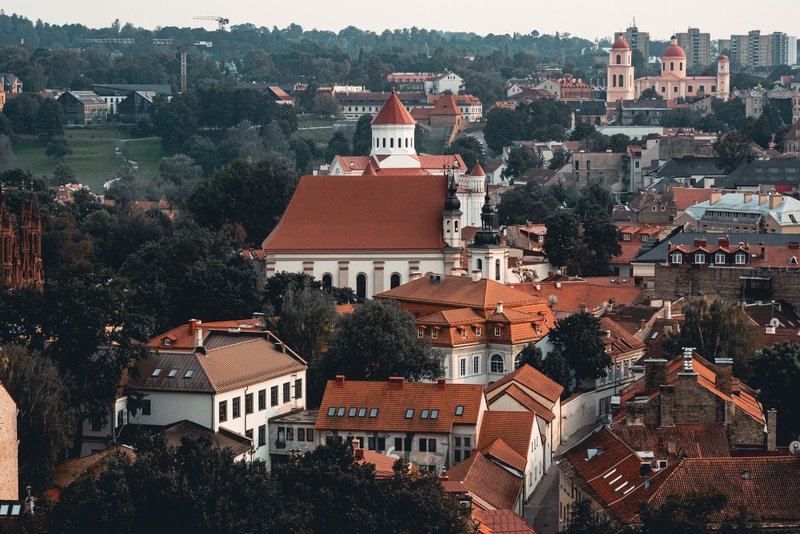
The Polish minority, concentrated around Vilnius and the southeast, is where the language law gets tested most.
Personal names. The Lithuanian alphabet has 32 letters and doesn’t include q, w or x. Polish names like Wojciech have traditionally been rendered in documents in Lithuanian form, ending with a masculine suffix, so Wojciech Kowalski becomes something like Vojciechas Kovalskis. Many Poles in Lithuania want original spelling in passports. The issue has gone through the Constitutional Court, the European Court of Justice and several rounds of Seimas debate, and the rules have shifted more than once. Check the current regulation if you’re dealing with documents.
Bilingual street signs. In districts such as Šalčininkai, where Poles are the clear majority, local councils have put up Polish-language street names alongside Lithuanian ones. Courts and state bodies have repeatedly challenged this under the State Language Law. Expect to see both signage styles on a drive through the southeast.
Schools. There are state-funded Polish and Russian language schools. Pupils there still sit Lithuanian language exams, and how strict the standard should be has been argued for years.
Dialects: Aukštaitian and Samogitian
Standard Lithuanian is based on the western Aukštaitian dialect. The two main regional forms are:
- Aukštaitian (High Lithuanian): spoken across the east and north, closest to the standard.
- Samogitian (Žemaitian): spoken in the northwest, around Telšiai and Plungė. It’s different enough that speakers of standard Lithuanian struggle to follow it. Lithuania treats it as a dialect, while many linguists and Samogitians describe it as a separate language.
Lithuanian itself is one of only two surviving Baltic languages, alongside Latvian. It preserves archaic Indo-European features that have disappeared from most European languages, which is why linguists love it.
Which language to use when you visit
Vilnius, Kaunas, Klaipėda and Šiauliai. English works. Younger Lithuanians learn it from school and online, and hotels, restaurants and transport apps are used to it. Start in English and you’ll rarely be misunderstood.
Older residents. Many people over about 45 grew up with compulsory Russian and can use it. It’s practical, but ask first: “Do you speak English?” is a safer opener than assuming Russian, especially since the 2022 invasion of Ukraine.
Vilnius district and the southeast. Polish and Russian are heard everywhere in Šalčininkai and the Vilnius district. A few words in Polish go a long way there.
Visaginas and parts of Klaipėda. Russian is a common everyday language, a legacy of Soviet-era settlement around the Ignalina nuclear plant and the port.
A few words in Lithuanian are still worth the effort: labas (hello), ačiū (thank you), prašau (please, you’re welcome). Pronounce them with the stress on the first syllable and people will notice.
FAQ
What is the official language of Lithuania? Lithuanian, as set out in Article 14 of the Constitution.
Is Russian an official language in Lithuania? No. It’s the most widely spoken minority language, but it has no official status at national or local level.
Is Polish an official language in Lithuania? No. Polish is spoken by roughly 5% of residents, mostly around Vilnius, and is protected as a minority language in education and private use only.
Do people speak English in Lithuania? Yes, particularly in cities and among anyone under 40. Outside the main cities and among older people, you’ll find less English and more Russian.
Is Lithuanian an EU official language? Yes, since 1 May 2004.
Are there official regional languages in Lithuania? No. Samogitian is recognized culturally, but it has no official status.