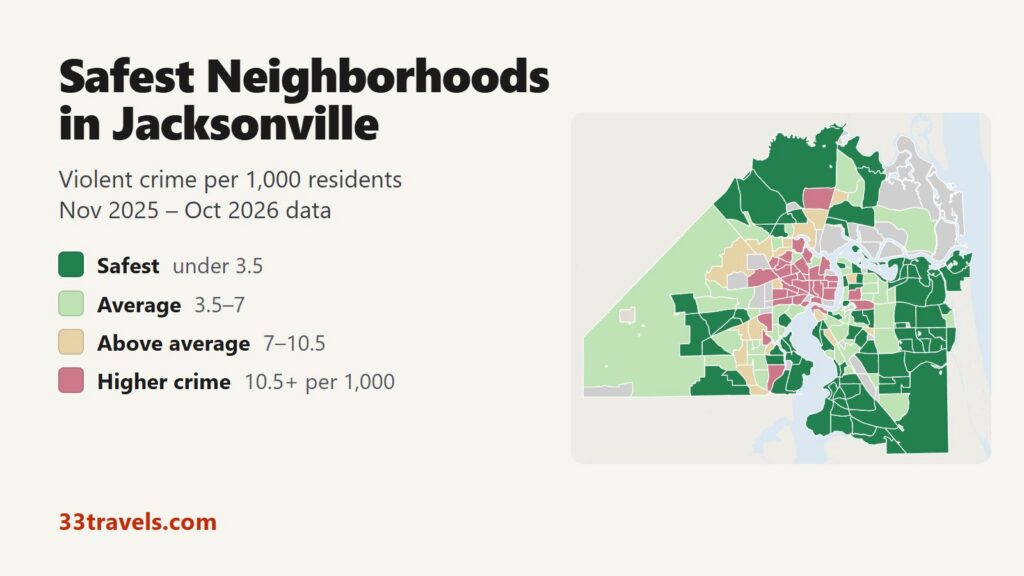
The safest neighborhoods in Jacksonville are in the south and east of the city: Mandarin and the subdivisions along Julington Creek, the Beach Boulevard corridor between the Southside and the ocean, and the riverfront neighborhoods of east Arlington around Fort Caroline Road. Between November 2025 and October 2026, 45 of the 130 neighborhoods with at least 2,500 residents recorded fewer than 2.6 violent crimes per 1,000 residents, half the city rate of 5.2. Those neighborhoods house 37% of Jacksonville’s residents and account for 10.1% of its violent crime.
Safest neighborhoods in Jacksonville: Mandarin, Mandarin Station, Del Rio, Julington Creek, Loretto, Sunbeam, Craven, Greenland, Bartram Park, Southeast Jacksonville and Far Southeast in the far south. Isle of Palms, Beach Haven, Beach Boulevard East, Sans Pareil, Southside East, Deerwood, Secret Cove, Tiger Hole/Secret Woods and Miramar elsewhere on the Southside. Fort Caroline Shores, Cobblestone, Hidden Hills, Beacon Hills & Harbour, Atlantic Highlands, Girvin, East Arlington, Golden Glades/The Woods, Sandlewood, Fara Ways Forrest and Glynea/Grove Park in Arlington. Rolling Hills, Crystal Springs, Normandy Estates, Jacksonville Farms/Terrace, Settlers Landing, Chimney Lakes, Ortega Hills and Ortega Farms on the Westside. Biscayne, San Mateo, The Cape, Forrest Trails and Biscayne Terrace on the Northside. Avondale in the urban core.
Southside & Mandarin is the safest part of town, at 2.4 violent crimes per 1,000 residents, and holds 20 of the 45. Citywide, violent crime rose 2% compared with the previous 12 months. Three areas are left out of the ranking because large shares of their residents live on a campus or a base with its own police: the area around the University of North Florida, the area around Jacksonville University and the area holding Naval Station Mayport.
Map of the safest neighborhoods in Jacksonville
On the map, dark green marks the lowest violent crime rates and light green marks neighborhoods near the city average. Beige areas sit above the average and rose areas have the highest rates. Grey covers places under 1,000 residents, such as the zoo and the stadium district, and the four separate towns inside Duval County: Jacksonville Beach, Neptune Beach, Atlantic Beach and Baldwin. The map’s dark green is wider than this article’s list: it covers every neighborhood under about two-thirds of the city rate, while the list above uses the stricter line of 2.6. The view buttons zoom to each part of town. The Theft & robbery layer shows where shoplifting and car break-ins cluster, which is often near malls rather than in the neighborhoods with the most violent crime.
Violent crime per 1,000 residents
Thefts & robberies per area
Tap or hover a neighborhood to see its crime numbers.
Table of Contents
- Safest neighborhoods in Jacksonville
- Best neighborhoods in Jacksonville
- Safe areas in Jacksonville for tourists
- Is Mandarin safe?
- Is Arlington safe?
- Is the Southside safe?
- Low numbers that mislead
- Where crime is higher
- Safest suburbs of Jacksonville
- Tips for choosing a neighborhood
- How this map was made
- FAQ
Safest neighborhoods in Jacksonville
The table lists the 15 neighborhoods of 2,500 or more residents with the lowest violent crime rates. In a neighborhood of 3,000 people a single crime moves the rate by about 0.3, so the first 15 form a group rather than a strict order. Beach Boulevard East, Southeast Jacksonville and Southside East are Census block-group areas with no official city name.
| Neighborhood | Council district | Violent crimes per 1,000 | vs. city avg | Homicides | Aggravated assaults | Thefts + robberies |
|---|---|---|---|---|---|---|
| Fort Caroline ShoresDistrict 2 | District 2 | 0.0 | 0.0x | 0 | 0 | 7 |
| CobblestoneDistrict 2 | District 2 | 0.2 | 0.0x | 0 | 1 | 27 |
| MandarinDistrict 6 | District 6 | 0.3 | 0.1x | 0 | 3 | 46 |
| Del RioDistrict 6 | District 6 | 0.4 | 0.1x | 0 | 3 | 13 |
| Isle of PalmsDistrict 13 | District 13 | 0.4 | 0.1x | 0 | 2 | 18 |
| Beach Boulevard EastDistrict 3 | District 3 | 0.5 | 0.1x | 0 | 4 | 57 |
| Southeast JacksonvilleDistrict 6 | District 6 | 0.5 | 0.1x | 0 | 2 | 27 |
| Sans PareilDistrict 3 | District 3 | 0.6 | 0.1x | 0 | 4 | 37 |
| Rolling HillsDistrict 12 | District 12 | 0.6 | 0.1x | 0 | 3 | 35 |
| Southside EastDistrict 11 | District 11 | 0.7 | 0.1x | 0 | 6 | 109 |
| Beach HavenDistrict 3 | District 3 | 0.7 | 0.1x | 1 | 2 | 21 |
| Mandarin StationDistrict 6 | District 6 | 0.8 | 0.2x | 1 | 8 | 46 |
| AvondaleDistrict 7 | District 7 | 0.9 | 0.2x | 0 | 4 | 38 |
| Hidden HillsDistrict 2 | District 2 | 0.9 | 0.2x | 1 | 2 | 17 |
| Beacon Hills & HarbouDistrict 2 | District 2 | 0.9 | 0.2x | 0 | 3 | 3 |
Mandarin, Del Rio and Julington Creek
The city’s Mandarin neighborhood follows Mandarin Road and San Jose Boulevard south of I-295 toward the St. Johns River. It recorded 3 violent crimes on 10,396 residents, a rate of 0.3, and it is the largest of the five lowest-rate neighborhoods. Del Rio, east of it along Julington Creek Road and Old St. Augustine Road, rates 0.4. Julington Creek, between San Jose Boulevard and Hood Landing Road, rates 1.2. Mandarin Station, between I-295, Hood Road and I-95, is the largest neighborhood in the top 15 with 12,149 residents and rates 0.8.
Beach Boulevard and San Pablo Road
Four of the top 15 sit between J. Turner Butler Boulevard and Beach Boulevard on the way to the ocean. Isle of Palms, along San Pablo Road South, rates 0.4, and Beach Haven, west of it between Beach Boulevard and San Pablo Road South, rates 0.7. The Beach Boulevard East area, from Hodges Boulevard to San Pablo Parkway around William Davis Parkway, rates 0.5. Sans Pareil, between Kernan Boulevard and St. Johns Bluff Road, rates 0.6.
Fort Caroline Road and east Arlington
Fort Caroline Shores, along Mount Pleasant Road and Fort Caroline Road, recorded no violent crimes in 12 months on 3,329 residents. Cobblestone, between Monument Road and McCormick Road, rates 0.2, and Hidden Hills, next to it on Fort Caroline Road, rates 0.9. Beacon Hills & Harbour, on the river where I-295 crosses the Dames Point Bridge, rates 0.9. Part of Fort Caroline Shores lies inside the boundary of the Timucuan Preserve, the National Park Service area that also contains Fort Caroline National Memorial.
Rolling Hills and the Westside
The Westside has the second-highest violent crime rate of the five parts of town, but eight of its neighborhoods are under the safe line. Rolling Hills, where I-10 meets I-295 between Normandy Boulevard and Lenox Avenue, rates 0.6. Crystal Springs, along I-10 and Crystal Springs Road toward Hammond Boulevard, rates 1.3. Farther south, Chimney Lakes, the largest Westside neighborhood under the safe line with 18,683 residents, rates 2.5.
The Cape and the Northside
The Northside rates 4.5 per 1,000 as a whole, and five of its neighborhoods are under the safe line. The Cape, between Yellow Bluff Road and New Berlin Road, rates 1.3 on 8,903 residents. Biscayne, on Duval Road and Armsdale Road near I-295, rates 1.0, and Forrest Trails, along Lem Turner Road and New Kings Road, rates 1.4.
Best neighborhoods in Jacksonville
A low violent crime rate is the first test. The best neighborhoods in Jacksonville add a park, a main street or a lower rent, and the sections below cover each.
Best neighborhoods for visitors
Avondale is the one neighborhood under the safe line that is close to Downtown. It rates 0.9, the lowest in the urban core, and its St. Johns Avenue shops, laid out as a planned district starting in 1920, are a short drive from the Cummer Museum and the Saturday Riverside Arts Market under the Fuller Warren Bridge. On the Southside, Deerwood rates 1.6 and lies between J. Turner Butler Boulevard, Southside Boulevard and Baymeadows Road. Most sights beyond St. Johns Avenue are a drive away: the JTA Skyway monorail has been paused since October 30, 2026, and the bus fare is $1.75.
Best neighborhoods for families
Mandarin and Mandarin Station suit families who want low crime and parks. Walter Jones Historical Park, at 11964 Mandarin Road, has a riverwalk, picnic shelters, a restored farmhouse and an 1898 schoolhouse. Richard H. “Dick” Kravitz Regional Park in Mandarin Station, called Losco Regional Park until 2025, covers 210 acres with a playground, a splash pad and soccer fields. In Deerwood, the Southeast Regional Library on Deerwood Park Boulevard is open until 9 p.m. Monday to Thursday. Avondale’s Boone Park has tennis and pickleball courts and a playground.
Best neighborhoods for young professionals
Avondale combines a low violent crime rate with a walkable main street. St. Johns Avenue has restaurants, coffee shops and a wine bar, and the Amplified Avondale street event runs on the last Friday of each month. Riverside and Five Points, next door, have more bars and the Riverside Historic District, Jacksonville’s first on the National Register, but Riverside rates 5.4, close to the city average. Golden Glades/The Woods is the largest neighborhood in the city, with 23,651 residents between Beach Boulevard and Atlantic Boulevard, and rates 1.6.
Best affordable safe neighborhoods
Census Bureau estimates for 2020 to 2024 put median rent near $2,040 in Mandarin and $2,170 in Del Rio, with median home values of about $364,000 to $464,000. Mandarin Station and Deerwood are cheaper at about $1,860 a month. Avondale’s median rent is about $1,510, and Isle of Palms about $1,500, though its median home value is close to $880,000. The figures are for census tracts, which do not follow neighborhood lines exactly.
Safe areas in Jacksonville for tourists
Several of Jacksonville’s main sights sit in places the map does not rate. EverBank Stadium and VyStar Veterans Memorial Arena are in Midtown, which has almost no residents, and the Jacksonville Zoo is in Imeson Park, which has too few to rate. Most ocean beaches belong to Jacksonville Beach, Neptune Beach and Atlantic Beach, which have their own police. Downtown, with Riverfront Plaza and the Museum of Contemporary Art, rates 11.4 on only 5,109 residents, a figure raised by the thousands who work and attend events there. The safe areas in Jacksonville for tourists who want to stay inside the city are Avondale near the river and Deerwood on the Southside, both under the safe line and both below the city’s theft rate per resident. St. Johns Town Center, a 1.1-million-square-foot open-air mall, is in Windy Hill, which rates 3.6 for violent crime but recorded 646 thefts, more than twice the city’s rate per resident.
Is Mandarin safe?
Yes. The Mandarin neighborhood rates 0.3 and Mandarin Station 0.8, and Julington Creek and Del Rio to the south are also under the safe line. The exception is theft along the shopping strips: Loretto, around Loretto Road, rates 2.0 for violent crime but recorded 260 thefts, about 1.7 times the city rate per resident.
Is Arlington safe?
It depends on which end. Arlington as a whole rates 3.7 per 1,000, below the city’s 5.2, and 11 of its neighborhoods are under the safe line, from Fort Caroline Shores and Cobblestone to East Arlington and Golden Glades/The Woods. Some neighborhoods are different: the Arlington neighborhood itself rates 16.1, the highest in the area, and Woodland Acres rates 10.9.
Is the Southside safe?
Yes for violent crime. Deerwood rates 1.6, under the safe line, and Baymeadows, along Baymeadows Road west of Deerwood, rates 3.1, below the city average. Theft is the main risk: Windy Hill and the Town Center area recorded 646 thefts. In January 2026 a man fired into a car in a drive-thru line on Town Center Parkway. Park in lit lots and keep bags out of sight around the malls.
Low numbers that mislead
Fort Caroline Shores shows zero violent crimes, but on 3,329 residents the difference between zero and Cobblestone’s 1 is one crime. It is a quiet subdivision, not proof that it is safer than its neighbors. Ortega, south of Avondale, also shows zero, with 2,464 residents, just under the ranking’s minimum.
The area around the University of North Florida rates 0.3, but a third of its residents live in dorms that UNF Police patrol, and their reports are not in JSO’s file. The area around Jacksonville University and the area holding Naval Station Mayport are low for the same reason, so all three are left out of the ranking. St. Johns Bluff, which holds Fort Caroline National Memorial, and NAS Jacksonville have too few residents to rank at all. The zoo, the stadium district and Fort George Island have no rating.
Where crime is higher
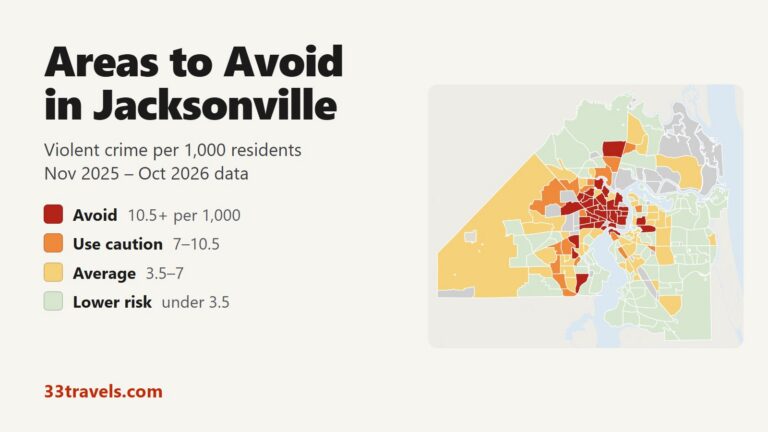
Violent crime in Jacksonville is concentrated in the urban core and the inner Northwest, from Springfield and the Eastside west to Moncrief Road. The Downtown & Urban Core view rates 14.8 per 1,000 and the Westside 7.3, against 2.4 for Southside & Mandarin. Our areas to avoid in Jacksonville guide maps those 36 neighborhoods street by street.
Safest suburbs of Jacksonville
The agencies around Jacksonville reported 1.46 violent crimes per 1,000 residents in 2025; the Sheriff’s Office reported 5.19 in the same FBI data. Neptune Beach and the St. Johns County Sheriff’s Office, which polices Ponte Vedra, are the lowest. Two smaller cities outside the table also report less crime than Jacksonville: Fernandina Beach recorded 28 violent crimes in 2025 for about 13,800 residents and Orange Park 19 for about 9,000.
| City | Population | Violent crimes | Per 1,000 | Year |
|---|---|---|---|---|
| Jacksonville Sheriff's Office | 1,008,920 | 5,239 | 5.2 | 2025 |
| Jacksonville Beach PD | 23,585 | 80 | 3.4 | 2025 |
| Clay County SO | 218,420 | 529 | 2.4 | 2025 |
| Atlantic Beach PD | 13,226 | 20 | 1.5 | 2025 |
| Nassau County SO | 92,440 | 112 | 1.2 | 2025 |
| St. Johns County SO | 322,319 | 245 | 0.8 | 2025 |
| Neptune Beach PD | 6,991 | 5 | 0.7 | 2025 |
Murder, rape, robbery and aggravated assault reported to the FBI by each agency, per 1,000 residents of the population the agency reports. Source: FBI Crime Data Explorer. Agencies that report no complete year are left out.
Tips for choosing a neighborhood
- Check the street as well as the neighborhood. Large areas such as Golden Glades/The Woods and East Arlington have one rate for many blocks.
- Switch the map to Theft & robbery near malls. Windy Hill and Loretto rate low for violent crime and high for theft.
- Plan on a car: most neighborhoods under the safe line are suburban.
- For a beach stay, compare the city’s Beach Boulevard neighborhoods with Neptune Beach and Atlantic Beach, which have their own police.
- Call 9-1-1 in an emergency and 904-630-0500 for the Jacksonville Sheriff’s Office non-emergency line.
How this map was made
The Jacksonville Sheriff’s Office Transparency Portal supplies the counts, for November 2025 through October 2026. Violent crime means murder, robbery and aggravated assault, with murder and assault counted by victim. JSO publishes no rape records, so they are not counted. Each crime is placed in one of the City of Jacksonville’s GIS neighborhoods, or a Census block-group area where the city map has none, and the rate divides it by the 2020 Census population. The ranking includes neighborhoods with at least 2,500 residents and leaves out the three campus and base areas named above. Crimes handled by university police, the Navy, the airport police and the beach cities are not in JSO’s records. Suburban rates come from each department’s FBI Crime Data Explorer reports, and the housing figures come from the Census Bureau’s 2020-2024 American Community Survey.
We ranked the safest neighborhoods in Milwaukee, Houston, San Diego, Austin, San Francisco, Buffalo, Baltimore, Atlanta, Honolulu, Boston, Denver, Chicago, Detroit and Los Angeles.
FAQ
What is the safest neighborhood in Jacksonville?
Among neighborhoods with at least 2,500 residents, Fort Caroline Shores in east Arlington recorded no violent crimes in 12 months, followed by Cobblestone at 0.2 and Mandarin at 0.3 per 1,000 residents. Mandarin has about three times the residents of Fort Caroline Shores, so its low rate rests on a larger base.
What part of Jacksonville is the safest?
Southside and Mandarin. Its neighborhoods together recorded 2.4 violent crimes per 1,000 residents, the lowest of the city's five parts of town and under half the city rate of 5.2. Arlington is second at 3.7.
What are the best neighborhoods in Jacksonville to live in?
For families, Mandarin and Mandarin Station, with Walter Jones Historical Park and Kravitz Regional Park. For a walkable street close to Downtown, Avondale. For a shorter drive to the ocean, Isle of Palms and Beach Haven off San Pablo Road. All of them rate under half the city average for violent crime.
Where is the safest place to stay in Jacksonville as a tourist?
Inside the city limits, Avondale near the river and Deerwood on the Southside. Both are under half the city rate for violent crime and below the city's theft rate per resident. For an ocean stay, Neptune Beach, a separate city with its own police, reported the lowest violent crime rate of any department in the suburban table for 2025.
Is St. Johns Town Center safe?
Violent crime is below the city rate, but car break-ins and shoplifting are common. Windy Hill, the neighborhood that holds the mall, rates 3.6 per 1,000 residents against the city's 5.2, and it recorded 646 thefts in 12 months, the second-highest total of any neighborhood in Jacksonville.
Is St. Johns County safer than Jacksonville?
Yes. The St. Johns County Sheriff's Office reported 245 violent crimes in 2025 for about 322,000 residents, a rate of 0.76 per 1,000, against 5.19 for the Jacksonville Sheriff's Office in the same FBI data. Only Neptune Beach reported a lower rate among the nearby departments.
Why do some Jacksonville neighborhoods show zero crime?
Some areas are small enough that a quiet year shows zero: Fort Caroline Shores, Ortega and St. Johns Bluff all recorded no violent crimes. Others hold a campus or a base with its own police, such as the University of North Florida and Naval Station Mayport, whose reports are not in the Sheriff's Office file. Those campus and base areas are left out of the ranking.