Four sovereign countries use nothing but blue and yellow on their flags: Ukraine, Sweden, Kazakhstan and Palau. Add a few white stars and you get Nauru and Bosnia and Herzegovina. Add red and you get a whole family of tricolors across South America, Eastern Europe and Africa.
Most lists of countries with blue and yellow flags blur the line between nations, US states and regional banners. This one sticks to sovereign states, and it sorts them by what is actually on the cloth.
TLDR
- Blue and yellow only: Ukraine, Sweden, Kazakhstan, Palau.
- Blue and yellow plus white: Nauru, Bosnia and Herzegovina.
- Blue, yellow and red: Colombia, Ecuador, Venezuela, Romania, Moldova, Andorra, Chad.
- Blue and yellow plus another color: Brazil (green and white), Barbados (black).
- The easiest confusions: Ukraine vs. Sweden (stripes vs. cross) and Romania vs. Chad vs. Andorra (nearly the same vertical tricolor).
Table of Contents
- Flags with only blue and yellow
- Blue and yellow with white
- Flags with blue, yellow and red
- Other blue and yellow flags
- Comparison table
- How to tell look-alike flags apart
- FAQ
Flags with only blue and yellow
Ukraine
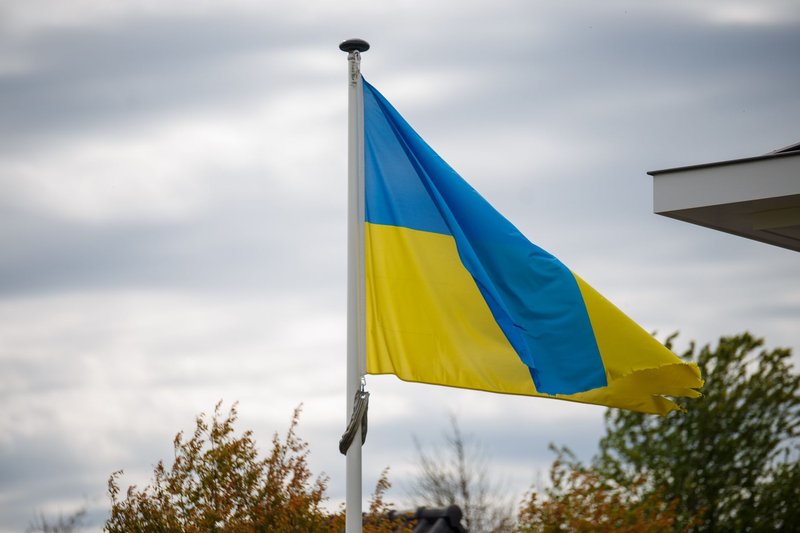
Two equal horizontal bands: blue on top, yellow below. The usual reading is blue sky over golden wheat fields, which suits a country that sits on some of the most productive farmland in Europe.
The pairing is older than the modern state. The flag was used by the short-lived Ukrainian People’s Republic in 1918, banned under Soviet rule, and restored in 1991 as independence arrived. It became the official national flag in January 1992. Details on the country’s symbols are in the CIA World Factbook entry for Ukraine.
Sweden
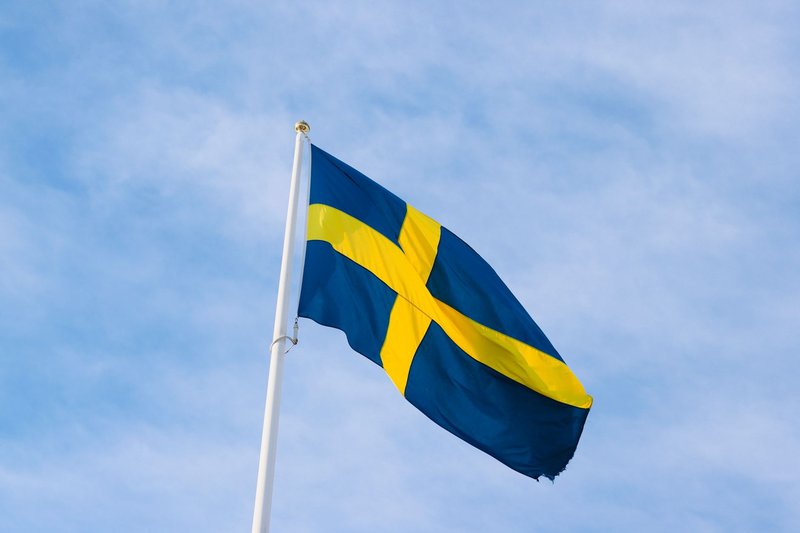
A yellow Nordic cross on a blue field, with the vertical bar shifted toward the hoist. The colors come from the national coat of arms: three gold crowns on a blue shield, a design that goes back to the 14th and 15th centuries.
The cross layout is borrowed from Denmark’s Dannebrog, and the flag was in use long before 1906, the year it was formally defined as the national flag in law. It is the one blue-and-yellow flag in this list that is closer to a heraldic shield turned into fabric than to a statement about landscape.
Kazakhstan
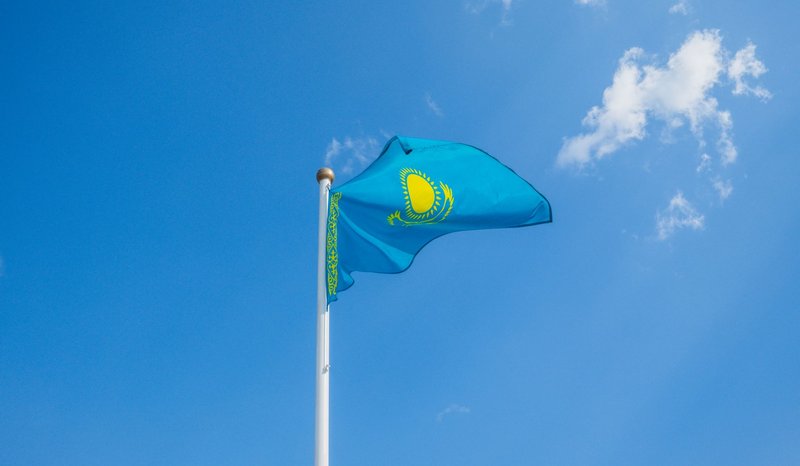
Sky blue field, a golden sun with 32 rays at the center, and a steppe eagle soaring beneath it. A vertical strip of national ornament runs along the hoist, also in gold.
Every element is yellow or blue, which keeps it in the strict two-color group. The sky blue is a nod to the Turkic tradition of venerating the sky, and it stands for unity and peace. The flag was adopted in June 1992, shortly after independence. The CIA World Factbook describes it as a gold sun with an eagle on a blue field.
Palau
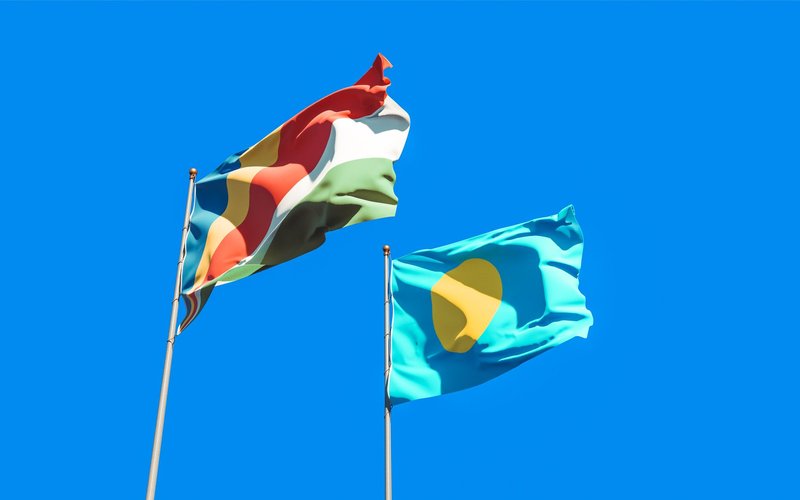
A light blue field with a golden-yellow disc. The disc is a full moon, and the Pacific blue is the ocean around the islands. In Palauan tradition the full moon is the best time for fishing, planting and celebrations.
The disc sits slightly toward the hoist rather than dead center. That offset is deliberate: a centered disc would make the flag look like Japan’s flag in different colors. Palau adopted this design on 1 January 1981, when it gained self-government. See the CIA World Factbook entry.
Blue and yellow with white
Two more flags are overwhelmingly blue and yellow, but each has white stars. Strictly, that makes them three-color flags, though most people search for them under this keyword.
Nauru
A blue field with a thin yellow horizontal stripe across the middle and a white 12-pointed star below it on the hoist side. The stripe is the equator. The star sits just under it because Nauru lies about 42 kilometers south of the equator. Its twelve points represent the island’s twelve original tribes, and the blue is the Pacific. Adopted 1968, the year of independence.
Bosnia and Herzegovina
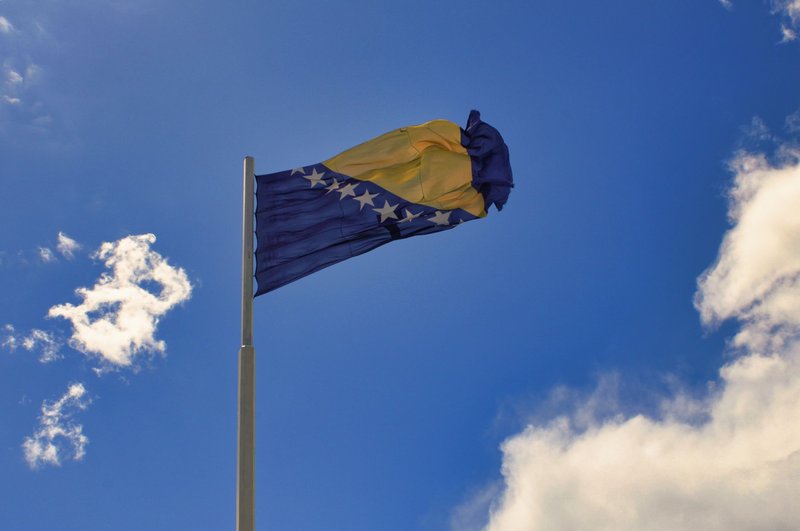
A blue field with a yellow right-angled triangle and a diagonal row of white stars. The triangle loosely echoes the country’s shape. The stars suggest Europe, and the blue-and-yellow scheme intentionally resembles the European Union’s flag.
This one has an unusual origin story: the design was imposed in 1998 by the international High Representative overseeing the peace process, after the country’s own parliament failed to agree on a flag. Ethnically neutral colors and shapes were the point.
Flags with blue, yellow and red
These are the flags that fill the top results for “flags with blue, yellow and red.” Two groups: horizontal tricolors in South America, and vertical tricolors in Europe and Africa.
Colombia
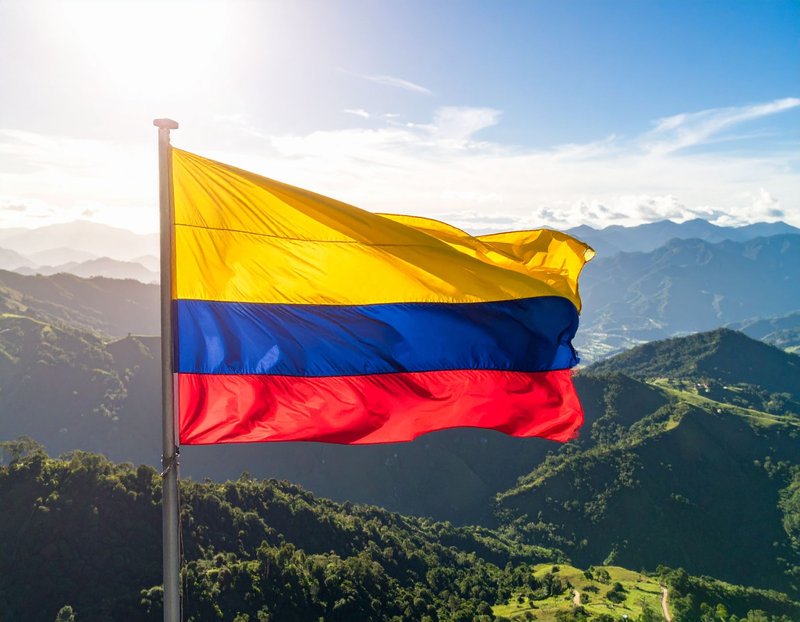
Yellow takes the top half. Blue and red each take a quarter below. The yellow is usually read as the country’s wealth and sovereignty, the blue as the seas on its two coasts, and the red as blood shed for independence. The current design dates to 1861.
Ecuador
Same proportions as Colombia: a double-width yellow stripe, then blue, then red. The difference is the coat of arms in the center, showing Mount Chimborazo, a river, a ship and a condor. The flag was adopted in 1860.
Venezuela
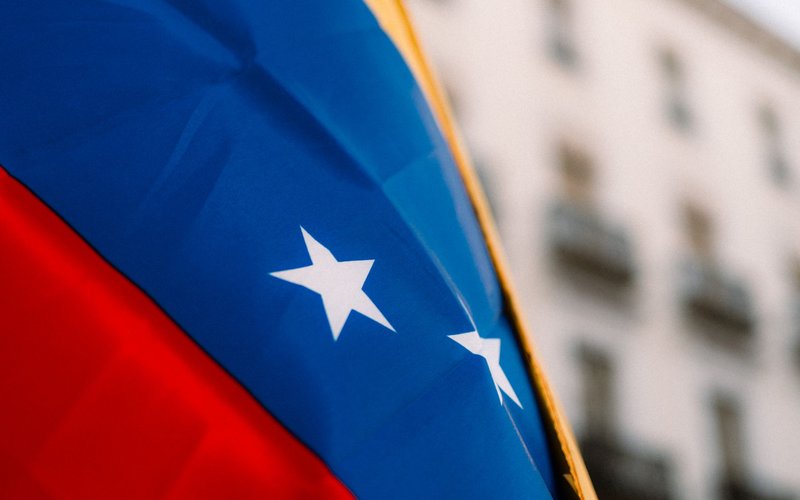
Three equal stripes (yellow, blue, red) with an arc of eight white stars across the blue band. The stars were originally seven, one for each province that signed the 1811 declaration of independence. An eighth was added in 2006 to represent the Guayana province.
Romania
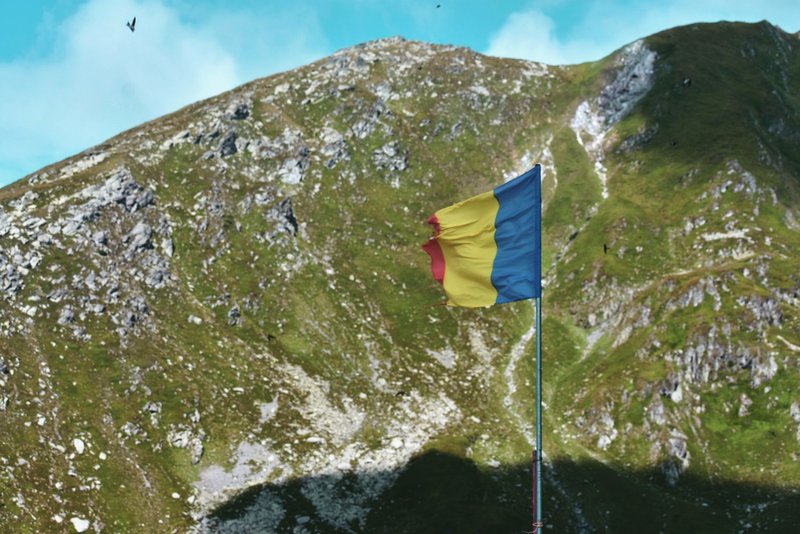
A plain vertical tricolor: blue, yellow, red, with no emblem. Romania’s colors date back to the 1848 revolution. The current flag has been in use since 1989, when the communist coat of arms was cut out of the middle after the fall of Ceausescu.
Moldova
Almost the same vertical tricolor as Romania, with the national coat of arms (an eagle holding a cross, a bison’s head on its shield) added in the center. The shared design reflects shared history and language. Moldova adopted its version in 1990, as the Soviet Union was coming apart.
Andorra
Another vertical blue-yellow-red tricolor with a coat of arms in the middle. The arms hold two cows and the heraldic symbols of the area’s historic rulers. The colors are shared with the neighboring French and Spanish traditions, and the flag as used today traces back to 1866.
Chad
A vertical tricolor of indigo blue, yellow and red with no emblem, adopted in 1959. The blue is for the sky and water, the yellow for the sun and the Sahara desert, and the red for national sacrifice. The country’s flag looks so much like Romania’s that Chad formally raised the issue with the UN in 2004.
Other blue and yellow flags
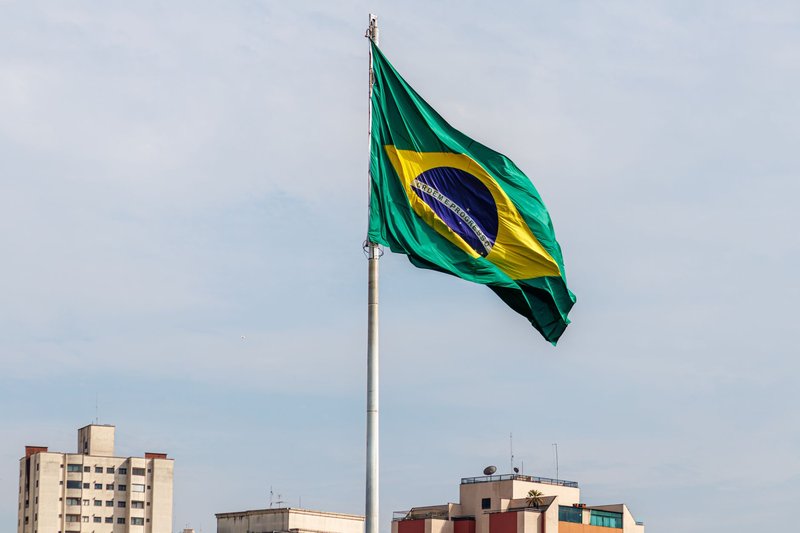
Brazil is green, yellow and blue. A yellow rhombus on a green field holds a blue globe with 27 stars (26 states plus the Federal District) and a white banner reading “Ordem e Progresso.” It has been in this form since 1889, with the star count updated over time.
Barbados uses ultramarine, gold and ultramarine vertical stripes, with a black trident head in the center, adopted at independence in 1966. The broken trident marks the break from colonial rule.
Comparison table
| Country | Layout | Colors | Adopted |
|---|---|---|---|
| Ukraine | Horizontal bicolor | Blue, yellow | 1992 (used 1918) |
| Sweden | Nordic cross | Blue, yellow | 1906 (law) |
| Kazakhstan | Emblem on field | Sky blue, gold | 1992 |
| Palau | Offset disc | Light blue, golden yellow | 1981 |
| Nauru | Stripe and star | Blue, yellow, white | 1968 |
| Bosnia and Herzegovina | Triangle and stars | Blue, yellow, white | 1998 |
| Colombia | Horizontal, 2:1:1 | Yellow, blue, red | 1861 |
| Ecuador | Horizontal, 2:1:1, arms | Yellow, blue, red | 1860 |
| Venezuela | Horizontal, 8 stars | Yellow, blue, red | 1811 (current: 2006) |
| Romania | Vertical tricolor | Blue, yellow, red | 1989 |
| Moldova | Vertical tricolor, arms | Blue, yellow, red | 1990 |
| Andorra | Vertical tricolor, arms | Blue, yellow, red | 1866 |
| Chad | Vertical tricolor | Indigo, yellow, red | 1959 |
| Brazil | Rhombus and globe | Green, yellow, blue, white | 1889 |
| Barbados | Vertical, trident | Blue, gold, black | 1966 |
How to tell look-alike flags apart
Ukraine vs. Sweden. Both are blue and yellow, but the layouts are different. Ukraine is two flat horizontal bands. Sweden is a blue field with a yellow cross whose vertical bar sits left of center. If you can see a cross, it’s Sweden.
Romania vs. Chad vs. Andorra vs. Moldova. All four are blue, yellow, red vertical tricolors. Check the center first. A coat of arms means Andorra or Moldova. Moldova’s shows an eagle with a cross in its beak. Andorra’s has a quartered shield with cows. No emblem means Romania or Chad, and here only the blue helps: Chad’s is a darker indigo, while Romania’s is a brighter cobalt.
Colombia vs. Ecuador vs. Venezuela. If the yellow band is twice as wide as the others, it’s Colombia or Ecuador, and Ecuador has the coat of arms. Three equal bands with white stars on the blue is Venezuela.
Palau vs. Japan. The shapes are alike. The colors are not: Palau’s moon is yellow on light blue, Japan’s sun is red on white.
FAQ
Which countries have only blue and yellow on their flags? Ukraine, Sweden, Kazakhstan and Palau.
Which country has a blue and yellow flag with a cross? Sweden. Its yellow Nordic cross on blue is the model for the other Nordic flags.
Is the Ukrainian flag blue and yellow or yellow and blue? Blue on top, yellow on the bottom. Flipped, it is a common mistake in photos and graphics.
Do the European Union and US states count? They have blue-and-yellow flags too (the EU’s is blue with a ring of yellow stars, and Alaska, Indiana and Oregon use blue and gold), but none is a sovereign country, so they aren’t included in the list above.