Every ruins list for Mexico opens with Chichen Itza and Tulum. Fair enough, they’re famous for a reason. But Mexico has thousands of archaeological sites, built by at least four distinct civilizations over roughly 3,000 years, and the best day of your trip may be at a site most visitors skip. This list covers 14, grouped by region, with the practical details most roundups leave out: what it costs, whether you can climb it, and who else will be there.
Quick Picks: Which Ruins Should You Visit?
| If you are… | Go to |
|---|---|
| A first-timer with one day | Chichen Itza (from Cancun) or Teotihuacan (from Mexico City) |
| Based on the Caribbean coast | Tulum, Coba, Ek Balam |
| Chasing the fewest crowds | Calakmul, Yaxchilan, Mitla, Cacaxtla |
| Into jungle and wildlife | Palenque, Calakmul, Yaxchilan |
| Into carved detail and architecture | Uxmal, Mitla, Palenque |
| Staying in Mexico City | Teotihuacan, Templo Mayor, Tula, Cacaxtla |
| Wanting to climb a pyramid | Coba (no longer), Ek Balam, Calakmul, Uxmal’s Great Pyramid |
Entry fees below are approximate and in Mexican pesos. They’re set by the federal archaeology institute (INAH) plus separate state fees, and they change most years, so check INAH before you go. Plan on cash: some sites and most parking lots don’t take cards.
Table of Contents
- Who Built What: Maya, Aztec, Zapotec and Toltec
- Ruins in the Yucatan Peninsula
- Ruins in Chiapas
- Ruins in Oaxaca
- Ruins in Central Mexico
- Chichen Itza vs Tulum
- Practical Tips: Heat, Climbing, Guides and Itineraries
Who Built What: Maya, Aztec, Zapotec and Toltec
People use “Mayan ruins” for everything, which is how you end up asking where the Aztec pyramids are in Cancun. They aren’t. The four main cultures sit in different parts of the country and different centuries.
- Maya (roughly 250 to 900 CE for the classic peak, with a later phase on the coast): the Yucatan Peninsula, Chiapas and Campeche. Corbelled arches, stelae with hieroglyphs, stepped pyramids topped with small temples.
- Zapotec (about 500 BCE to 800 CE at Monte Alban): the Oaxaca valleys. Terraced hilltop cities and geometric stone mosaics.
- Teotihuacan (about 100 BCE to 550 CE): a city whose builders remain unnamed. It predates the Aztecs by roughly a thousand years, though the Aztecs gave it the name it still carries.
- Toltec (about 900 to 1150 CE): central Mexico, centered on Tula. Known for warrior statues and a heavy influence on later Maya construction at Chichen Itza.
- Aztec / Mexica (1325 to 1521): Tenochtitlan, now buried under Mexico City. Few of its buildings survived the Spanish conquest.
So “Aztec ruins near Mexico City” really means Templo Mayor, and the big pyramids an hour outside the capital are older.
Ruins in the Yucatan Peninsula
The peninsula holds the densest cluster of sites and the most visitors. The sites run from heavily managed to nearly empty.
1. Chichen Itza
Culture and era: Maya, with Toltec-style influence, mainly 800 to 1200 CE. Base city: Cancun (about 2.5 hours), Merida (about 2 hours) or Valladolid (about 45 minutes). Entry: roughly 600 to 700 pesos for foreign visitors, the most expensive site on this list. Best time: at opening, 8 a.m. Tour buses from the coast arrive by 10:30. Allow: 2 to 3 hours.
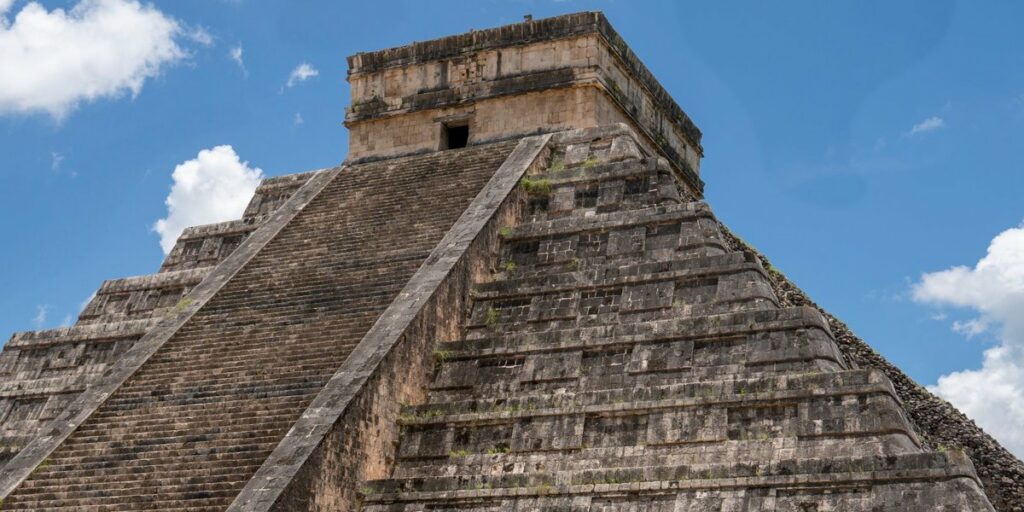
UNESCO lists Chichen Itza as a World Heritage Site, and El Castillo is the reason: a 24-meter pyramid whose four staircases carry 365 steps in total. Chichen Itza is one of Mexico’s UNESCO World Heritage Sites, many of which offer equally compelling archaeological and cultural experiences across the country. At the spring and autumn equinoxes, a serpent-shaped shadow appears to slide down the northern balustrade. You can’t climb it, a rule in place since 2006 after a visitor fell. Walk on to the Great Ball Court, the largest in Mesoamerica at about 168 meters, where a clap at one end echoes back with unnerving clarity.
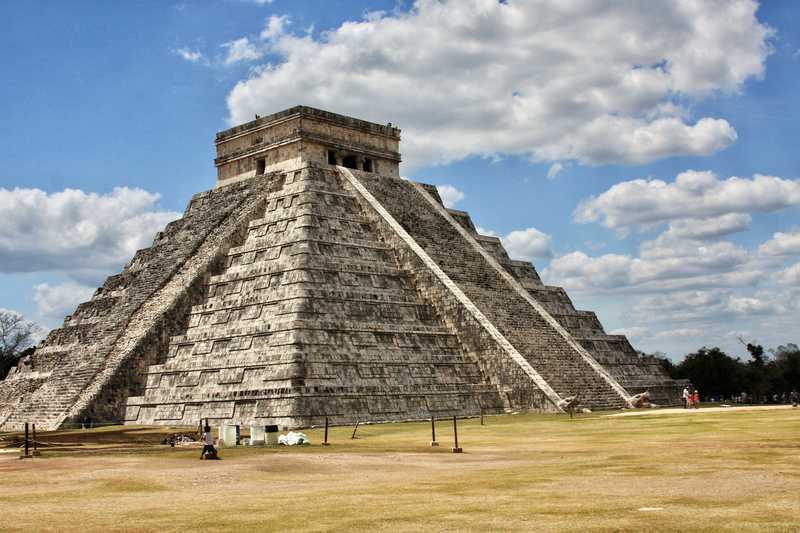
Vendors fill the paths between monuments, and the noise can undercut the atmosphere. That’s the trade for Mexico’s most visited ruin.
2. Ek Balam
Culture and era: Maya, peak around 700 to 1000 CE. Base city: Valladolid (about 30 minutes) or Cancun (about 2 hours). Entry: roughly 550 to 600 pesos for foreign visitors. Best time: at opening, then swim in the cenote after. Allow: 2 hours, plus the cenote.
Ek Balam is the answer to “off-the-beaten-path ruins in Mexico” that sits closest to Cancun. The Acropolis, over 30 meters high, is still climbable, and the stucco figures on the upper temple, including winged figures, are the best-preserved on the peninsula. You can see them without a crowd at your back. The nearby Xcanche cenote is a short bike or taxi ride, and it’s the reason to bring swimwear.
3. Uxmal
Culture and era: Maya (Puuc style), roughly 700 to 1000 CE. Base city: Merida (about 1 hour). Entry: roughly 500 to 600 pesos for foreign visitors. Best time: early morning, when the Puuc stone is at its warmest color. Allow: 2 to 3 hours.
Uxmal is for people who care about architecture. The Pyramid of the Magician has rounded corners, unusual for Maya building, and the Nunnery Quadrangle is covered in lattice fretwork and long-nosed rain-god masks. You can’t climb the Magician anymore, but the Great Pyramid at the south end allows it and gives you a view across the Puuc hills. Combine it with Kabah, a smaller Puuc site 20 minutes down the road, with a facade of hundreds of Chaac masks.
4. Tulum
Culture and era: Maya, a walled port city active around 1200 to 1500 CE. Base city: Tulum town (10 minutes), Playa del Carmen (about 1 hour) or Cancun (about 2 hours). Entry: roughly 100 to 150 pesos for the site, plus parking, which is often more than the ticket. Best time: 8 a.m. opening. Allow: 1.5 hours.
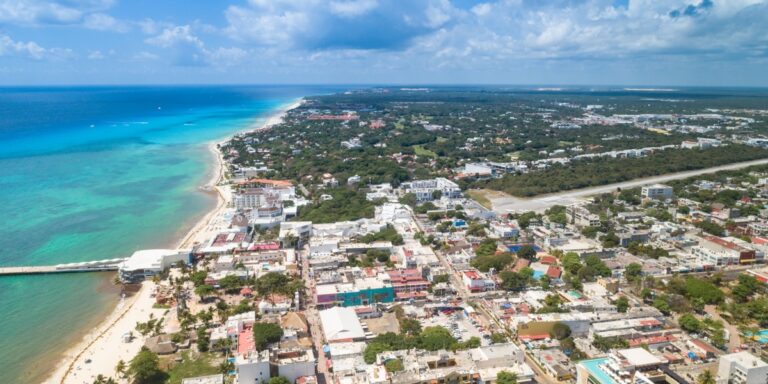
The ruins here are modest. The setting is not: a small Maya trading port built on a limestone cliff over turquoise water, with a limestone temple known as El Castillo guarding the cliff edge. If you’re staying in the area, explore the towns and cities near Tulum for lodging and dining options. The buildings are roped off and you can’t climb, but you can swim from the small beach below, which most visitors forget to plan for. By midday it’s packed, so go early and leave before the cruise-ship groups arrive.
5. Coba
Culture and era: Maya, peak around 600 to 900 CE. Base city: Tulum (about 45 minutes) or Playa del Carmen (about 1 hour 15 minutes). Entry: roughly 100 to 150 pesos, plus a bike or tricycle rental if you want one. Best time: first thing, before the heat settles in the forest. Allow: 2 to 3 hours.
Coba spreads across forest and lagoon, with the main pyramid, Nohoch Mul, standing at about 42 meters, one of the tallest in the Yucatan. The climb was closed to the public in 2020 and is no longer allowed, but the site is still worth a morning. Rent a bike or hire a tricycle taxi at the entrance, since the temples sit kilometers apart along old Maya causeways called sacbeob. It’s a good pairing with Tulum for a coast-based itinerary, and quieter than anything at the Chichen Itza level.
6. Calakmul
Culture and era: Maya, one of the largest Classic-period cities, with its peak around 600 to 800 CE. Base city: Xpujil (about 1 hour), Campeche (about 4 hours) or Chetumal (about 3 hours). Entry: roughly 100 to 150 pesos for the site, plus a separate biosphere reserve fee at the gate. Best time: at opening, which is when monkeys and toucans are active. Allow: a full day, including the drive.
UNESCO recognizes Calakmul as both a cultural and a natural site, since the ruins sit inside a large tropical forest reserve. The reward for the long road is Structure II, over 45 meters high, which you can climb and from which you see an unbroken green canopy to the horizon, with other pyramids poking through. Calakmul rarely gets more than a few dozen visitors on a weekday. Most reach it by rental car or tour from Xpujil, and the 60-kilometer access road runs through reserve forest, so fuel up first and bring water.
Ruins in Chiapas
Chiapas offers jungle-covered sites with the best stone carving.
7. Palenque
Culture and era: Maya, peak under King Pakal, 615 to 683 CE. Base city: Palenque town (10 minutes) or Villahermosa (about 2 hours). Entry: roughly 100 to 200 pesos, depending on current state fees. Best time: early morning, when mist hangs in the trees and howler monkeys call. Allow: 2 to 3 hours.
UNESCO describes Palenque as a masterpiece of Maya architecture and sculpture, and the site backs that up. The Temple of the Inscriptions holds Pakal’s tomb, discovered in 1952 beneath the floor of the pyramid. The tomb itself is closed to visitors, but the pyramid, the palace tower and the small waterfall pools along the path make it one of the most atmospheric sites in the country. Visit the museum at the lower entrance for the jade funerary mask replica.
8. Yaxchilan
Culture and era: Maya, peak around 680 to 770 CE. Base city: Palenque (about 3 hours to Frontera Corozal, then a boat ride of 40 minutes). Entry: roughly 100 to 200 pesos, plus boat fare, which is the larger cost. Best time: go on a guided day trip from Palenque to avoid arranging transport yourself. Allow: a full day.
Yaxchilan stands on a bend of the Usumacinta River, and the only practical way in is by boat from Frontera Corozal. You enter through a dark, bat-filled labyrinth into the main plaza, with carved lintels above the doorways showing rulers in ritual scenes. Since most visitors come in a single group from Palenque, you often have the stonework to yourself for stretches. Many tours add Bonampak, whose painted murals show a royal ceremony in color.
Ruins in Oaxaca
Oaxaca’s sites belong to the Zapotec and Mixtec, so the architecture looks different from anything on the peninsula.
9. Monte Alban
Culture and era: Zapotec, from about 500 BCE to 800 CE. Base city: Oaxaca City (about 20 minutes by road). Entry: roughly 90 to 120 pesos. Best time: morning, or late afternoon for light on the Main Plaza. Allow: 2 hours.
The Zapotecs leveled a mountaintop 400 meters above the valley and built a city on the flat summit. Walk the Main Plaza, then look for the Danzantes, carved stone figures that have been dated to around 500 BCE and are among the earliest examples of writing in Mesoamerica. Hire a taxi or take the shuttle from Oaxaca City, and see it before Mitla or after, never skip the drive.
10. Mitla
Culture and era: Zapotec and Mixtec, active mostly from 1000 to 1500 CE. Base city: Oaxaca City (about 1 hour). Entry: roughly 90 to 120 pesos. Best time: midday is fine; the site is small and rarely crowded. Allow: 1 hour.
Mitla is smaller and quieter than Monte Alban, with an unusual feature: walls covered in interlocking geometric mosaics, made of thousands of cut stones fitted without mortar. It was a religious center, and a Spanish church was built directly on top of part of it. Pair it with Hierve el Agua, the petrified waterfalls, about 30 minutes further on, and a mezcal tasting nearby for a full Oaxaca valley day.
Ruins in Central Mexico
Mexico City sits within day-trip range of several major sites, and they are the closest answer to “Aztec ruins near Mexico City”.
11. Teotihuacan
Culture and era: Teotihuacan, about 100 BCE to 550 CE. Base city: Mexico City (about 1 hour). Entry: roughly 100 to 120 pesos. Best time: at opening, 9 a.m., before the sun and the tour groups arrive. Allow: 3 to 4 hours.
UNESCO lists Teotihuacan as one of the largest cities of the ancient Americas, and the scale is clear from the Avenue of the Dead, which runs roughly 2 kilometers between the Pyramid of the Moon and the Citadel. The Pyramid of the Sun, at around 65 meters, is among the largest in the world, though climbing it has been closed since 2020. The Pyramid of the Moon is the one to use for views, when open, since the Avenue stretches below you. The site has almost no shade, so bring a hat.
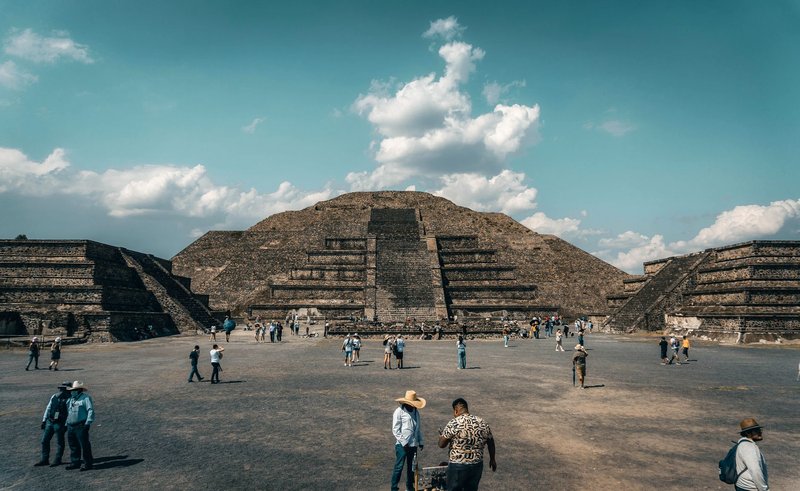
Hot-air balloon flights over the site leave at dawn, and they’re worth it if you’ve already seen the ruins from the ground.
12. Templo Mayor
Culture and era: Aztec/Mexica, 1325 to 1521 CE. Base city: Mexico City, a few steps from the Zocalo. Entry: roughly 95 to 100 pesos, including the museum. Best time: weekday mornings. Allow: 1.5 to 2 hours.
This is the real Aztec site. The Mexica built Tenochtitlan’s main temple at the center of their island city, and the Spanish then built Mexico City on top. Excavation began in 1978 after workers found a giant stone disc of the goddess Coyolxauhqui. Today you walk along raised paths through the foundations, then through the museum with its carved stones and offerings. It’s the only site on this list reached by subway.
13. Tula
Culture and era: Toltec, around 900 to 1150 CE. Base city: Mexico City (about 1.5 hours). Entry: roughly 90 to 100 pesos. Best time: morning. Allow: 1.5 hours.
Tula’s attraction is the Atlantes: four 4.6-meter basalt warrior figures that stood on top of Pyramid B and held up a temple roof. Pair it with the site museum and the ball courts. It works well as a half-day if you are on a Mexico City base and have already seen Teotihuacan. Few visitors come, and it’s one of the places that shows how Toltec art fed into the later Maya style at Chichen Itza.
14. Cacaxtla
Culture and era: Olmeca-Xicalanca, about 650 to 900 CE. Base city: Tlaxcala (about 30 minutes) or Puebla (about 45 minutes). Entry: roughly 90 to 100 pesos. Best time: any time; a roof covers the murals so weather doesn’t matter. Allow: 1.5 hours.
Cacaxtla is the odd one out here, and the most underrated. It has big, colorful murals still visible after 1,200 years, including the Battle Mural, which shows jaguar warriors and bird warriors in combat in reds, blues and blacks. The site is covered by a huge roof, so you walk on raised paths at eye level with the paintings. Combine it with nearby Xochitecatl, a pyramid complex on a neighboring hill, for a full day from Puebla or Tlaxcala.
Chichen Itza vs Tulum
This is the question most Cancun visitors have, and it has a clean answer.
- Choose Chichen Itza if you want scale and the most important monuments. It costs more, takes a day, and gets crowded.
- Choose Tulum if you want a setting. It takes half a morning, costs less, and ends at a beach.
- Do both if you have three days: Chichen Itza early on a tour or rental car, Tulum on another morning combined with Coba.
If you can only pick a lesser-known option, Ek Balam gives you the climbing, the carved stucco and the cenote, without either site’s crowds.
Practical Tips: Heat, Climbing, Guides and Itineraries
Heat. Most sites have little shade and midday temperatures in the Yucatan often pass 35 degrees Celsius. Arrive at opening, carry at least a liter of water per person, and wear a hat. The rainy season, roughly June to October, brings afternoon storms rather than all-day rain, so mornings usually stay workable. The dry months, December to April, are the best for comfort and the busiest.
Climbing. The rules have tightened in the past two decades. Currently open to climbers: Ek Balam’s Acropolis, Calakmul’s Structure II and Uxmal’s Great Pyramid. Closed: El Castillo at Chichen Itza, Nohoch Mul at Coba, the Pyramid of the Sun at Teotihuacan and the Pyramid of the Magician at Uxmal. Rules change when a pyramid is under conservation, so confirm on arrival.
Guides. Licensed guides wait at most entrances and often quote a few hundred pesos per group. At Chichen Itza and Teotihuacan, a guide changes the visit, since the astronomy and symbolism are not visible from plaques. At sites like Tulum, Mitla and Cacaxtla, you can manage without. Look for the official credential.
Combining sites. These pairings work in a single day:
- Cancun base: Chichen Itza plus a Valladolid lunch and Ek Balam, or Chichen Itza plus a cenote.
- Tulum base: Tulum at opening, then Coba.
- Merida base: Uxmal plus Kabah.
- Oaxaca base: Monte Alban in the morning, Mitla in the afternoon.
- Mexico City base: Teotihuacan in the morning, then Templo Mayor the next day. Tula and Cacaxtla each need their own day.
- Palenque base: Palenque in the morning, then Agua Azul and Misol-Ha waterfalls, or a full day to Yaxchilan and Bonampak.
For a first trip to Mexico, a sensible spine is Mexico City and Teotihuacan, then Oaxaca for Monte Alban and Mitla, then the Yucatan for Uxmal, Chichen Itza and the coast. That covers three of the four civilizations and takes about two weeks without rushing.