
Table of Contents
- TLDR
- Why Antarctica Has No Countries
- Which Countries Actually Have People in Antarctica Right Now
- The 7 Claimant Nations vs. the 29 That Just Show Up
- Why the Population Swings 4x Between Summer and Winter
- McMurdo Station: The Closest Thing Antarctica Has to a City
- Trivia Even Geography Nerds Miss
If you searched for the largest countries in Antarctica by population expecting a list of nations ranked by citizens, here’s the correction nobody puts in the first line: there are no countries in Antarctica. No passports, no capital cities, no census. What exists instead is a rotating population of scientists, engineers, and support staff from dozens of nations, spread across roughly 77 research stations on a continent that belongs, on paper, to no one.
That doesn’t make the “which country has the most people there” question meaningless. It’s actually more interesting than the premise you started with.
TLDR
- No sovereign countries exist in Antarctica — the 1959 Antarctic Treaty froze all territorial claims.
- The United States has the most people there, roughly 1,293 during peak season, mostly through McMurdo Station and the South Pole base.
- Argentina (about 667) and Russia (about 429) round out the top three, followed by Chile, the UK, and Australia.
- Population swings hard by season: around 4,400–5,000 people in the Antarctic summer, dropping to 1,000–1,100 who tough out the winter.
- Seven nations claim territory; roughly 29 countries actually operate research stations there, and it’s not the same list.
Why Antarctica Has No Countries
Antarctica isn’t unclaimed the way international waters are unclaimed. Seven countries — Argentina, Australia, Chile, France, Norway, New Zealand, and the United Kingdom — have formally asserted territorial claims, and three of those claims physically overlap. Argentina, Chile, and the UK all claim a slice of the Antarctic Peninsula, and none of them recognize the other two’s claims.
The Antarctic Treaty, signed in 1959 by twelve nations including the US and the Soviet Union, sidestepped the fight instead of settling it. Article IV of the treaty freezes the claims in place: existing claims aren’t cancelled, but no new ones can be made, and nobody can act on the ones already filed. The continent is set aside for peaceful scientific research, full stop. That’s why you won’t find a Chilean consulate at the South Pole — the treaty made sure of it.
What the treaty didn’t freeze was presence. Any country can build a station and send people, whether or not it has a territorial claim. That’s the gap between “who owns Antarctica” (nobody) and “who’s actually there” (a shifting mix of researchers), and it’s the second question that has a real answer.
Which Countries Actually Have People in Antarctica Right Now
Population data from World Population Review tracks station staffing across roughly 31 countries with an Antarctic presence. Here’s how the top of that list breaks down during the austral summer, when staffing peaks:
| Rank | Country | Approx. Population Present |
|---|---|---|
| 1 | United States | ~1,293 |
| 2 | Argentina | ~667 |
| 3 | Russia | ~429 |
| 4 | Chile | ~350 |
| 5 | United Kingdom | ~300 |
| 6 | Australia | ~250 |
The US leads by a wide margin, and not because it’s the biggest treaty claimant — it isn’t a claimant at all. Its lead comes down to infrastructure: McMurdo Station, the Amundsen-Scott South Pole Station, and Palmer Station together run a logistics operation that dwarfs anyone else’s, funded through the National Science Foundation’s US Antarctic Program. Russia’s numbers reflect a similar Cold War-era investment in year-round infrastructure, even though it also reserved rather than claimed territorial rights.
Argentina’s second-place spot isn’t an accident either. Of the seven claimant nations, Argentina has staffed its Antarctic presence the most aggressively — partly for research, partly to keep its territorial claim visibly occupied. More on that below.
The 7 Claimant Nations vs. the 29 That Just Show Up
This is the distinction almost every “countries in Antarctica” list glosses over, and it’s the one that actually explains the population numbers.
The claimants (7): Argentina, Australia, Chile, France, Norway, New Zealand, and the United Kingdom. These are the only countries that have formally drawn lines on an Antarctic map and called them borders — pie-slice sectors radiating out from the South Pole.
The operators (roughly 29): Under the treaty’s Consultative Party system, any country that demonstrates “substantial scientific research” — usually by running a station — earns a vote in how Antarctica is governed. As of the most recent count, that list includes the seven claimants plus the US, Russia, China, Germany, Japan, India, Brazil, South Africa, South Korea, Poland, and roughly a dozen others, none of whom have (or can have, under the treaty) a territorial claim.
The two lists barely overlap in what they mean. A claimant nation is making a legal argument about ownership that the rest of the world has agreed not to acknowledge. An operating nation is just doing the science and, not coincidentally, staying in the room where Antarctic policy gets decided — non-Consultative Parties don’t get a vote. The US and Russia sit at the top of the population table precisely because they skipped the ownership argument and went straight for infrastructure and influence.
Why the Population Swings 4x Between Summer and Winter
Antarctica’s population isn’t a fixed number — it’s a tide. During the austral summer (roughly November through February, when the sun barely sets), the continent hosts somewhere between 4,400 and 5,000 people: researchers running field seasons, construction crews doing the maintenance you can’t do in the dark, and support staff keeping stations fed and powered.
Come winter, most of them leave. The ships stop running, flights get riskier, and the population that stays — around 1,000 to 1,100 people across all nations — is the crew willing to spend months in total darkness with no way out until spring. Winter-over staff at US and Russian stations in particular deal with temperatures that regularly drop past -60°C (-76°F), and evacuation isn’t really an option once the last flight leaves.
That seasonal math is also why any “population by country” figure is really a snapshot, not a constant. A country’s rank can shift depending on whether you’re counting a January afternoon or a July night.
McMurdo Station: The Closest Thing Antarctica Has to a City
If any single place in Antarctica deserves to be called a town, it’s McMurdo Station. Run by the US on Ross Island, McMurdo sprawls across roughly 100 buildings and about 2.6 square kilometers (1 square mile) of volcanic rock and ice — a genuine footprint, not just a cluster of huts. In peak summer, it houses up to around 1,200 people, more than the population of some actual Antarctic-adjacent Chilean or Argentine towns on Tierra del Fuego.
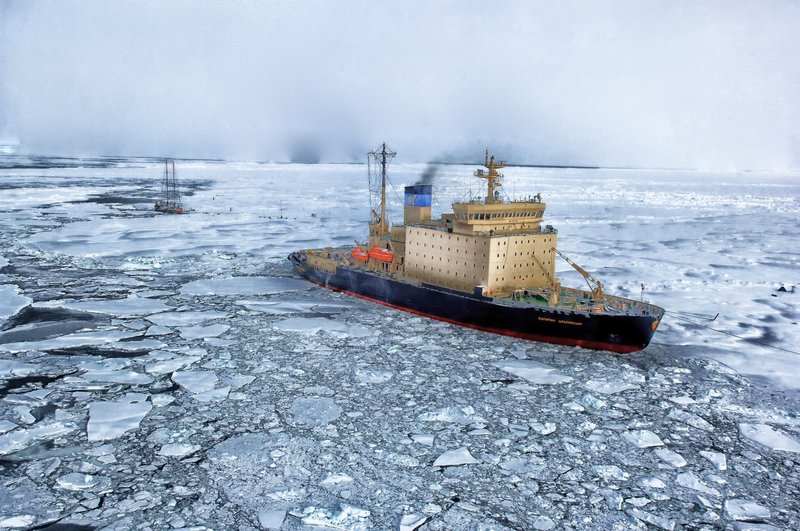
McMurdo has a firehouse, a chapel, a coffee shop, dorm-style housing, and a dive locker for researchers working under the sea ice. It functions as the logistics hub for the entire US Antarctic Program — nearly everyone and everything headed to the South Pole station passes through McMurdo first, usually by ski-equipped LC-130 aircraft or the annual resupply icebreaker that cuts a channel through the sea ice each austral summer.
No other station on the continent comes close to that scale. Russia’s Bellingshausen and Argentina’s Esperanza are significant by Antarctic standards, but they’re a fraction of McMurdo’s size and population.
Trivia Even Geography Nerds Miss
A few details that separate a real answer from a Wikipedia skim:
- Antarctica has had actual births. Argentina flew a pregnant woman to Esperanza Base in 1977 specifically so her son, Emilio Marcos Palma, could be born there in January 1978 — a deliberate move to strengthen its territorial claim by showing Argentine citizens being born on the continent. Close to a dozen children have reportedly been born at Esperanza since, all part of the same strategy.
- Nobody has ever grown up in Antarctica. Families with children have lived at stations like Esperanza and Chile’s Villa Las Estrellas for stretches, but no child has been raised there permanently into adulthood — school-age kids eventually leave for the mainland.
- The most populous Antarctic “settlements” aren’t stations at all. Villa Las Estrellas (Chile) and Esperanza Base (Argentina) both function more like small civilian villages, with families, a post office, and a school — a deliberate contrast to the all-researcher model most other countries use.
- The current 29 Consultative Parties are a fraction of the treaty’s full membership. Over 40 additional countries have signed the Antarctic Treaty without operating a station, meaning they’ve agreed to its rules but have no vote and, for our purposes, no population to count.
None of this changes the basic fact: Antarctica has residents, not citizens, and the numbers on any given day depend entirely on who bothered to build there and who’s willing to stay through the winter.