The languages spoken in Algeria are Arabic, Tamazight (the Berber language family), and French, and they don’t line up the way a map of “official languages” suggests. Modern Standard Arabic and Tamazight are official. Algerian Arabic, known as Darija, is what people actually speak at home and in the street. French has no official status at all, yet it dominates universities, medicine, business, and a good share of the media.
This post sorts out which language does which job, why every source quotes different percentages, and what to expect when you land.
Table of Contents
- TLDR
- The languages at a glance
- Modern Standard Arabic and Darija
- Tamazight and the Berber varieties
- French: no status, plenty of power
- English and other languages
- Why the statistics never match
- Which language to use where as a traveler
- FAQ
TLDR
- Official languages: Modern Standard Arabic (official since independence, constitution of 1963) and Tamazight (national language in 2002, official since 2016).
- Everyday spoken language: Algerian Arabic (Darija) for most people; Berber varieties such as Kabyle for a substantial minority.
- French: Not official, but widely understood and used in work, study, and signage.
- English: Growing, but still thin outside schools and universities.
- Safe travel bet: Greet in Darija or French, switch to French for anything practical in cities, and expect Arabic-script signs with French beneath them.
The languages at a glance
| Language | Status | Where it’s used | Rough share of population |
|---|---|---|---|
| Modern Standard Arabic | Official | Government, schools, news, religion, written texts | Understood by most, spoken natively by almost no one |
| Algerian Arabic (Darija) | No formal status | Everyday speech across most of the country | Roughly 70% to 80% (estimates vary) |
| Tamazight (Berber varieties) | National (2002), official (2016) | Kabylia, the Aurès, the M’zab, the Sahara | Roughly 15% to 30% (estimates vary) |
| French | None | Business, higher education, medicine, media, cities | Understood by a large share; estimates run from about a third to over half |
| English | None | Schools, universities, tech, some tourism | Small but rising |
Treat these as ranges, not facts. The section on statistics below explains why.
Modern Standard Arabic and Darija
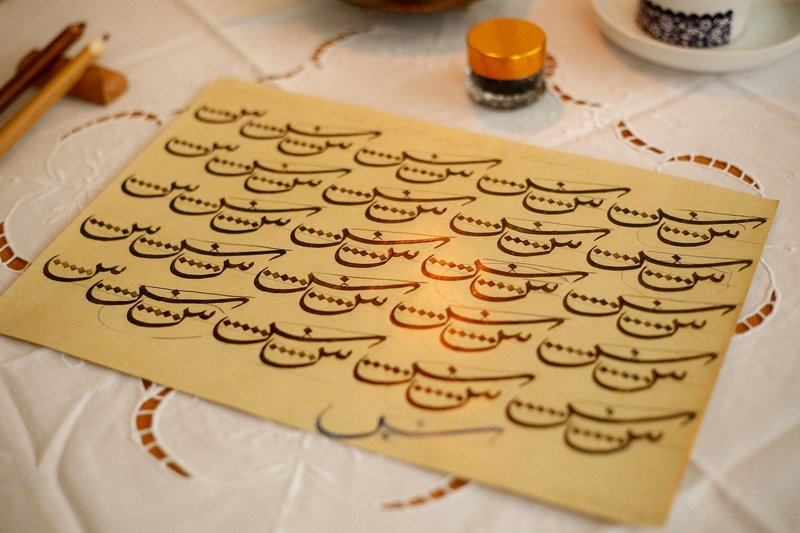
Arabic has been the sole official language since the 1963 constitution, and the state spent decades pushing it through schools and administration, a campaign known as Arabization. Modern Standard Arabic (MSA) is what you see on government buildings, in textbooks, on the evening news, and in Friday sermons. MSA is also the written standard across the Arabic-speaking countries of Africa, so a textbook in Algiers reads much like one in Cairo or Rabat.
Nobody grows up speaking it. Algerian kids learn MSA at school, the way English speakers learn formal written English, except the gap is far wider. At home they speak Darija, the Maghrebi Arabic dialect that has absorbed centuries of Berber, Turkish, Spanish, and French vocabulary.
Darija is the thing to know. A few markers:
- Pronunciation: vowels get swallowed, so words come out clipped and consonant-heavy. Many Arabic speakers from the Gulf or Egypt struggle to follow it at full speed.
- French borrowing: a car is a tomobil, and French verbs get Arabic endings. A single sentence often switches between Darija and French midway.
- Everyday words: bezzaf means “a lot,” wesh means “what,” and saha is a casual thanks (it literally means “health”).
Algeria uses Western numerals (0 to 9) rather than the Eastern Arabic ones, so prices and phone numbers read like they do in Europe.
Tamazight and the Berber varieties
Berber peoples were in North Africa long before Arabic arrived, and Tamazight is the umbrella name for their languages. It isn’t one language so much as a chain of related varieties, and the main ones in Algeria are:
- Kabyle (Taqbaylit): spoken in Kabylia, the mountainous region east of Algiers around Tizi Ouzou, Béjaïa, and Bouira. It has the most speakers, a deep literary and music tradition, and a large diaspora in France.
- Shawiya (Tacawit): spoken in the Aurès mountains around Batna and Khenchela.
- Mozabite (Tumzabt): spoken in the M’zab valley around Ghardaïa.
- Tuareg (Tamahaq): spoken by the Tuareg of the deep south, around Tamanrasset and Djanet, and traditionally written in the Tifinagh script. Kabyle and the northern varieties are mostly written in Latin letters.
Smaller pockets exist too, such as Chenoua near the coast west of Algiers.
The political history matters here. Berber identity was suppressed for years after independence, and the Kabyle protests of the “Berber Spring” in 1980 and the unrest of 2001 pushed the state to move. Tamazight became a national language in 2002 and entered the curriculum earlier, in the mid-1990s. The 2016 constitutional revision made it official alongside Arabic and created an academy to standardize it. Since 2018, Yennayer, the Amazigh New Year on January 12, has been a national public holiday.
Official status and practice still differ. Tamazight is taught in a limited number of regions, and the varieties are not equally intelligible, so a Kabyle speaker and a Tuareg speaker usually can’t understand each other without Arabic or French.
French: no status, plenty of power
French is the language that confuses people most. Algeria was a French colony for 132 years, ending in 1962, and independence led to a hard turn toward Arabic. Yet French never left.
It is still the main language of instruction in scientific and medical degrees, the default for corporate and administrative paperwork, and a daily presence in newspapers, TV, and shop signs. Many Algerians, especially in Algiers, Oran, Annaba, and Constantine, are comfortable in it. Algeria is not a full member of the Francophonie organization, which tells you how politically loaded the subject remains.
In practice, French works as a lingua franca between Arabic speakers and Berber speakers. The CIA World Factbook lists French as the lingua franca while recording Arabic as official and Tamazight in its main regional forms. Older Algerians tend to be more fluent than the youngest generation, who have had more Arabic-medium schooling and more exposure to English online.
English and other languages
English is the language the government keeps promising. English teaching was brought into primary schools from the 2022 to 2023 school year, and universities and tech-focused students lean on it more every year. Outside that world, it’s patchy. A hotel receptionist in Algiers may speak it. A taxi driver or a market seller probably won’t.
Other languages worth a mention:
- Hassaniya Arabic: spoken in the far southwest around Tindouf, and across neighboring Mauritania.
- Algerian Sign Language: the language of the deaf community, with its own signs, though accessibility remains limited.
- Spanish: a historical presence around Oran, which still shows in some place names and dialect words.
Why the statistics never match
You’ll see Arabic at 72% on one page and 81% on another, Berber at 17% in one place and 27% in the next, and French described as “a third,” “40%,” or “half” of Algerians. They aren’t all wrong. They’re answering different questions.
The core problem is that Algeria has not asked a full mother-tongue question in a census since 1966. Every figure since then is a survey estimate, a sampling model, or a guess carried forward from an older source. Add a few more complications:
- “Speaks” is ambiguous. Does it mean native speaker, fluent user, or someone who understands the language? French figures swing the most because of this. Far more people understand French than would call it their first language.
- Bilingualism hides in the totals. Many Kabyle speakers also speak Darija and French, so percentages can add up past 100.
- Politics shapes reporting. Counting Berber speakers is sensitive, and estimates range widely depending on who is counting.
- Population keeps moving. Algeria has roughly 45 million people according to the CIA World Factbook, and a few points of percentage means millions of people.
Take any single number with caution, and trust the ranges in the table above.
Which language to use where as a traveler
- Algiers, Oran, Constantine, and the coast: Darija is the street language, French handles anything formal. Start with salam (hello), then switch to French if the conversation gets practical. Menus, pharmacy labels, and tickets are often in French.
- Kabylia (Tizi Ouzou, Béjaïa): People speak Kabyle among themselves, but nearly everyone also speaks French. Greeting someone in Kabyle, even just azul (hello), lands well and is a good icebreaker.
- The Aurès and the M’zab: Arabic and French cover most exchanges. Locals speak Shawiya or Mozabite among themselves, and hearing the difference tells you where you are.
- The Sahara (Tamanrasset, Djanet): Arabic and Tuareg, with French in guiding and tourism circles. Check the current U.S. State Department travel advisory before any trip south, since access rules and security conditions change.
A few practical habits help everywhere. Learn the greeting labas? (“are you well?”), carry a French phrase list, and keep a translation app with offline Arabic and French downloaded. English works best with younger people in big cities.
FAQ
What is the official language of Algeria? Modern Standard Arabic and Tamazight. Arabic has been official since the 1963 constitution, and Tamazight joined it in 2016 after becoming a national language in 2002.
Is French spoken in Algeria? Yes, widely. It has no official status, but it is used in education, business, and media, and most urban Algerians understand it.
What is Darija? Darija is the Algerian dialect of Arabic. It is the main everyday language, heavily mixed with Berber and French words, and it differs enough from MSA that Arabic learners often need a separate course for it.
Is Kabyle the same as Tamazight? Kabyle is one variety of Tamazight, along with Shawiya, Mozabite, and Tuareg. They’re related but not mutually intelligible.
Do people speak English in Algeria? Some do, mainly younger people and university students. It is being pushed into schools, but you’ll get further with French in most situations.
Which language is best to learn before visiting? A little Darija for greetings and politeness, and working French for logistics. MSA helps with reading signs but sounds formal in conversation.