TLDR
- Spanish (Castilian) is the only language that is official across all of Spain. Every Spaniard has a constitutional duty to know it.
- Catalan, Galician, Basque and Aranese are co-official, but only in their own regions. Valencian, the form of Catalan spoken in Valencia, has the same status there.
- Asturian, Aragonese and Leonese are protected by regional law but are not official.
- As a traveler, Spanish works everywhere. Learning two or three phrases in the local language is a courtesy, not a requirement.
Table of Contents
- The languages of Spain at a glance
- Spanish: the one language official everywhere
- Catalan and Valencian
- Galician
- Basque (Euskara)
- Aranese, Asturian, Aragonese and Leonese
- Official, co-official, protected: what the terms mean
- From Franco’s ban to today
- Immigrant languages
- Which language to use in each region
The languages of Spain at a glance
Spain has one language everyone is expected to know and four others that share official status in particular regions. A fifth group of languages has legal protection without being official. The speaker figures below are rounded from regional government surveys and shift from year to year, so read them as orders of magnitude.
| Language | Where it’s spoken | Legal status | Rough speaker count |
|---|---|---|---|
| Spanish (Castilian) | All of Spain | Official nationwide | Understood by virtually the whole population of about 48 million |
| Catalan | Catalonia, Balearic Islands, eastern Aragon, parts of Valencia | Co-official in Catalonia and the Balearics | Roughly 9 million speakers across all Catalan-speaking areas |
| Valencian | Valencian Community | Co-official in the Valencian Community | Counted within Catalan figures |
| Galician | Galicia, plus fringes of Asturias, León and Zamora | Co-official in Galicia | Most of Galicia’s 2.7 million residents can speak it |
| Basque (Euskara) | Basque Country, northern Navarre | Co-official in the Basque Country and in Navarre’s Basque-speaking zone | Over a third of Basque Country residents are fluent |
| Aranese (Occitan) | Val d’Aran, Catalonia | Official in Catalonia | A few thousand speakers, in a valley of about 10,000 people |
| Asturian | Asturias | Protected, not official | Estimates run from about 100,000 to several hundred thousand, depending on how you count |
| Aragonese | Pyrenean valleys of Huesca | Protected, not official | Around 10,000 |
| Leonese | León and Zamora provinces | Protected, not official | A few tens of thousands at most |
Spanish: the one language official everywhere
Article 3 of the 1978 Spanish Constitution makes Castilian the official language of the State and adds that all Spaniards have “the duty to know it and the right to use it.” No other language in Spain carries that duty.
“Castilian” and “Spanish” mean the same thing here. The constitution says Castilian, partly because Spain has other languages that are also Spanish in the sense of belonging to Spain. In everyday English, Spanish is fine. In Spain, you’ll hear castellano far more often than español in regions where Catalan, Galician or Basque are strong. Accents and word choice also vary by region. The regional varieties of Spanish are worth a look before you travel.
Outside Spain, Spanish is the second most spoken native language in the world. Inside Spain, it’s the shared language of a population that includes people from every region and, increasingly, from abroad.
Catalan and Valencian
Catalan is the largest of the regional languages. It’s co-official in Catalonia and the Balearic Islands, and in the Valencian Community it’s co-official under the name Valencian.
The naming dispute is political more than linguistic. The regional language academy in Valencia, the Acadèmia Valenciana de la Llengua, treats Valencian as a variety of the same language that Catalan speakers use, and most linguists agree. Many Valencians still call their language valencià and see no reason to apologize for it. Use whichever word the person in front of you uses.
Catalan is Romance, closer to Occitan than to Spanish, and it’s not a dialect of Spanish. It has its own literature going back to the 13th century. In Catalonia, almost everyone understands it, and a large majority can speak it. Andorra, the small state between France and Spain, makes Catalan its only official language, and the country’s language landscape covers how many people use it. In parts of the Valencian Community, mostly inland and in the south, the law designates the area as Spanish-speaking and local schools are not required to teach in Valencian the same way.
A few phrases:
- Bon dia: good morning
- Gràcies: thank you
- Si us plau: please
- Adéu: goodbye
Galician
Galician is spoken in Galicia, in Spain’s northwest corner, and it’s the closest relative of Portuguese. The two split only in the late Middle Ages. A Galician speaker and a Portuguese speaker can have a basic conversation, with patience.
Most of Galicia’s 2.7 million residents can speak Galician, and surveys by the Galician statistics institute consistently find that around half use it as their main language at home. It dominates in villages and the countryside, while Spanish is stronger in the cities of A Coruña and Vigo.
Look at the road signs. Galician place names are the only ones shown in Galicia, so the city many maps call La Coruña appears as A Coruña, and Orense appears as Ourense.
A few phrases:
- Bo día: good morning
- Grazas: thank you
- Por favor: please
- Ata logo: see you later
Basque (Euskara)
Basque is the odd one out. It’s a language isolate, with no proven relationship to any other living language, including Spanish and French. It was here before the Romans arrived, and nobody has pinned down where it came from.
It’s co-official in the Basque Autonomous Community and in the Basque-speaking zone of Navarre, the northern part of that region. Navarre divides itself by law into a Basque-speaking zone, a mixed zone and a non-Basque zone, with different rules in each. Pamplona, the capital, is in the mixed zone.
Roughly a third of the people aged 16 and over in the Basque Autonomous Community are fluent, according to the Basque Government’s sociolinguistic surveys. The figure is much higher among young people, who mostly go through schooling in Basque.
The language you see written on signs is a standardized version, Euskara Batua, created in the late 1960s so that speakers of different dialects could understand one another in print.
A few phrases:
- Kaixo: hello
- Eskerrik asko: thank you
- Mesedez: please
- Agur: goodbye
Aranese, Asturian, Aragonese and Leonese
Aranese is a variety of Occitan, the language historically spoken across southern France. It lives in the Val d’Aran, a Pyrenean valley in northwest Catalonia. Catalonia’s 2006 autonomy statute made it official throughout Catalonia, which is why it counts among the co-official languages even though only a few thousand people speak it. Schools in the valley teach in Aranese.
Asturian (asturianu, historically called bable) is spoken across Asturias. Asturias’ autonomy statute commits the regional government to protect it, and a 1998 law promotes its use in schools. But it hasn’t been granted official status, and proposals to make it co-official have stalled repeatedly in the regional parliament.
Aragonese survives in the high valleys of Huesca province, with only a few thousand fluent speakers. Aragon’s language law protects it, along with the Catalan spoken in the strip of eastern Aragon known as La Franja. Neither is official.
Leonese is a Romance language of the old Kingdom of León, spoken in parts of León and Zamora. The Castile and León autonomy statute of 2007 commits the region to protect and promote it. It has the fewest speakers in this group, and most are older.
A few smaller varieties exist too, such as Fala in a handful of villages in Extremadura, and Caló, the Romani-derived speech of Spain’s Gitano community.
Official, co-official, protected: what the terms mean
Spanish law sorts languages into tiers, and the vocabulary trips up even Spaniards. The table below is the short version.
| Tier | Languages | What it means in practice |
|---|---|---|
| Official nationwide | Spanish (Castilian) | Used in all state institutions. Citizens have a duty to know it. |
| Co-official in a region | Catalan, Valencian, Galician, Basque, Aranese | Official next to Spanish in the stated region. Citizens can deal with regional administration in either language, and the language is taught in schools. |
| Protected, not official | Asturian, Aragonese, Leonese, Catalan in Aragon | Regional law commits to protection and promotion. No right to use it in official dealings. |
| Recognized varieties | Fala, Caló and others | Cultural heritage under Article 3, with little or no formal regime. |
The mechanism sits in the constitution. Article 3 lets regional statutes declare their own languages official inside their own territories, so the list of co-official languages is set region by region, not by Madrid.
Spain also ratified the Council of Europe’s European Charter for Regional or Minority Languages, which is the international framework behind protection for languages such as Asturian and Aragonese. Spanish Sign Language and Catalan Sign Language have their own legal recognition too, under a 2007 national law.
From Franco’s ban to today
After the Civil War ended in 1939, Franco’s regime pushed Spanish as the single language of public life. Catalan, Galician and Basque were banned from schools, official documents, street signs and the press. People spoke them at home, and some were fined or punished for using them in public. Basque survived partly through secret schools, the ikastolas.
Things changed after Franco’s death in 1975. The 1978 constitution recognized the other languages, and the autonomy statutes of Catalonia, the Basque Country and Galicia followed within a few years, each declaring its language co-official. Catalonia’s 1983 linguistic normalization law and similar laws in the Basque Country and Galicia made regional languages a normal part of schooling, regional media and public administration.
The revival worked unevenly. Catalan and Basque have strong institutional support and have gained speakers in recent decades. Galician is widely spoken but has been losing ground among young urban families, who increasingly raise children in Spanish. Asturian, Aragonese and Leonese never got the same institutional backing, and their speaker numbers keep falling.
Immigrant languages
Spain’s foreign-born population is now well over 8 million people, according to figures from the national statistics institute, INE. Many of them come from Latin America and already speak Spanish. Others bring languages that now count among the most heard in the country.
Moroccan Arabic is common, especially in Catalonia, Andalusia and Madrid. Romanian is spoken by one of the largest foreign communities. English is everywhere along the Mediterranean coast and the islands, thanks to British and northern European residents and retirees. Chinese, Ukrainian, Urdu, Wolof and Portuguese all have communities large enough to support their own shops and services.
In the autonomous cities of Ceuta and Melilla, on the North African coast, Moroccan Arabic and Tamazight (a Berber language) are widely spoken at home alongside Spanish.
None of these languages has legal status, but they shape what you hear in Barcelona, Madrid and Valencia. Spain’s schools treat them as home languages, not curriculum languages.
Which language to use in each region
Spanish works in every part of Spain. If that’s all you have, you’re fine. Here’s how the rest plays out on the ground.
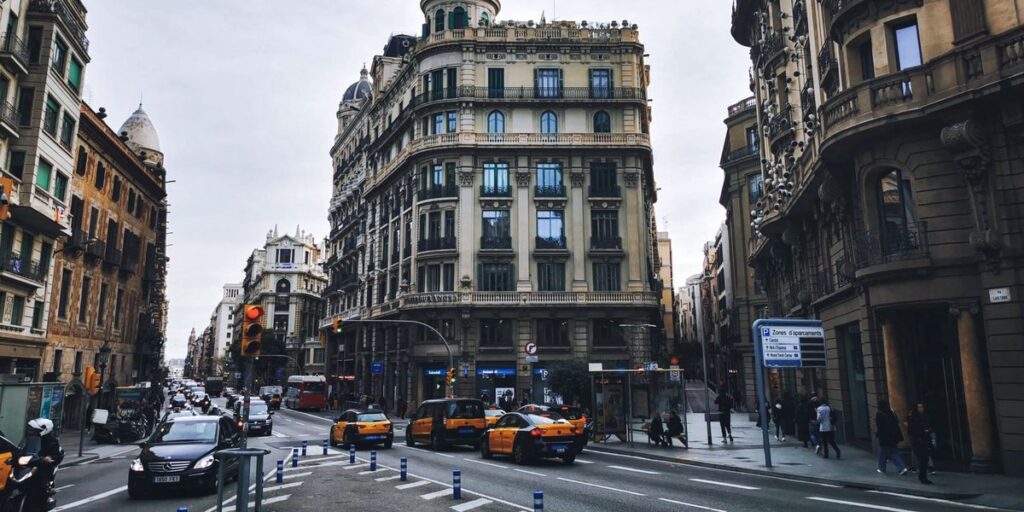
Catalonia: Most people switch to Spanish the moment they hear an accent. Signs, menus and announcements are in Catalan first. Saying bon dia and gràcies gets a smile. Nobody expects more.
Valencian Community and Balearic Islands: Spanish dominates in coastal tourist areas. Valencian and Catalan are used more inland and in local government.
Galicia: Road signs are in Galician only. Spoken Spanish is understood everywhere, but in small towns you’ll hear Galician in the shops and bars.
Basque Country: Signs are bilingual. In San Sebastián and Bilbao, you’ll hear a mix, and Spanish is the default with visitors. Basque pronunciation is quite different, with tx sounding like English ch, so don’t worry if you can’t read the street names aloud.
Navarre: Spanish is dominant in Pamplona. Basque is stronger in the north.
Asturias, Aragon, Castile and León: Spanish in practice. The protected languages are heard mostly among older people in rural areas, or at cultural events.
One thing worth knowing: the Spanish you’ll hear in these regions is the same language you’d study in a class, and people in bilingual regions are used to switching between languages mid-conversation. If somebody answers in Catalan or Galician when you spoke Spanish, they are not being rude, and you can keep going in Spanish.