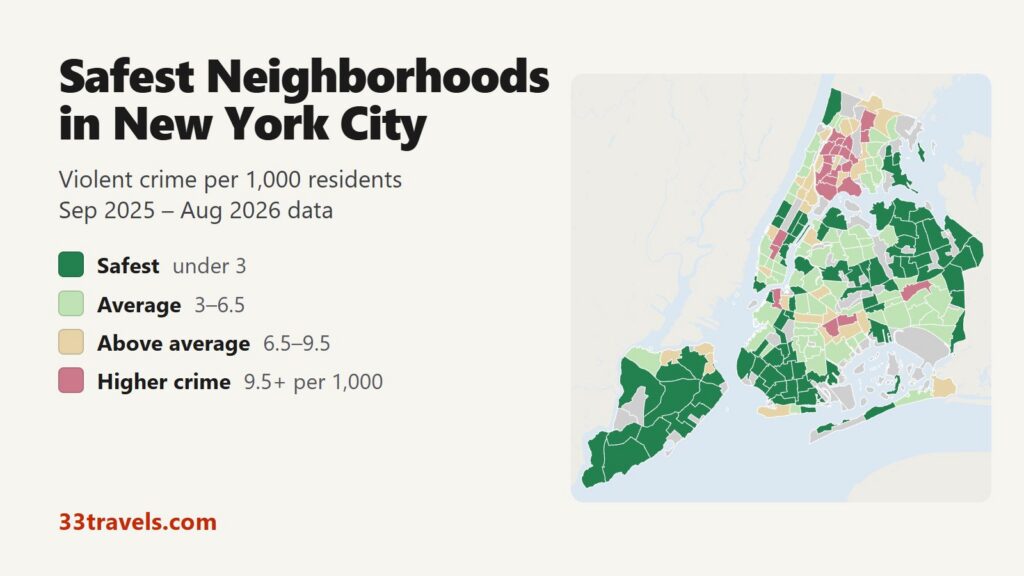
The safest neighborhoods in New York City are in the outer boroughs: the south and middle of Staten Island, northeast Queens from Whitestone to Little Neck and a wide stretch of southern Brooklyn from Windsor Terrace through Borough Park to Bay Ridge. In Manhattan, the Upper East Side, Stuyvesant Town and the central Upper West Side make the list. From September 2025 to August 2026, 54 of the city’s 197 residential neighborhoods logged fewer than 2.4 violent crimes per 1,000 residents, half the New York rate of 4.8. Those 54 neighborhoods house 27% of New Yorkers and saw 8.6% of the violent crime placed on the map.
Safest neighborhoods in New York City: Windsor Terrace and South Slope, Park Slope, Kensington, Borough Park, Midwood, western Midwood and Mapleton, Flatbush West and Ditmas Park, Gravesend, Homecrest, Bensonhurst, Bath Beach, Dyker Heights, Bay Ridge, Marine Park and Mill Basin, Brooklyn Heights, Clinton Hill and South Williamsburg in Brooklyn. Whitestone, Bay Terrace, Douglaston and Little Neck, Bayside, Auburndale, Oakland Gardens, Fresh Meadows, Murray Hill and Broadway Flushing, East Flushing, Queensboro Hill, Kew Gardens Hills, Kew Gardens, Forest Hills, Middle Village, Glendale, central Astoria, Ditmars and Steinway, Glen Oaks, Bellerose, Cambria Heights and Breezy Point with Rockaway Park in Queens. Great Kills and Eltingville, Arden Heights, Annadale and Huguenot, Tottenville, Oakwood and Richmondtown, New Dorp and Midland Beach, Todt Hill, Westerleigh and New Springville with Willowbrook on Staten Island. Yorkville, Lenox Hill with Roosevelt Island, Carnegie Hill, Stuyvesant Town, the central Upper West Side and Murray Hill with Kips Bay in Manhattan. Riverdale in the Bronx.
Staten Island is the safest of the five boroughs at 2.5 violent crimes per 1,000 residents, about half the citywide figure. Queens follows at 3.7. Citywide, violent crime fell 3% and homicides fell 29% against the 12 months before.
Map of the safest neighborhoods in New York City
The map colors each of the city’s 2020 neighborhood tabulation areas by its violent crime rate. Dark green marks the lowest rates and light green sits near the city average; beige is above average and rose is the highest. Grey shapes are parks, cemeteries, the airports and Rikers Island, which have no residential rating. Yonkers, Mount Vernon, Nassau County and the New Jersey towns have their own police departments and are drawn in light grey. Pick a borough with the buttons, switch to Theft & robbery for property crime and tap any neighborhood for its counts.
Violent crime per 1,000 residents
Thefts & robberies per area
Tap or hover a neighborhood to see its crime numbers.
Table of Contents
- Safest neighborhoods in New York City
- Best neighborhoods in New York City
- Safe areas in New York City for tourists
- Is Brooklyn safe?
- Is Queens safe?
- Is Staten Island safe?
- Low numbers that mislead
- Where crime is higher
- Safest suburbs of New York City
- Tips for choosing a neighborhood
- How this map was made
- FAQ
Safest neighborhoods in New York City
The table lists the 15 residential neighborhoods with the lowest violent crime rates. New York’s neighborhood areas are large, from about 15,000 to over 100,000 residents, so one extra assault moves a rate by well under 0.1. The top 15 sit within 0.7 of each other.
| Neighborhood | Police precinct | Violent crimes per 1,000 | vs. city avg | Homicides | Shooting victims | Thefts + robberies |
|---|---|---|---|---|---|---|
| Windsor Terrace-South SlopePrecinct 72 | Precinct 72 | 0.5 | 0.1x | 0 | 0 | 137 |
| Whitestone-BeechhurstPrecinct 109 | Precinct 109 | 0.8 | 0.2x | 0 | 1 | 273 |
| Borough ParkPrecinct 66 | Precinct 66 | 0.9 | 0.2x | 0 | 0 | 437 |
| Great Kills-EltingvillePrecinct 122 | Precinct 122 | 0.9 | 0.2x | 1 | 1 | 233 |
| Arden Heights-RossvillePrecinct 123 | Precinct 123 | 1.0 | 0.2x | 0 | 0 | 135 |
| Oakland Gardens-Hollis HillsPrecinct 111 | Precinct 111 | 1.0 | 0.2x | 0 | 1 | 170 |
| Bay Terrace-ClearviewPrecinct 109 | Precinct 109 | 1.0 | 0.2x | 1 | 0 | 149 |
| Todt Hill-Emerson Hill-Lighthouse Hill-Manor HeightsPrecinct 122 | Precinct 122 | 1.1 | 0.2x | 0 | 0 | 258 |
| Douglaston-Little NeckPrecinct 111 | Precinct 111 | 1.1 | 0.2x | 0 | 0 | 169 |
| Stuyvesant Town-Peter Cooper VillagePrecinct 13 | Precinct 13 | 1.1 | 0.2x | 0 | 0 | 298 |
| New Springville-Willowbrook-Bulls Head-TravisPrecinct 121 | Precinct 121 | 1.2 | 0.3x | 0 | 0 | 295 |
| Annadale-Huguenot-Prince's Bay-WoodrowPrecinct 123 | Precinct 123 | 1.2 | 0.3x | 0 | 0 | 180 |
| Mapleton-Midwood (West)Precinct 66 | Precinct 66 | 1.2 | 0.3x | 0 | 0 | 271 |
| Middle VillagePrecinct 104 | Precinct 104 | 1.2 | 0.3x | 0 | 1 | 410 |
| Oakwood-RichmondtownPrecinct 122 | Precinct 122 | 1.2 | 0.3x | 0 | 0 | 87 |
Windsor Terrace and south Brooklyn
Windsor Terrace-South Slope has the lowest rate in the city: 12 violent crimes in 12 months among 23,622 residents, a rate of 0.5. It runs along Prospect Park Southwest and the Prospect Expressway, with Prospect Park on its eastern edge. Borough Park, third on the list, is far larger at 93,905 residents and rates 0.9. Western Midwood and Mapleton, along Coney Island Avenue, rate 1.2, and Midwood rates 1.4. Farther southwest, Dyker Heights and Bay Ridge rate 1.4 and 1.5.
Northeast Queens
Five of the top 15 sit in Queens, four of them in the northeast corner near Little Neck Bay. Whitestone-Beechhurst, along the Cross Island Parkway and the Whitestone Expressway, rates 0.8. Bay Terrace-Clearview, which holds the Clearview Park golf course and part of Little Bay Park, rates 1.0. Douglaston-Little Neck rates 1.1, and Oakland Gardens-Hollis Hills, between the Long Island Expressway and the Grand Central Parkway, rates 1.0. Middle Village, in western Queens, rates 1.2.
South and mid Staten Island
Staten Island has six neighborhoods in the top 15, more than any other borough. Great Kills-Eltingville, the largest of them with 54,699 residents, rates 0.9, and Arden Heights-Rossville rates 1.0. Todt Hill, Emerson Hill and Lighthouse Hill take in LaTourette Park and its golf course and rate 1.1. New Springville-Willowbrook, around Willowbrook Park, and Annadale-Huguenot on the South Shore both rate 1.2, and Oakwood-Richmondtown, which holds most of Great Kills Park, rates 1.2.
Stuyvesant Town and the Upper East Side
Stuyvesant Town-Peter Cooper Village is the only Manhattan entry in the top 15, at 1.1. It is a single private complex of about 11,250 apartments, with its own unarmed security force, between East 14th and East 23rd streets, First Avenue and the FDR Drive. The Upper East Side follows: Yorkville, from East 79th to East 96th Street east of Third Avenue, rates 1.3 with 84,046 residents, and Lenox Hill with Roosevelt Island rates 1.6.
Best neighborhoods in New York City
The lowest rates are in residential areas far from Midtown. The best neighborhoods in New York City for a visit, a family or a first apartment pair a low rate with a subway line, a park or a main street.
Best neighborhoods for visitors
For a first trip, the Upper East Side and the Upper West Side give a one-seat subway ride to Midtown from a low-crime base. Yorkville rates 1.3, and the 6 train on Lexington Avenue reaches Grand Central from 77th and 86th streets, while the Q on Second Avenue runs to Times Square. Carnegie Hill, along Museum Mile on Fifth Avenue, rates 1.8 but logged 1,922 thefts. The central Upper West Side, between Central Park West and Riverside Park, rates 2.1 and has the American Museum of Natural History at 81st Street, served by the B and C, with the 1 train on Broadway. In Brooklyn, Brooklyn Heights rates 1.9 and sits one stop from Lower Manhattan on the 2 and 3 at Clark Street. The subway runs 24 hours a day.
Best neighborhoods for families
Staten Island and northeast Queens pair low rates with large parks. Great Kills Park, run by the National Park Service, has a lifeguarded swimming beach from Memorial Day weekend to Labor Day, a marina and a multi-use path. Clove Lakes Park, with three lakes and 193 acres, lies inside Westerleigh-Castleton Corners, which rates 1.5. In Queens, Juniper Valley Park in Middle Village has ball fields, bocce courts and two playgrounds, and Fort Totten and Little Bay Park sit by Bay Terrace. Riverdale-Spuyten Duyvil, the only Bronx neighborhood under the line at 1.4, holds Wave Hill, a public garden on the Hudson, and Riverdale Park.
Best neighborhoods for young professionals
Park Slope, Astoria and Bay Ridge combine low rates with bars, restaurants and a subway ride to Manhattan. Park Slope rates 2.0 and its Fifth Avenue business district counts over 500 merchants from Dean Street to 18th Street. Central Astoria rates 2.0 and Ditmars-Steinway 2.1; the N train runs from Ditmars Boulevard to Times Square, and the Museum of the Moving Image is on 35th Avenue. Bay Ridge has the Fifth Avenue business district from 65th to 85th Street and the R train to Manhattan. Long Island City, with Gantry Plaza State Park and MoMA PS1, rates 4.9, about the city average, and logged 915 thefts.
Best affordable safe neighborhoods
Bay Ridge and Riverdale are the lowest-rent safe neighborhoods we priced. Census Bureau estimates for 2020 to 2024 put the typical tract median rent near $1,860 a month in Bay Ridge and $1,910 in Riverdale, which also has the lowest home values of the group, near $420,000. Great Kills-Eltingville comes in near $2,060. Rents in Park Slope, Brooklyn Heights, Carnegie Hill and Stuyvesant Town run about $3,100 to $3,300. All figures are census tract medians.
Safe areas in New York City for tourists
Parks and museum districts draw most visitors, and several of the busiest have no rating at all. The safe areas in New York City for tourists are the low-rate neighborhoods around them. Central Park, Prospect Park, Flushing Meadows-Corona Park and both airports have almost no residents. Carnegie Hill holds the Metropolitan Museum and the Guggenheim and rates low for violent crime, but it logged 1,922 thefts, nearly twice the city’s per-resident level. The Financial District, with the 9/11 Memorial and the Statue of Liberty ferries, rates 2.9 with 1,578 thefts. Midtown-Times Square is the other extreme: its rate of 25.1 divides its crimes by 25,575 residents while far more people pass through each day, and its 5,890 thefts are the most in the city.
Is Brooklyn safe?
Most of Brooklyn is. The borough rates 4.3 violent crimes per 1,000 residents, below the city’s 4.8, and 17 of the 54 neighborhoods under the safe line are in Brooklyn, more than in any borough but Queens. The higher rates are in the east, in Brownsville and East New York. Williamsburg, the bar and music district north of South Williamsburg, rates 3.1, under the city rate, with 1,379 thefts. Downtown Brooklyn-DUMBO-Boerum Hill rates 10.2: it is a courthouse, office and shopping district with few residents and many daytime visitors.
Is Queens safe?
Queens is the second-safest borough at 3.7 per 1,000, and it has more neighborhoods under the safe line than any other, 21. Forest Hills, with 88,965 residents, rates 1.8. The exception is Jamaica, which rates 12.8, more than double the city figure. Long Island City-Hunters Point rates 4.9 and logged 915 thefts, well above the Queens norm per resident. Flushing Meadows-Corona Park, home of the US Open and the Queens Museum, has no residents and no rating.
Is Staten Island safe?
Yes. Staten Island has the lowest violent crime rate of the five boroughs, 2.5 per 1,000, and nine of its neighborhoods are under the safe line. The North Shore near the ferry is the exception. St. George-New Brighton, where the Staten Island Ferry lands, rates 7.0, and Tompkinsville-Stapleton rates 7.3. Every Staten Island neighborhood outside that North Shore strip rates under 3.
Low numbers that mislead
Rape is missing from every neighborhood count. NYPD records each rape complaint at the address of the precinct stationhouse, not where it happened, so this map counts rapes in the citywide totals but places none of them in a neighborhood.
Borough Park and South Williamsburg have some of the lowest reported rates, at 0.9 and 1.3. Local officials and news reports have described residents there calling volunteer Shomrim patrols before the police, so NYPD counts may understate crime in both. Stuyvesant Town’s rate covers one private complex with its own unarmed security force; NYPD’s 13th Precinct takes its complaints. Kew Gardens Hills holds Queens College, whose peace officers pass crimes to NYPD only with the victim’s consent.
The parks are not empty of crime. Central Park logged 64 violent crimes and Flushing Meadows-Corona Park 73, but with no residents neither has a rate.
Where crime is higher
Violent crime is concentrated in the South and central Bronx. The Bronx rates 8.6 per 1,000 as a borough, the highest of the five and more than three times Staten Island. Our areas to avoid in New York City guide covers those neighborhoods, eastern Brooklyn and Jamaica in detail. Manhattan rates 4.8, the same as the city as a whole, with the low Upper East Side offset by higher rates in Harlem and Midtown.
Safest suburbs of New York City
The suburbs report far less violent crime per resident. The 32 other departments in the table reported 2.84 violent crimes per 1,000 residents in 2025, against 6.61 for New York City in the same FBI data. Ramapo in Rockland County, Montclair and Bloomfield in New Jersey are the lowest of the larger departments. The smaller commuter towns are not in the table: Scarsdale reported 3 violent crimes in 2025, Rye 1, Millburn 2 and Westfield none, according to FBI data.
| City | Population | Violent crimes | Per 1,000 | Year |
|---|---|---|---|---|
| Paterson | 160,567 | 1,406 | 8.8 | 2025 |
| New York City | 8,496,850 | 56,133 | 6.6 | 2025 |
| Passaic | 70,744 | 413 | 5.8 | 2025 |
| Newark | 318,638 | 1,646 | 5.2 | 2025 |
| Mount Vernon | 71,615 | 356 | 5.0 | 2025 |
| Jersey City | 305,249 | 1,487 | 4.9 | 2025 |
| Hempstead (village) | 59,748 | 257 | 4.3 | 2025 |
| East Orange | 72,390 | 308 | 4.3 | 2025 |
| Irvington | 62,004 | 245 | 4.0 | 2025 |
| Elizabeth | 141,194 | 487 | 3.5 | 2025 |
| Spring Valley | 33,805 | 115 | 3.4 | 2025 |
| Yonkers | 211,056 | 556 | 2.6 | 2025 |
| Union City | 66,539 | 165 | 2.5 | 2025 |
| West New York | 53,036 | 125 | 2.4 | 2025 |
| Hackensack | 46,753 | 110 | 2.4 | 2025 |
| Peekskill | 25,865 | 59 | 2.3 | 2025 |
| Kearny | 40,610 | 90 | 2.2 | 2025 |
| Hoboken | 58,889 | 117 | 2.0 | 2025 |
| Linden | 45,814 | 88 | 1.9 | 2025 |
| Garfield | 33,737 | 61 | 1.8 | 2025 |
| Clifton | 90,406 | 151 | 1.7 | 2025 |
| New Rochelle | 86,892 | 134 | 1.5 | 2025 |
| Nassau County (police district) | 1,091,921 | 1,513 | 1.4 | 2025 |
| Freeport (village) | 43,965 | 60 | 1.4 | 2025 |
| Teaneck | 42,875 | 54 | 1.3 | 2025 |
| North Bergen | 61,290 | 77 | 1.3 | 2025 |
| West Orange | 49,285 | 55 | 1.1 | 2025 |
| Fort Lee | 40,646 | 44 | 1.1 | 2025 |
| Secaucus | 22,862 | 24 | 1.1 | 2025 |
| Wayne | 53,903 | 52 | 1.0 | 2025 |
| Bloomfield | 56,009 | 46 | 0.8 | 2025 |
| Montclair | 41,340 | 32 | 0.8 | 2025 |
| Ramapo | 113,671 | 81 | 0.7 | 2025 |
Murder, rape, robbery and aggravated assault reported to the FBI by each agency, per 1,000 residents of the population the agency reports. Source: FBI Crime Data Explorer. Agencies that report no complete year are left out.
Tips for choosing a neighborhood
- Look at the blocks around the subway stop you will use. A neighborhood area of 80,000 people has quiet streets and busy ones.
- Switch the map to Theft & robbery before picking a hotel near a museum district or a shopping street. Carnegie Hill rates low for violence and high for theft.
- For a short visit, stay near a subway line with a one-seat ride to Midtown: the 6 or the Q on the Upper East Side, the 1 or the B and C on the Upper West Side, the 2 and 3 in Brooklyn Heights.
- For a move, compare Bay Ridge, Riverdale and southern Staten Island, which pair low rates with the lowest rents of the safe group.
- Call 911 for emergencies and 311 for non-emergency police matters in the city. From outside New York, 311 is 212-639-9675.
How this map was made
Crime counts come from NYPD complaint data for September 2025 through August 2026, combining the historic and year-to-date files. Neighborhood violent crime means murder, robbery and felony assault, counted once per complaint; rape is in the citywide totals only, for the reason given above. The map keeps complaints taken by NYPD patrol, Transit and Housing, and leaves out those of the Department of Correction, the Port Authority and the MTA police. Each complaint is placed in one of the city’s 262 neighborhood tabulation areas by its coordinates, and complaints logged at police stations, hospitals and jails are taken out of the neighborhood counts. Rates use 2020 Census population. The suburban table uses each department’s reports to the FBI’s Crime Data Explorer, and rents come from the Census Bureau’s 2020-2024 American Community Survey.
We ranked the safest neighborhoods in Milwaukee, Houston, San Diego, Austin, San Francisco, Buffalo, Baltimore, Atlanta, Honolulu, Boston, Denver, Chicago, Jacksonville, Detroit, Los Angeles, Miami, Philadelphia, Oklahoma City, Dallas, St. Louis, San Antonio and Phoenix.
FAQ
What is the safest neighborhood in New York City?
Windsor Terrace-South Slope in Brooklyn had the lowest violent crime rate of any residential neighborhood, 0.5 per 1,000 residents, with 12 violent crimes in 12 months. Whitestone-Beechhurst in Queens and Borough Park in Brooklyn come next.
What is the safest borough in New York City?
Staten Island, at 2.5 violent crimes per 1,000 residents, followed by Queens at 3.7 and Brooklyn at 4.3. The Bronx has the highest rate at 8.6.
What is the safest part of Manhattan?
Stuyvesant Town-Peter Cooper Village, one private complex, at 1.1, then the three Upper East Side areas: Yorkville at 1.3, Lenox Hill with Roosevelt Island at 1.6 and Carnegie Hill at 1.8, which also rates high for theft. Murray Hill-Kips Bay and the central Upper West Side are the only other Manhattan areas under half the city rate.
Where is the safest place for a tourist to stay in NYC?
Yorkville and Lenox Hill on the Upper East Side, or the central Upper West Side, combine low violent crime with a direct subway ride to Midtown. Brooklyn Heights is one subway stop from Lower Manhattan. Hotels in Times Square are central, but theft per resident there runs about 14 times the city level.
Is Times Square safe?
Times Square's rate of 25.1 is the highest in the city on paper, because its crimes are divided by only 25,575 residents while far more people pass through. The risk most visitors face there is theft: 5,890 thefts in 12 months, the most of any neighborhood.
What are the safest suburbs of New York City?
Among the larger departments, Ramapo in Rockland County and Montclair and Bloomfield in New Jersey reported the lowest violent crime rates to the FBI for 2025, all under 1 per 1,000 residents. Smaller towns such as Scarsdale, Rye, Millburn and Westfield reported 3 or fewer violent crimes each.
Why does Central Park have no rating?
A rate needs residents, and Central Park has almost none. It still logged 64 violent crimes and 197 thefts in 12 months, against about 42 million visits a year. Prospect Park, Flushing Meadows-Corona Park and the airports are left unrated for the same reason.
Is Borough Park really one of the safest neighborhoods?
It has one of the lowest reported rates, 0.9 per 1,000 among 93,905 residents. Some crimes there are first reported to the volunteer Shomrim patrols rather than to NYPD, so the police count may understate crime there.