
East Timor (Timor-Leste) sits at the eastern end of the Lesser Sunda Islands and has a recent history as an independent nation with a rich mix of local and colonial influences. Language is a practical lens for understanding daily life, education and government across the country’s varied communities.
There are 2 Official Languages in Timor-Leste, ranging from Portuguese to Tetum. The entries are organized by Official status,Speakers (est.) (people),Domains of use; you’ll find them below.
How are Portuguese and Tetum used differently in government and everyday life?
Portuguese is often used in formal government, legal texts and some higher education, reflecting historical ties, while Tetum functions as the common lingua franca for most people, media and local administration; in practice you’ll see a mix depending on setting, generation and urban versus rural areas.
Which language is most useful for visitors to Timor-Leste?
Tetum will usually get you the furthest for daily interactions, markets and local travel, though Portuguese can help in official contexts and some public services; English is increasingly spoken in Dili and tourist spots, so a few Tetum phrases plus English works well.
Official Languages in Timor-Leste
| Language | Official status | Speakers (est.) (people) | Domains of use |
|---|---|---|---|
| Tetum | Constitutional co-official language alongside Portuguese | 800,000 | Everyday communication, media, local government, primary and informal education |
| Portuguese | Constitutional co-official language alongside Tetum | 250,000 | Government, law, formal education, national media, diplomacy |
Images and Descriptions
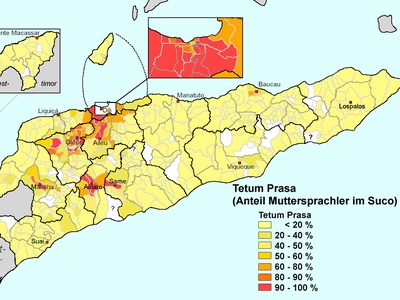
Tetum
Tetum is an Austronesian language used as the main lingua franca in Timor-Leste, widely spoken in daily life and local media. It was promoted after independence and modernized with Portuguese loanwords; many speakers use it alongside Portuguese in official contexts.

Portuguese
Portuguese is a Romance language and co-official state language, restored after 2002 independence as a symbol of ties to the Lusophone world. It serves in government, courts, higher education and formal media, though fluency is concentrated among urban and educated populations.